A French Word to Live By
How to Conjugate Peupler in French
/pœ.ple/
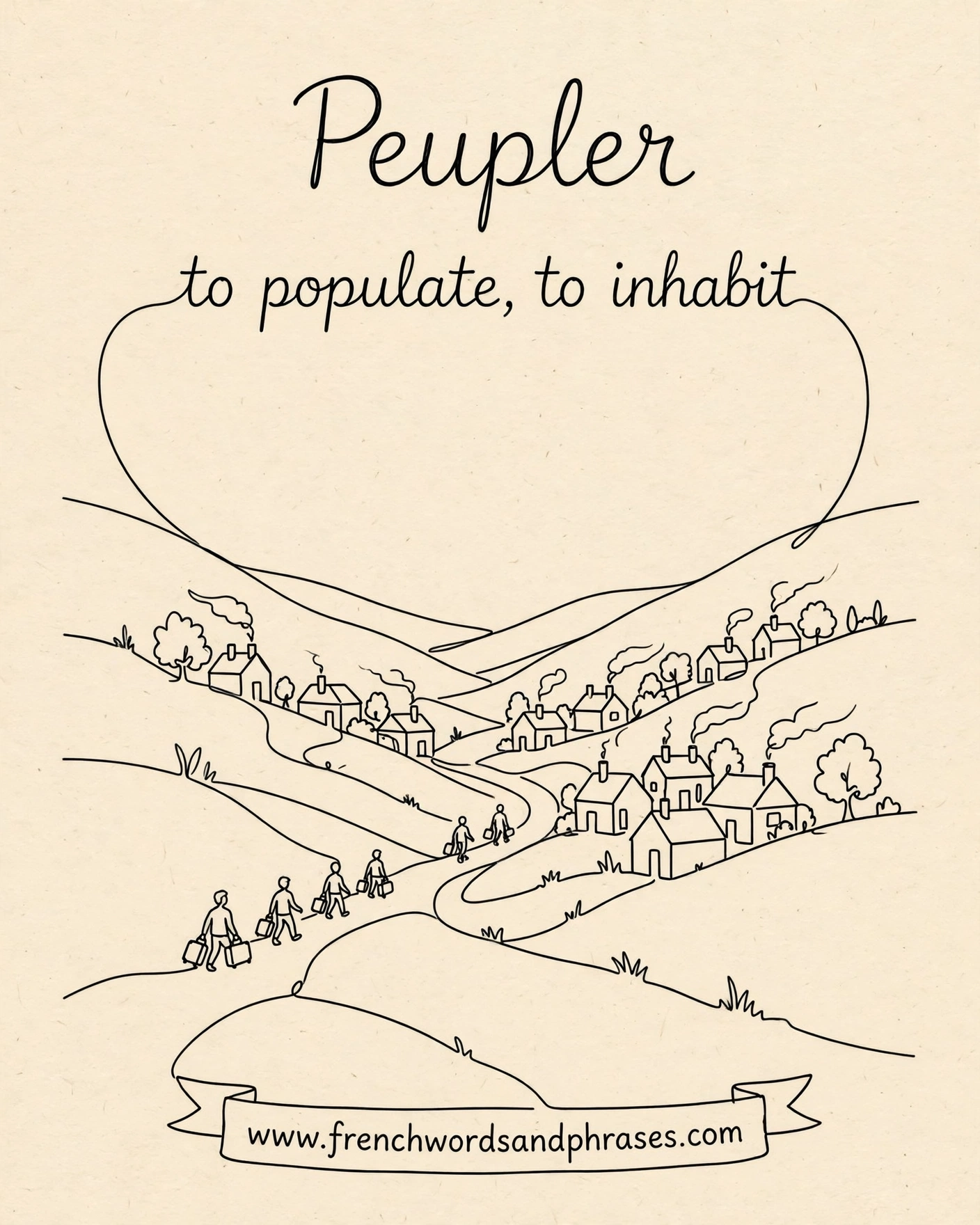
Peupler means to populate, to inhabit — to fill a place with people, animals or living things, the way settlers peuplent a valley, fish peuplent a lake, and memories peuplent an old house.
Ships arriving at an empty coast, bees arriving at an empty hive, stars arriving in the evening sky one by one — peupler is the verb of empty places filling with life: wherever something was vacant and is vacant no longer, French reaches for peupler.
In this guide, you’ll learn how to conjugate peupler in all the major French tenses and moods. Explore complete conjugation tables, French examples, English translations, and practice quizzes.
Understanding the French Verb Peupler
Peupler is a regular French verb belonging to the first group of verbs, those ending in-er.
It means to populate, to inhabit. Peupler works in both directions of filling: people peuplent a place, and a place is peuplé de its inhabitants. Historians use it for settlement (les Vikings ont peuplé l’Islande), biologists for species (les loups peuplent à nouveau les montagnes), and everyone for the figurative crowds: les souvenirs qui peuplent une maison, the memories that people a house.
Verb classification: First group (-er)
Auxiliary verb: Avoir
Past participle: peuplé
Present participle: peuplant
English equivalents: To populate, to inhabit, to people; peupler une région — to settle/populate a region; peupler un étang de poissons — to stock a pond with fish; un pays peuplé — a populated country; peuplé de — filled with, teeming with.
One important detail: peupler is a perfectly regular -er verb — je peuple, nous peuplons, ils peuplent, past participle peuplé — but it hides a twin: un peuple is a people, a nation, and le peuple is the people in the political sense. The adjective peuplé does everyday work: un quartier très peuplé, a densely populated district, and peuplé de opens the door to crowds of anything: une forêt peuplée d’oiseaux.
Experience the Word
Peupler is the verb of arrival in numbers — the empty valley, the empty lake, the empty sky, filling up with life.
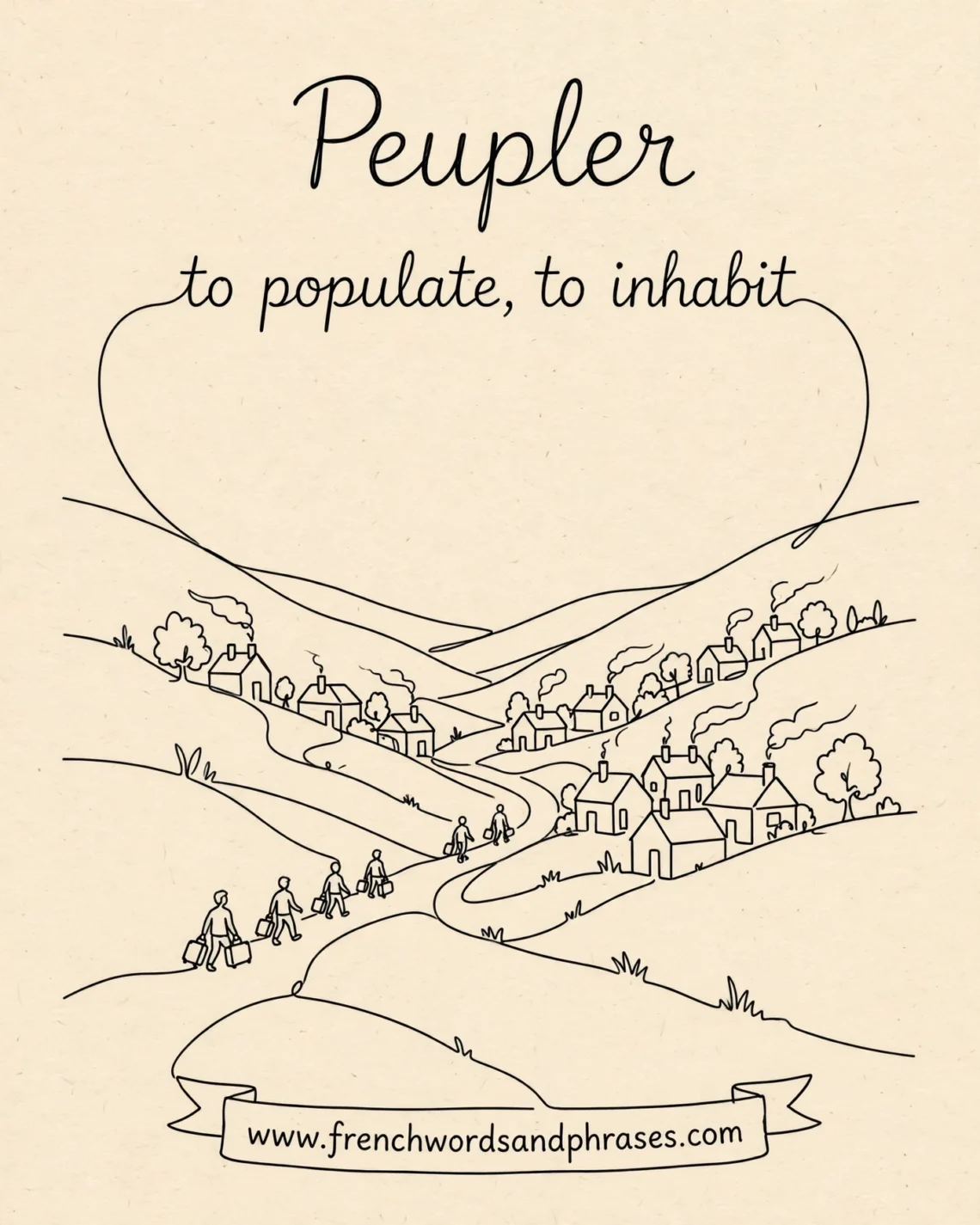
Imagine Iceland in the ninth century: one ship, then ten, then farms stitching the coast together, smoke rising where no smoke had ever risen. En deux générations, les Vikings ont peuplé l’île — an empty land became a homeland.
The land did not change. It became populated — peuplée — and that changed it forever.
How to Conjugate Peupler: Complete French Conjugation Guide
Let’s explore every major conjugation of peupler, beginning with the indicative mood.
How to Conjugate Peupler in the Indicative Mood
The indicative mood is used to express facts, observations, actions, and events.
How to Conjugate Peupler in the Present Tense (Présent)
Used for actions happening now, habitual actions, and general truths.
| Subject | Conjugation |
|---|---|
| je | peuple |
| tu | peuples |
| il / elle | peuple |
| nous | peuplons |
| vous | peuplez |
| ils / elles | peuplent |
Example
Des milliers d’oiseaux peuplent les falaises en été.
Thousands of birds populate the cliffs in summer.
Quick Quiz 1
Complete the sentence:
Les loups ______ à nouveau les montagnes.
Reveal the answer
peuplent
Les loups peuplent à nouveau les montagnes.
Wolves inhabit the mountains again.
How to Conjugate Peupler in the Passé Composé
Used for completed actions in the past. Peupler takes the auxiliary verb avoir.
| Subject | Conjugation |
|---|---|
| j’ | ai peuplé |
| tu | as peuplé |
| il / elle | a peuplé |
| nous | avons peuplé |
| vous | avez peuplé |
| ils / elles | ont peuplé |
Example
Les colons ont peuplé la vallée en dix ans.
The settlers populated the valley in ten years.
How to Conjugate Peupler in the Imparfait (Imperfect Tense)
Used for habitual past actions, descriptions, and ongoing situations in the past.
| Subject | Conjugation |
|---|---|
| je | peuplais |
| tu | peuplais |
| il / elle | peuplait |
| nous | peuplions |
| vous | peupliez |
| ils / elles | peuplaient |
Example
Autrefois, les loups peuplaient toutes les forêts du pays.
In the old days, wolves inhabited all the country’s forests.
Quick Quiz 2
Choose the correct form:
The settlers populated the valley.
Les colons ______ la vallée. (ont peuplé / sont peuplés)
Reveal the answer
ont peuplé
Les colons ont peuplé la vallée.
Peupler takes avoir.
How to Conjugate Peupler in the Plus-que-parfait
Used to describe an action that had already been completed before another past event.
| Subject | Conjugation |
|---|---|
| j’ | avais peuplé |
| tu | avais peuplé |
| il / elle | avait peuplé |
| nous | avions peuplé |
| vous | aviez peuplé |
| ils / elles | avaient peuplé |
Example
Les pêcheurs avaient peuplé l’étang de truites.
The fishermen had stocked the pond with trout.
How to Conjugate Peupler in the Passé Simple
Primarily used in formal writing, literature, and historical narratives. It is rarely used in everyday conversation.
| Subject | Conjugation |
|---|---|
| je | peuplai |
| tu | peuplas |
| il / elle | peupla |
| nous | peuplâmes |
| vous | peuplâtes |
| ils / elles | peuplèrent |
Example
Les Vikings peuplèrent l’Islande au neuvième siècle.
The Vikings settled Iceland in the ninth century.
How to Conjugate Peupler in the Passé Antérieur
A literary tense used to express an action completed immediately before another past action, generally in the passé simple.
| Subject | Conjugation |
|---|---|
| j’ | eus peuplé |
| tu | eus peuplé |
| il / elle | eut peuplé |
| nous | eûmes peuplé |
| vous | eûtes peuplé |
| ils / elles | eurent peuplé |
Example
Dès que les abeilles eurent peuplé la ruche, la colonie prospéra.
As soon as the bees had populated the hive, the colony prospered.
How to Conjugate Peupler in the Future Tense (Futur Simple)
Used to describe actions that will take place in the future.
| Subject | Conjugation |
|---|---|
| je | peuplerai |
| tu | peupleras |
| il / elle | peuplera |
| nous | peuplerons |
| vous | peuplerez |
| ils / elles | peupleront |
Example
De nouvelles espèces peupleront la réserve naturelle.
New species will populate the nature reserve.
How to Conjugate Peupler in the Futur Antérieur (Future Perfect)
Used for an action that will have been completed before a particular point in the future.
| Subject | Conjugation |
|---|---|
| j’ | aurai peuplé |
| tu | auras peuplé |
| il / elle | aura peuplé |
| nous | aurons peuplé |
| vous | aurez peuplé |
| ils / elles | auront peuplé |
Example
À la fin du siècle, les hommes auront peuplé la vallée entière.
By the end of the century, men will have populated the whole valley.
How to Conjugate Peupler in the Near Future (Futur Proche)
Used to describe something that is going to happen soon. Formed with aller + infinitive.
| Subject | Conjugation |
|---|---|
| je | vais peupler |
| tu | vas peupler |
| il / elle | va peupler |
| nous | allons peupler |
| vous | allez peupler |
| ils / elles | vont peupler |
Example
On va peupler l’aquarium de poissons tropicaux.
We are going to stock the aquarium with tropical fish.
How to Conjugate Peupler in the Conditional Mood
The conditional mood expresses what would happen under certain circumstances. It is also frequently used to make polite requests or express wishes.
How to Conjugate Peupler in the Present Conditional
| Subject | Conjugation |
|---|---|
| je | peuplerais |
| tu | peuplerais |
| il / elle | peuplerait |
| nous | peuplerions |
| vous | peupleriez |
| ils / elles | peupleraient |
Example
Sans eau, personne ne peuplerait cette région sèche.
Without water, nobody would inhabit this dry region.
How to Conjugate Peupler in the Past Conditional
| Subject | Conjugation |
|---|---|
| j’ | aurais peuplé |
| tu | aurais peuplé |
| il / elle | aurait peuplé |
| nous | aurions peuplé |
| vous | auriez peuplé |
| ils / elles | auraient peuplé |
Example
Les familles auraient peuplé le village si la route avait été construite.
The families would have settled the village if the road had been built.
Peupler in the Literary Past Conditional Form
This less common literary form uses the imperfect subjunctive of avoir.
| Subject | Conjugation |
|---|---|
| j’ | eusse peuplé |
| tu | eusses peuplé |
| il / elle | eût peuplé |
| nous | eussions peuplé |
| vous | eussiez peuplé |
| ils / elles | eussent peuplé |
Example
Les colons eussent peuplé la côte, si les tempêtes ne les eussent découragés.
The settlers would have populated the coast, had the storms not discouraged them.
How to Conjugate Peupler in the Subjunctive Mood
The subjunctive is used to express wishes, emotions, doubts, necessity, and uncertainty. It frequently follows expressions such as il faut que (it is necessary that) or bien que (although).
How to Conjugate Peupler in the Present Subjunctive
| Subject | Conjugation |
|---|---|
| que je | peuple |
| que tu | peuples |
| qu’il / qu’elle | peuple |
| que nous | peuplions |
| que vous | peupliez |
| qu’ils / qu’elles | peuplent |
Example
Il faut que les poissons peuplent à nouveau la rivière.
The fish must populate the river again.
Quick Quiz 3
Complete the sentence using the subjunctive:
Il faut que les poissons ______ la rivière.
Reveal the answer
peuplent
Il faut que les poissons peuplent la rivière.
The fish must populate the river.
How to Conjugate Peupler in the Imperfect Subjunctive
A literary tense, rarely encountered in modern spoken French.
| Subject | Conjugation |
|---|---|
| que je | peuplasse |
| que tu | peuplasses |
| qu’il / qu’elle | peuplât |
| que nous | peuplassions |
| que vous | peuplassiez |
| qu’ils / qu’elles | peuplassent |
Example
Le roi souhaitait que des marchands peuplassent le nouveau port.
The king wished merchants to settle the new port.
How to Conjugate Peupler in the Pluperfect Subjunctive
A literary construction used to express an action completed before another past action.
| Subject | Conjugation |
|---|---|
| que j’ | eusse peuplé |
| que tu | eusses peuplé |
| qu’il / qu’elle | eût peuplé |
| que nous | eussions peuplé |
| que vous | eussiez peuplé |
| qu’ils / qu’elles | eussent peuplé |
Example
On racontait que les moines eussent peuplé la vallée dès le dixième siècle.
People said the monks had settled the valley as early as the tenth century.
How to Conjugate Peupler in the Past Subjunctive
| Subject | Conjugation |
|---|---|
| que j’ | aie peuplé |
| que tu | aies peuplé |
| qu’il / qu’elle | ait peuplé |
| que nous | ayons peuplé |
| que vous | ayez peuplé |
| qu’ils / qu’elles | aient peuplé |
Example
Je suis heureux que les hirondelles aient peuplé la grange.
I am glad the swallows have taken up residence in the barn.
How to Conjugate Peupler in the Imperative
The imperative is used to give commands, instructions, invitations, or suggestions. Subject pronouns are omitted.
How to Conjugate Peupler in the Present Imperative
| Person | Conjugation |
|---|---|
| (tu) | peuple |
| (nous) | peuplons |
| (vous) | peuplez |
Example
Peuple cet étang de carpes avant l’été !
Stock this pond with carp before the summer!
Quick Quiz 4
How would you say Stock the aquarium (tu form)?
Reveal the answer
Peuple l’aquarium !
French Participles of Peupler
Participles are verb forms that can be used in compound tenses and other grammatical constructions.
Present Participle of Peupler
peuplant
En peuplant la réserve, les gardes ont sauvé trois espèces.
By populating the reserve, the wardens saved three species.
Past Participle of Peupler
peuplé
Peuplée de souvenirs, la vieille maison semble encore habitée.
Peopled with memories, the old house still seems inhabited.
Peupler in Everyday French: Real-Life Examples
Now that you know the conjugations, let’s see how peupler appears in everyday French.
Example 1 — Present
Les oiseaux peuplent les falaises.
The birds populate the cliffs.
Example 2 — Passé composé
Les colons ont peuplé la vallée.
The settlers populated the valley.
Example 3 — Imparfait
Les loups peuplaient les forêts.
Wolves inhabited the forests.
Example 4 — Future
De nouvelles espèces peupleront la réserve.
New species will populate the reserve.
Example 5 — Conditional
Personne ne peuplerait cette région sèche.
Nobody would inhabit this dry region.
Example 6 — Imperative
Peuplez l’aquarium de poissons rouges !
Stock the aquarium with goldfish!
Beyond Translation: The Meaning of Peupler
Peupler carries a whole philosophy of place: a land is not finished when it is mapped, but when it is peuplée — lived in, named, remembered. Its noun twin, le peuple, the people, made the verb political too: to populate was for centuries a policy, a hope and sometimes a weapon. In modern French the word has softened into ecology and memory — species returning to mountains, souvenirs peuplant an empty house — the filling of places with whatever makes them alive.
To peupler is to turn space into place — emptiness into a home.
Learn its adjective too: peuplé de, teeming with, is one of the prettiest frames in descriptive French.
How to Remember the French Verb Peupler
Remember it this way: Peupler is about settlers filling an empty valley — peupler, and peuplé de, teeming with.
- Perfectly regular: je peuple, nous peuplons, past participle peuplé.
- The adjective is the everyday star: un quartier peuplé, une forêt peuplée d’oiseaux.
- The twin to keep apart: un peuple is a people, a nation — le peuple, the people.
The key idea is settlers filling an empty valley — peupler, and peuplé de, teeming with.
Test Your Knowledge of Peupler
Let’s see how much you’ve learned. Try answering these questions before revealing the answers.
Question 1
What is the past participle of peupler?
Reveal the answer
Peuplé — un pays peuplé, a populated country.
Question 2
How do you say Thousands of birds populate the cliffs in French?
Reveal the answer
Des milliers d’oiseaux peuplent les falaises.
Question 3
Translate: The settlers populated the valley in ten years.
Reveal the answer
Les colons ont peuplé la vallée en dix ans.
Question 4
What does une forêt peuplée d’oiseaux mean?
Reveal the answer
A forest teeming with birds — peuplé de, filled with.
Question 5
Complete the sentence:
Il faut que les poissons ______ à nouveau la rivière.
Reveal the answer
peuplent
Il faut que les poissons peuplent à nouveau la rivière.
The fish must populate the river again.
Your Final Challenge
Can You Use It?
How would you say this in French?
In two generations, the settlers populated the valley, farm after farm.
Reveal the answer
En deux générations, les colons ont peuplé la vallée, ferme après ferme.
In two generations, the settlers populated the valley, farm after farm.
A little French. A little curiosity. A richer everyday life.
LEARN FRENCH ONE WORD AT A TIME