A French Word to Live By
How to Conjugate Sortir in French
/sɔʁ.tiʁ/
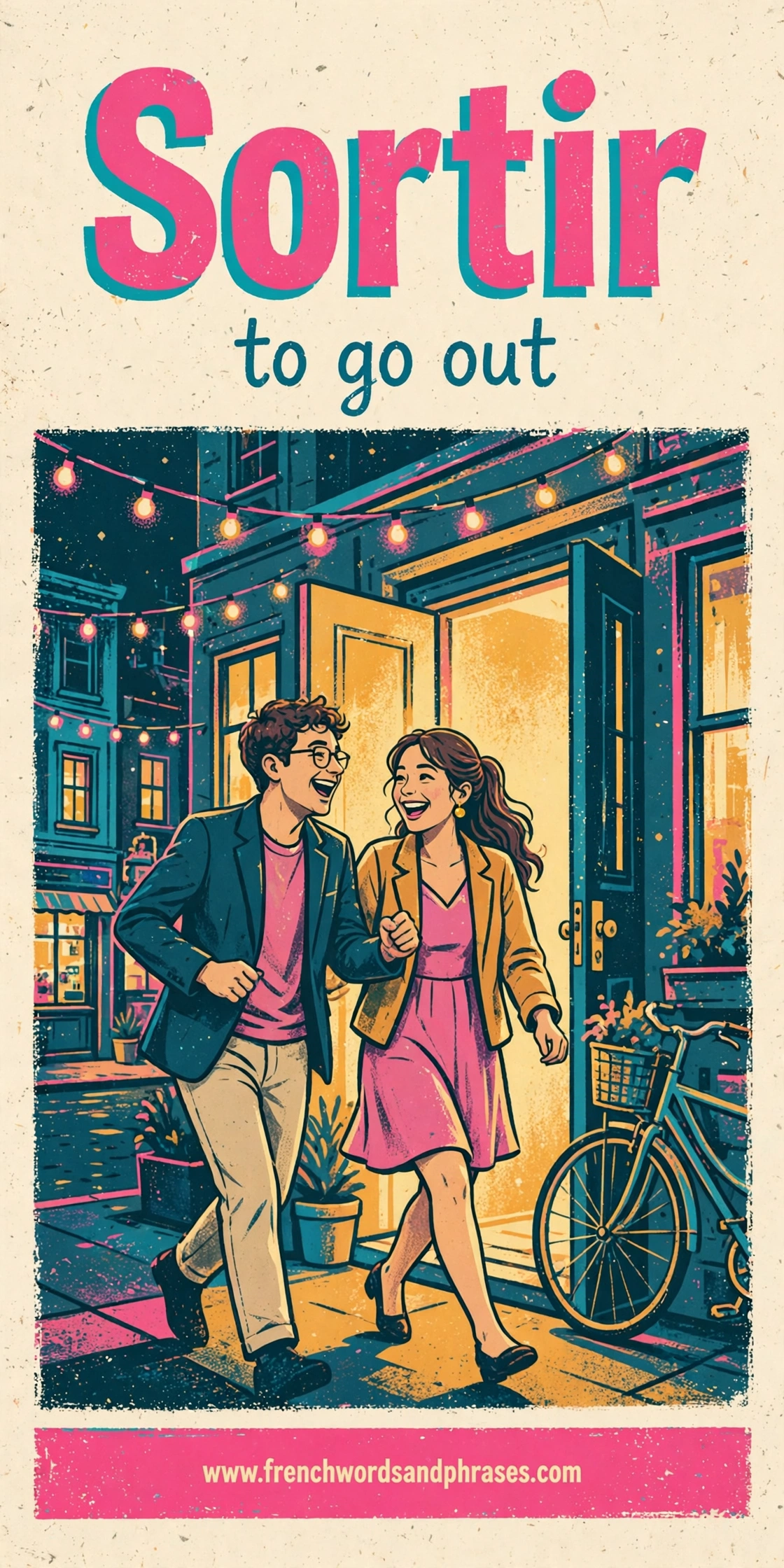
Sortir means to go out — to cross the threshold, leave the room, the house or the shell, and step into the open air.
A teenager slipping out on a Friday night, a chick cracking its shell, a new book appearing in the shops — sortir is the verb of every exit: whoever or whatever leaves an inside for an outside sort.
In this guide, you’ll learn how to conjugate sortir in all the major French tenses and moods. Explore complete conjugation tables, French examples, English translations, and practice quizzes.
Understanding the French Verb Sortir
Sortir is an irregular French verb ending in -ir, conjugated exactly like partir — except that it takes être, not avoir, in the compound tenses.
It means to go out. It is used of people leaving home or going out socially (sortir le soir, sortir avec des amis), of things emerging (le soleil sort, une dent sort — a tooth coming through), of books and films being released (le film sort vendredi), and in the great escape idiom sortir de ses gonds — literally a door coming off its hinges, said of a person who suddenly loses their temper.
Verb classification: Irregular (-ir)
Auxiliary verb: Être
Past participle: sorti
Present participle: sortant
English equivalents: To go out, to come out, to leave; sortir de la maison — to go out of the house; sortir le soir — to go out in the evening; sortir de ses gonds — to fly off the handle (of a door: to come off its hinges); sortir un livre — to bring out a book; sortir la poubelle — to take the rubbish out.
One important detail: sortir belongs to the small partir family of -ir verbs whose singular drops the last letter of the stem: je sors, tu sors, il sort — the t of sort- is heard in the plural only: nous sortons, vous sortez, ils sortent. There is never an -iss- anywhere. And sortir is one of the famous house verbs: used on its own (to go out, to come out), it takes être and the participle agrees — elle est sortie, ils sont sortis. But the moment sortir carries a direct object — sortir la poubelle, sortir le chien, sortir un mouchoir (to take out the rubbish, the dog, a handkerchief) — it switches to avoir: elle a sorti la poubelle. The tables on this page show the être conjugation, the one you need for going out.
Experience the Word
Sortir is the verb of the threshold — every story begins the moment somebody sort, out of the house, out of the shell, out of the ordinary day.
Imagine a flat in Paris at seven on a Friday evening. All week the rain has kept everyone in; now the sky clears, the shutters fly open, and the whole staircase comes alive — les voisins sortent, les enfants sortent, même le chat sort sur le balcon. One little verb, and the whole building breathes again.
Nothing has changed except a door opening. They have gone out — ils sont sortis — and the evening can begin.
How to Conjugate Sortir: Complete French Conjugation Guide
Let’s explore every major conjugation of sortir, beginning with the indicative mood.
How to Conjugate Sortir in the Indicative Mood
The indicative mood is used to express facts, observations, actions, and events.
How to Conjugate Sortir in the Present Tense (Présent)
Used for actions happening now, habitual actions, and general truths.
| Subject | Conjugation |
|---|---|
| je | sors |
| tu | sors |
| il / elle | sort |
| nous | sortons |
| vous | sortez |
| ils / elles | sortent |
Example
Le soir, nous sortons toujours après le dîner.
In the evening, we always go out after dinner.
Quick Quiz 1
Complete the sentence:
Nous ______ tous les samedis soir.
Reveal the answer
sortons
Nous sortons tous les samedis soir.
We go out every Saturday evening.
How to Conjugate Sortir in the Passé Composé
Used for completed actions in the past. Sortir takes the auxiliary verb être.
| Subject | Conjugation |
|---|---|
| je | suis sorti / suis sortie |
| tu | es sorti / es sortie |
| il / elle | est sorti / est sortie |
| nous | sommes sortis / sommes sorties |
| vous | êtes sortis / êtes sorties / êtes sorti / êtes sortie |
| ils / elles | sont sortis / sont sorties |
Example
Elle est sortie de la maison à huit heures.
She went out of the house at eight o’clock.
How to Conjugate Sortir in the Imparfait (Imperfect Tense)
Used for habitual past actions, descriptions, and ongoing situations in the past.
| Subject | Conjugation |
|---|---|
| je | sortais |
| tu | sortais |
| il / elle | sortait |
| nous | sortions |
| vous | sortiez |
| ils / elles | sortaient |
Example
Autrefois, les enfants sortaient jouer dans la rue.
In the old days, the children used to go out and play in the street.
Quick Quiz 2
Choose the correct form:
She went out at eight o’clock.
Elle ______ à huit heures. (est sortie / a sorti)
Reveal the answer
est sortie
Elle est sortie à huit heures.
Sortir meaning to go out takes être, and the participle agrees: sortie.
How to Conjugate Sortir in the Plus-que-parfait
Used to describe an action that had already been completed before another past event.
| Subject | Conjugation |
|---|---|
| je | étais sorti / étais sortie |
| tu | étais sorti / étais sortie |
| il / elle | était sorti / était sortie |
| nous | étions sortis / étions sorties |
| vous | étiez sortis / étiez sorties / étiez sorti / étiez sortie |
| ils / elles | étaient sortis / étaient sorties |
Example
Quand je suis arrivé, il était déjà sorti.
When I arrived, he had already gone out.
How to Conjugate Sortir in the Passé Simple
Primarily used in formal writing, literature, and historical narratives. It is rarely used in everyday conversation.
| Subject | Conjugation |
|---|---|
| je | sortis |
| tu | sortis |
| il / elle | sortit |
| nous | sortîmes |
| vous | sortîtes |
| ils / elles | sortirent |
Example
À minuit, la foule sortit du théâtre en silence.
At midnight, the crowd came out of the theatre in silence.
How to Conjugate Sortir in the Passé Antérieur
A literary tense used to express an action completed immediately before another past action, generally in the passé simple.
| Subject | Conjugation |
|---|---|
| je | fus sorti / fus sortie |
| tu | fus sorti / fus sortie |
| il / elle | fut sorti / fut sortie |
| nous | fûmes sortis / fûmes sorties |
| vous | fûtes sortis / fûtes sorties / fûtes sorti / fûtes sortie |
| ils / elles | furent sortis / furent sorties |
Example
Dès qu’elle fut sortie, la porte se referma derrière elle.
As soon as she had gone out, the door closed behind her.
How to Conjugate Sortir in the Future Tense (Futur Simple)
Used to describe actions that will take place in the future.
| Subject | Conjugation |
|---|---|
| je | sortirai |
| tu | sortiras |
| il / elle | sortira |
| nous | sortirons |
| vous | sortirez |
| ils / elles | sortiront |
Example
Demain, nous sortirons de bonne heure pour éviter la foule.
Tomorrow, we will go out early to avoid the crowd.
How to Conjugate Sortir in the Futur Antérieur (Future Perfect)
Used for an action that will have been completed before a particular point in the future.
| Subject | Conjugation |
|---|---|
| je | serai sorti / serai sortie |
| tu | seras sorti / seras sortie |
| il / elle | sera sorti / sera sortie |
| nous | serons sortis / serons sorties |
| vous | serez sortis / serez sorties / serez sorti / serez sortie |
| ils / elles | seront sortis / seront sorties |
Example
À sept heures, elle sera déjà sortie du bureau.
By seven o’clock, she will already have left the office.
How to Conjugate Sortir in the Near Future (Futur Proche)
Used to describe something that is going to happen soon. Formed with aller + infinitive.
| Subject | Conjugation |
|---|---|
| je | vais sortir |
| tu | vas sortir |
| il / elle | va sortir |
| nous | allons sortir |
| vous | allez sortir |
| ils / elles | vont sortir |
Example
Allez, on va sortir prendre l’air !
Come on, we are going out to get some fresh air!
How to Conjugate Sortir in the Conditional Mood
The conditional mood expresses what would happen under certain circumstances. It is also frequently used to make polite requests or express wishes.
How to Conjugate Sortir in the Present Conditional
| Subject | Conjugation |
|---|---|
| je | sortirais |
| tu | sortirais |
| il / elle | sortirait |
| nous | sortirions |
| vous | sortiriez |
| ils / elles | sortiraient |
Example
Avec ce beau soleil, je sortirais volontiers me promener.
With this lovely sunshine, I would gladly go out for a walk.
How to Conjugate Sortir in the Past Conditional
| Subject | Conjugation |
|---|---|
| je | serais sorti / serais sortie |
| tu | serais sorti / serais sortie |
| il / elle | serait sorti / serait sortie |
| nous | serions sortis / serions sorties |
| vous | seriez sortis / seriez sorties / seriez sorti / seriez sortie |
| ils / elles | seraient sortis / seraient sorties |
Example
Elle serait sortie hier soir si elle n’avait pas été fatiguée.
She would have gone out last night if she had not been tired.
Sortir in the Literary Past Conditional Form
This less common literary form uses the imperfect subjunctive of être.
| Subject | Conjugation |
|---|---|
| je | fusse sorti / fusse sortie |
| tu | fusses sorti / fusses sortie |
| il / elle | fût sorti / fût sortie |
| nous | fussions sortis / fussions sorties |
| vous | fussiez sortis / fussiez sorties / fussiez sorti / fussiez sortie |
| ils / elles | fussent sortis / fussent sorties |
Example
Il fût sorti avant l’aube sans cette maudite pluie.
He would have gone out before dawn without that wretched rain.
How to Conjugate Sortir in the Subjunctive Mood
The subjunctive is used to express wishes, emotions, doubts, necessity, and uncertainty. It frequently follows expressions such as il faut que (it is necessary that) or bien que (although).
How to Conjugate Sortir in the Present Subjunctive
| Subject | Conjugation |
|---|---|
| que je | sorte |
| que tu | sortes |
| qu’il / qu’elle | sorte |
| que nous | sortions |
| que vous | sortiez |
| qu’ils / qu’elles | sortent |
Example
Il faut que tu sortes un peu, tu es tout pâle.
You really must go out a bit, you are quite pale.
Quick Quiz 3
Complete the sentence using the subjunctive:
Il faut que vous ______ par la porte de derrière.
Reveal the answer
sortiez
Il faut que vous sortiez par la porte de derrière.
You must go out through the back door.
How to Conjugate Sortir in the Imperfect Subjunctive
A literary tense, rarely encountered in modern spoken French.
| Subject | Conjugation |
|---|---|
| que je | sortisse |
| que tu | sortisses |
| qu’il / qu’elle | sortît |
| que nous | sortissions |
| que vous | sortissiez |
| qu’ils / qu’elles | sortissent |
Example
Elle voulait qu’il sortît de sa chambre avant midi.
She wanted him to come out of his room before noon.
How to Conjugate Sortir in the Pluperfect Subjunctive
A literary construction used to express an action completed before another past action.
| Subject | Conjugation |
|---|---|
| que je | fusse sorti / fusse sortie |
| que tu | fusses sorti / fusses sortie |
| qu’il / qu’elle | fût sorti / fût sortie |
| que nous | fussions sortis / fussions sorties |
| que vous | fussiez sortis / fussiez sorties / fussiez sorti / fussiez sortie |
| ils / elles | fussent sortis / fussent sorties |
Example
On racontait qu’elle fût sortie par la porte de derrière.
People said she had slipped out through the back door.
How to Conjugate Sortir in the Past Subjunctive
| Subject | Conjugation |
|---|---|
| que je | sois sorti / sois sortie |
| que tu | sois sorti / sois sortie |
| qu’il / qu’elle | soit sorti / soit sortie |
| que nous | soyons sortis / soyons sorties |
| que vous | soyez sortis / soyez sorties / soyez sorti / soyez sortie |
| qu’ils / qu’elles | soient sortis / soient sorties |
Example
Je suis content que vous soyez sortis malgré la pluie.
I am glad you went out despite the rain.
How to Conjugate Sortir in the Imperative
The imperative is used to give commands, instructions, invitations, or suggestions. Subject pronouns are omitted.
How to Conjugate Sortir in the Present Imperative
| Person | Conjugation |
|---|---|
| (tu) | sors |
| (nous) | sortons |
| (vous) | sortez |
Example
Sors de là, tu vas attraper froid !
Come out of there, you will catch cold!
Quick Quiz 4
How would you say Go out and get some fresh air (tu form)?
Reveal the answer
Sors prendre l’air !
French Participles of Sortir
Participles are verb forms that can be used in compound tenses and other grammatical constructions.
Present Participle of Sortir
sortant
En sortant du cinéma, nous avons croisé un vieil ami.
Coming out of the cinema, we bumped into an old friend.
Past Participle of Sortir
sorti
Sortie de l’hôpital après une semaine, elle respirait enfin l’air libre.
Out of hospital after a week, she was finally breathing fresh air.
Sortir in Everyday French: Real-Life Examples
Now that you know the conjugations, let’s see how sortir appears in everyday French.
Example 1 — Present
Nous sortons tous les samedis soir.
We go out every Saturday evening.
Example 2 — Passé composé
Elle est sortie à huit heures.
She went out at eight o’clock.
Example 3 — Imparfait
Les enfants sortaient jouer dans la rue.
The children used to go out and play in the street.
Example 4 — Future
Vous sortirez par la porte de derrière.
You will go out through the back door.
Example 5 — Conditional
Je sortirais bien ce soir, mais je suis fatigué.
I would gladly go out tonight, but I am tired.
Example 6 — Imperative
Sortez par ici, s’il vous plaît !
Please go out this way!
Beyond Translation: The Meaning of Sortir
Sortir comes from Latin sortiri — to draw lots, to obtain by lot — because what comes out of the urn, like what comes out of a door, passes from the hidden to the visible.
French lets everything sortir.
Teeth come through (une dent qui sort), books and films are released (le livre sort demain), stains come out in the wash, and a person who loses their temper sort de ses gonds — flies clean off their hinges, like the door in the idiom that made this page necessary.
How to Remember the French Verb Sortir
Remember it this way: Sortir is about the door opening on a Friday evening — and the angry door flying off its hinges.
- Partir family: je sors, tu sors, il sort — the t appears only in the plural: nous sortons, ils sortent.
- A house verb: on its own it takes être and agrees — elle est sortie, ils sont sortis; with a direct object it takes avoir — elle a sorti la poubelle.
- Sortir de ses gonds: the door flies off its hinges — and so does the angry person.
The key idea is the door opening on a Friday evening — and the angry door flying off its hinges.
Test Your Knowledge of Sortir
Let’s see how much you’ve learned. Try answering these questions before revealing the answers.
Question 1
Which auxiliary does sortir use when it means to go out, and what happens to the participle?
Reveal the answer
Être, and the participle agrees with the subject: elle est sortie, ils sont sortis.
Question 2
How do you say She went out at eight o’clock in French?
Reveal the answer
Elle est sortie à huit heures.
Question 3
Translate: Coming out of the cinema, we bumped into an old friend.
Reveal the answer
En sortant du cinéma, nous avons croisé un vieil ami.
Question 4
What is the past participle of sortir?
Reveal the answer
Sorti — agreeing: sortie, sortis, sorties.
Question 5
Complete the sentence:
Il faut que tu ______ un peu, tu es tout pâle.
Reveal the answer
sortes
Il faut que tu sortes un peu, tu es tout pâle.
You really must go out a bit, you are quite pale.
Your Final Challenge
Can You Use It?
How would you say this in French?
When the door opens and the whole neighbourhood goes out, the evening truly begins.
Reveal the answer
Quand la porte s’ouvre et que tout le quartier sort, la soirée commence vraiment.
When the door opens and the whole neighbourhood goes out, the evening truly begins.
A little French. A little curiosity. A richer everyday life.
LEARN FRENCH ONE WORD AT A TIME