A French Word to Live By
How to Conjugate Se ennuyer in French
/sə ɑ̃.nɥi.je/
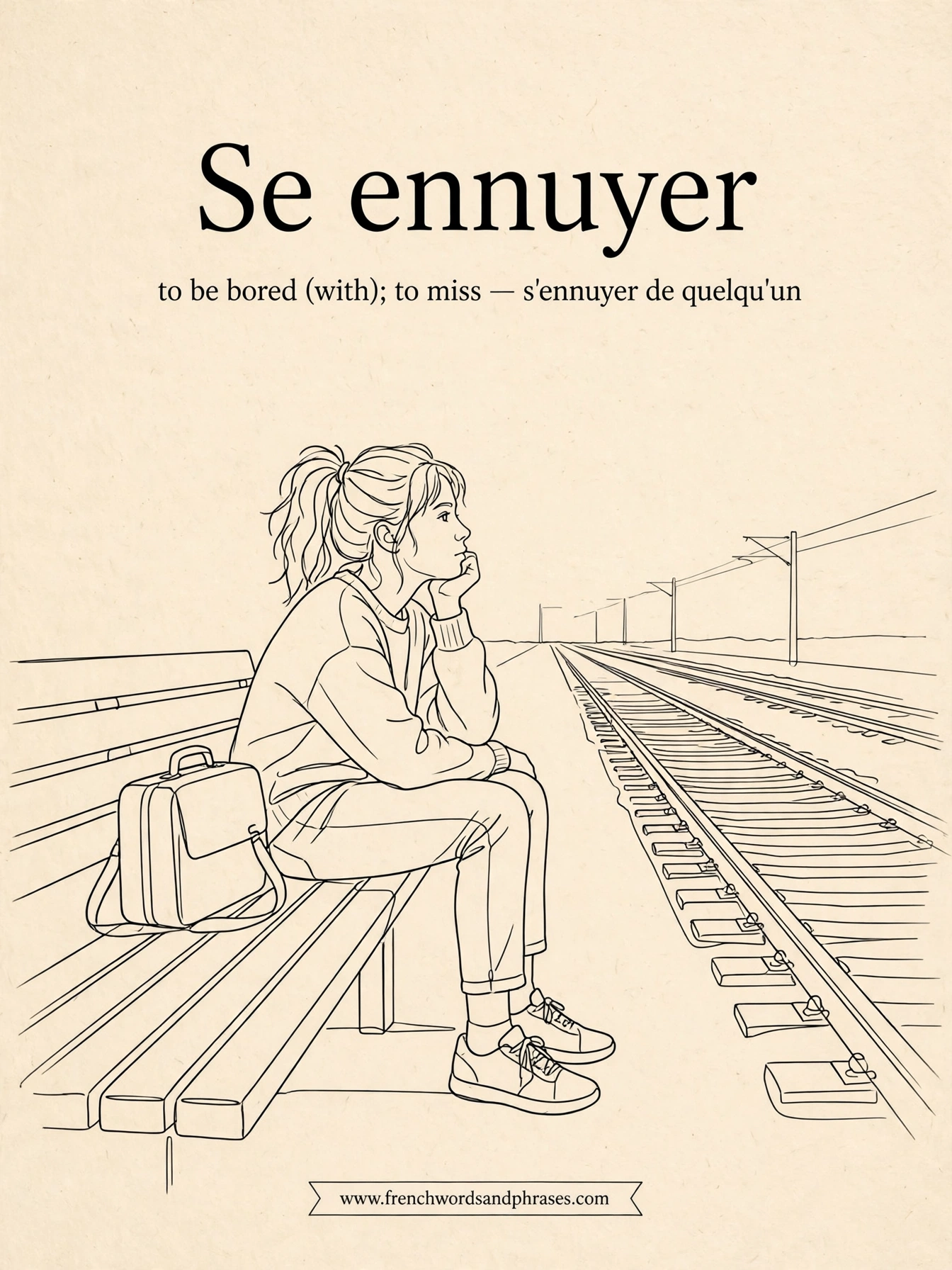
Se ennuyer means to be bored (with); to miss — s’ennuyer de quelqu’un — to be bored by one’s own empty hours, and, with de, to feel the absence of someone missed.
A child trailing through a rainy Sunday with nothing to do, a grandmother in a quiet house missing the grandchildren who have gone home — s’ennuyer holds both: the boredom of empty time, and the ache of missing someone, s’ennuyer de quelqu’un.
In this guide, you’ll learn how to conjugate se ennuyer in all the major French tenses and moods. Explore complete conjugation tables, French examples, English translations, and practice quizzes.
Understanding the French Verb Se ennuyer
Se ennuyer is a regular French verb belonging to the first group of verbs, those ending in-er.
It means to be bored (with); to miss — s’ennuyer de quelqu’un. The boredom sense is the everyday verb of empty time — school, waiting rooms, wet Sundays — and it easily intensifies: s’ennuyer à mourir, s’ennuyer ferme. The missing sense, s’ennuyer de quelqu’un, is tender and slightly old-fashioned in France, still very much alive in Belgium, Switzerland and Canada — the dictionary’s second gift in the same entry.
Verb classification: First group (-er), reflexive
Auxiliary verb: Être
Past participle: ennuyé
Present participle: ennuyant
English equivalents: To be bored, to be bored with; to miss someone; s’ennuyer à mourir — to be bored to death; s’ennuyer en classe — to be bored in class; s’ennuyer de quelqu’un — to miss someone; je m’ennuie de toi — I miss you; s’ennuyer ferme — to be thoroughly bored.
One important detail: s’ennuyer carries TWO lives, and the little word de separates them. Without de, it is boredom: je m’ennuie en classe, I am bored in class. With de and a person, it is missing them: je m’ennuie de toi — I miss you; elle s’ennuie de ses enfants — she misses her children. The spelling follows the -uyer rule of the family: y becomes i before a mute syllable — je m’ennuie, ils s’ennuient, je m’ennuierai — and stays in nous nous ennuyons, je m’ennuyais. Being reflexive, it takes être and the participle agrees: elle s’est ennuyée, ils se sont ennuyés.
Experience the Word
Se ennuyer is the verb of the empty hour — and, with one small de, of the empty chair where someone used to sit.
Imagine a boy of ten at his grandmother’s village house, the rain on the windows, the cousins gone home. He trails from room to room, sighs at the clock — il s’ennuie. And the grandmother, watching him, s’ennuie de ses petits-enfants dès qu’ils sont partis: she misses them the moment they leave.
Two feelings, one verb. He is bored — ennuyé by the rain; she is missing — ennuyée de ceux qui sont partis.
How to Conjugate Se ennuyer: Complete French Conjugation Guide
Let’s explore every major conjugation of se ennuyer, beginning with the indicative mood.
How to Conjugate Se ennuyer in the Indicative Mood
The indicative mood is used to express facts, observations, actions, and events.
How to Conjugate Se ennuyer in the Present Tense (Présent)
Used for actions happening now, habitual actions, and general truths.
| Subject | Conjugation |
|---|---|
| je | m’ennuie |
| tu | t’ennuies |
| il / elle | s’ennuie |
| nous | nous ennuyons |
| vous | vous ennuyez |
| ils / elles | s’ennuient |
Example
Les enfants s’ennuient pendant les longs trajets.
The children get bored during long journeys.
Quick Quiz 1
Complete the sentence:
Nous nous ______ pendant les longs trajets.
Reveal the answer
ennuyons
Nous nous ennuyons pendant les longs trajets.
We get bored during long journeys.
How to Conjugate Se ennuyer in the Passé Composé
Used for completed actions in the past. Se ennuyer takes the auxiliary verb être.
| Subject | Conjugation |
|---|---|
| je | me suis ennuyé / me suis ennuyée |
| tu | t’es ennuyé / t’es ennuyée |
| il / elle | s’est ennuyé / s’est ennuyée |
| nous | nous sommes ennuyés / nous sommes ennuyées |
| vous | vous êtes ennuyés / vous êtes ennuyées / vous êtes ennuyé / vous êtes ennuyée |
| ils / elles | se sont ennuyés / se sont ennuyées |
Example
Elle s’est ennuyée de ses petits-enfants tout l’hiver.
She missed her grandchildren all winter.
How to Conjugate Se ennuyer in the Imparfait (Imperfect Tense)
Used for habitual past actions, descriptions, and ongoing situations in the past.
| Subject | Conjugation |
|---|---|
| je | m’ennuyais |
| tu | t’ennuyais |
| il / elle | s’ennuyait |
| nous | nous ennuyions |
| vous | vous ennuyiez |
| ils / elles | s’ennuyaient |
Example
Je m’ennuyais de toi pendant ton voyage.
I missed you during your trip.
Quick Quiz 2
Choose the correct form:
She missed her grandchildren.
Elle ______ de ses petits-enfants. (s’est ennuyée / a ennuyé)
Reveal the answer
s’est ennuyée
Elle s’est ennuyée de ses petits-enfants.
S’ennuyer is reflexive, takes être, and the participle agrees: ennuyée.
How to Conjugate Se ennuyer in the Plus-que-parfait
Used to describe an action that had already been completed before another past event.
| Subject | Conjugation |
|---|---|
| je | m’étais ennuyé / m’étais ennuyée |
| tu | t’étais ennuyé / t’étais ennuyée |
| il / elle | s’était ennuyé / s’était ennuyée |
| nous | nous étions ennuyés / nous étions ennuyées |
| vous | vous étiez ennuyés / vous étiez ennuyées / vous étiez ennuyé / vous étiez ennuyée |
| ils / elles | s’étaient ennuyés / s’étaient ennuyées |
Example
Il s’était ennuyé à mourir dans ce village.
He had been bored to death in that village.
How to Conjugate Se ennuyer in the Passé Simple
Primarily used in formal writing, literature, and historical narratives. It is rarely used in everyday conversation.
| Subject | Conjugation |
|---|---|
| je | m’ennuyai |
| tu | t’ennuyas |
| il / elle | s’ennuya |
| nous | nous ennuyâmes |
| vous | vous ennuyâtes |
| ils / elles | s’ennuyèrent |
Example
Le roi s’ennuya à la chasse dès la première heure.
The king got bored with the hunt from the first hour.
How to Conjugate Se ennuyer in the Passé Antérieur
A literary tense used to express an action completed immediately before another past action, generally in the passé simple.
| Subject | Conjugation |
|---|---|
| je | me fus ennuyé / me fus ennuyée |
| tu | te fus ennuyé / te fus ennuyée |
| il / elle | se fut ennuyé / se fut ennuyée |
| nous | nous fûmes ennuyés / nous fûmes ennuyées |
| vous | vous fûtes ennuyés / vous fûtes ennuyées / vous fûtes ennuyé / vous fûtes ennuyée |
| ils / elles | se furent ennuyés / se furent ennuyées |
Example
Dès qu’elle se fut ennuyée de sa famille, elle écrivit une longue lettre.
As soon as she had begun missing her family, she wrote a long letter.
How to Conjugate Se ennuyer in the Future Tense (Futur Simple)
Used to describe actions that will take place in the future.
| Subject | Conjugation |
|---|---|
| je | m’ennuierai |
| tu | t’ennuieras |
| il / elle | s’ennuiera |
| nous | nous ennuierons |
| vous | vous ennuierez |
| ils / elles | s’ennuieront |
Example
Sans ses amis, il s’ennuiera pendant les vacances.
Without his friends, he will be bored during the holidays.
How to Conjugate Se ennuyer in the Futur Antérieur (Future Perfect)
Used for an action that will have been completed before a particular point in the future.
| Subject | Conjugation |
|---|---|
| je | me serai ennuyé / me serai ennuyée |
| tu | te seras ennuyé / te seras ennuyée |
| il / elle | se sera ennuyé / se sera ennuyée |
| nous | nous serons ennuyés / nous serons ennuyées |
| vous | vous serez ennuyés / vous serez ennuyées / vous serez ennuyé / vous serez ennuyée |
| ils / elles | se seront ennuyés / se seront ennuyées |
Example
À la fin de l’été, elle se sera ennuyée de la mer.
By the end of the summer, she will have missed the sea.
How to Conjugate Se ennuyer in the Near Future (Futur Proche)
Used to describe something that is going to happen soon. Formed with aller + infinitive.
| Subject | Conjugation |
|---|---|
| je | vais m’ennuyer |
| tu | vas t’ennuyer |
| il / elle | va s’ennuyer |
| nous | allons nous ennuyer |
| vous | allez vous ennuyer |
| ils / elles | vont s’ennuyer |
Example
Regarde-le bâiller : il va s’ennuyer ici.
Look at him yawning: he is going to be bored here.
How to Conjugate Se ennuyer in the Conditional Mood
The conditional mood expresses what would happen under certain circumstances. It is also frequently used to make polite requests or express wishes.
How to Conjugate Se ennuyer in the Present Conditional
| Subject | Conjugation |
|---|---|
| je | m’ennuierais |
| tu | t’ennuierais |
| il / elle | s’ennuierait |
| nous | nous ennuierions |
| vous | vous ennuieriez |
| ils / elles | s’ennuieraient |
Example
Je m’ennuierais sans mes livres.
I would be bored without my books.
How to Conjugate Se ennuyer in the Past Conditional
| Subject | Conjugation |
|---|---|
| je | me serais ennuyé / me serais ennuyée |
| tu | te serais ennuyé / te serais ennuyée |
| il / elle | se serait ennuyé / se serait ennuyée |
| nous | nous serions ennuyés / nous serions ennuyées |
| vous | vous seriez ennuyés / vous seriez ennuyées / vous seriez ennuyé / vous seriez ennuyée |
| ils / elles | se seraient ennuyés / se seraient ennuyées |
Example
Elle se serait ennuyée de lui sans ses lettres.
She would have missed him without his letters.
Se ennuyer in the Literary Past Conditional Form
This less common literary form uses the imperfect subjunctive of être.
| Subject | Conjugation |
|---|---|
| je | me fusse ennuyé / me fusse ennuyée |
| tu | te fusses ennuyé / te fusses ennuyée |
| il / elle | se fût ennuyé / se fût ennuyée |
| nous | nous fussions ennuyés / nous fussions ennuyées |
| vous | vous fussiez ennuyés / vous fussiez ennuyées / vous fussiez ennuyé / vous fussiez ennuyée |
| ils / elles | se fussent ennuyés / se fussent ennuyées |
Example
Il se fût ennuyé de sa terre natale jusqu’à la mort.
He would have missed his native land until death.
How to Conjugate Se ennuyer in the Subjunctive Mood
The subjunctive is used to express wishes, emotions, doubts, necessity, and uncertainty. It frequently follows expressions such as il faut que (it is necessary that) or bien que (although).
How to Conjugate Se ennuyer in the Present Subjunctive
| Subject | Conjugation |
|---|---|
| que je | m’ennuie |
| que tu | t’ennuies |
| qu’il / qu’elle | s’ennuie |
| que nous | nous ennuyions |
| que vous | vous ennuyiez |
| qu’ils / qu’elles | s’ennuient |
Example
Je ne veux pas que tu t’ennuies pendant mon absence.
I do not want you to be bored during my absence.
Quick Quiz 3
Complete the sentence using the subjunctive:
Je ne veux pas que tu ______ pendant mon absence.
Reveal the answer
t’ennuies
Je ne veux pas que tu t’ennuies pendant mon absence.
I do not want you to be bored during my absence.
How to Conjugate Se ennuyer in the Imperfect Subjunctive
A literary tense, rarely encountered in modern spoken French.
| Subject | Conjugation |
|---|---|
| que je | m’ennuyasse |
| que tu | t’ennuyasses |
| qu’il / qu’elle | s’ennuyât |
| que nous | nous ennuyassions |
| que vous | vous ennuyassiez |
| qu’ils / qu’elles | s’ennuyassent |
Example
Elle craignait qu’il s’ennuyât de sa famille à l’étranger.
She feared he might miss his family abroad.
How to Conjugate Se ennuyer in the Pluperfect Subjunctive
A literary construction used to express an action completed before another past action.
| Subject | Conjugation |
|---|---|
| que je | me fusse ennuyé / me fusse ennuyée |
| que tu | te fusses ennuyé / te fusses ennuyée |
| qu’il / qu’elle | se fût ennuyé / se fût ennuyée |
| que nous | nous fussions ennuyés / nous fussions ennuyées |
| que vous | vous fussiez ennuyés / vous fussiez ennuyées / vous fussiez ennuyé / vous fussiez ennuyée |
| qu’ils / qu’elles | se fussent ennuyés / se fussent ennuyées |
Example
On racontait qu’elle se fût ennuyée de son village toute sa vie.
People said she had missed her village all her life.
How to Conjugate Se ennuyer in the Past Subjunctive
| Subject | Conjugation |
|---|---|
| que je | me sois ennuyé / me sois ennuyée |
| que tu | te sois ennuyé / te sois ennuyée |
| qu’il / qu’elle | se soit ennuyé / se soit ennuyée |
| que nous | nous soyons ennuyés / nous soyons ennuyées |
| que vous | vous soyez ennuyés / vous soyez ennuyées / vous soyez ennuyé / vous soyez ennuyée |
| qu’ils / qu’elles | se soient ennuyés / se soient ennuyées |
Example
Je suis triste qu’elle se soit ennuyée de nous si longtemps.
I am sad she missed us for so long.
How to Conjugate Se ennuyer in the Imperative
The imperative is used to give commands, instructions, invitations, or suggestions. Subject pronouns are omitted.
How to Conjugate Se ennuyer in the Present Imperative
| Person | Conjugation |
|---|---|
| (tu) | ennuie-toi |
| (nous) | ennuyons-nous |
| (vous) | ennuyez-vous |
Example
Ne t’ennuie pas, les vacances commencent demain !
Do not be bored, the holidays start tomorrow!
Quick Quiz 4
How would you say Do not be bored (tu form)?
Reveal the answer
Ne t’ennuie pas !
French Participles of Se ennuyer
Participles are verb forms that can be used in compound tenses and other grammatical constructions.
Present Participle of Se ennuyer
ennuyant
En s’ennuyant de sa famille, il a appris à écrire des lettres.
Missing his family, he learned to write letters.
Past Participle of Se ennuyer
ennuyé
Ennuyée de ses amis, elle a pris le premier train pour Paris.
Missing her friends, she took the first train to Paris.
Se ennuyer in Everyday French: Real-Life Examples
Now that you know the conjugations, let’s see how se ennuyer appears in everyday French.
Example 1 — Present
Les enfants s’ennuient pendant les longs trajets.
The children get bored during long journeys.
Example 2 — Passé composé
Elle s’est ennuyée de ses petits-enfants.
She missed her grandchildren.
Example 3 — Imparfait
Je m’ennuyais de toi pendant ton voyage.
I missed you during your trip.
Example 4 — Future
Il s’ennuiera sans ses amis.
He will be bored without his friends.
Example 5 — Conditional
Je m’ennuierais sans mes livres.
I would be bored without my books.
Example 6 — Imperative
Ne t’ennuie pas, les vacances commencent demain !
Do not be bored, the holidays start tomorrow!
Beyond Translation: The Meaning of Se ennuyer
The missing sense surprises learners, because France mostly says tu me manques — but s’ennuyer de quelqu’un is the older, gentler phrasing, kept alive in letters, songs and the French of Belgium and Canada.
One verb, two emptinesses.
Boredom is time with nobody in it; missing is a person with no time together left in it. French, economical as ever, lets s’ennuyer carry both, and lets the small word de decide which one you mean.
How to Remember the French Verb Se ennuyer
Remember it this way: Se ennuyer is about the rainy Sunday child — and the grandmother missing the children.
- De changes everything: je m’ennuie = I am bored; je m’ennuie de toi = I miss you.
- The -uyer rule: je m’ennuie with i, nous nous ennuyons with y.
- Être in compound tenses, participle agreeing: elle s’est ennuyée, ils se sont ennuyés.
The key idea is the rainy Sunday child — and the grandmother missing the children.
Test Your Knowledge of Se ennuyer
Let’s see how much you’ve learned. Try answering these questions before revealing the answers.
Question 1
What does the little word de change in s’ennuyer?
Reveal the answer
Everything — je m’ennuie is ‘I am bored’; je m’ennuie de toi is ‘I miss you’.
Question 2
How do you say The children get bored during long journeys in French?
Reveal the answer
Les enfants s’ennuient pendant les longs trajets.
Question 3
Translate: I missed you during your trip.
Reveal the answer
Je m’ennuyais de toi pendant ton voyage.
Question 4
What is the past participle of s’ennuyer?
Reveal the answer
Ennuyé — agreeing: ennuyée, ennuyés, ennuyées.
Question 5
Complete the sentence:
Je ne veux pas que tu ______ pendant mon absence.
Reveal the answer
t’ennuies
Je ne veux pas que tu t’ennuies pendant mon absence.
I do not want you to be bored during my absence.
Your Final Challenge
Can You Use It?
How would you say this in French?
She misses her village, and every letter from there makes the winter shorter.
Reveal the answer
Elle s’ennuie de son village, et chaque lettre de là-bas raccourcit l’hiver.
She misses her village, and every letter from there makes the winter shorter.
A little French. A little curiosity. A richer everyday life.
LEARN FRENCH ONE WORD AT A TIME