A French Word to Live By
How to Conjugate Se combler in French
/sə kɔ̃.ble/
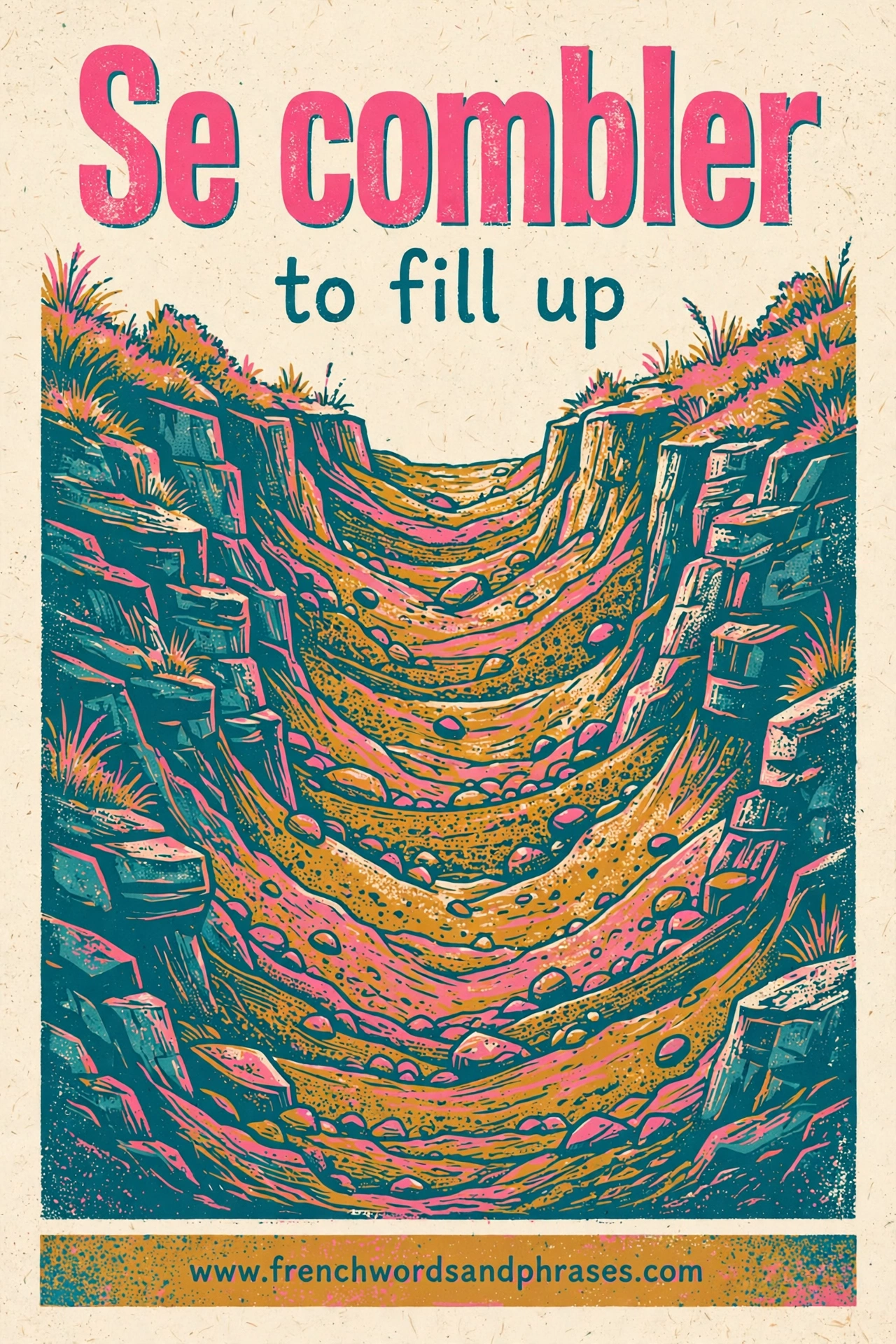
Se combler means to fill up — for a gap, a ditch or a backlog to close by itself, little by little, until the space is gone.
Leaves drifting into a ditch autumn after autumn, sand sliding back into a hole on the beach, a backlog quietly shrinking — se combler is the verb of gaps that close on their own: no one fills them, yet one day they are full.
In this guide, you’ll learn how to conjugate se combler in all the major French tenses and moods. Explore complete conjugation tables, French examples, English translations, and practice quizzes.
Understanding the French Verb Se combler
Se combler is a regular French verb belonging to the first group of verbs, those ending in-er.
It means to fill up. Gardeners, builders and teachers all use it: fossés, fissures and trous se comblent with time and weather, and in the classroom les lacunes se comblent is the hopeful news that a student’s gaps in knowledge are closing.
Verb classification: First group (-er), reflexive
Auxiliary verb: Être
Past participle: comblé
Present participle: comblant
English equivalents: To fill up, to fill in, to close up; le fossé se comble — the ditch is filling up; les lacunes se comblent — the gaps are closing; le retard se comble — the backlog is being made up; se combler peu à peu — to fill up gradually.
One important detail: se combler is what a gap does when nobody is filling it — the reflexive of combler, with être in every compound tense and the participle agreeing with the gap itself: la brèche s’est comblée, les trous se sont comblés. The conjugation is a regular -er: il se comble, nous nous comblons. Do not confuse it with être comblé (a person fulfilled, showered with good things): a ditch se comble; a grandfather est comblé.
Experience the Word
Se combler is the verb of patience — of empty places that heal themselves.
Imagine a ditch dug across a meadow one spring. Nobody tends it. The rains soften its edges, the leaves of three autumns settle into it, grass creeps down its sides — le fossé se comble peu à peu, until one spring only a green line in the grass remembers it was ever there.
No one filled it. It filled up — il s’est comblé — all by itself.
How to Conjugate Se combler: Complete French Conjugation Guide
Let’s explore every major conjugation of se combler, beginning with the indicative mood.
How to Conjugate Se combler in the Indicative Mood
The indicative mood is used to express facts, observations, actions, and events.
How to Conjugate Se combler in the Present Tense (Présent)
Used for actions happening now, habitual actions, and general truths.
| Subject | Conjugation |
|---|---|
| je | me comble |
| tu | te combles |
| il / elle | se comble |
| nous | nous comblons |
| vous | vous comblez |
| ils / elles | se comblent |
Example
Le fossé se comble peu à peu avec les feuilles.
The ditch is gradually filling up with leaves.
Quick Quiz 1
Complete the sentence:
Le fossé se ______ peu à peu.
Reveal the answer
comble
Le fossé se comble peu à peu.
The ditch is gradually filling up.
How to Conjugate Se combler in the Passé Composé
Used for completed actions in the past. Se combler takes the auxiliary verb être.
| Subject | Conjugation |
|---|---|
| je | me suis comblé / me suis comblée |
| tu | t’es comblé / t’es comblée |
| il / elle | s’est comblé / s’est comblée |
| nous | nous sommes comblés / nous sommes comblées |
| vous | vous êtes comblés / vous êtes comblées / vous êtes comblé / vous êtes comblée |
| ils / elles | se sont comblés / se sont comblées |
Example
Le vide s’est comblé avec le temps.
The void filled up with time.
How to Conjugate Se combler in the Imparfait (Imperfect Tense)
Used for habitual past actions, descriptions, and ongoing situations in the past.
| Subject | Conjugation |
|---|---|
| je | me comblais |
| tu | te comblais |
| il / elle | se comblait |
| nous | nous comblions |
| vous | vous combliez |
| ils / elles | se comblaient |
Example
Les lacunes se comblaient au fil des révisions.
The gaps used to close as the revision went on.
Quick Quiz 2
Choose the correct form:
The gap filled up.
Le vide ______. (s’est comblé / a comblé)
Reveal the answer
s’est comblé
Le vide s’est comblé.
Se combler is reflexive and takes être.
How to Conjugate Se combler in the Plus-que-parfait
Used to describe an action that had already been completed before another past event.
| Subject | Conjugation |
|---|---|
| je | m’étais comblé / m’étais comblée |
| tu | t’étais comblé / t’étais comblée |
| il / elle | s’était comblé / s’était comblée |
| nous | nous étions comblés / nous étions comblées |
| vous | vous étiez comblés / vous étiez comblées / vous étiez comblé / vous étiez comblée |
| ils / elles | s’étaient comblés / s’étaient comblées |
Example
La brèche s’était comblée pendant la nuit.
The breach had filled in during the night.
How to Conjugate Se combler in the Passé Simple
Primarily used in formal writing, literature, and historical narratives. It is rarely used in everyday conversation.
| Subject | Conjugation |
|---|---|
| je | me comblai |
| tu | te comblas |
| il / elle | se combla |
| nous | nous comblâmes |
| vous | vous comblâtes |
| ils / elles | se comblèrent |
Example
La mare se combla en quelques années.
The pond silted up and filled in a few years.
How to Conjugate Se combler in the Passé Antérieur
A literary tense used to express an action completed immediately before another past action, generally in the passé simple.
| Subject | Conjugation |
|---|---|
| je | me fus comblé / me fus comblée |
| tu | te fus comblé / te fus comblée |
| il / elle | se fut comblé / se fut comblée |
| nous | nous fûmes comblés / nous fûmes comblées |
| vous | vous fûtes comblés / vous fûtes comblées / vous fûtes comblé / vous fûtes comblée |
| ils / elles | se furent comblés / se furent comblées |
Example
Dès que le trou se fut comblé, les enfants rejouèrent dessus.
As soon as the hole had filled up, the children played on it again.
How to Conjugate Se combler in the Future Tense (Futur Simple)
Used to describe actions that will take place in the future.
| Subject | Conjugation |
|---|---|
| je | me comblerai |
| tu | te combleras |
| il / elle | se comblera |
| nous | nous comblerons |
| vous | vous comblerez |
| ils / elles | se combleront |
Example
Ces écarts se combleront avec l’expérience.
These gaps will close with experience.
How to Conjugate Se combler in the Futur Antérieur (Future Perfect)
Used for an action that will have been completed before a particular point in the future.
| Subject | Conjugation |
|---|---|
| je | me serai comblé / me serai comblée |
| tu | te seras comblé / te seras comblée |
| il / elle | se sera comblé / se sera comblée |
| nous | nous serons comblés / nous serons comblées |
| vous | vous serez comblés / vous serez comblées / vous serez comblé / vous serez comblée |
| ils / elles | se seront comblés / se seront comblées |
Example
Au printemps, le fossé se sera comblé entièrement.
By spring, the ditch will have filled up completely.
How to Conjugate Se combler in the Near Future (Futur Proche)
Used to describe something that is going to happen soon. Formed with aller + infinitive.
| Subject | Conjugation |
|---|---|
| je | vais me combler |
| tu | vas te combler |
| il / elle | va se combler |
| nous | allons nous combler |
| vous | allez vous combler |
| ils / elles | vont se combler |
Example
Le retard va se combler si nous travaillons bien.
The backlog is going to be made up if we work well.
How to Conjugate Se combler in the Conditional Mood
The conditional mood expresses what would happen under certain circumstances. It is also frequently used to make polite requests or express wishes.
How to Conjugate Se combler in the Present Conditional
| Subject | Conjugation |
|---|---|
| je | me comblerais |
| tu | te comblerais |
| il / elle | se comblerait |
| nous | nous comblerions |
| vous | vous combleriez |
| ils / elles | se combleraient |
Example
Sans entretien, la fissure se comblerait de saleté.
Without upkeep, the crack would fill up with dirt.
How to Conjugate Se combler in the Past Conditional
| Subject | Conjugation |
|---|---|
| je | me serais comblé / me serais comblée |
| tu | te serais comblé / te serais comblée |
| il / elle | se serait comblé / se serait comblée |
| nous | nous serions comblés / nous serions comblées |
| vous | vous seriez comblés / vous seriez comblées / vous seriez comblé / vous seriez comblée |
| ils / elles | se seraient comblés / se seraient comblées |
Example
Le vide se serait comblé plus vite avec de l’aide.
The void would have filled up faster with help.
Se combler in the Literary Past Conditional Form
This less common literary form uses the imperfect subjunctive of être.
| Subject | Conjugation |
|---|---|
| je | me fusse comblé / me fusse comblée |
| tu | te fusses comblé / te fusses comblée |
| il / elle | se fût comblé / se fût comblée |
| nous | nous fussions comblés / nous fussions comblées |
| vous | vous fussiez comblés / vous fussiez comblées / vous fussiez comblé / vous fussiez comblée |
| ils / elles | se fussent comblés / se fussent comblées |
Example
La brèche se fût comblée sans les pluies d’automne.
The breach would have filled in without the autumn rains.
How to Conjugate Se combler in the Subjunctive Mood
The subjunctive is used to express wishes, emotions, doubts, necessity, and uncertainty. It frequently follows expressions such as il faut que (it is necessary that) or bien que (although).
How to Conjugate Se combler in the Present Subjunctive
| Subject | Conjugation |
|---|---|
| que je | me comble |
| que tu | te combles |
| qu’il / qu’elle | se comble |
| que nous | nous comblions |
| que vous | vous combliez |
| qu’ils / qu’elles | se comblent |
Example
Il faut que les lacunes se comblent avant l’examen.
The gaps must close before the exam.
Quick Quiz 3
Complete the sentence using the subjunctive:
Il faut que les lacunes se ______ avant l’examen.
Reveal the answer
comblent
Il faut que les lacunes se comblent avant l’examen.
The gaps must close before the exam.
How to Conjugate Se combler in the Imperfect Subjunctive
A literary tense, rarely encountered in modern spoken French.
| Subject | Conjugation |
|---|---|
| que je | me comblasse |
| que tu | te comblasses |
| qu’il / qu’elle | se comblât |
| que nous | nous comblassions |
| que vous | vous comblassiez |
| qu’ils / qu’elles | se comblassent |
Example
Je ne pensais pas que le fossé se comblât si vite.
I did not think the ditch would fill up so fast.
How to Conjugate Se combler in the Pluperfect Subjunctive
A literary construction used to express an action completed before another past action.
| Subject | Conjugation |
|---|---|
| que je | me fusse comblé / me fusse comblée |
| que tu | te fusses comblé / te fusses comblée |
| qu’il / qu’elle | se fût comblé / se fût comblée |
| que nous | nous fussions comblés / nous fussions comblées |
| que vous | vous fussiez comblés / vous fussiez comblées / vous fussiez comblé / vous fussiez comblée |
| qu’ils / qu’elles | se fussent comblés / se fussent comblées |
Example
On constatait que la mare se fût comblée en un seul hiver.
People noted that the pond had filled up in a single winter.
How to Conjugate Se combler in the Past Subjunctive
| Subject | Conjugation |
|---|---|
| que je | me sois comblé / me sois comblée |
| que tu | te sois comblé / te sois comblée |
| qu’il / qu’elle | se soit comblé / se soit comblée |
| que nous | nous soyons comblés / nous soyons comblées |
| que vous | vous soyez comblés / vous soyez comblées / vous soyez comblé / vous soyez comblée |
| qu’ils / qu’elles | se soient comblés / se soient comblées |
Example
Je suis surpris que le retard se soit comblé si facilement.
I am surprised the backlog was made up so easily.
How to Conjugate Se combler in the Imperative
The imperative is used to give commands, instructions, invitations, or suggestions. Subject pronouns are omitted.
How to Conjugate Se combler in the Present Imperative
| Person | Conjugation |
|---|---|
| (tu) | comble-toi |
| (nous) | comblons-nous |
| (vous) | comblez-vous |
Example
Laisse le fossé se combler tout seul !
Let the ditch fill up by itself!
Quick Quiz 4
How would you say Let the ditch fill up (tu form)?
Reveal the answer
Laisse le fossé se combler !
French Participles of Se combler
Participles are verb forms that can be used in compound tenses and other grammatical constructions.
Present Participle of Se combler
comblant
En se comblant lentement, la mare est devenue un pré.
By slowly filling up, the pond became a meadow.
Past Participle of Se combler
comblé
Comblée par les feuilles de trois automnes, la fosse avait disparu.
Filled in by the leaves of three autumns, the pit had disappeared.
Se combler in Everyday French: Real-Life Examples
Now that you know the conjugations, let’s see how se combler appears in everyday French.
Example 1 — Present
Le fossé se comble peu à peu.
The ditch is gradually filling up.
Example 2 — Passé composé
Le vide s’est comblé avec le temps.
The void filled up with time.
Example 3 — Imparfait
Les lacunes se comblaient vite.
The gaps used to close quickly.
Example 4 — Future
Les écarts se combleront.
The gaps will close.
Example 5 — Conditional
Le retard se comblerait avec un peu d’aide.
The backlog would be made up with a little help.
Example 6 — Imperative
Laissez le trou se combler tout seul !
Let the hole fill up by itself!
Beyond Translation: The Meaning of Se combler
The reflexive does quiet work in French: where combler needs a gardener with a spade, se combler hands the job to time.
Gaps, in this verb, are temporary.
Fossés, retards, lacunes, déficits — French lets them all se combler, as if the world disliked a vacuum and were slowly, patiently, putting it right.
How to Remember the French Verb Se combler
Remember it this way: Se combler is about the ditch that three autumns of leaves quietly filled.
- Reflexive with être, agreeing with the gap: la brèche s’est comblée.
- The subject is the empty place itself: le fossé se comble, les lacunes se comblent.
- Not être comblé: ditches se comblent; people showered with gifts sont comblés.
The key idea is the ditch that three autumns of leaves quietly filled.
Test Your Knowledge of Se combler
Let’s see how much you’ve learned. Try answering these questions before revealing the answers.
Question 1
Which auxiliary does se combler use, and why?
Reveal the answer
Être — it is a reflexive verb: le vide s’est comblé.
Question 2
How do you say The ditch is filling up in French?
Reveal the answer
Le fossé se comble.
Question 3
Translate: The gaps closed with time.
Reveal the answer
Les lacunes se sont comblées avec le temps.
Question 4
What is the past participle of se combler?
Reveal the answer
Comblé — agreeing with the gap: la brèche s’est comblée.
Question 5
Complete the sentence:
Il faut que les écarts se ______ avant l’examen.
Reveal the answer
comblent
Il faut que les écarts se comblent avant l’examen.
The gaps must close before the exam.
Your Final Challenge
Can You Use It?
How would you say this in French?
The ditches dug by anger fill up slowly, leaf after leaf, pardon after pardon.
Reveal the answer
Les fossés creusés par la colère se comblent lentement, feuille après feuille, pardon après pardon.
The ditches dug by anger fill up slowly, leaf after leaf, pardon after pardon.
A little French. A little curiosity. A richer everyday life.
LEARN FRENCH ONE WORD AT A TIME