A French Word to Live By
How to Conjugate Se combiner in French
/sə kɔ̃.bi.ne/
Se combiner means to unite with — for separate things to join together and form a single whole.
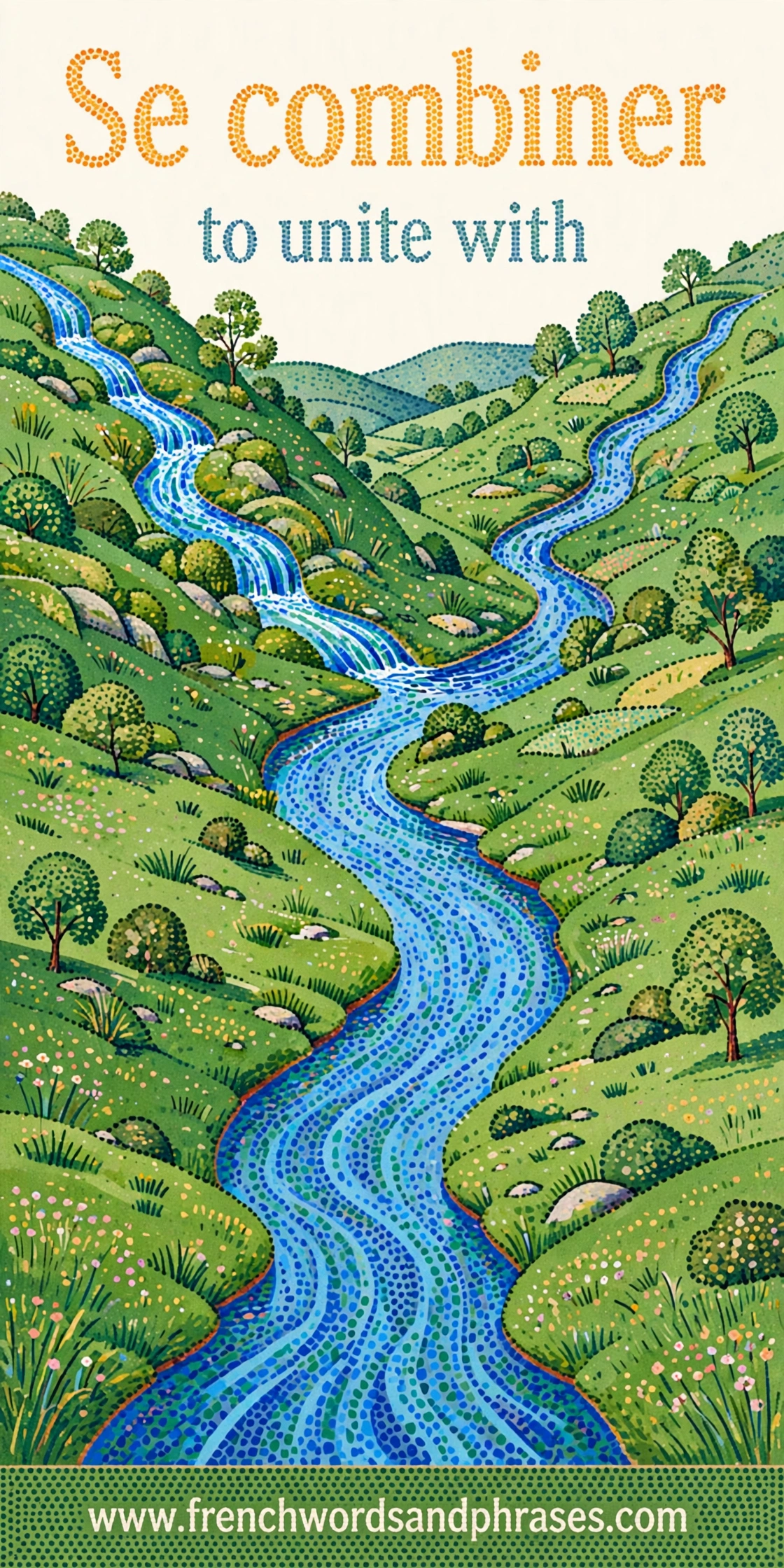
Two rivers meeting below a bridge, two gases joining in a chemist’s flask, two small firms becoming one — se combiner is the verb of things that join together: separate elements flowing into a single, stronger whole.
In this guide, you’ll learn how to conjugate se combiner in all the major French tenses and moods. Explore complete conjugation tables, French examples, English translations, and practice quizzes.
Understanding the French Verb Se combiner
Se combiner is a regular French verb belonging to the first group of verbs, those ending in-er.
It means to unite with. Chemists use it for elements uniting into compounds, cooks for flavours blending, and business pages for firms merging. Where combiner (transitive) has a person doing the joining, se combiner lets the elements do it themselves.
Verb classification: First group (-er), reflexive
Auxiliary verb: Être
Past participle: combiné
Present participle: combinant
English equivalents: To combine, to join together, to unite; se combiner avec — to combine with; les saveurs se combinent — the flavours blend; se combiner pour former — to combine to form; deux entreprises qui se combinent — two companies merging.
One important detail: se combiner is the reflexive twin of combiner, used when things join together of themselves or with each other — and being reflexive, it takes être in every compound tense, with the participle agreeing: les deux entreprises se sont combinées. The conjugation stays regular: je me combine, nous nous combinons, and the plural subjunctive keeps its single i: qu’elles se combinent, que nous nous combinions. Its partner preposition is avec: se combiner avec quelque chose.
Experience the Word
Se combiner is the verb of the meeting point — the moment separate things become one thing.
Imagine two streams high in the mountains, each too small to turn a mill wheel. They wind down their separate valleys, meet below the village, and suddenly there is a river — les deux ruisseaux se sont combinés, and the mill begins to turn.
Neither stream was enough alone. Together — combinés — they are a force.
How to Conjugate Se combiner: Complete French Conjugation Guide
Let’s explore every major conjugation of se combiner, beginning with the indicative mood.
How to Conjugate Se combiner in the Indicative Mood
The indicative mood is used to express facts, observations, actions, and events.
How to Conjugate Se combiner in the Present Tense (Présent)
Used for actions happening now, habitual actions, and general truths.
| Subject | Conjugation |
|---|---|
| je | me combine |
| tu | te combines |
| il / elle | se combine |
| nous | nous combinons |
| vous | vous combinez |
| ils / elles | se combinent |
Example
Dans ce matériau, la légèreté se combine avec la solidité.
In this material, lightness combines with strength.
Quick Quiz 1
Complete the sentence:
Les saveurs se ______ à merveille.
Reveal the answer
combinent
Les saveurs se combinent à merveille.
The flavours blend beautifully.
How to Conjugate Se combiner in the Passé Composé
Used for completed actions in the past. Se combiner takes the auxiliary verb être.
| Subject | Conjugation |
|---|---|
| je | me suis combiné / me suis combinée |
| tu | t’es combiné / t’es combinée |
| il / elle | s’est combiné / s’est combinée |
| nous | nous sommes combinés / nous sommes combinées |
| vous | vous êtes combinés / vous êtes combinées / vous êtes combiné / vous êtes combinée |
| ils / elles | se sont combinés / se sont combinées |
Example
Les deux entreprises se sont combinées pour former un géant.
The two companies combined to form a giant.
How to Conjugate Se combiner in the Imparfait (Imperfect Tense)
Used for habitual past actions, descriptions, and ongoing situations in the past.
| Subject | Conjugation |
|---|---|
| je | me combinais |
| tu | te combinais |
| il / elle | se combinait |
| nous | nous combinions |
| vous | vous combiniez |
| ils / elles | se combinaient |
Example
Les saveurs se combinaient à merveille dans ce plat.
The flavours used to blend beautifully in this dish.
Quick Quiz 2
Choose the correct form:
The two teams combined.
Les deux équipes ______. (se sont combinées / ont combiné)
Reveal the answer
se sont combinées
Les deux équipes se sont combinées.
Se combiner is reflexive, takes être, and the participle agrees.
How to Conjugate Se combiner in the Plus-que-parfait
Used to describe an action that had already been completed before another past event.
| Subject | Conjugation |
|---|---|
| je | m’étais combiné / m’étais combinée |
| tu | t’étais combiné / t’étais combinée |
| il / elle | s’était combiné / s’était combinée |
| nous | nous étions combinés / nous étions combinées |
| vous | vous étiez combinés / vous étiez combinées / vous étiez combiné / vous étiez combinée |
| ils / elles | s’étaient combinés / s’étaient combinées |
Example
Leurs efforts s’étaient combinés pour produire un miracle.
Their efforts had combined to produce a miracle.
How to Conjugate Se combiner in the Passé Simple
Primarily used in formal writing, literature, and historical narratives. It is rarely used in everyday conversation.
| Subject | Conjugation |
|---|---|
| je | me combinai |
| tu | te combinas |
| il / elle | se combina |
| nous | nous combinâmes |
| vous | vous combinâtes |
| ils / elles | se combinèrent |
Example
Les atomes se combinèrent en une molécule nouvelle.
The atoms combined into a new molecule.
How to Conjugate Se combiner in the Passé Antérieur
A literary tense used to express an action completed immediately before another past action, generally in the passé simple.
| Subject | Conjugation |
|---|---|
| je | me fus combiné / me fus combinée |
| tu | te fus combiné / te fus combinée |
| il / elle | se fut combiné / se fut combinée |
| nous | nous fûmes combinés / nous fûmes combinées |
| vous | vous fûtes combinés / vous fûtes combinées / vous fûtes combiné / vous fûtes combinée |
| ils / elles | se furent combinés / se furent combinées |
Example
Dès que les deux courants se furent combinés, le fleuve devint puissant.
As soon as the two currents had joined, the river became powerful.
How to Conjugate Se combiner in the Future Tense (Futur Simple)
Used to describe actions that will take place in the future.
| Subject | Conjugation |
|---|---|
| je | me combinerai |
| tu | te combineras |
| il / elle | se combinera |
| nous | nous combinerons |
| vous | vous combinerez |
| ils / elles | se combineront |
Example
Un jour, ces technologies se combineront parfaitement.
One day, these technologies will combine perfectly.
How to Conjugate Se combiner in the Futur Antérieur (Future Perfect)
Used for an action that will have been completed before a particular point in the future.
| Subject | Conjugation |
|---|---|
| je | me serai combiné / me serai combinée |
| tu | te seras combiné / te seras combinée |
| il / elle | se sera combiné / se sera combinée |
| nous | nous serons combinés / nous serons combinées |
| vous | vous serez combinés / vous serez combinées / vous serez combiné / vous serez combinée |
| ils / elles | se seront combinés / se seront combinées |
Example
À la fin, tous les éléments se seront combinés en un tout harmonieux.
In the end, all the elements will have combined into a harmonious whole.
How to Conjugate Se combiner in the Near Future (Futur Proche)
Used to describe something that is going to happen soon. Formed with aller + infinitive.
| Subject | Conjugation |
|---|---|
| je | vais me combiner |
| tu | vas te combiner |
| il / elle | va se combiner |
| nous | allons nous combiner |
| vous | allez vous combiner |
| ils / elles | vont se combiner |
Example
Les deux approches vont se combiner dans ce projet.
The two approaches are going to combine in this project.
How to Conjugate Se combiner in the Conditional Mood
The conditional mood expresses what would happen under certain circumstances. It is also frequently used to make polite requests or express wishes.
How to Conjugate Se combiner in the Present Conditional
| Subject | Conjugation |
|---|---|
| je | me combinerais |
| tu | te combinerais |
| il / elle | se combinerait |
| nous | nous combinerions |
| vous | vous combineriez |
| ils / elles | se combineraient |
Example
Sans catalyseur, les substances se combineraient lentement.
Without a catalyst, the substances would combine slowly.
How to Conjugate Se combiner in the Past Conditional
| Subject | Conjugation |
|---|---|
| je | me serais combiné / me serais combinée |
| tu | te serais combiné / te serais combinée |
| il / elle | se serait combiné / se serait combinée |
| nous | nous serions combinés / nous serions combinées |
| vous | vous seriez combinés / vous seriez combinées / vous seriez combiné / vous seriez combinée |
| ils / elles | se seraient combinés / se seraient combinées |
Example
Les couleurs se seraient combinées autrement avec plus de lumière.
The colours would have combined differently with more light.
Se combiner in the Literary Past Conditional Form
This less common literary form uses the imperfect subjunctive of être.
| Subject | Conjugation |
|---|---|
| je | me fusse combiné / me fusse combinée |
| tu | te fusses combiné / te fusses combinée |
| il / elle | se fût combiné / se fût combinée |
| nous | nous fussions combinés / nous fussions combinées |
| vous | vous fussiez combinés / vous fussiez combinées / vous fussiez combiné / vous fussiez combinée |
| ils / elles | se fussent combinés / se fussent combinées |
Example
Les forces se fussent combinées contre l’ennemi commun.
The forces would have united against the common enemy.
How to Conjugate Se combiner in the Subjunctive Mood
The subjunctive is used to express wishes, emotions, doubts, necessity, and uncertainty. It frequently follows expressions such as il faut que (it is necessary that) or bien que (although).
How to Conjugate Se combiner in the Present Subjunctive
| Subject | Conjugation |
|---|---|
| que je | me combine |
| que tu | te combines |
| qu’il / qu’elle | se combine |
| que nous | nous combinions |
| que vous | vous combiniez |
| qu’ils / qu’elles | se combinent |
Example
Il faut que les ingrédients se combinent lentement.
The ingredients must combine slowly.
Quick Quiz 3
Complete the sentence using the subjunctive:
Il faut que les ingrédients se ______ lentement.
Reveal the answer
combinent
Il faut que les ingrédients se combinent lentement.
The ingredients must combine slowly.
How to Conjugate Se combiner in the Imperfect Subjunctive
A literary tense, rarely encountered in modern spoken French.
| Subject | Conjugation |
|---|---|
| que je | me combinasse |
| que tu | te combinasses |
| qu’il / qu’elle | se combinât |
| que nous | nous combinassions |
| que vous | vous combinassiez |
| qu’ils / qu’elles | se combinassent |
Example
Je souhaitais que les deux styles se combinassent mieux.
I wished the two styles would blend better.
How to Conjugate Se combiner in the Pluperfect Subjunctive
A literary construction used to express an action completed before another past action.
| Subject | Conjugation |
|---|---|
| que je | me fusse combiné / me fusse combinée |
| que tu | te fusses combiné / te fusses combinée |
| qu’il / qu’elle | se fût combiné / se fût combinée |
| que nous | nous fussions combinés / nous fussions combinées |
| que vous | vous fussiez combinés / vous fussiez combinées / vous fussiez combiné / vous fussiez combinée |
| qu’ils / qu’elles | se fussent combinés / se fussent combinées |
Example
On expliquait que les gaz se fussent combinés dans le tube.
It was explained that the gases had combined in the tube.
How to Conjugate Se combiner in the Past Subjunctive
| Subject | Conjugation |
|---|---|
| que je | me sois combiné / me sois combinée |
| que tu | te sois combiné / te sois combinée |
| qu’il / qu’elle | se soit combiné / se soit combinée |
| que nous | nous soyons combinés / nous soyons combinées |
| que vous | vous soyez combinés / vous soyez combinées / vous soyez combiné / vous soyez combinée |
| qu’ils / qu’elles | se soient combinés / se soient combinées |
Example
Je suis étonné que les deux équipes se soient combinées si vite.
I am amazed the two teams combined so quickly.
How to Conjugate Se combiner in the Imperative
The imperative is used to give commands, instructions, invitations, or suggestions. Subject pronouns are omitted.
How to Conjugate Se combiner in the Present Imperative
| Person | Conjugation |
|---|---|
| (tu) | combine-toi |
| (nous) | combinons-nous |
| (vous) | combinez-vous |
Example
Combine-toi avec elle pour former un duo imbattable !
Team up with her to form an unbeatable duo!
Quick Quiz 4
How would you say Team up with her (tu form)?
Reveal the answer
Combine-toi avec elle !
French Participles of Se combiner
Participles are verb forms that can be used in compound tenses and other grammatical constructions.
Present Participle of Se combiner
combinant
En se combinant, ces deux gaz produisent de l’eau.
By combining, these two gases produce water.
Past Participle of Se combiner
combiné
Combinées l’une à l’autre, les deux méthodes donnent d’excellents résultats.
Combined with each other, the two methods give excellent results.
Se combiner in Everyday French: Real-Life Examples
Now that you know the conjugations, let’s see how se combiner appears in everyday French.
Example 1 — Present
Les saveurs se combinent à merveille.
The flavours blend beautifully.
Example 2 — Passé composé
Les deux équipes se sont combinées pour le projet.
The two teams combined for the project.
Example 3 — Imparfait
Les couleurs se combinaient mal.
The colours used to blend badly.
Example 4 — Future
Les éléments se combineront lentement.
The elements will combine slowly.
Example 5 — Conditional
Sans chaleur, les gaz se combineraient lentement.
Without heat, the gases would combine slowly.
Example 6 — Imperative
Combinez-vous pour gagner !
Join forces to win!
Beyond Translation: The Meaning of Se combiner
French keeps the chemistry honest: elements se combinent into une combinaison, a compound — the same word that means a combination lock’s code and a pair of overalls.
Joining is the family trade.
From gas molecules to merging companies, se combiner always tells the same story: two halves arrive separately and leave as one whole.
How to Remember the French Verb Se combiner
Remember it this way: Se combiner is about two streams meeting below the village and becoming a river.
- Reflexive with être and agreement: les entreprises se sont combinées.
- Its preposition is avec: se combiner avec quelque chose.
- Regular -er underneath: je me combine, nous nous combinons, past participle combiné.
The key idea is two streams meeting below the village and becoming a river.
Test Your Knowledge of Se combiner
Let’s see how much you’ve learned. Try answering these questions before revealing the answers.
Question 1
Which auxiliary does se combiner use, and why?
Reveal the answer
Être — it is a reflexive verb: les entreprises se sont combinées.
Question 2
How do you say The flavours blend beautifully in French?
Reveal the answer
Les saveurs se combinent à merveille.
Question 3
Translate: The two companies combined to form a giant.
Reveal the answer
Les deux entreprises se sont combinées pour former un géant.
Question 4
What is the past participle of se combiner?
Reveal the answer
Combiné — agreeing: combinée, combinés, combinées.
Question 5
Complete the sentence:
Il faut que les ingrédients se ______ lentement.
Reveal the answer
combinent
Il faut que les ingrédients se combinent lentement.
The ingredients must combine slowly.
Your Final Challenge
Can You Use It?
How would you say this in French?
Alone, we move slowly; together, forces combine and everything becomes possible.
Reveal the answer
Seuls, nous avançons lentement ; ensemble, les forces se combinent et tout devient possible.
Alone, we move slowly; together, forces combine and everything becomes possible.
A little French. A little curiosity. A richer everyday life.
LEARN FRENCH ONE WORD AT A TIME