A French Word to Live By
How to Conjugate Se coller in French
/sə kɔ.le/
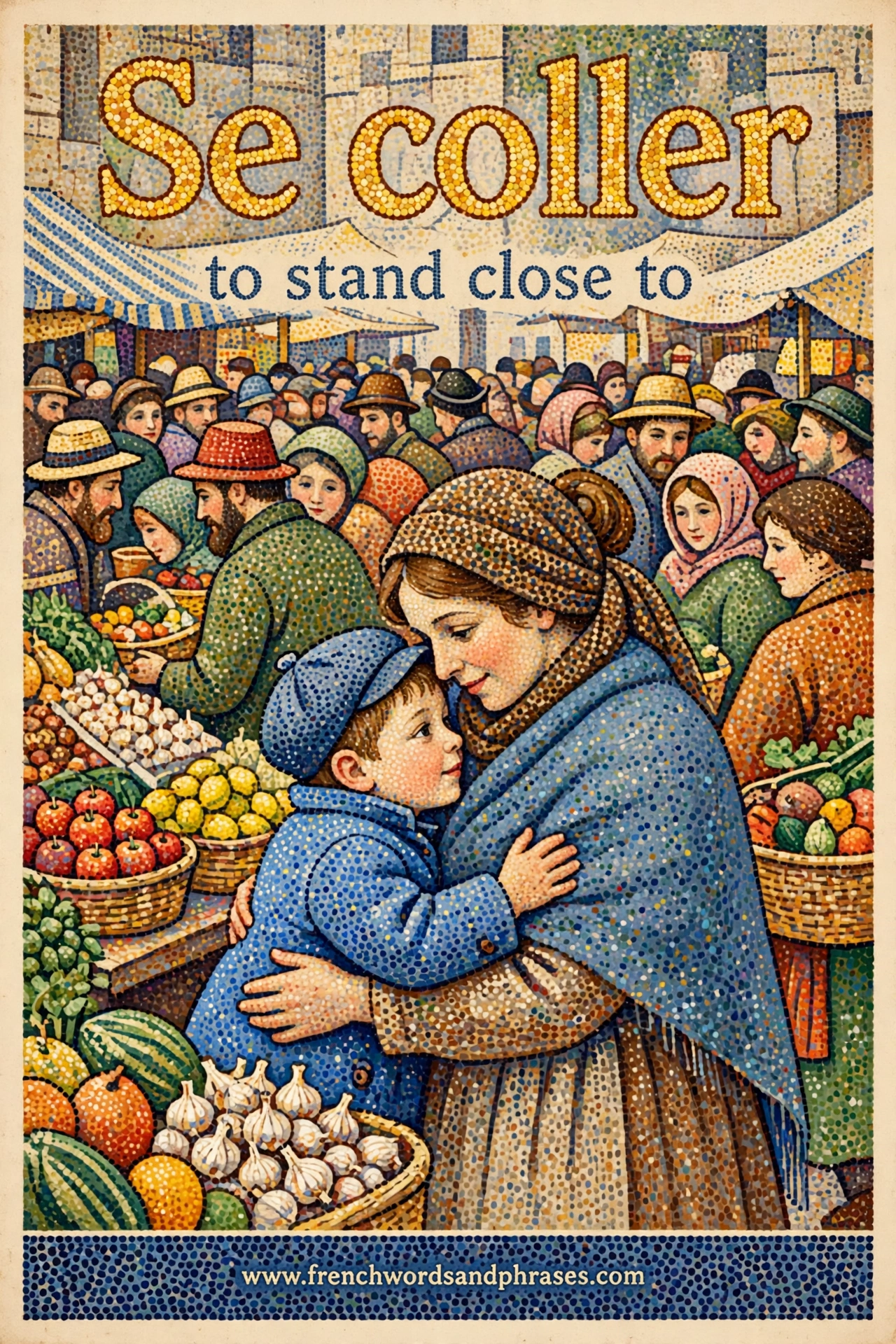
Se coller means to stand close to — to press yourself against someone or something and stay there, glued by cold, fear, love or a crowd.
A child edging closer to his mother in a thunderstorm, two sweethearts sharing one umbrella, passengers pressed shoulder to shoulder in a packed metro — se coller is the verb of closing the gap: bodies sticking close to whatever promises warmth or safety.
In this guide, you’ll learn how to conjugate se coller in all the major French tenses and moods. Explore complete conjugation tables, French examples, English translations, and practice quizzes.
Understanding the French Verb Se coller
Se coller is a regular French verb belonging to the first group of verbs, those ending in-er.
It means to stand close to. It paints physical closeness of every emotional colour: the toddler se colle à sa mère out of fear, lovers se collent l’un à l’autre under an umbrella, a shy guest se colle au mur at a party, and figuratively a worker can se coller à son poste — stick faithfully to his post.
Verb classification: First group (-er), reflexive
Auxiliary verb: Être
Past participle: collé
Present participle: collant
English equivalents: To press close, to stick close; se coller à quelqu’un — to press close to someone; se coller contre le mur — to press oneself against the wall; se coller l’un à l’autre — to huddle together; se coller à son poste — to stick to one’s post.
One important detail: se coller is reflexive, so it takes être in every compound tense and the past participle agrees with the subject: elle s’est collée contre lui, ils se sont collés l’un à l’autre. Its partners are the prepositions à and contre: se coller à sa mère, se coller contre le mur. The tu imperative tucks the pronoun behind the verb: colle-toi à moi ! The plain verb coller means to glue; the reflexive turns the glue onto yourself — you become the thing that sticks.
Experience the Word
Se coller is the verb of the closed gap — when French wants no daylight between two people, it reaches for the glue.
Imagine a sudden downpour at a bus stop with one small shelter. Six strangers shuffle closer and closer until shoulders touch and nobody minds — ils se sont collés les uns aux autres, and the rain, for a moment, has made them a single animal.
No one has spoken a word. They have pressed close — collés — and the storm feels smaller.
How to Conjugate Se coller: Complete French Conjugation Guide
Let’s explore every major conjugation of se coller, beginning with the indicative mood.
How to Conjugate Se coller in the Indicative Mood
The indicative mood is used to express facts, observations, actions, and events.
How to Conjugate Se coller in the Present Tense (Présent)
Used for actions happening now, habitual actions, and general truths.
| Subject | Conjugation |
|---|---|
| je | me colle |
| tu | te colles |
| il / elle | se colle |
| nous | nous collons |
| vous | vous collez |
| ils / elles | se collent |
Example
L’enfant se colle à sa mère quand il a peur.
The child presses close to his mother when he is scared.
Quick Quiz 1
Complete the sentence:
Nous nous ______ près du feu.
Reveal the answer
collons
Nous nous collons près du feu.
We press close to the fire.
How to Conjugate Se coller in the Passé Composé
Used for completed actions in the past. Se coller takes the auxiliary verb être.
| Subject | Conjugation |
|---|---|
| je | me suis collé / me suis collée |
| tu | t’es collé / t’es collée |
| il / elle | s’est collé / s’est collée |
| nous | nous sommes collés / nous sommes collées |
| vous | vous êtes collés / vous êtes collées / vous êtes collé / vous êtes collée |
| ils / elles | se sont collés / se sont collées |
Example
Elle s’est collée contre lui pour ne pas avoir froid.
She pressed against him so as not to be cold.
How to Conjugate Se coller in the Imparfait (Imperfect Tense)
Used for habitual past actions, descriptions, and ongoing situations in the past.
| Subject | Conjugation |
|---|---|
| je | me collais |
| tu | te collais |
| il / elle | se collait |
| nous | nous collions |
| vous | vous colliez |
| ils / elles | se collaient |
Example
Le chat se collait toujours à la cheminée en hiver.
The cat always used to press itself against the fireplace in winter.
Quick Quiz 2
Choose the correct form:
She pressed against the wall.
Elle ______ contre le mur. (s’est collée / a collé)
Reveal the answer
s’est collée
Elle s’est collée contre le mur.
Se coller is reflexive, takes être, and the participle agrees: collée.
How to Conjugate Se coller in the Plus-que-parfait
Used to describe an action that had already been completed before another past event.
| Subject | Conjugation |
|---|---|
| je | m’étais collé / m’étais collée |
| tu | t’étais collé / t’étais collée |
| il / elle | s’était collé / s’était collée |
| nous | nous étions collés / nous étions collées |
| vous | vous étiez collés / vous étiez collées / vous étiez collé / vous étiez collée |
| ils / elles | s’étaient collés / s’étaient collées |
Example
Ils s’étaient collés l’un à l’autre sous le parapluie.
They had pressed against each other under the umbrella.
How to Conjugate Se coller in the Passé Simple
Primarily used in formal writing, literature, and historical narratives. It is rarely used in everyday conversation.
| Subject | Conjugation |
|---|---|
| je | me collai |
| tu | te collas |
| il / elle | se colla |
| nous | nous collâmes |
| vous | vous collâtes |
| ils / elles | se collèrent |
Example
Elle se colla contre le mur pour laisser passer la foule.
She pressed herself against the wall to let the crowd pass.
How to Conjugate Se coller in the Passé Antérieur
A literary tense used to express an action completed immediately before another past action, generally in the passé simple.
| Subject | Conjugation |
|---|---|
| je | me fus collé / me fus collée |
| tu | te fus collé / te fus collée |
| il / elle | se fut collé / se fut collée |
| nous | nous fûmes collés / nous fûmes collées |
| vous | vous fûtes collés / vous fûtes collées / vous fûtes collé / vous fûtes collée |
| ils / elles | se furent collés / se furent collées |
Example
Dès qu’il se fut collé à la vitre, l’enfant regarda les trains.
As soon as he had pressed himself to the window, the child watched the trains.
How to Conjugate Se coller in the Future Tense (Futur Simple)
Used to describe actions that will take place in the future.
| Subject | Conjugation |
|---|---|
| je | me collerai |
| tu | te colleras |
| il / elle | se collera |
| nous | nous collerons |
| vous | vous collerez |
| ils / elles | se colleront |
Example
Les spectateurs se colleront les uns aux autres pour voir la scène.
The spectators will press against each other to see the stage.
How to Conjugate Se coller in the Futur Antérieur (Future Perfect)
Used for an action that will have been completed before a particular point in the future.
| Subject | Conjugation |
|---|---|
| je | me serai collé / me serai collée |
| tu | te seras collé / te seras collée |
| il / elle | se sera collé / se sera collée |
| nous | nous serons collés / nous serons collées |
| vous | vous serez collés / vous serez collées / vous serez collé / vous serez collée |
| ils / elles | se seront collés / se seront collées |
Example
À la fin du trajet, ils se seront collés pendant trois heures dans le métro bondé.
By the end of the journey, they will have been pressed together for three hours in the packed metro.
How to Conjugate Se coller in the Near Future (Futur Proche)
Used to describe something that is going to happen soon. Formed with aller + infinitive.
| Subject | Conjugation |
|---|---|
| je | vais me coller |
| tu | vas te coller |
| il / elle | va se coller |
| nous | allons nous coller |
| vous | allez vous coller |
| ils / elles | vont se coller |
Example
Viens, on va se coller près du feu.
Come on, we are going to snuggle close to the fire.
How to Conjugate Se coller in the Conditional Mood
The conditional mood expresses what would happen under certain circumstances. It is also frequently used to make polite requests or express wishes.
How to Conjugate Se coller in the Present Conditional
| Subject | Conjugation |
|---|---|
| je | me collerais |
| tu | te collerais |
| il / elle | se collerait |
| nous | nous collerions |
| vous | vous colleriez |
| ils / elles | se colleraient |
Example
Sans la foule, elle ne se collerait pas ainsi au mur.
Without the crowd, she would not press against the wall like that.
How to Conjugate Se coller in the Past Conditional
| Subject | Conjugation |
|---|---|
| je | me serais collé / me serais collée |
| tu | te serais collé / te serais collée |
| il / elle | se serait collé / se serait collée |
| nous | nous serions collés / nous serions collées |
| vous | vous seriez collés / vous seriez collées / vous seriez collé / vous seriez collée |
| ils / elles | se seraient collés / se seraient collées |
Example
Il se serait collé à elle si le banc avait été plus petit.
He would have pressed close to her if the bench had been smaller.
Se coller in the Literary Past Conditional Form
This less common literary form uses the imperfect subjunctive of être.
| Subject | Conjugation |
|---|---|
| je | me fusse collé / me fusse collée |
| tu | te fusses collé / te fusses collée |
| il / elle | se fût collé / se fût collée |
| nous | nous fussions collés / nous fussions collées |
| vous | vous fussiez collés / vous fussiez collées / vous fussiez collé / vous fussiez collée |
| ils / elles | se fussent collés / se fussent collées |
Example
Elle se fût collée contre lui sans la présence des enfants.
She would have pressed against him without the children being there.
How to Conjugate Se coller in the Subjunctive Mood
The subjunctive is used to express wishes, emotions, doubts, necessity, and uncertainty. It frequently follows expressions such as il faut que (it is necessary that) or bien que (although).
How to Conjugate Se coller in the Present Subjunctive
| Subject | Conjugation |
|---|---|
| que je | me colle |
| que tu | te colles |
| qu’il / qu’elle | se colle |
| que nous | nous collions |
| que vous | vous colliez |
| qu’ils / qu’elles | se collent |
Example
Il ne faut pas que les élèves se collent les uns aux autres dans le couloir.
The pupils must not crowd against each other in the corridor.
Quick Quiz 3
Complete the sentence using the subjunctive:
Il faut que tu te ______ à moi.
Reveal the answer
colles
Il faut que tu te colles à moi.
You must press close to me.
How to Conjugate Se coller in the Imperfect Subjunctive
A literary tense, rarely encountered in modern spoken French.
| Subject | Conjugation |
|---|---|
| que je | me collasse |
| que tu | te collasses |
| qu’il / qu’elle | se collât |
| que nous | nous collassions |
| que vous | vous collassiez |
| qu’ils / qu’elles | se collassent |
Example
Je ne voulais pas qu’elle se collât à moi devant tout le monde.
I did not want her pressing against me in front of everyone.
How to Conjugate Se coller in the Pluperfect Subjunctive
A literary construction used to express an action completed before another past action.
| Subject | Conjugation |
|---|---|
| que je | me fusse collé / me fusse collée |
| que tu | te fusses collé / te fusses collée |
| qu’il / qu’elle | se fût collé / se fût collée |
| que nous | nous fussions collés / nous fussions collées |
| que vous | vous fussiez collés / vous fussiez collées / vous fussiez collé / vous fussiez collée |
| qu’ils / qu’elles | se fussent collés / se fussent collées |
Example
On racontait qu’ils se fussent collés l’un à l’autre toute la nuit.
People said they had stayed pressed against each other all night.
How to Conjugate Se coller in the Past Subjunctive
| Subject | Conjugation |
|---|---|
| que je | me sois collé / me sois collée |
| que tu | te sois collé / te sois collée |
| qu’il / qu’elle | se soit collé / se soit collée |
| que nous | nous soyons collés / nous soyons collées |
| que vous | vous soyez collés / vous soyez collées / vous soyez collé / vous soyez collée |
| qu’ils / qu’elles | se soient collés / se soient collées |
Example
Je suis étonné qu’elle se soit collée à lui si vite.
I am surprised she pressed close to him so quickly.
How to Conjugate Se coller in the Imperative
The imperative is used to give commands, instructions, invitations, or suggestions. Subject pronouns are omitted.
How to Conjugate Se coller in the Present Imperative
| Person | Conjugation |
|---|---|
| (tu) | colle-toi |
| (nous) | collons-nous |
| (vous) | collez-vous |
Example
Colle-toi à moi, il fait froid !
Press close to me, it is cold!
Quick Quiz 4
How would you say Press close to me (tu form)?
Reveal the answer
Colle-toi à moi !
French Participles of Se coller
Participles are verb forms that can be used in compound tenses and other grammatical constructions.
Present Participle of Se coller
collant
En se collant à la vitre, l’enfant a laissé une trace de buée.
Pressing himself to the window, the child left a patch of mist.
Past Participle of Se coller
collé
Collés l’un à l’autre, ils ont traversé la tempête.
Pressed against each other, they got through the storm.
Se coller in Everyday French: Real-Life Examples
Now that you know the conjugations, let’s see how se coller appears in everyday French.
Example 1 — Present
L’enfant se colle à sa mère.
The child presses close to his mother.
Example 2 — Passé composé
Elle s’est collée contre lui.
She pressed against him.
Example 3 — Imparfait
Le chat se collait à la cheminée.
The cat used to press itself against the fireplace.
Example 4 — Future
Ils se colleront les uns aux autres.
They will press against each other.
Example 5 — Conditional
Il se collerait à elle sur un plus petit banc.
He would press close to her on a smaller bench.
Example 6 — Imperative
Colle-toi à moi !
Press close to me!
Beyond Translation: The Meaning of Se coller
The plain verb coller glues posters to walls; the reflexive se coller glues people to each other, and the image is exact — closeness you can feel, with no air in between.
French trusts the body to explain the heart.
Fear, cold, crowds and love all speak the same sentence: on se colle. The child, the cat and the sweethearts are all doing precisely the same thing, for precisely the same reason — the world feels safer stuck together.
How to Remember the French Verb Se coller
Remember it this way: Se coller is about six strangers under one bus shelter, pressed shoulder to shoulder.
- Always reflexive: je me colle, elle s’est collée — être, and the participle agrees.
- Its prepositions are à and contre: se coller à sa mère, se coller contre le mur.
- The plain coller glues things; se coller glues YOU — to a person, a wall, a fireside.
The key idea is six strangers under one bus shelter, pressed shoulder to shoulder.
Test Your Knowledge of Se coller
Let’s see how much you’ve learned. Try answering these questions before revealing the answers.
Question 1
Which auxiliary does se coller use, and why?
Reveal the answer
Être — it is a reflexive verb: elle s’est collée contre lui.
Question 2
How do you say The child presses close to his mother in French?
Reveal the answer
L’enfant se colle à sa mère.
Question 3
Translate: She pressed against him so as not to be cold.
Reveal the answer
Elle s’est collée contre lui pour ne pas avoir froid.
Question 4
What is the past participle of se coller?
Reveal the answer
Collé — agreeing: collée, collés, collées.
Question 5
Complete the sentence:
Il ne faut pas que les élèves se ______ dans le couloir.
Reveal the answer
collent
Il ne faut pas que les élèves se collent dans le couloir.
The pupils must not crowd together in the corridor.
Your Final Challenge
Can You Use It?
How would you say this in French?
Under the same umbrella, they press against each other and the rain no longer exists.
Reveal the answer
Sous le même parapluie, ils se collent l’un à l’autre et la pluie n’existe plus.
Under the same umbrella, they press against each other and the rain no longer exists.
A little French. A little curiosity. A richer everyday life.
LEARN FRENCH ONE WORD AT A TIME