A French Word to Live By
How to Conjugate Coller in French
/kɔ.le/
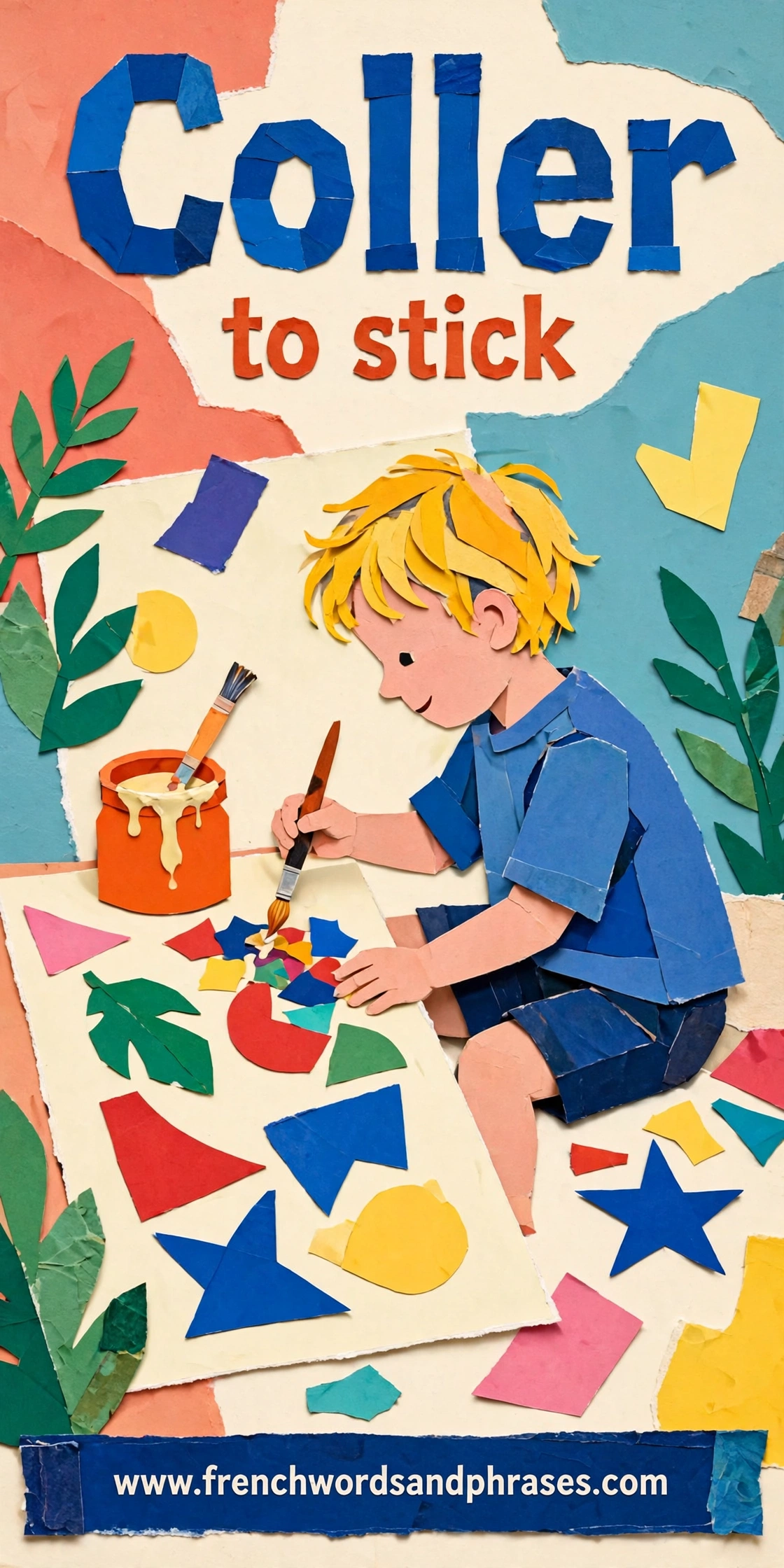
Coller means to stick — to glue things down, to cling tight, and, when everything fits, to say that it works: ça colle.
A poster going up on a city wall, a stamp settling into its album, two pages that will never come apart again — coller is the verb of glue and of sticking fast. But listen in a French schoolyard or office and you will hear its other lives: a plan that fits is a plan that colle, and a pupil in detention has been collé.
In this guide, you’ll learn how to conjugate coller in all the major French tenses and moods. Explore complete conjugation tables, French examples, English translations, and practice quizzes.
Understanding the French Verb Coller
Coller is a regular French verb belonging to the first group of verbs, those ending in-er.
It means to stick. Beyond the glue pot, coller à means to stick close to something — coller à la réalité, to stick to the facts; coller aux basques de quelqu’un, to stick to someone’s heels — and the adjective collant describes both tights and a person who will not leave you alone.
Verb classification: First group (-er)
Auxiliary verb: Avoir
Past participle: collé
Present participle: collant
English equivalents: To stick, to glue, to cling; coller une affiche — to stick up a poster; coller à la réalité — to stick to the facts; ça colle ! — that works, that fits; être collé — to be in detention, to fail (school); coller quelqu’un — to stump someone with a question.
One important detail: the spelling of coller never changes — je colle, nous collons, ils collent, past participle collé — the real trap is meaning, because this verb lives several lives. La colle is glue, and it is also a fiendish question: poser une colle is to stump someone, and tu me colles ! means you’ve got me, I can’t answer. At school, une colle is a detention, être collé is to be kept in — or to fail an exam — and coller un élève is to fail a pupil or give him detention. And when a plan fits your schedule perfectly, French shrugs happily: ça colle !
Experience the Word
Coller is the verb of things that hold — paper to a wall, a plan to a schedule, a pupil to his desk after hours.
Imagine the night before a village festival. A team of teenagers works its way down the main street with a bucket of paste and a stack of posters, collant each one straight and smooth — and by morning the whole street announces the fête in bright colours.
The posters will fade and peel by autumn. For one summer, they stuck — collées — and so did the festival in everyone’s memory.
How to Conjugate Coller: Complete French Conjugation Guide
Let’s explore every major conjugation of coller, beginning with the indicative mood.
How to Conjugate Coller in the Indicative Mood
The indicative mood is used to express facts, observations, actions, and events.
How to Conjugate Coller in the Present Tense (Présent)
Used for actions happening now, habitual actions, and general truths.
| Subject | Conjugation |
|---|---|
| je | colle |
| tu | colles |
| il / elle | colle |
| nous | collons |
| vous | collez |
| ils / elles | collent |
Example
Elle colle les photos dans un grand album.
She is sticking the photos into a big album.
Quick Quiz 1
Complete the sentence:
Nous ______ les affiches sur le mur.
Reveal the answer
collons
Nous collons les affiches sur le mur.
We are sticking the posters on the wall.
How to Conjugate Coller in the Passé Composé
Used for completed actions in the past. Coller takes the auxiliary verb avoir.
| Subject | Conjugation |
|---|---|
| j’ | ai collé |
| tu | as collé |
| il / elle | a collé |
| nous | avons collé |
| vous | avez collé |
| ils / elles | ont collé |
Example
Les enfants ont collé des étoiles sur la fenêtre.
The children stuck stars on the window.
How to Conjugate Coller in the Imparfait (Imperfect Tense)
Used for habitual past actions, descriptions, and ongoing situations in the past.
| Subject | Conjugation |
|---|---|
| je | collais |
| tu | collais |
| il / elle | collait |
| nous | collions |
| vous | colliez |
| ils / elles | collaient |
Example
Autrefois, on collait les affiches sur les murs de la ville.
In the old days, people used to stick posters on the city walls.
Quick Quiz 2
Choose the correct form:
She stuck the photo in the album.
Elle ______ la photo dans l’album. (a collé / est collée)
Reveal the answer
a collé
Elle a collé la photo dans l’album.
Coller takes avoir.
How to Conjugate Coller in the Plus-que-parfait
Used to describe an action that had already been completed before another past event.
| Subject | Conjugation |
|---|---|
| j’ | avais collé |
| tu | avais collé |
| il / elle | avait collé |
| nous | avions collé |
| vous | aviez collé |
| ils / elles | avaient collé |
Example
Il avait collé l’enveloppe avant de changer d’avis.
He had stuck down the envelope before changing his mind.
How to Conjugate Coller in the Passé Simple
Primarily used in formal writing, literature, and historical narratives. It is rarely used in everyday conversation.
| Subject | Conjugation |
|---|---|
| je | collai |
| tu | collas |
| il / elle | colla |
| nous | collâmes |
| vous | collâtes |
| ils / elles | collèrent |
Example
Elle colla la dernière photo et ferma l’album.
She stuck in the last photo and closed the album.
How to Conjugate Coller in the Passé Antérieur
A literary tense used to express an action completed immediately before another past action, generally in the passé simple.
| Subject | Conjugation |
|---|---|
| j’ | eus collé |
| tu | eus collé |
| il / elle | eut collé |
| nous | eûmes collé |
| vous | eûtes collé |
| ils / elles | eurent collé |
Example
Quand il eut collé toutes les affiches, la place était couverte.
When he had stuck up all the posters, the square was covered.
How to Conjugate Coller in the Future Tense (Futur Simple)
Used to describe actions that will take place in the future.
| Subject | Conjugation |
|---|---|
| je | collerai |
| tu | colleras |
| il / elle | collera |
| nous | collerons |
| vous | collerez |
| ils / elles | colleront |
Example
Demain, nous collerons les étiquettes sur les cartons.
Tomorrow, we will stick the labels on the boxes.
How to Conjugate Coller in the Futur Antérieur (Future Perfect)
Used for an action that will have been completed before a particular point in the future.
| Subject | Conjugation |
|---|---|
| j’ | aurai collé |
| tu | auras collé |
| il / elle | aura collé |
| nous | aurons collé |
| vous | aurez collé |
| ils / elles | auront collé |
Example
À midi, ils auront collé toutes les affiches du festival.
By noon, they will have stuck up all the festival posters.
How to Conjugate Coller in the Near Future (Futur Proche)
Used to describe something that is going to happen soon. Formed with aller + infinitive.
| Subject | Conjugation |
|---|---|
| je | vais coller |
| tu | vas coller |
| il / elle | va coller |
| nous | allons coller |
| vous | allez coller |
| ils / elles | vont coller |
Example
Attends, je vais coller l’affiche sur la porte.
Wait, I am going to stick the poster on the door.
How to Conjugate Coller in the Conditional Mood
The conditional mood expresses what would happen under certain circumstances. It is also frequently used to make polite requests or express wishes.
How to Conjugate Coller in the Present Conditional
| Subject | Conjugation |
|---|---|
| je | collerais |
| tu | collerais |
| il / elle | collerait |
| nous | collerions |
| vous | colleriez |
| ils / elles | colleraient |
Example
Avec une meilleure colle, le papier collerait tout seul.
With better glue, the paper would stick by itself.
How to Conjugate Coller in the Past Conditional
| Subject | Conjugation |
|---|---|
| j’ | aurais collé |
| tu | aurais collé |
| il / elle | aurait collé |
| nous | aurions collé |
| vous | auriez collé |
| ils / elles | auraient collé |
Example
Tu aurais collé l’affiche si tu avais eu de la colle.
You would have stuck up the poster if you had had some glue.
Coller in the Literary Past Conditional Form
This less common literary form uses the imperfect subjunctive of avoir.
| Subject | Conjugation |
|---|---|
| j’ | eusse collé |
| tu | eusses collé |
| il / elle | eût collé |
| nous | eussions collé |
| vous | eussiez collé |
| ils / elles | eussent collé |
Example
Il eût collé l’affiche lui-même sans ses élèves.
He would have stuck up the poster himself without his pupils.
How to Conjugate Coller in the Subjunctive Mood
The subjunctive is used to express wishes, emotions, doubts, necessity, and uncertainty. It frequently follows expressions such as il faut que (it is necessary that) or bien que (although).
How to Conjugate Coller in the Present Subjunctive
| Subject | Conjugation |
|---|---|
| que je | colle |
| que tu | colles |
| qu’il / qu’elle | colle |
| que nous | collions |
| que vous | colliez |
| qu’ils / qu’elles | collent |
Example
Il faut que ça colle du premier coup.
It has to stick first time.
Quick Quiz 3
Complete the sentence using the subjunctive:
Il faut que tu ______ l’affiche bien droite.
Reveal the answer
colles
Il faut que tu colles l’affiche bien droite.
You must stick the poster nice and straight.
How to Conjugate Coller in the Imperfect Subjunctive
A literary tense, rarely encountered in modern spoken French.
| Subject | Conjugation |
|---|---|
| que je | collasse |
| que tu | collasses |
| qu’il / qu’elle | collât |
| que nous | collassions |
| que vous | collassiez |
| qu’ils / qu’elles | collassent |
Example
Je ne pensais pas que ce papier collât au mur.
I did not think this paper would stick to the wall.
How to Conjugate Coller in the Pluperfect Subjunctive
A literary construction used to express an action completed before another past action.
| Subject | Conjugation |
|---|---|
| que j’ | eusse collé |
| que tu | eusses collé |
| qu’il / qu’elle | eût collé |
| que nous | eussions collé |
| que vous | eussiez collé |
| qu’ils / qu’elles | eussent collé |
Example
On vérifia qu’elle eût collé les deux moitiés proprement.
They checked that she had glued the two halves neatly.
How to Conjugate Coller in the Past Subjunctive
| Subject | Conjugation |
|---|---|
| que j’ | aie collé |
| que tu | aies collé |
| qu’il / qu’elle | ait collé |
| que nous | ayons collé |
| que vous | ayez collé |
| qu’ils / qu’elles | aient collé |
Example
Je suis content que tu aies collé la photo dans l’album.
I am glad you stuck the photo in the album.
How to Conjugate Coller in the Imperative
The imperative is used to give commands, instructions, invitations, or suggestions. Subject pronouns are omitted.
How to Conjugate Coller in the Present Imperative
| Person | Conjugation |
|---|---|
| (tu) | colle |
| (nous) | collons |
| (vous) | collez |
Example
Colle cette affiche bien droite !
Stick this poster nice and straight!
Quick Quiz 4
How would you say Stick the poster straight (tu form)?
Reveal the answer
Colle l’affiche bien droite !
French Participles of Coller
Participles are verb forms that can be used in compound tenses and other grammatical constructions.
Present Participle of Coller
collant
En collant les timbres, il pensait à son grand-père.
While sticking in the stamps, he thought of his grandfather.
Past Participle of Coller
collé
Collée au mur depuis dix ans, l’affiche avait jauni.
Stuck to the wall for ten years, the poster had yellowed.
Coller in Everyday French: Real-Life Examples
Now that you know the conjugations, let’s see how coller appears in everyday French.
Example 1 — Present
Elle colle les photos dans l’album.
She is sticking the photos into the album.
Example 2 — Passé composé
Les enfants ont collé des étoiles sur la fenêtre.
The children stuck stars on the window.
Example 3 — Imparfait
On collait les affiches sur les murs.
People used to stick posters on the walls.
Example 4 — Future
Nous collerons les étiquettes demain.
We will stick the labels tomorrow.
Example 5 — Conditional
Ça collerait parfaitement avec ton emploi du temps.
That would fit your schedule perfectly.
Example 6 — Imperative
Colle l’affiche bien droite !
Stick this poster nice and straight!
Beyond Translation: The Meaning of Coller
English stick is broader, but French coller has the glue built in — it comes from la colle, itself from Greek kolla, glue.
And then the word escaped the glue pot.
A question that sticks you is une colle, a detention sticks you to school, and a plan that sticks to your life is a plan that colle. Few verbs show better how French lets one sticky little word hold a whole school day together.
How to Remember the French Verb Coller
Remember it this way: Coller is about the bucket of paste, the posters, and the pupil stuck in detention.
- La colle is glue — and coller is what glue does: je colle, nous collons, past participle collé.
- Three bonus lives: ça colle ! (that works), être collé (in detention / failed), poser une colle (to stump someone).
- Coller à is to stick close: coller à la réalité, to stick to the facts.
The key idea is the bucket of paste, the posters, and the pupil stuck in detention.
Test Your Knowledge of Coller
Let’s see how much you’ve learned. Try answering these questions before revealing the answers.
Question 1
What does ça colle ! mean in everyday French?
Reveal the answer
That works / that fits / that’s fine by me — literally, it sticks.
Question 2
How do you say She is sticking the photos into the album in French?
Reveal the answer
Elle colle les photos dans l’album.
Question 3
Translate: The children stuck stars on the window.
Reveal the answer
Les enfants ont collé des étoiles sur la fenêtre.
Question 4
At school, what does être collé mean?
Reveal the answer
To be kept in detention — and in an exam, to be failed: le professeur m’a collé.
Question 5
Complete the sentence:
Il faut que ça ______ du premier coup.
Reveal the answer
colle
Il faut que ça colle du premier coup.
It has to stick first time.
Your Final Challenge
Can You Use It?
How would you say this in French?
She sticks the last photo into the album, and fifty years of memories fit between two pages.
Reveal the answer
Elle colle la dernière photo dans l’album, et cinquante ans de souvenirs tiennent entre deux pages.
She sticks the last photo into the album, and fifty years of memories fit between two pages.
A little French. A little curiosity. A richer everyday life.
LEARN FRENCH ONE WORD AT A TIME