
A French Word to Live By
How to Conjugate Se cailler in French
/sə ka.je/
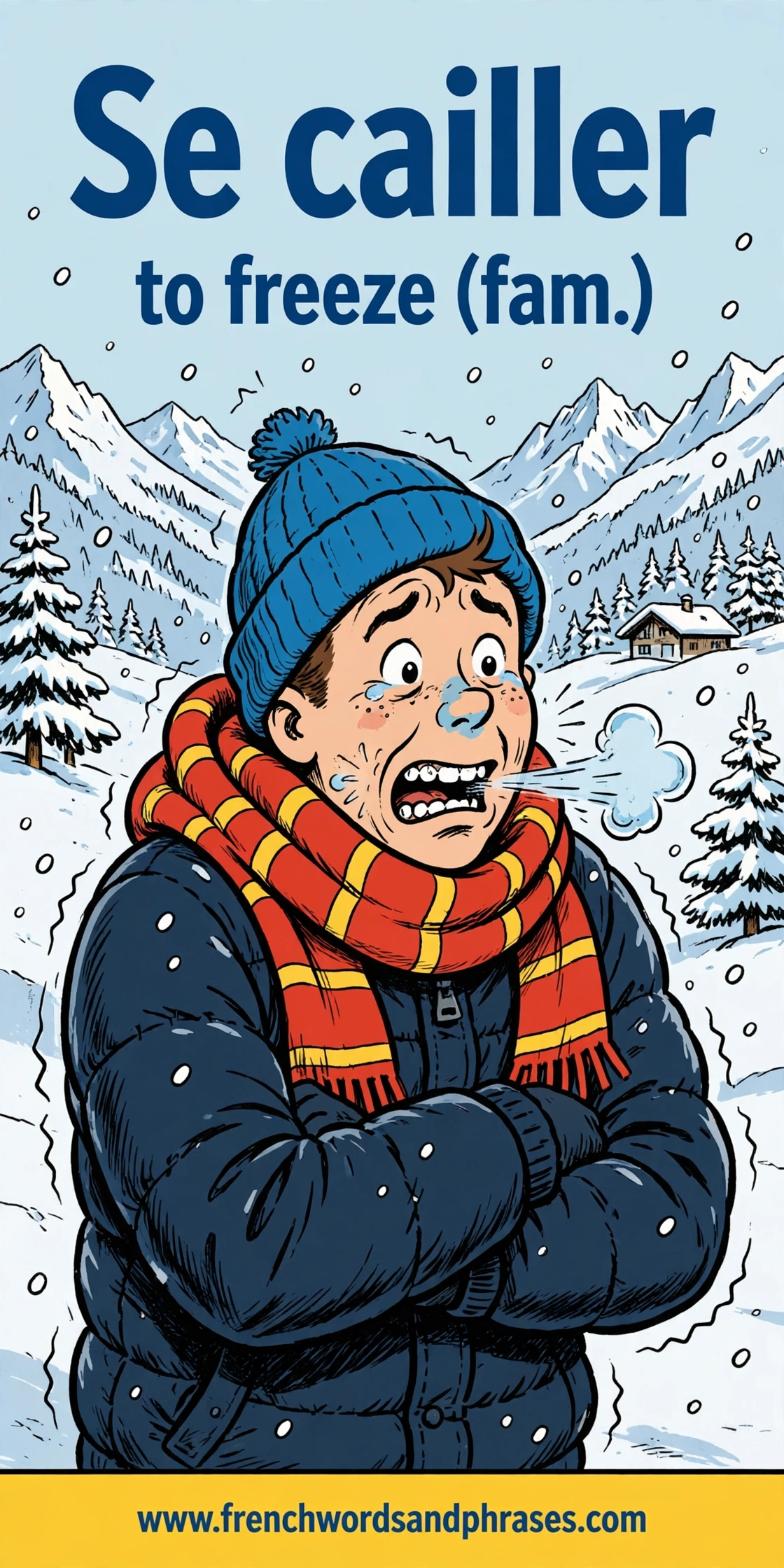
Se cailler means to freeze — in familiar French, to be so cold that you feel yourself setting solid, like milk turning to curd.
A January bus stop at dawn, fingers numb inside gloves, breath smoking in the air — se cailler is the shivering French of cold people: on se caille ! is what you say when the cold has got right through your coat.
In this guide, you’ll learn how to conjugate se cailler in all the major French tenses and moods. Explore complete conjugation tables, French examples, English translations, and practice quizzes.
Understanding the French Verb Se cailler
Se cailler is a regular French verb belonging to the first group of verbs, those ending in-er.
It means to freeze (fam.). It is the standard spoken way to complain about the cold — stronger and funnier than avoir froid, a notch below se geler in politeness and above it in colour. It belongs to bus stops, terraces in winter, badly heated classrooms and every football match played in January.
Verb classification: First group (-er), reflexive
Auxiliary verb: Être
Past participle: caillé
Present participle: caillant
English equivalents: To be freezing, to freeze solid (fam.); on se caille ! — we’re freezing!; se cailler les miches — to freeze one’s buns off (fam.); je me caille ici — I am freezing here; on s’est caillé toute la soirée — we froze all evening.
One important detail: se cailler is familier — the slangy offspring of cailler, to curdle. The picture is comic and exact: you are setting like milk in the cold, thickening into a shivering curd. Being reflexive, it takes être in every compound tense and the participle agrees: elle s’est caillée, nous nous sommes caillés. The classic exclamation needs no subject at all beyond on: on se caille ! — and the earthier se les cailler (les miches, les fesses understood) is best kept for friends. In the imperative it lives mostly in warnings: ne te caille pas dehors sans manteau ! — do not freeze outside without a coat.
Experience the Word
Se cailler is the verb of the bus stop at dawn — the whole body setting, like milk, into a cold and trembling curd.
Imagine a market square in the Vosges at seven on a January morning. The stallholders stamp their feet, blow on their fingers and call to each other across the frost: « On se caille aujourd’hui, hein ! » — and the café owner, taking pity, brings out a tray of hot coffee.
Nobody is in danger. They are simply freezing — caillés, cheerfully, the way French people have always frozen: out loud.
How to Conjugate Se cailler: Complete French Conjugation Guide
Let’s explore every major conjugation of se cailler, beginning with the indicative mood.
How to Conjugate Se cailler in the Indicative Mood
The indicative mood is used to express facts, observations, actions, and events.
How to Conjugate Se cailler in the Present Tense (Présent)
Used for actions happening now, habitual actions, and general truths.
| Subject | Conjugation |
|---|---|
| je | me caille |
| tu | te cailles |
| il / elle | se caille |
| nous | nous caillons |
| vous | vous caillez |
| ils / elles | se caillent |
Example
On se caille sur ce quai sans abri.
We are freezing on this shelterless platform.
Quick Quiz 1
Complete the sentence:
Nous nous ______ sur la terrasse en plein janvier.
Reveal the answer
caillons
Nous nous caillons sur la terrasse en plein janvier.
We are freezing on the terrace in the middle of January.
How to Conjugate Se cailler in the Passé Composé
Used for completed actions in the past. Se cailler takes the auxiliary verb être.
| Subject | Conjugation |
|---|---|
| je | me suis caillé / me suis caillée |
| tu | t’es caillé / t’es caillée |
| il / elle | s’est caillé / s’est caillée |
| nous | nous sommes caillés / nous sommes caillées |
| vous | vous êtes caillés / vous êtes caillées / vous êtes caillé / vous êtes caillée |
| ils / elles | se sont caillés / se sont caillées |
Example
Nous nous sommes caillés pendant tout le match.
We froze throughout the whole match.
How to Conjugate Se cailler in the Imparfait (Imperfect Tense)
Used for habitual past actions, descriptions, and ongoing situations in the past.
| Subject | Conjugation |
|---|---|
| je | me caillais |
| tu | te caillais |
| il / elle | se caillait |
| nous | nous caillions |
| vous | vous cailliez |
| ils / elles | se caillaient |
Example
Autrefois, on se caillait dans les salles de classe non chauffées.
In the old days, we used to freeze in unheated classrooms.
Quick Quiz 2
Choose the correct form:
She froze waiting for the bus.
Elle ______ à attendre le bus. (s’est caillée / a caillé)
Reveal the answer
s’est caillée
Elle s’est caillée à attendre le bus.
Se cailler is reflexive, takes être, and the participle agrees: caillée.
How to Conjugate Se cailler in the Plus-que-parfait
Used to describe an action that had already been completed before another past event.
| Subject | Conjugation |
|---|---|
| je | m’étais caillé / m’étais caillée |
| tu | t’étais caillé / t’étais caillée |
| il / elle | s’était caillé / s’était caillée |
| nous | nous étions caillés / nous étions caillées |
| vous | vous étiez caillés / vous étiez caillées / vous étiez caillé / vous étiez caillée |
| ils / elles | s’étaient caillés / s’étaient caillées |
Example
Elle s’était caillée à attendre le bus sous la neige.
She had frozen waiting for the bus in the snow.
How to Conjugate Se cailler in the Passé Simple
Primarily used in formal writing, literature, and historical narratives. It is rarely used in everyday conversation.
| Subject | Conjugation |
|---|---|
| je | me caillai |
| tu | te caillas |
| il / elle | se cailla |
| nous | nous caillâmes |
| vous | vous caillâtes |
| ils / elles | se caillèrent |
Example
Les spectateurs se caillèrent toute la soirée sur les gradins.
The spectators froze all evening in the stands.
How to Conjugate Se cailler in the Passé Antérieur
A literary tense used to express an action completed immediately before another past action, generally in the passé simple.
| Subject | Conjugation |
|---|---|
| je | me fus caillé / me fus caillée |
| tu | te fus caillé / te fus caillée |
| il / elle | se fut caillé / se fut caillée |
| nous | nous fûmes caillés / nous fûmes caillées |
| vous | vous fûtes caillés / vous fûtes caillées / vous fûtes caillé / vous fûtes caillée |
| ils / elles | se furent caillés / se furent caillées |
Example
Dès qu’ils se furent caillés une heure, ils rentrèrent au café.
As soon as they had frozen for an hour, they went back into the café.
How to Conjugate Se cailler in the Future Tense (Futur Simple)
Used to describe actions that will take place in the future.
| Subject | Conjugation |
|---|---|
| je | me caillerai |
| tu | te cailleras |
| il / elle | se caillera |
| nous | nous caillerons |
| vous | vous caillerez |
| ils / elles | se cailleront |
Example
Tu te cailleras si tu sors sans écharpe.
You will freeze if you go out without a scarf.
How to Conjugate Se cailler in the Futur Antérieur (Future Perfect)
Used for an action that will have been completed before a particular point in the future.
| Subject | Conjugation |
|---|---|
| je | me serai caillé / me serai caillée |
| tu | te seras caillé / te seras caillée |
| il / elle | se sera caillé / se sera caillée |
| nous | nous serons caillés / nous serons caillées |
| vous | vous serez caillés / vous serez caillées / vous serez caillé / vous serez caillée |
| ils / elles | se seront caillés / se seront caillées |
Example
À minuit, nous nous serons caillés assez pour mériter un chocolat chaud.
By midnight, we will have frozen enough to deserve a hot chocolate.
How to Conjugate Se cailler in the Near Future (Futur Proche)
Used to describe something that is going to happen soon. Formed with aller + infinitive.
| Subject | Conjugation |
|---|---|
| je | vais me cailler |
| tu | vas te cailler |
| il / elle | va se cailler |
| nous | allons nous cailler |
| vous | allez vous cailler |
| ils / elles | vont se cailler |
Example
On va se cailler sur la terrasse, rentrons !
We are going to freeze on the terrace, let us go in!
How to Conjugate Se cailler in the Conditional Mood
The conditional mood expresses what would happen under certain circumstances. It is also frequently used to make polite requests or express wishes.
How to Conjugate Se cailler in the Present Conditional
| Subject | Conjugation |
|---|---|
| je | me caillerais |
| tu | te caillerais |
| il / elle | se caillerait |
| nous | nous caillerions |
| vous | vous cailleriez |
| ils / elles | se cailleraient |
Example
Je me caillerais moins avec un vrai manteau d’hiver.
I would freeze less with a proper winter coat.
How to Conjugate Se cailler in the Past Conditional
| Subject | Conjugation |
|---|---|
| je | me serais caillé / me serais caillée |
| tu | te serais caillé / te serais caillée |
| il / elle | se serait caillé / se serait caillée |
| nous | nous serions caillés / nous serions caillées |
| vous | vous seriez caillés / vous seriez caillées / vous seriez caillé / vous seriez caillée |
| ils / elles | se seraient caillés / se seraient caillées |
Example
Elle se serait moins caillée avec des gants.
She would have frozen less with gloves.
Se cailler in the Literary Past Conditional Form
This less common literary form uses the imperfect subjunctive of être.
| Subject | Conjugation |
|---|---|
| je | me fusse caillé / me fusse caillée |
| tu | te fusses caillé / te fusses caillée |
| il / elle | se fût caillé / se fût caillée |
| nous | nous fussions caillés / nous fussions caillées |
| vous | vous fussiez caillés / vous fussiez caillées / vous fussiez caillé / vous fussiez caillée |
| ils / elles | se fussent caillés / se fussent caillées |
Example
Les soldats se fussent caillés sans leurs capotes de laine.
The soldiers would have frozen without their woollen greatcoats.
How to Conjugate Se cailler in the Subjunctive Mood
The subjunctive is used to express wishes, emotions, doubts, necessity, and uncertainty. It frequently follows expressions such as il faut que (it is necessary that) or bien que (although).
How to Conjugate Se cailler in the Present Subjunctive
| Subject | Conjugation |
|---|---|
| que je | me caille |
| que tu | te cailles |
| qu’il / qu’elle | se caille |
| que nous | nous caillions |
| que vous | vous cailliez |
| qu’ils / qu’elles | se caillent |
Example
Je ne veux pas que les enfants se caillent dehors.
I do not want the children freezing outside.
Quick Quiz 3
Complete the sentence using the subjunctive:
Je ne veux pas que tu te ______ dehors sans manteau.
Reveal the answer
cailles
Je ne veux pas que tu te cailles dehors sans manteau.
I do not want you freezing outside without a coat.
How to Conjugate Se cailler in the Imperfect Subjunctive
A literary tense, rarely encountered in modern spoken French.
| Subject | Conjugation |
|---|---|
| que je | me caillasse |
| que tu | te caillasses |
| qu’il / qu’elle | se caillât |
| que nous | nous caillassions |
| que vous | vous caillassiez |
| qu’ils / qu’elles | se caillassent |
Example
Il craignait que sa grand-mère se caillât sur le marché.
He feared his grandmother might freeze at the market.
How to Conjugate Se cailler in the Pluperfect Subjunctive
A literary construction used to express an action completed before another past action.
| Subject | Conjugation |
|---|---|
| que je | me fusse caillé / me fusse caillée |
| que tu | te fusses caillé / te fusses caillée |
| qu’il / qu’elle | se fût caillé / se fût caillée |
| que nous | nous fussions caillés / nous fussions caillées |
| que vous | vous fussiez caillés / vous fussiez caillées / vous fussiez caillé / vous fussiez caillée |
| ils / elles | se fussent caillés / se fussent caillées |
Example
On racontait que les spectateurs se fussent caillés jusqu’aux os.
People said the spectators had frozen to the bone.
How to Conjugate Se cailler in the Past Subjunctive
| Subject | Conjugation |
|---|---|
| que je | me sois caillé / me sois caillée |
| que tu | te sois caillé / te sois caillée |
| qu’il / qu’elle | se soit caillé / se soit caillée |
| que nous | nous soyons caillés / nous soyons caillées |
| que vous | vous soyez caillés / vous soyez caillées / vous soyez caillé / vous soyez caillée |
| qu’ils / qu’elles | se soient caillés / se soient caillées |
Example
Je suis étonné qu’il se soit caillé sans se plaindre.
I am amazed he froze without complaining.
How to Conjugate Se cailler in the Imperative
The imperative is used to give commands, instructions, invitations, or suggestions. Subject pronouns are omitted.
How to Conjugate Se cailler in the Present Imperative
| Person | Conjugation |
|---|---|
| (tu) | caille-toi |
| (nous) | caillons-nous |
| (vous) | caillez-vous |
Example
Ne te caille pas dehors, entre te réchauffer !
Do not freeze outside, come in and warm up!
Quick Quiz 4
How would you say Do not freeze outside, come in (tu form)?
Reveal the answer
Ne te caille pas dehors, entre !
French Participles of Se cailler
Participles are verb forms that can be used in compound tenses and other grammatical constructions.
Present Participle of Se cailler
caillant
En se caillant sur le quai, ils tapaient des pieds pour se réchauffer.
Freezing on the platform, they stamped their feet to warm up.
Past Participle of Se cailler
caillé
Caillés par le vent du nord, les promeneurs rentrèrent tôt.
Frozen by the north wind, the walkers went home early.
Se cailler in Everyday French: Real-Life Examples
Now that you know the conjugations, let’s see how se cailler appears in everyday French.
Example 1 — Present
On se caille sur ce quai !
We are freezing on this platform!
Example 2 — Passé composé
Nous nous sommes caillés pendant le match.
We froze during the match.
Example 3 — Imparfait
On se caillait dans les classes non chauffées.
We used to freeze in unheated classrooms.
Example 4 — Future
Tu te cailleras sans ton écharpe.
You will freeze without your scarf.
Example 5 — Conditional
Je me caillerais moins avec des gants.
I would freeze less with gloves.
Example 6 — Imperative
Ne te caille pas dehors, entre !
Do not freeze outside, come in!
Beyond Translation: The Meaning of Se cailler
English says I am freezing and thinks of ice; French se cailler thinks of the dairy — you are curdling with cold, setting solid like milk in the vat.
It is cailler, the curdle verb, gone out in the snow.
That is why it makes people smile even as they shiver: on se caille turns a complaint into a small joke, and a French January into something almost edible.
How to Remember the French Verb Se cailler
Remember it this way: Se cailler is about the curd in the cold — a body setting solid like milk in winter.
- Picture milk setting in the cold vat: se cailler is to set solid with cold.
- Reflexive, so être and agreement: elle s’est caillée, nous nous sommes caillés.
- The classic shout needs just three words: on se caille ! — we’re freezing!
The key idea is the curd in the cold — a body setting solid like milk in winter.
Test Your Knowledge of Se cailler
Let’s see how much you’ve learned. Try answering these questions before revealing the answers.
Question 1
Why does se cailler use être in compound tenses?
Reveal the answer
Because it is reflexive — nous nous sommes caillés, and the participle agrees.
Question 2
How do you say We are freezing here in familiar French?
Reveal the answer
On se caille ici !
Question 3
Translate: We froze throughout the whole match.
Reveal the answer
Nous nous sommes caillés pendant tout le match.
Question 4
What is the past participle of se cailler?
Reveal the answer
Caillé — agreeing: caillée, caillés, caillées.
Question 5
Complete the sentence:
Je ne veux pas que les enfants se ______ dehors.
Reveal the answer
caillent
Je ne veux pas que les enfants se caillent dehors.
I do not want the children freezing outside.
Your Final Challenge
Can You Use It?
How would you say this in French?
On the deserted platform, we are freezing as we wait for the train, but the station café is not far away.
Reveal the answer
Sur le quai désert, on se caille en attendant le train, mais le café de la gare n’est pas loin.
On the deserted platform, we are freezing as we wait for the train, but the station café is not far away.
A little French. A little curiosity. A richer everyday life.
LEARN FRENCH ONE WORD AT A TIME




