
A French Word to Live By
How to Conjugate Cailleter in French
/kaj.te/
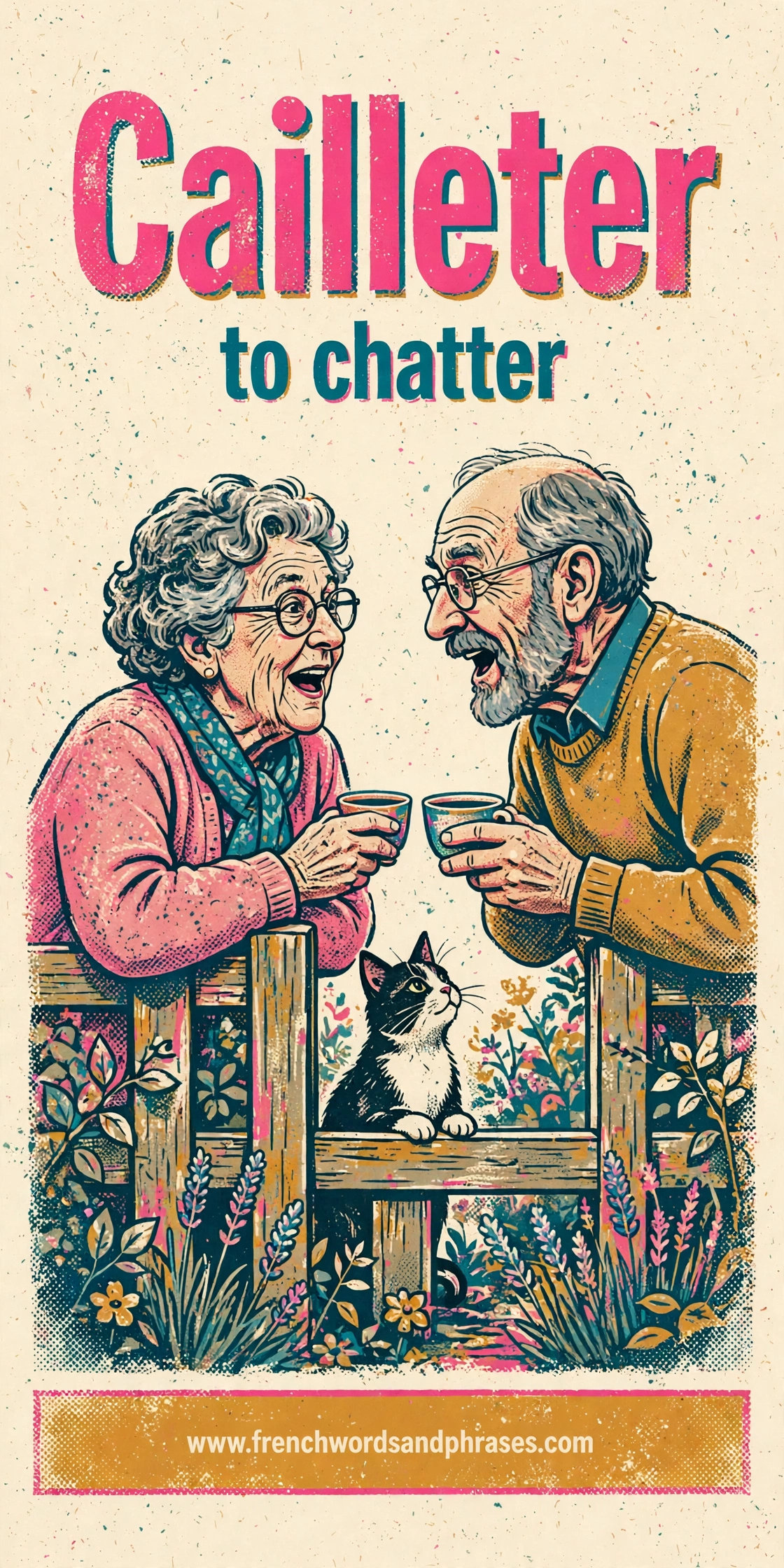
Cailleter means to chatter — to keep up an endless stream of light, empty talk, the way a cage of little birds fills a room with noise.
Two neighbours over the garden fence, a hairdresser’s salon at full hum, old friends who have not met for a year and cannot stop — cailleter is the old, familiar verb of cheerful, ceaseless chattering, more noise than news.
In this guide, you’ll learn how to conjugate cailleter in all the major French tenses and moods. Explore complete conjugation tables, French examples, English translations, and practice quizzes.
Understanding the French Verb Cailleter
Cailleter is a regular French verb belonging to the first group of verbs, those ending in-er.
It means to chatter. It is intransitive — one caillette, pure and simple, or caillette about the neighbours. The tone is teasing rather than cruel: cailleter is empty, happy noise, closer to prattling than to malicious gossip, and it paints the speakers as birds — the caillette was also a little bird, and magpies are never far away.
Verb classification: First group (-er)
Auxiliary verb: Avoir
Past participle: cailleté
Present participle: cailletant
English equivalents: To chatter, to prattle, to gossip idly; cailleter à longueur de journée — to chatter all day long; cailleter comme une pie — to chatter like a magpie; elles caillettent sur le pas de la porte — they gossip away on the doorstep; une vraie caillette — a real chatterbox.
One important detail: cailleter conjugates like jeter — the t doubles before a mute e. So in the present singular and third plural, the subjunctive and the tu imperative you write je caillette, tu caillettes, elles caillettent, caillette ! — and the doubling runs right through the future and conditional stems: je cailletterai, je cailletterais. But where the ending is sounded, the single t stays: nous cailletons, vous cailletez, je cailletais, past participle cailleté. The Académie calls the verb vieilli et familier — old-fashioned and informal: it chatters away about idle talk, and its noun une caillette is a chatterbox. (Since the 1990 spelling reform, je caillète with a grave accent is also accepted; the tables here keep the traditional doubled t.)
Experience the Word
Cailleter is the verb of the doorstep at dusk — talk that goes nowhere, and is all the better for it.
Imagine a Provençal village square in the hour before dinner. Three grandmothers have met by the fountain ‘for two minutes’ — and une heure plus tard, elles caillettent toujours, passing from the mayor’s roof to the baker’s daughter and back again, while the soup at home waits, patient and unwatched.
Nothing of importance has been said. They have simply chattered — cailleté, gloriously, as grandmothers have since the world began.
How to Conjugate Cailleter: Complete French Conjugation Guide
Let’s explore every major conjugation of cailleter, beginning with the indicative mood.
How to Conjugate Cailleter in the Indicative Mood
The indicative mood is used to express facts, observations, actions, and events.
How to Conjugate Cailleter in the Present Tense (Présent)
Used for actions happening now, habitual actions, and general truths.
| Subject | Conjugation |
|---|---|
| je | caillette |
| tu | caillettes |
| il / elle | caillette |
| nous | cailletons |
| vous | cailletez |
| ils / elles | caillettent |
Example
Les voisines caillettent sur le pas de la porte.
The neighbours chatter away on the doorstep.
Quick Quiz 1
Complete the sentence:
Nous ______ avec la voisine depuis une heure.
Reveal the answer
cailletons
Nous cailletons avec la voisine depuis une heure.
We have been chattering with the neighbour for an hour — single t before the sounded ending.
How to Conjugate Cailleter in the Passé Composé
Used for completed actions in the past. Cailleter takes the auxiliary verb avoir.
| Subject | Conjugation |
|---|---|
| j’ | ai cailleté |
| tu | as cailleté |
| il / elle | a cailleté |
| nous | avons cailleté |
| vous | avez cailleté |
| ils / elles | ont cailleté |
Example
Elles ont cailleté pendant tout l’après-midi.
They chattered all afternoon.
How to Conjugate Cailleter in the Imparfait (Imperfect Tense)
Used for habitual past actions, descriptions, and ongoing situations in the past.
| Subject | Conjugation |
|---|---|
| je | cailletais |
| tu | cailletais |
| il / elle | cailletait |
| nous | cailletions |
| vous | cailletiez |
| ils / elles | cailletaient |
Example
Ma grand-mère cailletait avec ses amies dès le matin.
My grandmother would chatter with her friends from early morning.
Quick Quiz 2
Choose the correct form:
They chattered all afternoon.
Elles ______ tout l’après-midi. (ont cailleté / sont cailletées)
Reveal the answer
ont cailleté
Elles ont cailleté tout l’après-midi.
Cailleter takes avoir.
How to Conjugate Cailleter in the Plus-que-parfait
Used to describe an action that had already been completed before another past event.
| Subject | Conjugation |
|---|---|
| j’ | avais cailleté |
| tu | avais cailleté |
| il / elle | avait cailleté |
| nous | avions cailleté |
| vous | aviez cailleté |
| ils / elles | avaient cailleté |
Example
Elles avaient cailleté si longtemps que le repas avait brûlé.
They had chattered so long that the meal had burnt.
How to Conjugate Cailleter in the Passé Simple
Primarily used in formal writing, literature, and historical narratives. It is rarely used in everyday conversation.
| Subject | Conjugation |
|---|---|
| je | cailletai |
| tu | cailletas |
| il / elle | cailleta |
| nous | cailletâmes |
| vous | cailletâtes |
| ils / elles | cailletèrent |
Example
Les commères cailletèrent jusqu’à la tombée de la nuit.
The gossips chattered until nightfall.
How to Conjugate Cailleter in the Passé Antérieur
A literary tense used to express an action completed immediately before another past action, generally in the passé simple.
| Subject | Conjugation |
|---|---|
| j’ | eus cailleté |
| tu | eus cailleté |
| il / elle | eut cailleté |
| nous | eûmes cailleté |
| vous | eûtes cailleté |
| ils / elles | eurent cailleté |
Example
Quand elles eurent cailleté une heure, elles rentrèrent enfin.
When they had chattered for an hour, they finally went home.
How to Conjugate Cailleter in the Future Tense (Futur Simple)
Used to describe actions that will take place in the future.
| Subject | Conjugation |
|---|---|
| je | cailletterai |
| tu | cailletteras |
| il / elle | caillettera |
| nous | cailletterons |
| vous | cailletterez |
| ils / elles | cailletteront |
Example
Demain, elles cailletteront encore devant la fontaine.
Tomorrow, they will be chattering again by the fountain.
How to Conjugate Cailleter in the Futur Antérieur (Future Perfect)
Used for an action that will have been completed before a particular point in the future.
| Subject | Conjugation |
|---|---|
| j’ | aurai cailleté |
| tu | auras cailleté |
| il / elle | aura cailleté |
| nous | aurons cailleté |
| vous | aurez cailleté |
| ils / elles | auront cailleté |
Example
À midi, elles auront cailleté sur tout le village.
By midday, they will have chattered about the whole village.
How to Conjugate Cailleter in the Near Future (Futur Proche)
Used to describe something that is going to happen soon. Formed with aller + infinitive.
| Subject | Conjugation |
|---|---|
| je | vais cailleter |
| tu | vas cailleter |
| il / elle | va cailleter |
| nous | allons cailleter |
| vous | allez cailleter |
| ils / elles | vont cailleter |
Example
Attention, la petite va cailleter comme sa grand-mère.
Watch out, the little one is going to chatter like her grandmother.
How to Conjugate Cailleter in the Conditional Mood
The conditional mood expresses what would happen under certain circumstances. It is also frequently used to make polite requests or express wishes.
How to Conjugate Cailleter in the Present Conditional
| Subject | Conjugation |
|---|---|
| je | cailletterais |
| tu | cailletterais |
| il / elle | cailletterait |
| nous | cailletterions |
| vous | cailletteriez |
| ils / elles | cailletteraient |
Example
Sans le téléphone, elles cailletteraient sur la place du village.
Without the telephone, they would chatter in the village square.
How to Conjugate Cailleter in the Past Conditional
| Subject | Conjugation |
|---|---|
| j’ | aurais cailleté |
| tu | aurais cailleté |
| il / elle | aurait cailleté |
| nous | aurions cailleté |
| vous | auriez cailleté |
| ils / elles | auraient cailleté |
Example
Elles auraient cailleté jusqu’au soir sans la pluie.
They would have chattered until evening if not for the rain.
Cailleter in the Literary Past Conditional Form
This less common literary form uses the imperfect subjunctive of avoir.
| Subject | Conjugation |
|---|---|
| j’ | eusse cailleté |
| tu | eusses cailleté |
| il / elle | eût cailleté |
| nous | eussions cailleté |
| vous | eussiez cailleté |
| ils / elles | eussent cailleté |
Example
Les commères eussent cailleté jusqu’à la nuit close.
The gossips would have chattered until full dark.
How to Conjugate Cailleter in the Subjunctive Mood
The subjunctive is used to express wishes, emotions, doubts, necessity, and uncertainty. It frequently follows expressions such as il faut que (it is necessary that) or bien que (although).
How to Conjugate Cailleter in the Present Subjunctive
| Subject | Conjugation |
|---|---|
| que je | caillette |
| que tu | caillettes |
| qu’il / qu’elle | caillette |
| que nous | cailletions |
| que vous | cailletiez |
| qu’ils / qu’elles | caillettent |
Example
Il est impossible qu’elles caillettent déjà à cette heure.
It is impossible that they are chattering already at this hour.
Quick Quiz 3
Complete the sentence using the subjunctive:
Il est impossible qu’elles ______ pendant le sermon.
Reveal the answer
caillettent
Il est impossible qu’elles caillettent pendant le sermon.
It is impossible that they chatter during the sermon — note the doubled t.
How to Conjugate Cailleter in the Imperfect Subjunctive
A literary tense, rarely encountered in modern spoken French.
| Subject | Conjugation |
|---|---|
| que je | cailletasse |
| que tu | cailletasses |
| qu’il / qu’elle | cailletât |
| que nous | cailletassions |
| que vous | cailletassiez |
| qu’ils / qu’elles | cailletassent |
Example
Je doutais qu’elle cailletât pendant le sermon.
I doubted she would chatter during the sermon.
How to Conjugate Cailleter in the Pluperfect Subjunctive
A literary construction used to express an action completed before another past action.
| Subject | Conjugation |
|---|---|
| que j’ | eusse cailleté |
| que tu | eusses cailleté |
| qu’il / qu’elle | eût cailleté |
| que nous | eussions cailleté |
| que vous | eussiez cailleté |
| qu’ils / qu’elles | eussent cailleté |
Example
On disait qu’elles eussent cailleté toute la matinée.
People said they had chattered all morning.
How to Conjugate Cailleter in the Past Subjunctive
| Subject | Conjugation |
|---|---|
| que j’ | aie cailleté |
| que tu | aies cailleté |
| qu’il / qu’elle | ait cailleté |
| que nous | ayons cailleté |
| que vous | ayez cailleté |
| qu’ils / qu’elles | aient cailleté |
Example
Je suis étonné qu’elles aient cailleté si longtemps.
I am surprised they chattered for so long.
How to Conjugate Cailleter in the Imperative
The imperative is used to give commands, instructions, invitations, or suggestions. Subject pronouns are omitted.
How to Conjugate Cailleter in the Present Imperative
| Person | Conjugation |
|---|---|
| (tu) | caillette |
| (nous) | cailletons |
| (vous) | cailletez |
Example
Caillette moins fort, le bébé dort !
Chatter more quietly, the baby is asleep!
Quick Quiz 4
How would you say Chatter more quietly (tu form)?
Reveal the answer
Caillette moins fort !
French Participles of Cailleter
Participles are verb forms that can be used in compound tenses and other grammatical constructions.
Present Participle of Cailleter
cailletant
En cailletant sans arrêt, elle a oublié l’heure du train.
Chattering non-stop, she forgot the time of the train.
Past Participle of Cailleter
cailleté
Cailleté entre amies, le secret n’en est déjà plus un.
Chattered between friends, the secret is already no longer one.
Cailleter in Everyday French: Real-Life Examples
Now that you know the conjugations, let’s see how cailleter appears in everyday French.
Example 1 — Present
Les voisines caillettent sur la porte.
The neighbours chatter on the doorstep.
Example 2 — Passé composé
Elles ont cailleté tout l’après-midi.
They chattered all afternoon.
Example 3 — Imparfait
Ma grand-mère cailletait dès le matin.
My grandmother would chatter from early morning.
Example 4 — Future
Elles cailletteront encore demain.
They will chatter again tomorrow.
Example 5 — Conditional
Elles cailletteraient sur la place sans le téléphone.
They would chatter in the square without the telephone.
Example 6 — Imperative
Caillette moins fort, le bébé dort !
Chatter more quietly, the baby is asleep!
Beyond Translation: The Meaning of Cailleter
English chatter is the sound twin, but French cailleter adds the birds: a caillette is a little chattering bird, and a chatterbox of a person at the same time.
To cailleter is to sing the magpie’s song.
The verb is old-fashioned now — the Académie labels it vieilli — but that is part of its charm: it belongs to doorsteps, fountains and grandmothers, to a France where the day’s news travelled by voice, at walking pace, with commentary.
How to Remember the French Verb Cailleter
Remember it this way: Cailleter is about magpies on the doorstep — talk, talk, talk, all day long.
- Like jeter, the t doubles before a mute e: je caillette, elles caillettent, je cailletterai.
- Nous and vous keep the single t: nous cailletons, vous cailletez.
- Une caillette is a chatterbox — cailleter is what a caillette does all day.
The key idea is magpies on the doorstep — talk, talk, talk, all day long.
Test Your Knowledge of Cailleter
Let’s see how much you’ve learned. Try answering these questions before revealing the answers.
Question 1
Why does je caillette have two t’s but nous cailletons only one?
Reveal the answer
The t doubles before a mute e, like jeter — je caillette, elles caillettent — but the sounded endings keep one t: nous cailletons.
Question 2
How do you say The neighbours chatter on the doorstep in French?
Reveal the answer
Les voisines caillettent sur le pas de la porte.
Question 3
Translate: They chattered all afternoon.
Reveal the answer
Elles ont cailleté pendant tout l’après-midi.
Question 4
What is the past participle of cailleter?
Reveal the answer
Cailleté — with a single t: the doubling only happens before a mute e.
Question 5
Complete the sentence:
Il est impossible qu’elles ______ déjà à cette heure.
Reveal the answer
caillettent
Il est impossible qu’elles caillettent déjà à cette heure.
It is impossible that they are chattering already at this hour.
Your Final Challenge
Can You Use It?
How would you say this in French?
On the doorstep, the neighbours are still chattering, and the whole village passes through their sentences.
Reveal the answer
Sur le pas de la porte, les voisines caillettent encore, et le village entier passe dans leurs phrases.
On the doorstep, the neighbours are still chattering, and the whole village passes through their sentences.
A little French. A little curiosity. A richer everyday life.
LEARN FRENCH ONE WORD AT A TIME




