A French Word to Live By
How to Conjugate Se borner in French
/sə bɔʁ.ne/
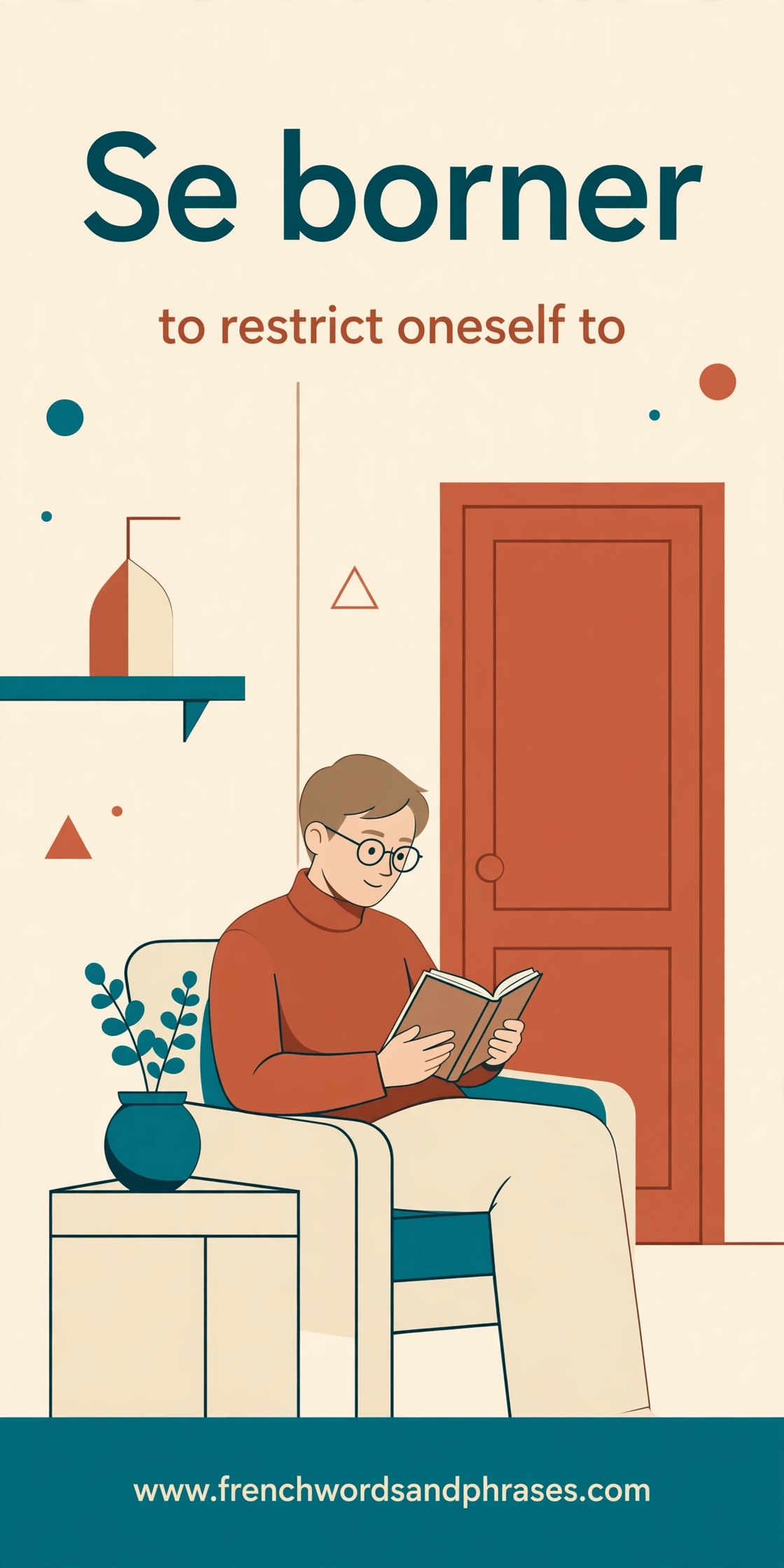
Se borner means to restrict oneself to — to draw one’s own boundary, plant one’s own stones, and stay inside them, doing no more than that.
A minister who answers a scandal with one dry sentence, a guest who takes one glass and no more, a speaker who promises to be brief — se borner is the verb of self-imposed limits: the boundary stone planted not in a field, but in one’s own behaviour.
In this guide, you’ll learn how to conjugate se borner in all the major French tenses and moods. Explore complete conjugation tables, French examples, English translations, and practice quizzes.
Understanding the French Verb Se borner
Se borner is a regular French verb belonging to the first group of verbs, those ending in-er.
It means to restrict oneself to. It is the diplomat’s and the minimalist’s verb: in speeches, letters and interviews, je me bornerai à… announces a deliberate restraint — though French audiences know the speaker who se borne à trois remarques may well make twelve.
Verb classification: First group (-er), reflexive
Auxiliary verb: Être
Past participle: borné
Present participle: bornant
English equivalents: To limit oneself to, to confine oneself to, to content oneself with; se borner à + infinitive — to limit oneself to doing; se borner à l’essentiel — to stick to the essentials; il s’est borné à sourire — he merely smiled; je me bornerai à dire que… — I shall simply say that…
One important detail: se borner is always followed by à — se borner à écouter, se borner à l’essentiel — never by de. It is reflexive, so compound tenses take être and the participle agrees: elle s’est bornée à un mot, ils se sont bornés à regarder. Very often it carries a quiet shrug of understatement: il s’est borné à répondre que… means he simply replied that…, and said not one word more. The tu imperative tucks the pronoun behind the verb: borne-toi aux faits !
Experience the Word
Se borner is borner turned inward — the stones are the same, but the field they fence is your own conduct.
Imagine a press conference after a difficult week. The journalists shout their questions; the minister rises, adjusts the microphone, and se borne à une phrase: « Le gouvernement travaille. » Then he sits down. The silence that follows says everything the sentence did not.
He could have explained, accused, promised. He confined himself — il s’est borné à une phrase, and the boundary held.
How to Conjugate Se borner: Complete French Conjugation Guide
Let’s explore every major conjugation of se borner, beginning with the indicative mood.
How to Conjugate Se borner in the Indicative Mood
The indicative mood is used to express facts, observations, actions, and events.
How to Conjugate Se borner in the Present Tense (Présent)
Used for actions happening now, habitual actions, and general truths.
| Subject | Conjugation |
|---|---|
| je | me borne |
| tu | te bornes |
| il / elle | se borne |
| nous | nous bornons |
| vous | vous bornez |
| ils / elles | se bornent |
Example
Elle se borne à répondre par oui ou par non.
She limits herself to answering yes or no.
Quick Quiz 1
Complete the sentence:
Nous nous ______ à l’essentiel.
Reveal the answer
bornons
Nous nous bornons à l’essentiel.
We confine ourselves to the essentials.
How to Conjugate Se borner in the Passé Composé
Used for completed actions in the past. Se borner takes the auxiliary verb être.
| Subject | Conjugation |
|---|---|
| je | me suis borné / me suis bornée |
| tu | t’es borné / t’es bornée |
| il / elle | s’est borné / s’est bornée |
| nous | nous sommes bornés / nous sommes bornées |
| vous | vous êtes bornés / vous êtes bornées / vous êtes borné / vous êtes bornée |
| ils / elles | se sont bornés / se sont bornées |
Example
Il s’est borné à sourire sans rien dire.
He confined himself to smiling without saying a word.
How to Conjugate Se borner in the Imparfait (Imperfect Tense)
Used for habitual past actions, descriptions, and ongoing situations in the past.
| Subject | Conjugation |
|---|---|
| je | me bornais |
| tu | te bornais |
| il / elle | se bornait |
| nous | nous bornions |
| vous | vous borniez |
| ils / elles | se bornaient |
Example
Je me bornais à écouter, sans donner mon avis.
I used to limit myself to listening, without giving my opinion.
Quick Quiz 2
Choose the correct form:
He confined himself to smiling.
Il ______ à sourire. (s’est borné / a borné)
Reveal the answer
s’est borné
Il s’est borné à sourire.
Se borner is reflexive and takes être.
How to Conjugate Se borner in the Plus-que-parfait
Used to describe an action that had already been completed before another past event.
| Subject | Conjugation |
|---|---|
| je | m’étais borné / m’étais bornée |
| tu | t’étais borné / t’étais bornée |
| il / elle | s’était borné / s’était bornée |
| nous | nous étions bornés / nous étions bornées |
| vous | vous étiez bornés / vous étiez bornées / vous étiez borné / vous étiez bornée |
| ils / elles | s’étaient bornés / s’étaient bornées |
Example
Ils s’étaient bornés à signer le registre.
They had merely signed the register.
How to Conjugate Se borner in the Passé Simple
Primarily used in formal writing, literature, and historical narratives. It is rarely used in everyday conversation.
| Subject | Conjugation |
|---|---|
| je | me bornai |
| tu | te bornas |
| il / elle | se borna |
| nous | nous bornâmes |
| vous | vous bornâtes |
| ils / elles | se bornèrent |
Example
Le ministre se borna à une courte déclaration.
The minister confined himself to a brief statement.
How to Conjugate Se borner in the Passé Antérieur
A literary tense used to express an action completed immediately before another past action, generally in the passé simple.
| Subject | Conjugation |
|---|---|
| je | me fus borné / me fus bornée |
| tu | te fus borné / te fus bornée |
| il / elle | se fut borné / se fut bornée |
| nous | nous fûmes bornés / nous fûmes bornées |
| vous | vous fûtes bornés / vous fûtes bornées / vous fûtes borné / vous fûtes bornée |
| ils / elles | se furent bornés / se furent bornées |
Example
Quand il se fut borné à saluer, tout le monde comprit.
When he had merely bowed, everyone understood.
How to Conjugate Se borner in the Future Tense (Futur Simple)
Used to describe actions that will take place in the future.
| Subject | Conjugation |
|---|---|
| je | me bornerai |
| tu | te borneras |
| il / elle | se bornera |
| nous | nous bornerons |
| vous | vous bornerez |
| ils / elles | se borneront |
Example
Nous nous bornerons à l’essentiel.
We shall confine ourselves to the essentials.
How to Conjugate Se borner in the Futur Antérieur (Future Perfect)
Used for an action that will have been completed before a particular point in the future.
| Subject | Conjugation |
|---|---|
| je | me serai borné / me serai bornée |
| tu | te seras borné / te seras bornée |
| il / elle | se sera borné / se sera bornée |
| nous | nous serons bornés / nous serons bornées |
| vous | vous serez bornés / vous serez bornées / vous serez borné / vous serez bornée |
| ils / elles | se seront bornés / se seront bornées |
Example
À la fin, tu te seras borné à trois remarques.
In the end, you will have limited yourself to three remarks.
How to Conjugate Se borner in the Near Future (Futur Proche)
Used to describe something that is going to happen soon. Formed with aller + infinitive.
| Subject | Conjugation |
|---|---|
| je | vais me borner |
| tu | vas te borner |
| il / elle | va se borner |
| nous | allons nous borner |
| vous | allez vous borner |
| ils / elles | vont se borner |
Example
Je vais me borner à écouter, promis.
I am going to limit myself to listening, I promise.
How to Conjugate Se borner in the Conditional Mood
The conditional mood expresses what would happen under certain circumstances. It is also frequently used to make polite requests or express wishes.
How to Conjugate Se borner in the Present Conditional
| Subject | Conjugation |
|---|---|
| je | me bornerais |
| tu | te bornerais |
| il / elle | se bornerait |
| nous | nous bornerions |
| vous | vous borneriez |
| ils / elles | se borneraient |
Example
À ta place, je me bornerais à remercier.
In your place, I would confine myself to saying thank you.
How to Conjugate Se borner in the Past Conditional
| Subject | Conjugation |
|---|---|
| je | me serais borné / me serais bornée |
| tu | te serais borné / te serais bornée |
| il / elle | se serait borné / se serait bornée |
| nous | nous serions bornés / nous serions bornées |
| vous | vous seriez bornés / vous seriez bornées / vous seriez borné / vous seriez bornée |
| ils / elles | se seraient bornés / se seraient bornées |
Example
Elle se serait bornée à hocher la tête.
She would have merely nodded.
Se borner in the Literary Past Conditional Form
This less common literary form uses the imperfect subjunctive of être.
| Subject | Conjugation |
|---|---|
| je | me fusse borné / me fusse bornée |
| tu | te fusses borné / te fusses bornée |
| il / elle | se fût borné / se fût bornée |
| nous | nous fussions bornés / nous fussions bornées |
| vous | vous fussiez bornés / vous fussiez bornées / vous fussiez borné / vous fussiez bornée |
| ils / elles | se fussent bornés / se fussent bornées |
Example
Il se fût borné à un signe de la main.
He would have confined himself to a wave of the hand.
How to Conjugate Se borner in the Subjunctive Mood
The subjunctive is used to express wishes, emotions, doubts, necessity, and uncertainty. It frequently follows expressions such as il faut que (it is necessary that) or bien que (although).
How to Conjugate Se borner in the Present Subjunctive
| Subject | Conjugation |
|---|---|
| que je | me borne |
| que tu | te bornes |
| qu’il / qu’elle | se borne |
| que nous | nous bornions |
| que vous | vous borniez |
| qu’ils / qu’elles | se bornent |
Example
Il vaut mieux que tu te bornes à ton rôle.
It is better that you stick to your role.
Quick Quiz 3
Complete the sentence using the subjunctive:
Il vaut mieux que tu te ______ aux faits.
Reveal the answer
bornes
Il vaut mieux que tu te bornes aux faits.
It is better that you stick to the facts.
How to Conjugate Se borner in the Imperfect Subjunctive
A literary tense, rarely encountered in modern spoken French.
| Subject | Conjugation |
|---|---|
| que je | me bornasse |
| que tu | te bornasses |
| qu’il / qu’elle | se bornât |
| que nous | nous bornassions |
| que vous | vous bornassiez |
| qu’ils / qu’elles | se bornassent |
Example
Je craignais qu’il se bornât à promettre.
I feared he would merely promise.
How to Conjugate Se borner in the Pluperfect Subjunctive
A literary construction used to express an action completed before another past action.
| Subject | Conjugation |
|---|---|
| que je | me fusse borné / me fusse bornée |
| que tu | te fusses borné / te fusses bornée |
| qu’il / qu’elle | se fût borné / se fût bornée |
| que nous | nous fussions bornés / nous fussions bornées |
| que vous | vous fussiez bornés / vous fussiez bornées / vous fussiez borné / vous fussiez bornée |
| qu’ils / qu’elles | se fussent bornés / se fussent bornées |
Example
On regretta qu’ils se fussent bornés à regarder.
People regretted that they had merely watched.
How to Conjugate Se borner in the Past Subjunctive
| Subject | Conjugation |
|---|---|
| que je | me sois borné / me sois bornée |
| que tu | te sois borné / te sois bornée |
| qu’il / qu’elle | se soit borné / se soit bornée |
| que nous | nous soyons bornés / nous soyons bornées |
| que vous | vous soyez bornés / vous soyez bornées / vous soyez borné / vous soyez bornée |
| qu’ils / qu’elles | se soient bornés / se soient bornées |
Example
Je suis étonné qu’elle se soit bornée à un mot.
I am surprised she confined herself to one word.
How to Conjugate Se borner in the Imperative
The imperative is used to give commands, instructions, invitations, or suggestions. Subject pronouns are omitted.
How to Conjugate Se borner in the Present Imperative
| Person | Conjugation |
|---|---|
| (tu) | borne-toi |
| (nous) | bornons-nous |
| (vous) | bornez-vous |
Example
Borne-toi aux faits, sans commentaires !
Stick to the facts, no commentary!
Quick Quiz 4
How would you say Stick to the facts (tu form)?
Reveal the answer
Borne-toi aux faits !
French Participles of Se borner
Participles are verb forms that can be used in compound tenses and other grammatical constructions.
Present Participle of Se borner
bornant
En se bornant à l’essentiel, il a convaincu tout le monde.
By confining himself to the essentials, he convinced everyone.
Past Participle of Se borner
borné
Borné à un sourire, il n’a rien ajouté.
Confined to a smile, he added nothing.
Se borner in Everyday French: Real-Life Examples
Now that you know the conjugations, let’s see how se borner appears in everyday French.
Example 1 — Present
Elle se borne à répondre oui ou non.
She limits herself to answering yes or no.
Example 2 — Passé composé
Il s’est borné à sourire.
He confined himself to smiling.
Example 3 — Imparfait
Je me bornais à écouter.
I used to limit myself to listening.
Example 4 — Future
Nous nous bornerons à l’essentiel.
We shall confine ourselves to the essentials.
Example 5 — Conditional
Je me bornerais à remercier.
I would confine myself to saying thank you.
Example 6 — Imperative
Borne-toi aux faits !
Stick to the facts!
Beyond Translation: The Meaning of Se borner
English to confine oneself to is the faithful translation, but it misses the masonry: se borner still carries its boundary stones, planted this time by the person they fence in.
It is the classic opening of the long speech.
Je me bornerai à dire que… — I shall simply say that… — begins a thousand French speeches, letters and communiqués; the promise of brevity is itself a rhetorical flourish, and everyone in the room knows it.
How to Remember the French Verb Se borner
Remember it this way: Se borner is about drawing your own boundary stone and staying inside it.
- Always se borner à — the à carries the limit: se borner à écouter, à l’essentiel.
- Reflexive, so être and agreement: elle s’est bornée à un mot.
- Its shrug sense: il s’est borné à sourire — he merely smiled, and said nothing more.
The key idea is drawing your own boundary stone and staying inside it.
Test Your Knowledge of Se borner
Let’s see how much you’ve learned. Try answering these questions before revealing the answers.
Question 1
Which preposition follows se borner, and what can follow that preposition?
Reveal the answer
À — followed by a noun (à l’essentiel) or an infinitive (à écouter). Never de.
Question 2
How do you say He confined himself to smiling in French?
Reveal the answer
Il s’est borné à sourire.
Question 3
Translate: We shall confine ourselves to the essentials.
Reveal the answer
Nous nous bornerons à l’essentiel.
Question 4
What is the past participle of se borner?
Reveal the answer
Borné — agreeing with the subject: bornée, bornés, bornées.
Question 5
Complete the sentence:
Il vaut mieux que tu te ______ aux faits.
Reveal the answer
bornes
Il vaut mieux que tu te bornes aux faits.
It is better that you stick to the facts.
Your Final Challenge
Can You Use It?
How would you say this in French?
He confined himself to a smile, and that smile said more than all the speeches.
Reveal the answer
Il s’est borné à sourire, et ce sourire a dit plus que tous les discours.
He confined himself to a smile, and that smile said more than all the speeches.
A little French. A little curiosity. A richer everyday life.
LEARN FRENCH ONE WORD AT A TIME