A French Word to Live By
How to Conjugate Borner in French
/bɔʁ.ne/
Borner means to mark out, to limit — to plant the boundary stones that say where one field ends and another begins.
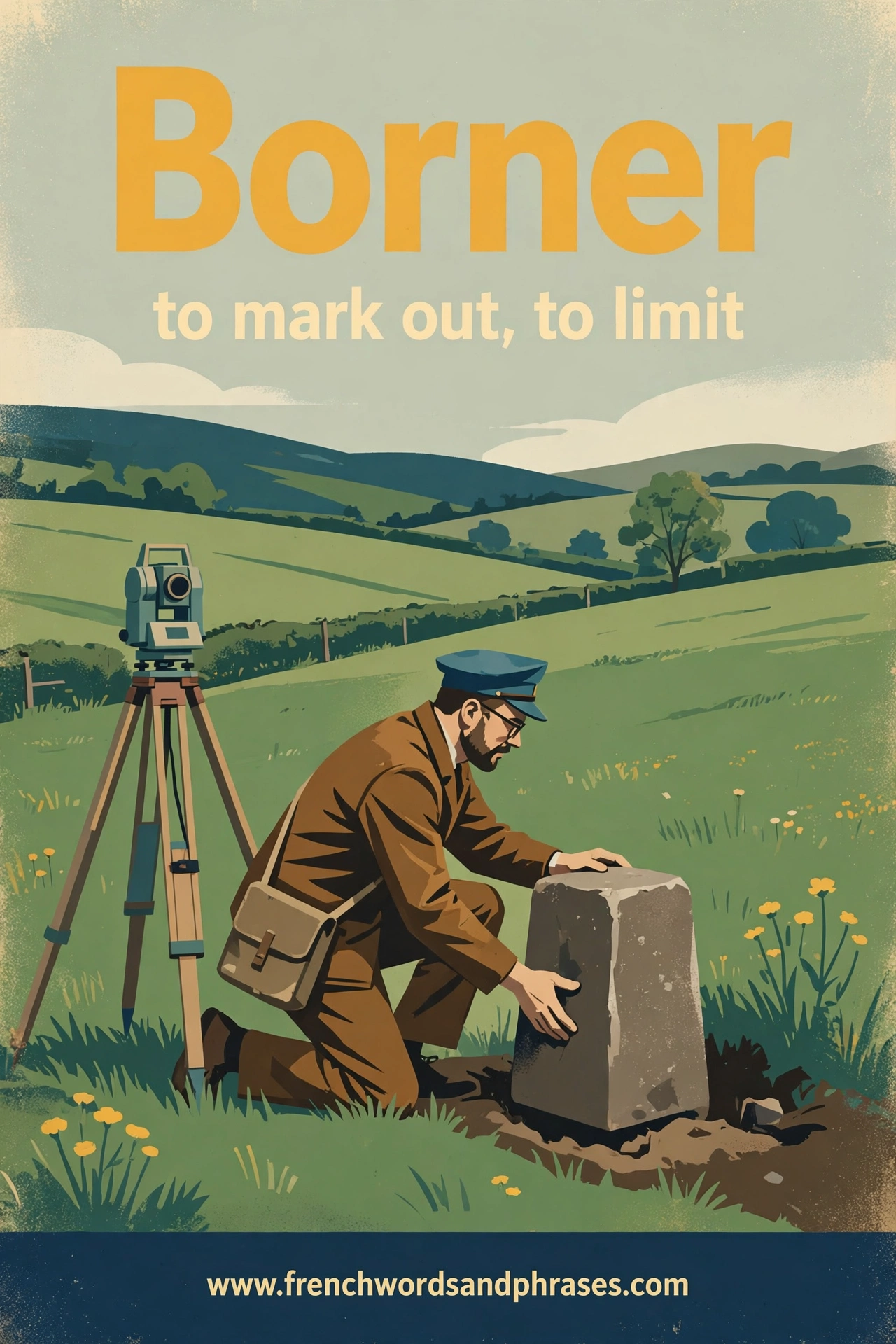
A surveyor with his tripod in a wheat field, a row of white stones appearing one by one along a hedge, an empire stopping at a river — borner is the verb of the drawn line: it sets the stones, and the stones say how far a thing extends.
In this guide, you’ll learn how to conjugate borner in all the major French tenses and moods. Explore complete conjugation tables, French examples, English translations, and practice quizzes.
Understanding the French Verb Borner
Borner is a regular French verb belonging to the first group of verbs, those ending in-er.
It means to mark out, to limit. Surveyors and notaries use it for land; everyone else meets it in the figurative plural — les bornes, the limits of decency or patience, which one can respecter or, more memorably, dépasser.
Verb classification: First group (-er)
Auxiliary verb: Avoir
Past participle: borné
Present participle: bornant
English equivalents: To mark out, to delimit, to bound, to limit; borner un terrain — to mark out a plot of land; borner ses ambitions — to limit one’s ambitions; une borne — a boundary stone, a milestone; dépasser les bornes — to go too far; borné — narrow-minded.
One important detail: borner is the verb of la borne, the boundary stone — to borner a field is literally to stone it, to plant its limits in the ground. The noun has wandered far: a borne is also a milestone, and in familiar French simply a kilometre (cent bornes d’ici). And the participle has a famous second career as an insult: un esprit borné, a narrow mind, is a mind with its stones planted too close together. The verb itself is regular: je borne, nous bornons.
Experience the Word
Borner is the verb of the white stone — before it, disputes; after it, a line everyone can see and no one may cross.
Imagine two brothers dividing their father’s farm. The surveyor walks the hedge with his instruments, the mason follows with a barrow of cut stones, and one by one the bornes rise out of the grass — ils ont borné le domaine, and what was an argument in the morning is a boundary by lunch.
Nothing has been fenced or walled. The land is marked out — borné, its limits standing in white stone.
How to Conjugate Borner: Complete French Conjugation Guide
Let’s explore every major conjugation of borner, beginning with the indicative mood.
How to Conjugate Borner in the Indicative Mood
The indicative mood is used to express facts, observations, actions, and events.
How to Conjugate Borner in the Present Tense (Présent)
Used for actions happening now, habitual actions, and general truths.
| Subject | Conjugation |
|---|---|
| je | borne |
| tu | bornes |
| il / elle | borne |
| nous | bornons |
| vous | bornez |
| ils / elles | bornent |
Example
Le géomètre borne le terrain avant la vente.
The surveyor marks out the plot before the sale.
Quick Quiz 1
Complete the sentence:
Le géomètre ______ le terrain avant la vente.
Reveal the answer
borne
Le géomètre borne le terrain avant la vente.
The surveyor marks out the plot before the sale.
How to Conjugate Borner in the Passé Composé
Used for completed actions in the past. Borner takes the auxiliary verb avoir.
| Subject | Conjugation |
|---|---|
| j’ | ai borné |
| tu | as borné |
| il / elle | a borné |
| nous | avons borné |
| vous | avez borné |
| ils / elles | ont borné |
Example
Ils ont borné le champ avec des pierres blanches.
They marked out the field with white stones.
How to Conjugate Borner in the Imparfait (Imperfect Tense)
Used for habitual past actions, descriptions, and ongoing situations in the past.
| Subject | Conjugation |
|---|---|
| je | bornais |
| tu | bornais |
| il / elle | bornait |
| nous | bornions |
| vous | borniez |
| ils / elles | bornaient |
Example
Une rivière bornait le domaine au sud.
A river bounded the estate to the south.
Quick Quiz 2
Choose the correct form:
They marked out the field.
Ils ______ le champ. (ont borné / sont bornés)
Reveal the answer
ont borné
Ils ont borné le champ.
Borner takes avoir.
How to Conjugate Borner in the Plus-que-parfait
Used to describe an action that had already been completed before another past event.
| Subject | Conjugation |
|---|---|
| j’ | avais borné |
| tu | avais borné |
| il / elle | avait borné |
| nous | avions borné |
| vous | aviez borné |
| ils / elles | avaient borné |
Example
Le notaire avait borné les parcelles en 1950.
The notary had marked out the parcels in 1950.
How to Conjugate Borner in the Passé Simple
Primarily used in formal writing, literature, and historical narratives. It is rarely used in everyday conversation.
| Subject | Conjugation |
|---|---|
| je | bornai |
| tu | bornas |
| il / elle | borna |
| nous | bornâmes |
| vous | bornâtes |
| ils / elles | bornèrent |
Example
Les Romains bornèrent l’empire par le Rhin.
The Romans bounded the empire by the Rhine.
How to Conjugate Borner in the Passé Antérieur
A literary tense used to express an action completed immediately before another past action, generally in the passé simple.
| Subject | Conjugation |
|---|---|
| j’ | eus borné |
| tu | eus borné |
| il / elle | eut borné |
| nous | eûmes borné |
| vous | eûtes borné |
| ils / elles | eurent borné |
Example
Quand il eut borné le pré, il planta la haie.
When he had marked out the meadow, he planted the hedge.
How to Conjugate Borner in the Future Tense (Futur Simple)
Used to describe actions that will take place in the future.
| Subject | Conjugation |
|---|---|
| je | bornerai |
| tu | borneras |
| il / elle | bornera |
| nous | bornerons |
| vous | bornerez |
| ils / elles | borneront |
Example
Demain, on bornera les lots du nouveau quartier.
Tomorrow, the plots of the new district will be marked out.
How to Conjugate Borner in the Futur Antérieur (Future Perfect)
Used for an action that will have been completed before a particular point in the future.
| Subject | Conjugation |
|---|---|
| j’ | aurai borné |
| tu | auras borné |
| il / elle | aura borné |
| nous | aurons borné |
| vous | aurez borné |
| ils / elles | auront borné |
Example
À la fin du mois, ils auront borné tout le domaine.
By the end of the month, they will have marked out the whole estate.
How to Conjugate Borner in the Near Future (Futur Proche)
Used to describe something that is going to happen soon. Formed with aller + infinitive.
| Subject | Conjugation |
|---|---|
| je | vais borner |
| tu | vas borner |
| il / elle | va borner |
| nous | allons borner |
| vous | allez borner |
| ils / elles | vont borner |
Example
Le géomètre va borner le jardin cet après-midi.
The surveyor is going to mark out the garden this afternoon.
How to Conjugate Borner in the Conditional Mood
The conditional mood expresses what would happen under certain circumstances. It is also frequently used to make polite requests or express wishes.
How to Conjugate Borner in the Present Conditional
| Subject | Conjugation |
|---|---|
| je | bornerais |
| tu | bornerais |
| il / elle | bornerait |
| nous | bornerions |
| vous | borneriez |
| ils / elles | borneraient |
Example
Un mur bornerait mieux le jardin que cette haie.
A wall would bound the garden better than this hedge.
How to Conjugate Borner in the Past Conditional
| Subject | Conjugation |
|---|---|
| j’ | aurais borné |
| tu | aurais borné |
| il / elle | aurait borné |
| nous | aurions borné |
| vous | auriez borné |
| ils / elles | auraient borné |
Example
Vous auriez borné le terrain sans ce litige.
You would have marked out the land if not for this dispute.
Borner in the Literary Past Conditional Form
This less common literary form uses the imperfect subjunctive of avoir.
| Subject | Conjugation |
|---|---|
| j’ | eusse borné |
| tu | eusses borné |
| il / elle | eût borné |
| nous | eussions borné |
| vous | eussiez borné |
| ils / elles | eussent borné |
Example
La mer eût borné leurs conquêtes.
The sea would have bounded their conquests.
How to Conjugate Borner in the Subjunctive Mood
The subjunctive is used to express wishes, emotions, doubts, necessity, and uncertainty. It frequently follows expressions such as il faut que (it is necessary that) or bien que (although).
How to Conjugate Borner in the Present Subjunctive
| Subject | Conjugation |
|---|---|
| que je | borne |
| que tu | bornes |
| qu’il / qu’elle | borne |
| que nous | bornions |
| que vous | borniez |
| qu’ils / qu’elles | bornent |
Example
Il faut que le géomètre borne chaque parcelle.
The surveyor must mark out each parcel.
Quick Quiz 3
Complete the sentence using the subjunctive:
Il faut que le géomètre ______ chaque parcelle.
Reveal the answer
borne
Il faut que le géomètre borne chaque parcelle.
The surveyor must mark out each parcel.
How to Conjugate Borner in the Imperfect Subjunctive
A literary tense, rarely encountered in modern spoken French.
| Subject | Conjugation |
|---|---|
| que je | bornasse |
| que tu | bornasses |
| qu’il / qu’elle | bornât |
| que nous | bornassions |
| que vous | bornassiez |
| qu’ils / qu’elles | bornassent |
Example
Le roi ordonna que l’on bornât le royaume par des pierres.
The king ordered the kingdom to be bounded with stones.
How to Conjugate Borner in the Pluperfect Subjunctive
A literary construction used to express an action completed before another past action.
| Subject | Conjugation |
|---|---|
| que j’ | eusse borné |
| que tu | eusses borné |
| qu’il / qu’elle | eût borné |
| que nous | eussions borné |
| que vous | eussiez borné |
| qu’ils / qu’elles | eussent borné |
Example
On disait que les anciens eussent borné le champ par des chênes.
People said the ancients had marked out the field with oaks.
How to Conjugate Borner in the Past Subjunctive
| Subject | Conjugation |
|---|---|
| que j’ | aie borné |
| que tu | aies borné |
| qu’il / qu’elle | ait borné |
| que nous | ayons borné |
| que vous | ayez borné |
| qu’ils / qu’elles | aient borné |
Example
Je suis ravi que vous ayez borné le pré.
I am glad you marked out the meadow.
How to Conjugate Borner in the Imperative
The imperative is used to give commands, instructions, invitations, or suggestions. Subject pronouns are omitted.
How to Conjugate Borner in the Present Imperative
| Person | Conjugation |
|---|---|
| (tu) | borne |
| (nous) | bornons |
| (vous) | bornez |
Example
Bornez le terrain avant de construire !
Mark out the land before building!
Quick Quiz 4
How would you say Mark out the land before building (tu form)?
Reveal the answer
Borne le terrain avant de construire !
French Participles of Borner
Participles are verb forms that can be used in compound tenses and other grammatical constructions.
Present Participle of Borner
bornant
En bornant son domaine, il a découvert une source.
While marking out his estate, he discovered a spring.
Past Participle of Borner
borné
Borné par la rivière, le pré ne pouvait pas s’étendre.
Bounded by the river, the meadow could not expand.
Borner in Everyday French: Real-Life Examples
Now that you know the conjugations, let’s see how borner appears in everyday French.
Example 1 — Present
Le géomètre borne le terrain.
The surveyor marks out the plot.
Example 2 — Passé composé
Ils ont borné le champ.
They marked out the field.
Example 3 — Imparfait
Une rivière bornait le domaine.
A river bounded the estate.
Example 4 — Future
On bornera les lots demain.
The plots will be marked out tomorrow.
Example 5 — Conditional
Un mur bornerait mieux le jardin.
A wall would bound the garden better.
Example 6 — Imperative
Bornez le terrain avant de construire !
Mark out the land before building!
Beyond Translation: The Meaning of Borner
English bound in its geographical sense — the bounding river, the bounded estate — is the closest cousin, and the family resemblance is real: both languages draw the line and then argue about it.
The stones outlasted the fields.
Roman bornes still stand along old roads, and the word walked from the field into the language of manners: dépasser les bornes, to go beyond the stones, is still the standard French way to say that someone has gone too far.
How to Remember the French Verb Borner
Remember it this way: Borner is about white boundary stones rising along a hedge.
- La borne is the stone; borner is planting it — mark out first, argue never.
- Two famous offspring: dépasser les bornes (to go too far) and un esprit borné (a narrow mind).
- Regular -er: je borne, nous bornons, past participle borné, auxiliary avoir.
The key idea is white boundary stones rising along a hedge.
Test Your Knowledge of Borner
Let’s see how much you’ve learned. Try answering these questions before revealing the answers.
Question 1
What is une borne?
Reveal the answer
A boundary stone — the marker planted to fix a limit; also a milestone, and in familiar French, a kilometre.
Question 2
How do you say The surveyor marks out the plot in French?
Reveal the answer
Le géomètre borne le terrain.
Question 3
Translate: A river bounded the estate to the south.
Reveal the answer
Une rivière bornait le domaine au sud.
Question 4
What is the past participle of borner?
Reveal the answer
Borné.
Question 5
Complete the sentence:
Il faut que le géomètre ______ chaque parcelle.
Reveal the answer
borne
Il faut que le géomètre borne chaque parcelle.
The surveyor must mark out each parcel.
Your Final Challenge
Can You Use It?
How would you say this in French?
They marked out the field with white stones, and the field, at last, knows where it ends.
Reveal the answer
Ils ont borné le champ de pierres blanches, et le champ, enfin, sait où il finit.
They marked out the field with white stones, and the field, at last, knows where it ends.
A little French. A little curiosity. A richer everyday life.
LEARN FRENCH ONE WORD AT A TIME