A French Word to Live By
How to Conjugate Bosseler in French
/bɔ.sə.le/
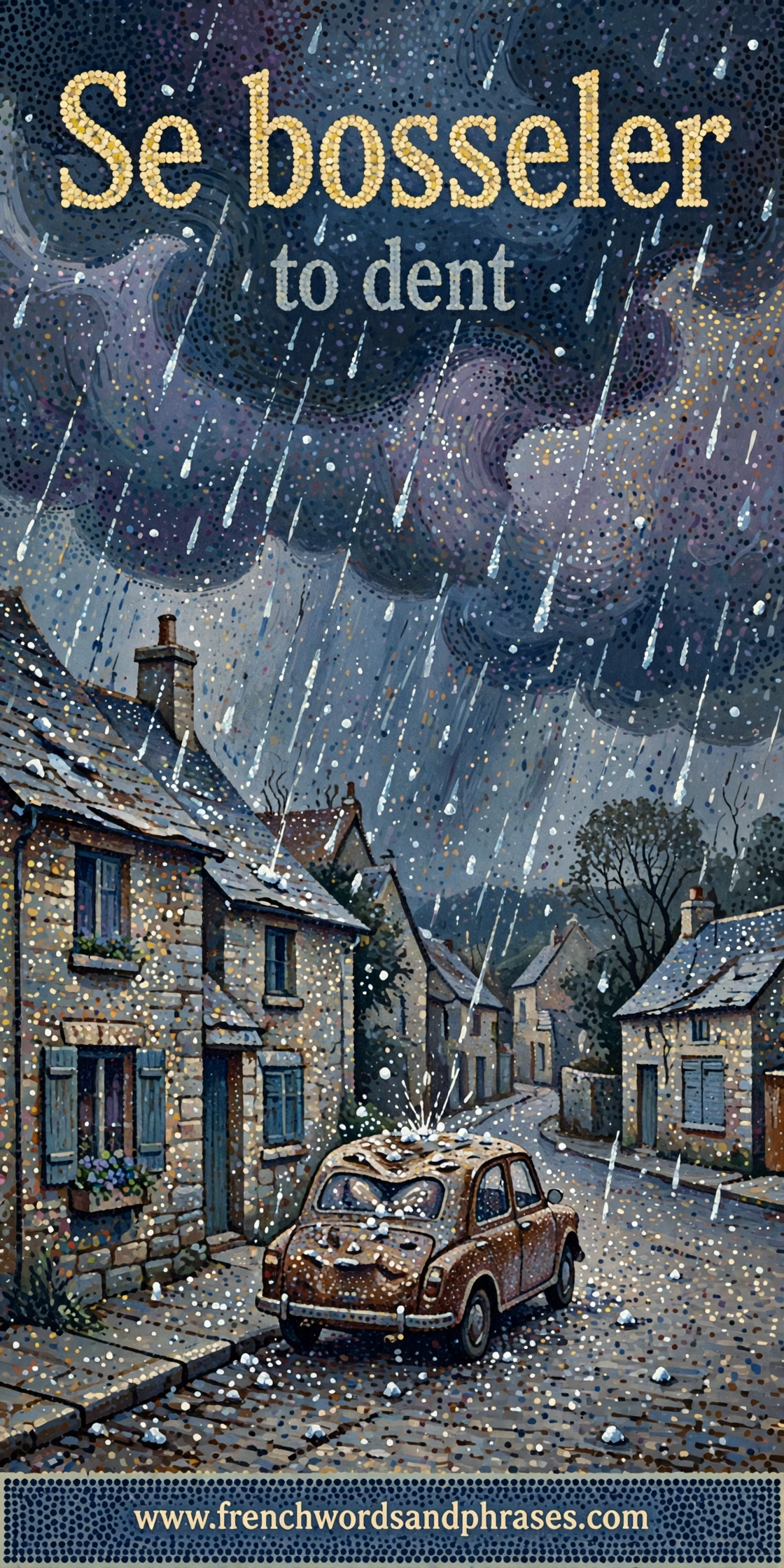
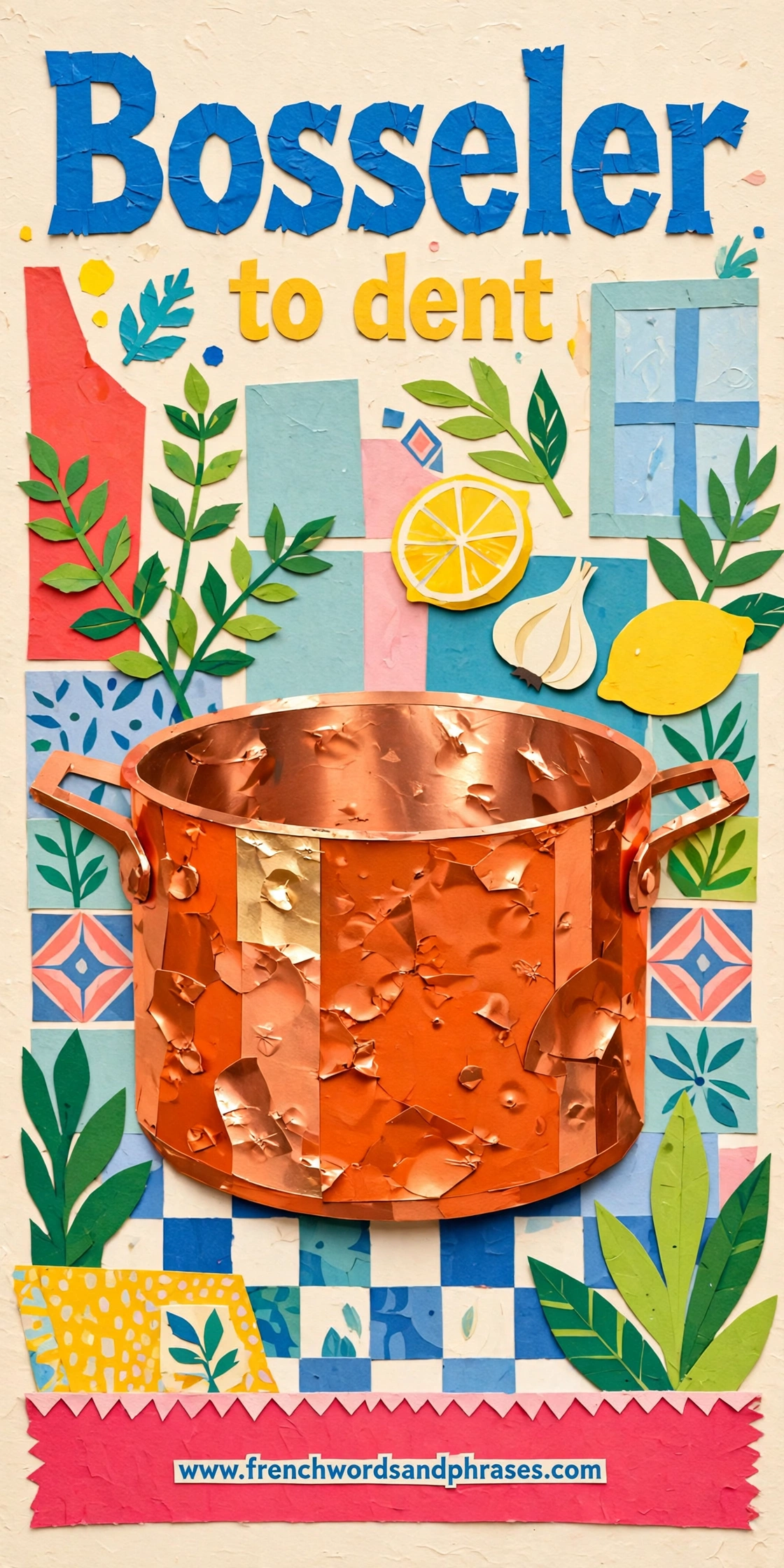
Bosseler means to dent — to knock a smooth surface of metal, a car door, a pan or a helmet, into little bumps and hollows.
A hailstorm drumming on a car roof, a saucepan dropped once too often on a stone floor, a careless reversing into a post — bosseler is the verb of the dent: the small, dishonourable hollow that smooth things collect.
In this guide, you’ll learn how to conjugate bosseler in all the major French tenses and moods. Explore complete conjugation tables, French examples, English translations, and practice quizzes.
Understanding the French Verb Bosseler
Bosseler is a regular French verb belonging to the first group of verbs, those ending in-er.
It means to dent. It is the everyday word for dents in metal and bodywork — voitures, casseroles, casques, tôles — and its participle bosselé describes any surface that life has knocked about. A whole trade exists to reverse it: le débosselage, paintless dent removal.
Verb classification: First group (-er)
Auxiliary verb: Avoir
Past participle: bosselé
Present participle: bosselant
English equivalents: To dent, to batter, to knock about; bosseler une portière — to dent a car door; une casserole bosselée — a dented saucepan; une bosse — a bump, a dent, a hump; le débosselage — dent removal, the trade that undoes bosseler.
One important detail: bosseler doubles its l wherever the next syllable is mute, exactly like appeler: je bosselle, tu bosselles, il bosselle, ils bossellent, and all through the future and conditional, je bossellerai, je bossellerais. Where the ending is sounded, the single l stays: nous bosselons, vous bosselez, je bosselais, en bosselant, and in the infinitive and participle, bosseler, bosselé. The verb is built on une bosse, a bump — to bosseler a surface is to cover it in little bosses, bumps and hollows.
Experience the Word
Bosseler is the verb of the small disaster — nothing breaks, nothing stops working, but the smooth surface will never be smooth again.
Imagine a summer storm over a car park. The hail arrives like thrown gravel, drumming on roofs and bonnets for ninety seconds — la grêle bosselle toutes les voitures, and by the time the sun returns, every panel wears a hundred tiny hollows.
No window is broken and every engine starts. The cars are dented — bosselés, dimpled like golf balls by the sky.
How to Conjugate Bosseler: Complete French Conjugation Guide
Let’s explore every major conjugation of bosseler, beginning with the indicative mood.
How to Conjugate Bosseler in the Indicative Mood
The indicative mood is used to express facts, observations, actions, and events.
How to Conjugate Bosseler in the Present Tense (Présent)
Used for actions happening now, habitual actions, and general truths.
| Subject | Conjugation |
|---|---|
| je | bosselle |
| tu | bosselles |
| il / elle | bosselle |
| nous | bosselons |
| vous | bosselez |
| ils / elles | bossellent |
Example
La grêle bosselle les carrosseries en quelques minutes.
Hail dents car bodies in a few minutes.
Quick Quiz 1
Complete the sentence:
La grêle ______ les toits.
Reveal the answer
bosselle
La grêle bosselle les toits.
Hail dents the roofs — note the doubled l.
How to Conjugate Bosseler in the Passé Composé
Used for completed actions in the past. Bosseler takes the auxiliary verb avoir.
| Subject | Conjugation |
|---|---|
| j’ | ai bosselé |
| tu | as bosselé |
| il / elle | a bosselé |
| nous | avons bosselé |
| vous | avez bosselé |
| ils / elles | ont bosselé |
Example
Tu as bosselé la portière contre le poteau.
You dented the door against the post.
How to Conjugate Bosseler in the Imparfait (Imperfect Tense)
Used for habitual past actions, descriptions, and ongoing situations in the past.
| Subject | Conjugation |
|---|---|
| je | bosselais |
| tu | bosselais |
| il / elle | bosselait |
| nous | bosselions |
| vous | bosseliez |
| ils / elles | bosselaient |
Example
Les enfants bosselaient les casseroles en jouant aux cuisiniers.
The children used to dent the saucepans playing at cooks.
Quick Quiz 2
Choose the correct form:
You dented the door.
Tu ______ la portière. (as bosselé / es bosselé)
Reveal the answer
as bosselé
Tu as bosselé la portière.
Bosseler takes avoir.
How to Conjugate Bosseler in the Plus-que-parfait
Used to describe an action that had already been completed before another past event.
| Subject | Conjugation |
|---|---|
| j’ | avais bosselé |
| tu | avais bosselé |
| il / elle | avait bosselé |
| nous | avions bosselé |
| vous | aviez bosselé |
| ils / elles | avaient bosselé |
Example
La chute avait bosselé son casque.
The fall had dented his helmet.
How to Conjugate Bosseler in the Passé Simple
Primarily used in formal writing, literature, and historical narratives. It is rarely used in everyday conversation.
| Subject | Conjugation |
|---|---|
| je | bosselai |
| tu | bosselas |
| il / elle | bossela |
| nous | bosselâmes |
| vous | bosselâtes |
| ils / elles | bosselèrent |
Example
Le choc bossela toute l’aile avant.
The impact dented the whole front wing.
How to Conjugate Bosseler in the Passé Antérieur
A literary tense used to express an action completed immediately before another past action, generally in the passé simple.
| Subject | Conjugation |
|---|---|
| j’ | eus bosselé |
| tu | eus bosselé |
| il / elle | eut bosselé |
| nous | eûmes bosselé |
| vous | eûtes bosselé |
| ils / elles | eurent bosselé |
Example
Quand la grêle eut bosselé les toits, le silence revint.
When the hail had dented the roofs, silence returned.
How to Conjugate Bosseler in the Future Tense (Futur Simple)
Used to describe actions that will take place in the future.
| Subject | Conjugation |
|---|---|
| je | bossellerai |
| tu | bosselleras |
| il / elle | bossellera |
| nous | bossellerons |
| vous | bossellerez |
| ils / elles | bosselleront |
Example
Ce marteau bossellera la tôle si tu frappes trop fort.
This hammer will dent the sheet metal if you strike too hard.
How to Conjugate Bosseler in the Futur Antérieur (Future Perfect)
Used for an action that will have been completed before a particular point in the future.
| Subject | Conjugation |
|---|---|
| j’ | aurai bosselé |
| tu | auras bosselé |
| il / elle | aura bosselé |
| nous | aurons bosselé |
| vous | aurez bosselé |
| ils / elles | auront bosselé |
Example
À ce rythme, ils auront bosselé toutes les voitures du parking.
At this rate, they will have dented every car in the car park.
How to Conjugate Bosseler in the Near Future (Futur Proche)
Used to describe something that is going to happen soon. Formed with aller + infinitive.
| Subject | Conjugation |
|---|---|
| je | vais bosseler |
| tu | vas bosseler |
| il / elle | va bosseler |
| nous | allons bosseler |
| vous | allez bosseler |
| ils / elles | vont bosseler |
Example
Attention, tu vas bosseler le capot !
Careful, you are going to dent the bonnet!
How to Conjugate Bosseler in the Conditional Mood
The conditional mood expresses what would happen under certain circumstances. It is also frequently used to make polite requests or express wishes.
How to Conjugate Bosseler in the Present Conditional
| Subject | Conjugation |
|---|---|
| je | bossellerais |
| tu | bossellerais |
| il / elle | bossellerait |
| nous | bossellerions |
| vous | bosselleriez |
| ils / elles | bosselleraient |
Example
Une simple chute bossellerait ce casque léger.
A simple fall would dent this light helmet.
How to Conjugate Bosseler in the Past Conditional
| Subject | Conjugation |
|---|---|
| j’ | aurais bosselé |
| tu | aurais bosselé |
| il / elle | aurait bosselé |
| nous | aurions bosselé |
| vous | auriez bosselé |
| ils / elles | auraient bosselé |
Example
Sans le poteau, il n’aurait pas bosselé sa portière.
Without the post, he would not have dented his door.
Bosseler in the Literary Past Conditional Form
This less common literary form uses the imperfect subjunctive of avoir.
| Subject | Conjugation |
|---|---|
| j’ | eusse bosselé |
| tu | eusses bosselé |
| il / elle | eût bosselé |
| nous | eussions bosselé |
| vous | eussiez bosselé |
| ils / elles | eussent bosselé |
Example
La grêle eût bosselé tous les toits du village.
The hail would have dented every roof in the village.
How to Conjugate Bosseler in the Subjunctive Mood
The subjunctive is used to express wishes, emotions, doubts, necessity, and uncertainty. It frequently follows expressions such as il faut que (it is necessary that) or bien que (although).
How to Conjugate Bosseler in the Present Subjunctive
| Subject | Conjugation |
|---|---|
| que je | bosselle |
| que tu | bosselles |
| qu’il / qu’elle | bosselle |
| que nous | bosselions |
| que vous | bosseliez |
| qu’ils / qu’elles | bossellent |
Example
Je ne veux pas que tu bosselles ma voiture neuve.
I do not want you to dent my new car.
Quick Quiz 3
Complete the sentence using the subjunctive:
Je ne veux pas que tu ______ ma voiture.
Reveal the answer
bosselles
Je ne veux pas que tu bosselles ma voiture.
I do not want you to dent my car.
How to Conjugate Bosseler in the Imperfect Subjunctive
A literary tense, rarely encountered in modern spoken French.
| Subject | Conjugation |
|---|---|
| que je | bosselasse |
| que tu | bosselasses |
| qu’il / qu’elle | bosselât |
| que nous | bosselassions |
| que vous | bosselassiez |
| qu’ils / qu’elles | bosselassent |
Example
Il fallait éviter que la presse bosselât la pièce.
It was necessary to prevent the press from denting the part.
How to Conjugate Bosseler in the Pluperfect Subjunctive
A literary construction used to express an action completed before another past action.
| Subject | Conjugation |
|---|---|
| que j’ | eusse bosselé |
| que tu | eusses bosselé |
| qu’il / qu’elle | eût bosselé |
| que nous | eussions bosselé |
| que vous | eussiez bosselé |
| qu’ils / qu’elles | eussent bosselé |
Example
On voyait que la grêle eût bosselé les capots.
You could see the hail had dented the bonnets.
How to Conjugate Bosseler in the Past Subjunctive
| Subject | Conjugation |
|---|---|
| que j’ | aie bosselé |
| que tu | aies bosselé |
| qu’il / qu’elle | ait bosselé |
| que nous | ayons bosselé |
| que vous | ayez bosselé |
| qu’ils / qu’elles | aient bosselé |
Example
Je suis fâché qu’il ait bosselé la casserole de grand-mère.
I am annoyed he dented grandmother’s saucepan.
How to Conjugate Bosseler in the Imperative
The imperative is used to give commands, instructions, invitations, or suggestions. Subject pronouns are omitted.
How to Conjugate Bosseler in the Present Imperative
| Person | Conjugation |
|---|---|
| (tu) | bosselle |
| (nous) | bosselons |
| (vous) | bosselez |
Example
Ne bosselle pas la carrosserie en te garant !
Do not dent the bodywork while parking!
Quick Quiz 4
How would you say Do not dent the bonnet (tu form)?
Reveal the answer
Ne bosselle pas le capot !
French Participles of Bosseler
Participles are verb forms that can be used in compound tenses and other grammatical constructions.
Present Participle of Bosseler
bosselant
En bosselant la tôle, l’ouvrier crée un motif décoratif.
By hammering dents into the sheet, the worker creates a decorative pattern.
Past Participle of Bosseler
bosselé
Bosselée de partout, la vieille voiture roule encore.
Dented all over, the old car still runs.
Bosseler in Everyday French: Real-Life Examples
Now that you know the conjugations, let’s see how bosseler appears in everyday French.
Example 1 — Present
La grêle bosselle les toits.
Hail dents the roofs.
Example 2 — Passé composé
Tu as bosselé la portière.
You dented the door.
Example 3 — Imparfait
Les enfants bosselaient les casseroles.
The children used to dent the saucepans.
Example 4 — Future
Ce marteau bossellera la tôle.
This hammer will dent the sheet metal.
Example 5 — Conditional
Une chute bossellerait ce casque.
A fall would dent this helmet.
Example 6 — Imperative
Ne bosselle pas le capot !
Do not dent the bonnet!
Beyond Translation: The Meaning of Bosseler
English dent is blunter; bosseler keeps the bump inside it — une bosse is the lump you raise on a forehead or a panel, and bosseler is to raise a crop of them.
It even has its own undoing.
Few verbs can boast a whole profession devoted to reversing them, but the débosseleur earns his living pushing bosselé panels back to smoothness — le débosselage is bosseler read backwards, one dent at a time.
How to Remember the French Verb Bosseler
Remember it this way: Bosseler is about hailstones drumming dents into a car roof.
- Une bosse is a bump: bosseler covers a surface in bumps and hollows.
- Appeler-type doubling: je bosselle with two l’s, but nous bosselons with one.
- Future doubles too: je bossellerai; participle bosselé, auxiliary avoir.
The key idea is hailstones drumming dents into a car roof.
Test Your Knowledge of Bosseler
Let’s see how much you’ve learned. Try answering these questions before revealing the answers.
Question 1
Why does je bosselle have two l’s but nous bosselons only one?
Reveal the answer
The appeler rule — -eler verbs double the l before a mute syllable (je bosselle, ils bossellent, je bossellerai) and keep one l where the ending is sounded (nous bosselons, en bosselant).
Question 2
How do you say Hail dents car bodies in French?
Reveal the answer
La grêle bosselle les carrosseries.
Question 3
Translate: You dented the door against the post.
Reveal the answer
Tu as bosselé la portière contre le poteau.
Question 4
What is the past participle of bosseler?
Reveal the answer
Bosselé — agreeing: bosselée, bosselés, bosselées.
Question 5
Complete the sentence:
Je ne veux pas que tu ______ ma voiture neuve.
Reveal the answer
bosselles
Je ne veux pas que tu bosselles ma voiture neuve.
I do not want you to dent my new car.
Your Final Challenge
Can You Use It?
How would you say this in French?
The hail dented every car in the village, except the bodywork man’s, parked under the shed.
Reveal the answer
La grêle a bosselé toutes les voitures du village, sauf celle du carrossier, garée sous le hangar.
The hail dented every car in the village, except the bodywork man’s, parked under the shed.
A little French. A little curiosity. A richer everyday life.
LEARN FRENCH ONE WORD AT A TIME