A French Word to Live By
Translate Sang to English
/sɑ̃/
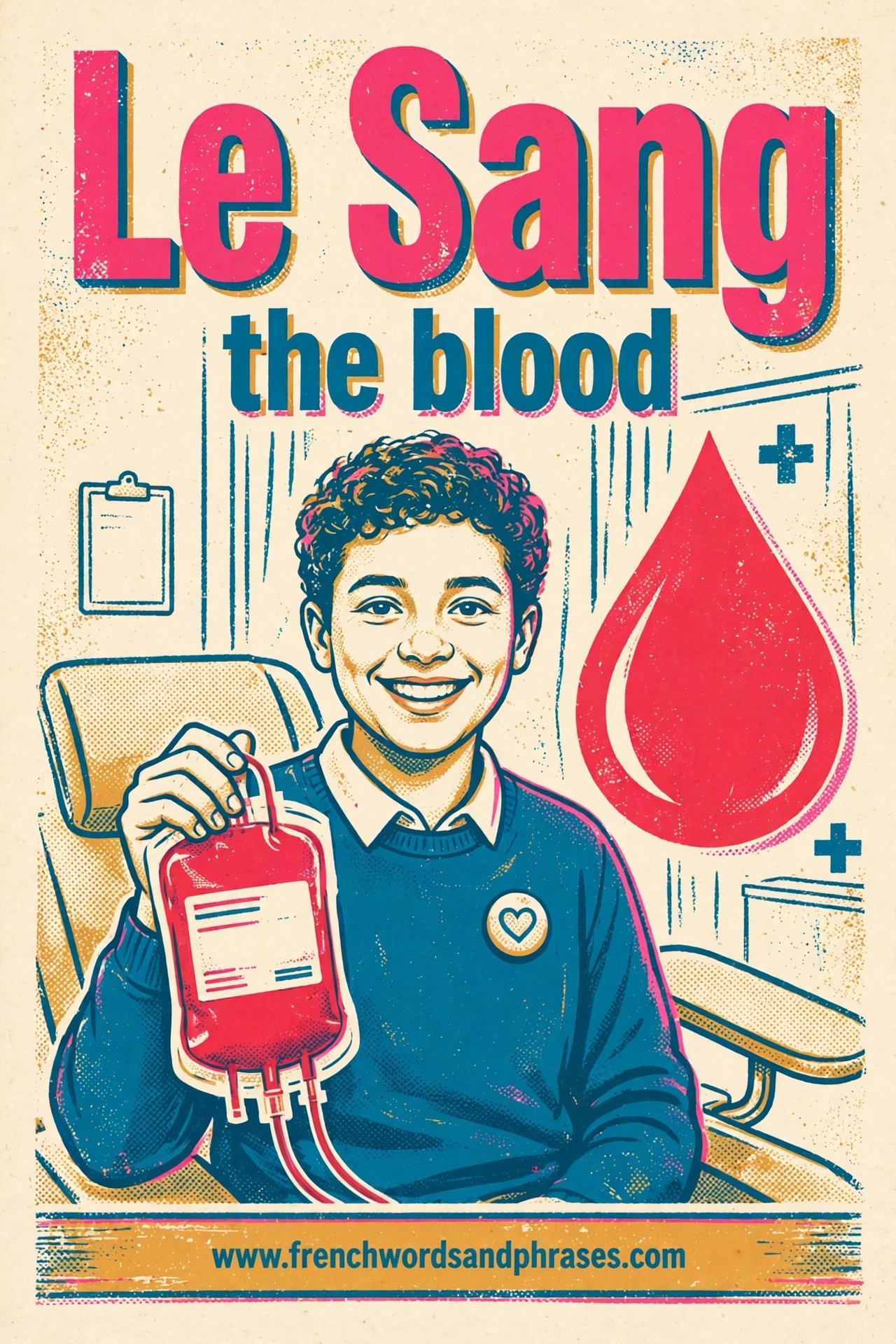
Le sang means the blood.
A small room at the blood-donation centre, a nurse smiling, a bag filling slowly with the deepest red in the world. Five litres of it run through you, quietly, all your life: le sang.
In this guide, you’ll learn what sang means in English, how to use it with its articles, how to form its plural, and how it appears in everyday French. Explore French examples, English translations, and practice quizzes.
Understanding the French Noun Sang
Sang is a masculine French noun, learned with its article: le sang, du sang. Blood is uncountable in French as in English, so everyday French has no plural for it — it is measured in drops, litres and tests: une goutte de sang, une prise de sang. And a warning for the ear: the final -g is silent.
It means the blood — the red river that carries oxygen from les poumons to every corner of le corps, pumped by le cœur. French meets the word at the doctor’s (une prise de sang, a blood test), at the donation centre (le don du sang), and in a rich family of expressions about courage, temper and composure.
Gender: Masculine
Definite article: le — le sang (the blood)
Partitive article: du — du sang (some blood)
Plural: None in everyday use — blood is uncountable
Sound: The final -g is silent — sang rhymes with « sans »
The volume: About five litres of sang flow through an adult body
English equivalents: The blood.
One treasure to collect: le sang-froid — literally « cold blood » — is composure, keeping your head in a crisis, and it is a compliment. Its opposite temper is avoir le sang chaud, to be hot-blooded. And at the doctor’s, remember the set phrase: une prise de sang is a blood test, never anything with « test » in it.
Experience the Word
Le sang is the body’s river system — five litres in constant circulation, delivering, collecting, repairing, never once stopping between your first cry and your last breath.
Imagine the donation room: strangers on reclining chairs, sleeves rolled up, giving a piece of their river to someone they will never meet.
You have not just named a liquid. You have named the courier of life itself — le sang, toujours en route.
How to Use Sang in French: Complete Guide
Let’s explore how sang works in French, beginning with its articles — an uncountable word, so the partitive du will take centre stage.
Sang with the Definite Article (Le)
Used for blood as a whole — the blood in your veins, the blood the heart pumps.
| Form | French |
|---|---|
| Singular (uncountable) | le sang |
Example
Le sang transporte l’oxygène dans tout le corps.
Blood carries oxygen throughout the body.
Sang with the Indefinite and Partitive Articles (Du)
Blood is not counted, it is measured — du sang, some blood, is the everyday form.
| Form | French |
|---|---|
| Some blood | du sang |
| After a negative | de sang (pas de sang) |
| A sample of blood | un échantillon de sang |
Example
Il a perdu un peu de sang après sa chute.
He lost a little blood after his fall.
Sang with the Partitive and Quantities (Du, Une goutte de…)
Drops, litres and tests — the true measures of an uncountable word.
| Quantity | French |
|---|---|
| some blood | du sang |
| a lot of blood | beaucoup de sang |
| a little blood | un peu de sang |
| a drop of blood | une goutte de sang |
| a blood test | une prise de sang |
Example
Une seule goutte de sang suffit pour cette analyse.
A single drop of blood is enough for this test.
Quick Quiz 1
Complete the sentence:
Le laboratoire a besoin d’un peu ______ sang pour l’analyse.
Reveal the answer
de
Un peu de sang.
Quantities take de: un peu de sang, beaucoup de sang — the partitive in its working clothes.
The Plural of Sang
There is none in everyday French — sang stays singular, counted in gouttes and litres instead.
| Number | French |
|---|---|
| Singular only | le sang / du sang |
| Measured in | des gouttes de sang, des litres de sang |
Example
Des gouttes de sang apparaissent sur le pansement.
Drops of blood appear on the dressing.
Sang with Possessive Adjectives (Mon, Ton, Son…)
Possessives agree with the noun — sang is masculine, so mon, ton, son.
| Owner | French |
|---|---|
| my | mon sang |
| your (tu) | ton sang |
| his / her | son sang |
| our | notre sang |
| your (vous) | votre sang |
| their | leur sang |
Example
Son sang circule plus vite quand il court.
His blood flows faster when he runs.
Quick Quiz 2
Complete the sentence:
______ sang-froid a impressionné tout le monde pendant l’incendie. (Her)
Reveal the answer
Son
Son sang-froid a impressionné tout le monde.
Her composure impressed everyone during the fire — son, because sang is masculine.
Sang with Demonstrative Adjectives (Ce)
Used to point: ce sang — this blood, the sample on the slide, the drop on the floor.
| Form | French |
|---|---|
| Singular | ce sang |
Example
Ce sang sera analysé au laboratoire ce matin.
This blood will be tested at the laboratory this morning.
Sang with Adjectives
Adjectives agree with sang, masculine: rouge, chaud, froid — temperature is everything with this word.
| Adjective | With Sang |
|---|---|
| rouge (red) | le sang rouge |
| chaud (hot) | le sang chaud |
| froid (cold) | le sang froid |
| frais (fresh) | du sang frais |
| épais (thick) | un sang épais |
Example
Le sang chaud circule jusqu’au bout des doigts.
Warm blood flows right to the fingertips.
Quick Quiz 3
What does garder son sang-froid mean?
Reveal the answer
To keep one’s composure, to stay calm — literally, to keep one’s cold blood.
Le pilote a gardé son sang-froid pendant la tempête.
The pilot kept his composure during the storm.
Everyday Expressions with Sang
Tests, donations and tempers — the sang phrases of daily life.
| Expression | In English |
|---|---|
| une prise de sang | a blood test |
| le don du sang | blood donation |
| verser son sang | to shed one’s blood |
| se faire du mauvais sang | to worry oneself sick |
| avoir le sang chaud | to be hot-blooded |
| garder son sang-froid | to keep one’s composure |
Example
Elle se fait du mauvais sang pour ses examens.
She is worrying herself sick about her exams.
Words from the Same Family as Sang
Bleeding, tempers and composure — the words that travel with sang.
| French | In English |
|---|---|
| saigner | to bleed |
| sanguin | blood- (and a ruddy temperament) |
| le sang-froid | composure, cool-headedness |
| ensanglanté | bloodstained, bloody |
| la circulation sanguine | blood circulation |
| le groupe sanguin | the blood group |
Example
Son genou saigne un peu après la chute.
His knee is bleeding a little after the fall.
Quick Quiz 4
What is une prise de sang?
Reveal the answer
A blood test — a small sample taken for analysis.
Je fais une prise de sang demain à jeun.
I’m having a blood test tomorrow, on an empty stomach.
Sang in Everyday French: Real-Life Examples
Now that you know the word, let’s see how sang appears in everyday French.
Example 1 — At the laboratory
Je fais une prise de sang demain matin à jeun.
I’m having a blood test tomorrow morning on an empty stomach.
Example 2 — Donation day
Le don du sang sauve des vies chaque jour.
Blood donation saves lives every day.
Example 3 — Worrying
Arrête de te faire du mauvais sang, tout ira bien.
Stop worrying yourself sick; everything will be fine.
Example 4 — Composure
Le chauffeur a gardé son sang-froid sur la route verglacée.
The driver kept his composure on the icy road.
Example 5 — A small cut
Il y a un peu de sang sur le pansement.
There is a little blood on the dressing.
Example 6 — Temper
Il a le sang chaud et s’énerve vite.
He is hot-blooded and loses his temper quickly.
Beyond Translation: The Meaning of Sang
French built a whole moral vocabulary on le sang. Composure is cold blood — le sang-froid; passion is hot blood — le sang chaud; worry is bad blood you make yourself — se faire du mauvais sang. Even nobility was measured in it: le sang bleu, blue blood. Few words show so clearly how a language thinks: character, for French, quite literally runs in the veins.
To say sang is to name the river that carries both life and temperament.
It evokes donation rooms and duel-era honour, blood tests and blue blood — the red thread through the whole language of feeling.
How to Remember the French Noun Sang
Remember it this way: Sang is the blood — le sang, du sang, uncountable, with a silent -g and a family of fiery expressions.
- You measure it, never count it — du sang, une goutte de sang, une prise de sang.
- You silence the ending — sang sounds like « sans », the -g sleeps.
- You grade the temperature — sang-froid for calm, sang chaud for passion.
The key idea is le sang — the blood; le sang-froid — composure.
Test Your Knowledge of Sang
Let’s see how much you’ve learned. Try answering these questions before revealing the answers.
Question 1
Is sang masculine or feminine?
Reveal the answer
Masculine — le sang, du sang.
Question 2
How do you say a blood test?
Reveal the answer
Une prise de sang.
Question 3
Translate: He is worrying himself sick.
Reveal the answer
Il se fait du mauvais sang.
Question 4
Is the final -g of sang sounded?
Reveal the answer
No — the -g is silent; sang rhymes with « sans ».
Question 5
Complete the sentence:
Le cœur pompe ______ sang dans tout le corps.
Reveal the answer
le
Le cœur pompe le sang dans tout le corps.
The heart pumps the blood throughout the body.
Your Final Challenge
Can You Use It?
How would you say this in French?
“She keeps her composure during the exam.”
Reveal the answer
Elle garde son sang-froid pendant l’examen.
She keeps her composure during the exam.
A little French. A little curiosity. A richer everyday life.
LEARN FRENCH ONE WORD AT A TIME