A French Word to Live By
Translate Muscle to English
/myskl/
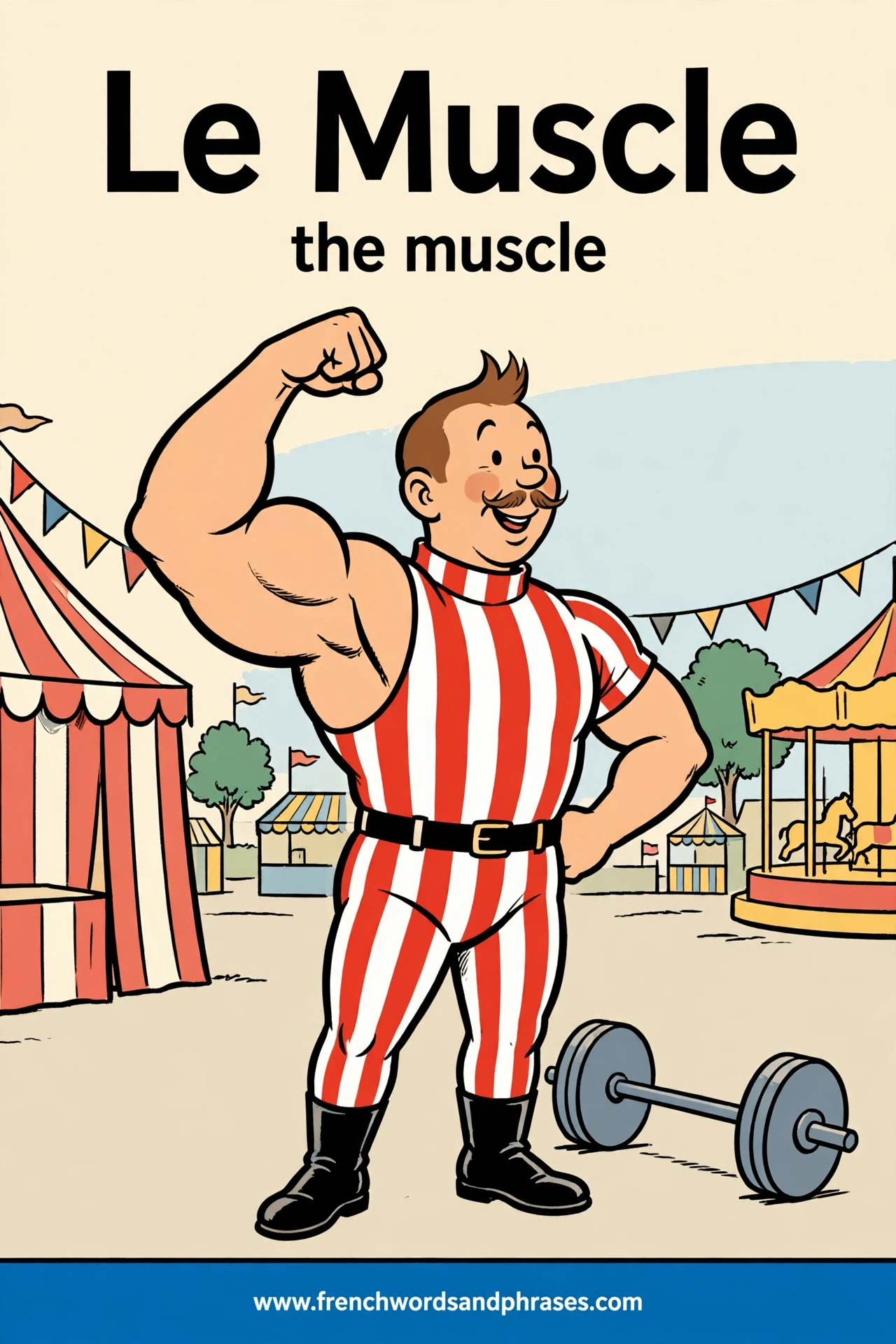
Le muscle means the muscle.
The last step of the staircase, the heavy suitcase, the jar lid that refuses to turn — and somewhere in your arm, a team of quiet workers tightens and pulls. That team, strand by strand, is le muscle.
In this guide, you’ll learn what muscle means in English, how to use it with its articles, how to form its plural, and how it appears in everyday French. Explore French examples, English translations, and practice quizzes.
Understanding the French Noun Muscle
Muscle is a masculine French noun, learned with its article: le muscle, un muscle. The plural is regular, les muscles — the body counts more than 600 of them. Muscle also works as a mass word: you build it with the partitive, prendre du muscle, to gain muscle.
It means the muscle — the tissue that contracts to move les os (the bones), from le cœur, itself a muscle, to the small muscles that smile. You train them (faire travailler ses muscles), pull them (se froisser un muscle) and show them off at the beach. The gym world built on the word has its own name: la musculation, weight training.
Gender: Masculine
Definite article: le — le muscle (the muscle)
Indefinite article: un — un muscle (a muscle)
Plural: les muscles
As a mass: du muscle — prendre du muscle, to gain muscle
The count: More than 600 muscles move the human body
English equivalents: The muscle.
One pairing to learn as a single block: prendre du muscle — literally « to take some muscle » — is how French says to build muscle, with the partitive du doing quiet work. Its sad twin is the pulled muscle: se froisser un muscle, with froisser, the verb for crumpling paper.
Experience the Word
Le muscle is effort made visible. It is the difference between the suitcase carried and the suitcase dragged, between the first dance of the evening and the last.
Imagine the morning after a first session at the gym: stairs become mountains, and every muscle you never knew you had introduces itself by name.
You have not just lifted something. You have spent strength — and the muscle, generous worker, grows back stronger.
How to Use Muscle in French: Complete Guide
Let’s explore how muscle works in French, beginning with its articles — one muscle among six hundred, and the mass you build at the gym.
Muscle with the Definite Article (Le, Les)
Used for the muscle everyone is talking about — the one that hurts, the one on the diagram.
| Form | French |
|---|---|
| Singular | le muscle |
| Plural | les muscles |
Example
Le muscle du bras se contracte quand on plie le coude.
The arm muscle contracts when you bend your elbow.
Muscle with the Indefinite Article (Un, Des)
Used for a muscle in general — un muscle froissé can ruin a whole week’s training.
| Form | French |
|---|---|
| Singular | un muscle |
| Plural | des muscles |
Example
Il s’est froissé un muscle pendant le match.
He pulled a muscle during the match.
Muscle with the Partitive and Quantities (Du, Beaucoup de…)
Muscle is both countable and a mass: un muscle for one of the 600, du muscle for the stuff you build.
| Quantity | French |
|---|---|
| some muscle (mass) | du muscle |
| a muscle | un muscle |
| a lot of muscle | beaucoup de muscle |
| every muscle | chaque muscle |
| all your muscles | tous tes muscles |
Example
Avec cet entraînement, elle prend du muscle rapidement.
With this training, she is gaining muscle quickly.
Quick Quiz 1
Complete the expression:
Depuis septembre, il prend ______ muscle grâce à la musculation.
Reveal the answer
du
Il prend du muscle.
He is gaining muscle — the partitive du, because muscle here is a mass, not a count.
The Plural of Muscle
Muscle adds an -s in the plural — les muscles, the whole workforce of the body.
| Number | French |
|---|---|
| Singular | le muscle |
| Plural | les muscles |
Example
Les muscles des jambes travaillent dur dans les escaliers.
The leg muscles work hard on the stairs.
Muscle with Possessive Adjectives (Mon, Ton, Son…)
Possessives agree with the noun — muscle is masculine, so mon, ton, son.
| Owner | French |
|---|---|
| my | mon muscle |
| your (tu) | ton muscle |
| his / her | son muscle |
| our | notre muscle |
| your (vous) | votre muscle |
| their | leur muscle |
Example
Son muscle du mollet est encore douloureux.
His calf muscle is still sore.
Quick Quiz 2
Complete the sentence:
______ muscles sont fatigués après la course. (My)
Reveal the answer
Mes
Mes muscles sont fatigués après la course.
My muscles are tired after the run — mes, because muscles is plural.
Muscle with Demonstrative Adjectives (Ce, Ces)
Used to point: ce muscle — this muscle, the one the coach is tapping.
| Form | French |
|---|---|
| Singular | ce muscle |
| Plural | ces muscles |
Example
Ce muscle travaille quand tu pousses la porte.
This muscle works when you push the door.
Muscle with Adjectives
Adjectives agree with muscle, masculine: fort, froissé, douloureux.
| Adjective | With Muscle |
|---|---|
| fort (strong) | un muscle fort |
| froissé (pulled) | un muscle froissé |
| douloureux (sore) | un muscle douloureux |
| développé (developed) | un muscle développé |
| tendu (tense) | un muscle tendu |
Example
Un muscle froissé demande du repos et de la glace.
A pulled muscle needs rest and ice.
Quick Quiz 3
What does se froisser un muscle mean?
Reveal the answer
To pull a muscle — froisser is the verb for crumpling, borrowed for the body’s own crumple.
Elle s’est froissé un muscle au dos.
She pulled a muscle in her back.
Everyday Expressions with Muscle
Gyms, injuries and steel — the muscle phrases of daily life.
| Expression | In English |
|---|---|
| prendre du muscle | to gain muscle, to bulk up |
| se froisser un muscle | to pull a muscle |
| faire travailler ses muscles | to work one’s muscles |
| les abdos | the abs (short for abdominaux) |
| avoir des muscles d’acier | to have muscles of steel |
Example
Il fait travailler ses muscles tous les matins avant le travail.
He works his muscles every morning before work.
Words from the Same Family as Muscle
Training, strength and anatomy — the words that travel with muscle.
| French | In English |
|---|---|
| musculaire | muscular, of the muscles |
| musclé | muscular, well-built |
| la musculation | weight training, bodybuilding |
| muscler | to build up, to strengthen |
| le squelette | the skeleton |
| la force | strength |
Example
La musculation développe les muscles du dos.
Weight training develops the back muscles.
Quick Quiz 4
What is la musculation?
Reveal the answer
Weight training — the gym discipline built entirely on le muscle.
Elle fait de la musculation trois fois par semaine.
She does weight training three times a week.
Muscle in Everyday French: Real-Life Examples
Now that you know the word, let’s see how muscle appears in everyday French.
Example 1 — At the gym
Il prend du muscle depuis qu’il s’entraîne régulièrement.
He has been gaining muscle since he started training regularly.
Example 2 — An injury
Elle s’est froissé un muscle et doit se reposer.
She pulled a muscle and has to rest.
Example 3 — The morning after
Tous mes muscles me font mal après cette randonnée.
All my muscles ache after that hike.
Example 4 — Hard work
Porter ces cartons fait travailler les muscles des bras.
Carrying these boxes works the arm muscles.
Example 5 — A compliment
Ce nageur a des muscles d’acier.
That swimmer has muscles of steel.
Example 6 — The heart
Le cœur est le muscle le plus travailleur du corps.
The heart is the hardest-working muscle in the body.
Beyond Translation: The Meaning of Muscle
Muscle hides a small animal inside it: the word descends from the Latin musculus, « little mouse » — Roman doctors thought a flexed muscle looked like a mouse moving under the skin. French kept the word and built a whole culture on it, from la musculation in suburban gyms to the quiet pride of a grandfather who still splits his own firewood at eighty.
To say muscle is to name the body’s engines — six hundred little mice, pulling together.
It evokes chalked hands and pulled hamstrings, strong hearts and strong arms — strength, in French, always with a story inside it.
How to Remember the French Noun Muscle
Remember it this way: Muscle is the muscle — le muscle for one, du muscle for the mass you build, and la musculation for the training.
- You count them — le muscle, les muscles, more than six hundred in the body.
- You build the mass — prendre du muscle, with the partitive du.
- You fear the crumple — se froisser un muscle, to pull one.
The key idea is le muscle — the muscle; prendre du muscle — to gain muscle.
Test Your Knowledge of Muscle
Let’s see how much you’ve learned. Try answering these questions before revealing the answers.
Question 1
Is muscle masculine or feminine?
Reveal the answer
Masculine — le muscle, un muscle.
Question 2
How do you say to gain muscle?
Reveal the answer
Prendre du muscle — with the partitive du, muscle as a mass.
Question 3
Translate: He pulled a muscle.
Reveal the answer
Il s’est froissé un muscle.
Question 4
What is la musculation?
Reveal the answer
Weight training — the sport of building les muscles.
Question 5
Complete the sentence:
______ muscles des jambes sont fatigués. (My)
Reveal the answer
Mes
Mes muscles des jambes sont fatigués.
My leg muscles are tired.
Your Final Challenge
Can You Use It?
How would you say this in French?
“Running strengthens the muscles of the legs.”
Reveal the answer
La course renforce les muscles des jambes.
Running strengthens the muscles of the legs.
A little French. A little curiosity. A richer everyday life.
LEARN FRENCH ONE WORD AT A TIME