A French Word to Live By
Translate Squelette to English
/skə.lɛt/
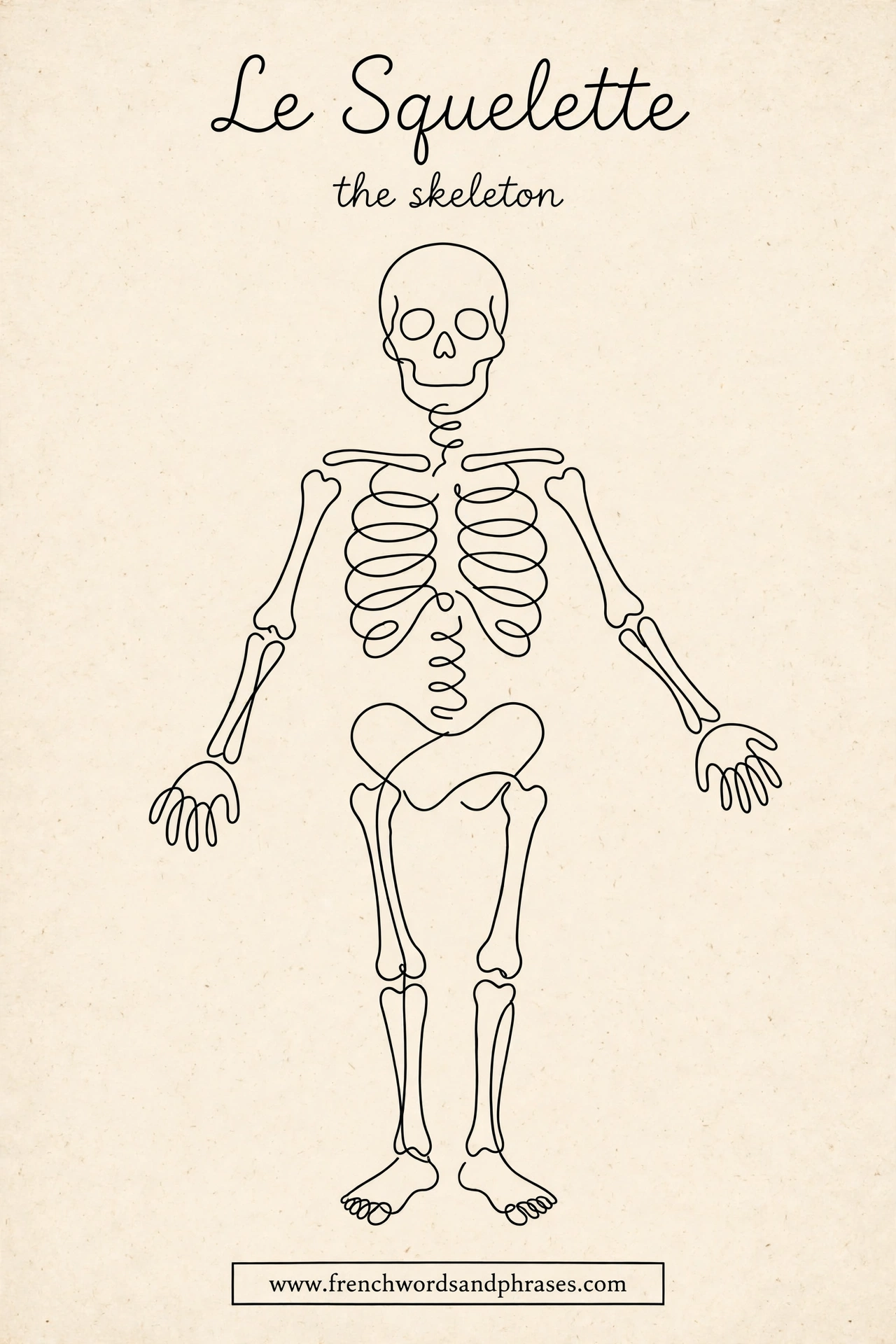
Le squelette means the skeleton.
At the back of the science classroom, in a glass case, stands the classroom’s oldest resident — grinning politely, holding up a pointer, assembled from two hundred pieces of patience: le squelette.
In this guide, you’ll learn what squelette means in English, how to use it with its articles, how to form its plural, and how it appears in everyday French. Explore French examples, English translations, and practice quizzes.
Understanding the French Noun Squelette
Squelette is a masculine French noun — beware the ending, because words in -ette are usually feminine, but not this one: le squelette, un squelette. The plural is regular: les squelettes. It names the whole frame of os (bones) that carries the body.
It means the skeleton — the complete framework of bones inside le corps, 206 of them in an adult, holding everything up and protecting le cœur and le cerveau. The word also walks into metaphor: a building has its frame, a plan has its bones, and a shameful secret is un squelette dans le placard — a skeleton in the cupboard, exactly as in English.
Gender: Masculine — despite the -ette ending
Definite article: le — le squelette (the skeleton)
Indefinite article: un — un squelette (a skeleton)
Plural: les squelettes
The count: 206 os (bones) in an adult squelette
Shared metaphor: un squelette dans le placard — a skeleton in the cupboard
English equivalents: The skeleton.
The trap is the ending: -ette sings feminine in French (la fourchette, la serviette), yet squelette is stubbornly masculine — le squelette, un squelette, ce squelette. Learn it with its article welded on, and the exception becomes automatic.
Experience the Word
Le squelette is the body’s hidden cathedral — arches, pillars and hinges assembled before birth and carried, unseen, through every day of your life.
Imagine the natural history museum: a whale’s squelette suspended from the ceiling, floating in mid-air over the visitors like a ship over a harbour.
You have not just named a frame. You have met the architecture of a person — les os, en ordre de marche.
How to Use Squelette in French: Complete Guide
Let’s explore how squelette works in French, beginning with its articles — and keeping a firm grip on that surprising masculine le.
Squelette with the Definite Article (Le, Les)
Used for the skeleton everyone is talking about — the one in the museum, the one inside you.
| Form | French |
|---|---|
| Singular | le squelette |
| Plural | les squelettes |
Example
Le squelette humain compte 206 os.
The human skeleton has 206 bones.
Squelette with the Indefinite Article (Un, Des)
Used for a skeleton in general — un squelette de dinosaure is every museum’s star.
| Form | French |
|---|---|
| Singular | un squelette |
| Plural | des squelettes |
Example
Ils ont découvert un squelette de dinosaure dans le désert.
They discovered a dinosaur skeleton in the desert.
Squelette with Quantities (Entier, Tous les os…)
A skeleton is counted whole or by its bones — French measures it complete, or piece by piece.
| Quantity | French |
|---|---|
| a whole skeleton | un squelette entier |
| the human skeleton | le squelette humain |
| a skeleton in the cupboard | un squelette dans le placard |
| all the bones of the skeleton | tous les os du squelette |
| a dinosaur skeleton | un squelette de dinosaure |
Example
Un squelette entier de mammouth domine la salle du musée.
A complete mammoth skeleton dominates the museum hall.
Quick Quiz 1
Complete the sentence:
______ squelette de ce poisson est très fin.
Reveal the answer
Le
Le squelette de ce poisson est très fin.
This fish’s skeleton is very fine — le, because squelette is masculine despite its -ette ending.
The Plural of Squelette
Squelette adds an -s in the plural — les squelettes, a whole museum of them.
| Number | French |
|---|---|
| Singular | le squelette |
| Plural | les squelettes |
Example
Les squelettes exposés au musée fascinent les enfants.
The skeletons on display at the museum fascinate the children.
Squelette with Possessive Adjectives (Mon, Ton, Son…)
Possessives agree with the noun — squelette is masculine, so mon, ton, son.
| Owner | French |
|---|---|
| my | mon squelette |
| your (tu) | ton squelette |
| his / her | son squelette |
| our | notre squelette |
| your (vous) | votre squelette |
| their | leur squelette |
Example
Ton squelette te porte toute la journée sans se plaindre.
Your skeleton carries you all day without complaining.
Quick Quiz 2
Complete the sentence:
Chaque famille a ______ squelette dans le placard. (its)
Reveal the answer
son
Chaque famille a son squelette dans le placard.
Every family has its skeleton in the cupboard.
Squelette with Demonstrative Adjectives (Ce, Ces)
Used to point: ce squelette — this skeleton, the one under the glass.
| Form | French |
|---|---|
| Singular | ce squelette |
| Plural | ces squelettes |
Example
Ce squelette de baleine mesure vingt mètres.
This whale skeleton measures twenty metres.
Squelette with Adjectives
Adjectives agree with squelette, masculine: humain, entier, fragile.
| Adjective | With Squelette |
|---|---|
| humain (human) | le squelette humain |
| entier (whole) | un squelette entier |
| vieux (old) | un vieux squelette |
| fragile (fragile) | un squelette fragile |
| complet (complete) | un squelette complet |
Example
Le squelette humain protège le cœur et le cerveau.
The human skeleton protects the heart and the brain.
Quick Quiz 3
Complete the sentence:
Elle est maigre comme ______ squelette.
Reveal the answer
un
Elle est maigre comme un squelette.
She is as thin as a skeleton — un, masculine, every time.
Everyday Expressions with Squelette
Secrets, museums and thin frames — the squelette phrases of daily life.
| Expression | In English |
|---|---|
| un squelette dans le placard | a skeleton in the cupboard |
| maigre comme un squelette | as thin as a rake, skin and bone |
| le squelette humain | the human skeleton |
| un squelette de dinosaure | a dinosaur skeleton |
Example
Ce politicien cache un squelette dans le placard.
That politician is hiding a skeleton in the cupboard.
Words from the Same Family as Squelette
Bones, skulls and spines — the words that travel with squelette.
| French | In English |
|---|---|
| l’os | the bone |
| le crâne | the skull |
| la colonne vertébrale | the spine |
| osseux | bony, of bone |
| squelettique | skeletal, gaunt |
| la côte | the rib |
Example
Le crâne est la partie la plus connue du squelette.
The skull is the best-known part of the skeleton.
Quick Quiz 4
What is un squelette dans le placard?
Reveal the answer
A hidden, shameful secret — the same image as in English, a skeleton shut away in a cupboard.
Personne ne connaît son squelette dans le placard.
Nobody knows his skeleton in the cupboard.
Squelette in Everyday French: Real-Life Examples
Now that you know the word, let’s see how squelette appears in everyday French.
Example 1 — At the museum
Le squelette du dinosaure impressionne tous les visiteurs.
The dinosaur’s skeleton impresses all the visitors.
Example 2 — In class
Le professeur montre le squelette humain aux élèves.
The teacher shows the human skeleton to the pupils.
Example 3 — A secret
Cette famille cache un squelette dans le placard.
This family is hiding a skeleton in the cupboard.
Example 4 — Protection
Le squelette protège les organes les plus fragiles.
The skeleton protects the most fragile organs.
Example 5 — Very thin
Après sa maladie, il était maigre comme un squelette.
After his illness, he was as thin as a rake.
Example 6 — Archaeology
Les chercheurs assemblent le squelette pièce par pièce.
The researchers are assembling the skeleton piece by piece.
Beyond Translation: The Meaning of Squelette
The squelette is where anatomy meets theatre: every French schoolchild has met the classroom skeleton, that grinning teaching assistant in the glass case, and every French adult knows the metaphor it inspired — the secret in the cupboard. The word even escaped the body: architects and engineers speak of a building’s frame in the same breath, because a squelette is, at heart, whatever lets a thing stand up.
To say squelette is to name the part of us built to last — the frame that remains when everything soft has gone.
It evokes museum whales and Halloween costumes, dinosaur halls and family secrets — bones, holding their stories.
How to Remember the French Noun Squelette
Remember it this way: Squelette is the skeleton — masculine against all expectations: le squelette, un squelette, 206 os strong.
- You defy the ending — -ette looks feminine, but it is le squelette.
- You count the frame — 206 os in the adult squelette.
- You hide the secret — un squelette dans le placard, a skeleton in the cupboard.
The key idea is le squelette — the skeleton (masculine, despite -ette).
Test Your Knowledge of Squelette
Let’s see how much you’ve learned. Try answering these questions before revealing the answers.
Question 1
Is squelette masculine or feminine?
Reveal the answer
Masculine — le squelette, un squelette, despite the -ette ending.
Question 2
How many bones are there in the adult human skeleton?
Reveal the answer
206 — le squelette humain compte 206 os.
Question 3
Translate: Every family has a skeleton in the cupboard.
Reveal the answer
Chaque famille a un squelette dans le placard.
Question 4
What is le crâne?
Reveal the answer
The skull — the part of the squelette that protects le cerveau.
Question 5
Complete the sentence:
______ squelette mesure vingt mètres. (This)
Reveal the answer
Ce
Ce squelette mesure vingt mètres.
This skeleton measures twenty metres.
Your Final Challenge
Can You Use It?
How would you say this in French?
“The human skeleton protects the heart and the brain.”
Reveal the answer
Le squelette humain protège le cœur et le cerveau.
The human skeleton protects the heart and the brain.
A little French. A little curiosity. A richer everyday life.
LEARN FRENCH ONE WORD AT A TIME