A French Word to Live By
Translate Sel to English
/sɛl/
Le sel means the salt.
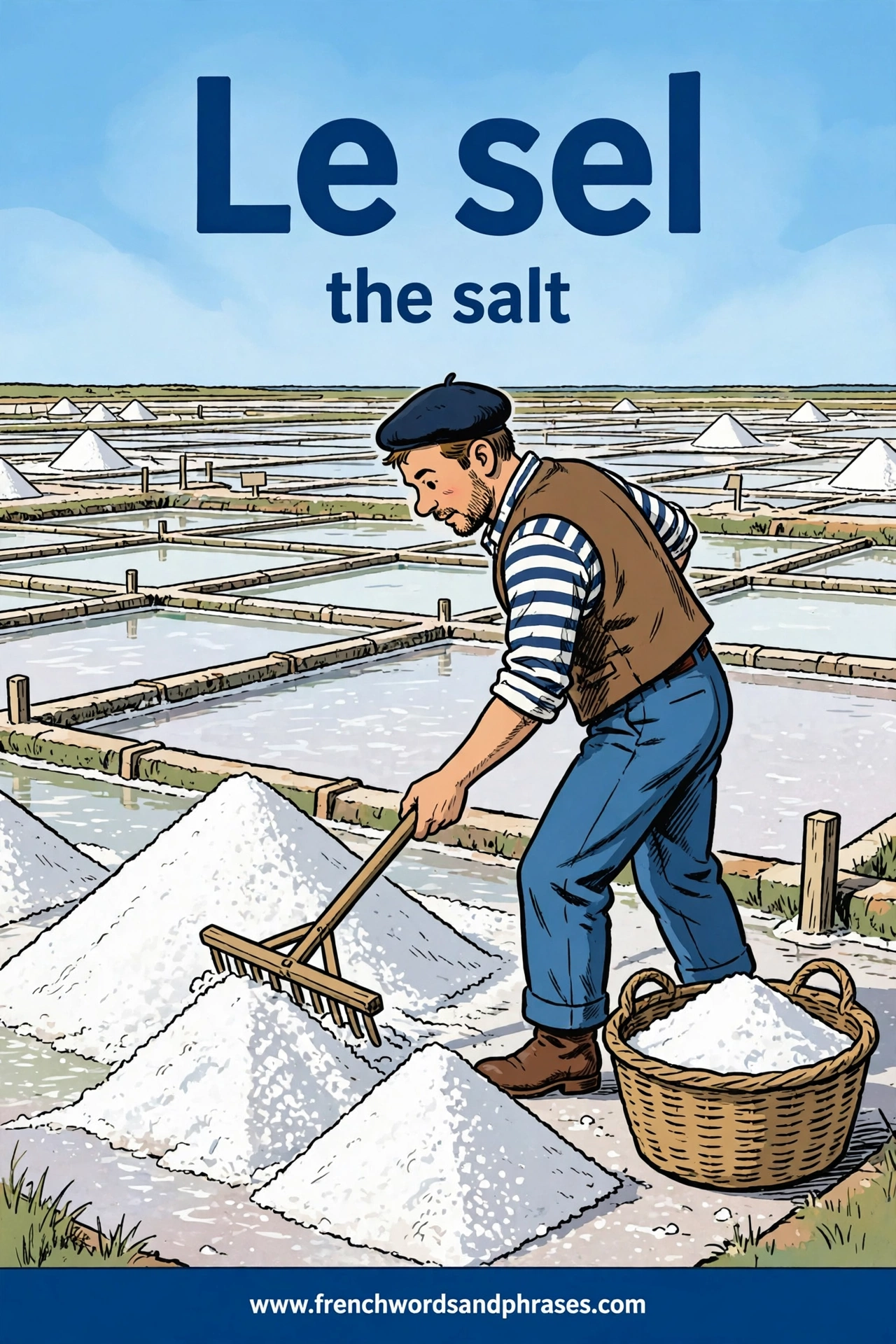
A pinch between finger and thumb over the pot, white pyramids drying in the Guérande marshes, the shaker standing guard on every table: le sel, salt — the oldest seasoning on earth, the mineral that made food keep, roads passable and wages worth the name.
In this guide, you’ll learn what sel means in English, how to use it with its articles, how to form its plural, and how it appears in everyday French. Explore French examples, English translations, and practice quizzes.
Understanding the French Noun Sel
Sel is a masculine French noun, learned with its article: le sel, du sel. It comes straight from the Latin sal — the word behind salary, since Roman soldiers were paid to buy it, and behind salade, the salted greens. French keeps the word for the table, the sea and the chemist’s shelf alike.
It means salt — the white mineral of seasoning: une pincée de sel, a pinch of salt, le sel de mer, sea salt, la fleur de sel, the prized flaky salt skimmed from the marshes of Guérande and Camargue. In the kitchen it is measured and warned about: mettre du sel, to add salt, trop de sel, too much salt, sans sel, unsalted. Chemistry widens the family: les sels minéraux, mineral salts, les sels de bain, bath salts — and wit itself is seasoned: le sel de la conversation, the salt, the spice, of the conversation.
Gender: Masculine — le sel
Definite article: le — le sel (the salt)
Indefinite article: un — un sel (a salt, in chemistry)
Plural: les sels — mineral salts, bath salts; table salt is usually uncountable
Spelling note: from Latin sal — the root of salary and of salade, salted greens
The treasure: la fleur de sel — the fine flakes skimmed by hand from salt marshes
English equivalents: The salt.
At table, salt takes the partitive: du sel, some salt, passe-moi le sel, pass me the salt — the specific shaker on the table. Quantities are pinches and spoonfuls: une pincée de sel, une cuillère de sel. The adjective is salé, salty — and beware, salé also describes a steep bill: une addition salée. To salt is saler: salez l’eau des pâtes, salt the pasta water.
Experience the Word
Sel is the smallest ingredient with the longest history: empires taxed it, caravans crossed deserts for it, and a pinch of it still decides whether dinner sings or mumbles.
Imagine the paludier in the Guérande marshes at evening, raking la fleur de sel from the pans in white drifts — the same harvest his family has gathered, unchanged, for a thousand summers.
You have not just named a seasoning. You have named preservation, wages and wit — le sel, salt, the white gold of the table.
How to Use Sel in French: Complete Guide
Let’s explore how sel works in French, beginning with its articles — le sel, du sel, une pincée de sel.
Sel with the Definite Article (Le, Les)
Used for the specific salt — the shaker on the table, the salt in the dish.
| Form | French |
|---|---|
| Masculine singular | le sel |
| Plural | les sels |
Example
Passe-moi le sel, s’il te plaît.
Pass me the salt, please.
Sel with the Partitive (Du sel…)
Salt as an ingredient takes the partitive: du sel, un peu de sel, pas de sel.
| Quantity | French |
|---|---|
| some salt | du sel |
| a pinch of salt | une pincée de sel |
| too much salt | trop de sel |
| without salt | sans sel |
| a spoonful of salt | une cuillère de sel |
Example
Ajoute une pincée de sel à la soupe.
Add a pinch of salt to the soup.
Kinds of Sel (De mer, De bain…)
French names its salts by their source — marsh, mine, bath and laboratory.
| Kind | French |
|---|---|
| sea salt | le sel de mer |
| the flower of salt (fine flakes) | la fleur de sel |
| table salt | le sel de table |
| bath salts | les sels de bain |
| mineral salts | les sels minéraux |
Example
La fleur de sel de Guérande est célèbre dans le monde entier.
The fleur de sel of Guérande is famous throughout the world.
Quick Quiz 1
Complete the sentence:
______ sel est sur la table, près du poivre. (the)
Reveal the answer
Le
Le sel est sur la table, près du poivre.
The salt is on the table, next to the pepper — sel is masculine, so le.
The Plural of Sel
Sel is usually uncountable at table, but the plural les sels is real — for the chemist’s and the bathroom’s salts.
| Number | French |
|---|---|
| Singular | le sel |
| Plural | les sels |
Example
Les sels minéraux sont bons pour la santé.
Mineral salts are good for your health.
Sel with Possessive Adjectives (Mon, Ton, Son…)
Possessives agree with the noun: sel is masculine, so mon, ton, son in the singular.
| Owner | French |
|---|---|
| my | mon sel |
| your (tu) | ton sel |
| his / her | son sel |
| our | notre sel |
| your (vous) | votre sel |
| their | leur sel |
Example
Le paludier récolte son sel à la fin de l’été.
The salt worker harvests his salt at the end of summer.
Quick Quiz 2
Complete the sentence:
Elle met toujours ______ sel avant de goûter. (her)
Reveal the answer
son
Elle met toujours son sel avant de goûter.
She always adds her salt before tasting — son, because sel is masculine.
Sel with Demonstrative Adjectives (Ce, Ces)
Used to point: ce sel, this salt — this marsh’s, this maker’s.
| Form | French |
|---|---|
| Masculine singular | ce sel |
| Plural | ces sels |
Example
Ce sel vient des marais de Camargue.
This salt comes from the marshes of the Camargue.
Sel with Adjectives
Adjectives agree with sel — masculine singular: du sel fin, le sel gris.
| Adjective | With Sel |
|---|---|
| fin (fine) | du sel fin |
| gros (coarse) | du gros sel |
| gris (grey, unrefined) | le sel gris |
| marin (marine, sea) | le sel marin |
| iodé (iodised) | du sel iodé |
Example
Le gros sel sert à saler l’eau des pâtes.
Coarse salt is used to salt the pasta water.
Quick Quiz 3
Complete the sentence:
Elle préfère le sel ______ de Guérande. (grey)
Reveal the answer
gris
Elle préfère le sel gris de Guérande.
She prefers the grey salt of Guérande — gris, masculine, to agree with sel.
Everyday Expressions with Sel
Kitchens, marshes and wit — the sel phrases of daily life.
| Expression | In English |
|---|---|
| une pincée de sel | a pinch of salt |
| la fleur de sel | the fine flaked salt, skimmed by hand |
| mettre son grain de sel | to put in one’s two cents (to chip in unasked) |
| le sel de la conversation | the spice, the wit of the conversation |
| sans sel | unsalted; bland |
Example
Il met toujours son grain de sel dans nos discussions.
He always puts his two cents into our discussions.
Words from the Same Family as Sel
Salting and saltiness — the words that travel with sel.
| French | In English |
|---|---|
| saler | to salt (the verb) |
| salé | salty; steep, for a bill (the adjective) |
| la salière | the salt cellar, the shaker |
| le marais salant | the salt marsh |
| le poivre | the pepper — sel’s table partner |
Example
La salière est vide, remplis-la de sel fin.
The salt cellar is empty, fill it with fine salt.
Quick Quiz 4
What is la fleur de sel?
Reveal the answer
The fine flaked salt skimmed by hand from the surface of salt marshes — the treasure of Guérande.
Une pincée de fleur de sel finit le plat.
A pinch of fleur de sel finishes the dish.
Sel in Everyday French: Real-Life Examples
Now that you know the word, let’s see how sel appears in everyday French.
Example 1 — At table
Passe-moi le sel et le poivre, s’il te plaît.
Pass me the salt and pepper, please.
Example 2 — In the kitchen
N’oublie pas de saler les pommes de terre.
Don’t forget to salt the potatoes.
Example 3 — Too much
Cette soupe a trop de sel.
This soup has too much salt.
Example 4 — The marshes
Le sel de Guérande se récolte en été.
Guérande salt is harvested in summer.
Example 5 — Health
Le médecin lui conseille un régime sans sel.
The doctor advises him a salt-free diet.
Example 6 — Wit
Son humour est le sel de la soirée.
His humour is the spice of the evening.
Beyond Translation: The Meaning of Sel
Salt built the French state’s finances and broke them: la gabelle, the hated salt tax, forced every household to buy its ration of sel from the king — and helped light the Revolution. The word reaches further still: Latin sal paid the soldiers (salary), seasoned the greens (salade), and in French it seasoned speech itself — le sel attique, Attic salt, was the sharp wit of Athens, and mettre son grain de sel remains how every French conversation gets its volunteer contributor.
To say sel is to taste history in a pinch.
It evokes the white pyramids of Guérande, the shaker passed hand to hand, and the joke that gives a dinner its sparkle.
How to Remember the French Noun Sel
Remember it this way: Sel is salt — masculine: le sel, du sel, une pincée de sel, and la fleur de sel as the treasure.
- Always masculine — le sel, du sel, mon sel.
- The pinch — une pincée de sel; the verb is saler, the adjective salé.
- The idiom — mettre son grain de sel, to put in one’s two cents.
The key idea is le sel — salt, masculine; une pincée de sel = a pinch of salt.
Test Your Knowledge of Sel
Let’s see how much you’ve learned. Try answering these questions before revealing the answers.
Question 1
Is sel masculine or feminine?
Reveal the answer
Masculine — le sel, du sel.
Question 2
How do you say a pinch of salt?
Reveal the answer
Une pincée de sel.
Question 3
Translate: Pass me the salt, please.
Reveal the answer
Passe-moi le sel, s’il te plaît.
Question 4
What does mettre son grain de sel mean?
Reveal the answer
To put in one’s two cents — to chip in with an unasked opinion.
Question 5
Complete the sentence:
______ sels de bain parfument l’eau. (the)
Reveal the answer
Les
Les sels de bain parfument l’eau.
The bath salts scent the water.
Your Final Challenge
Can You Use It?
How would you say this in French?
“Add a pinch of salt to the soup.”
Reveal the answer
Ajoute une pincée de sel à la soupe.
Add a pinch of salt to the soup.
A little French. A little curiosity. A richer everyday life.
LEARN FRENCH ONE WORD AT A TIME