A French Word to Live By
Translate Presque to English
/pʁɛsk/
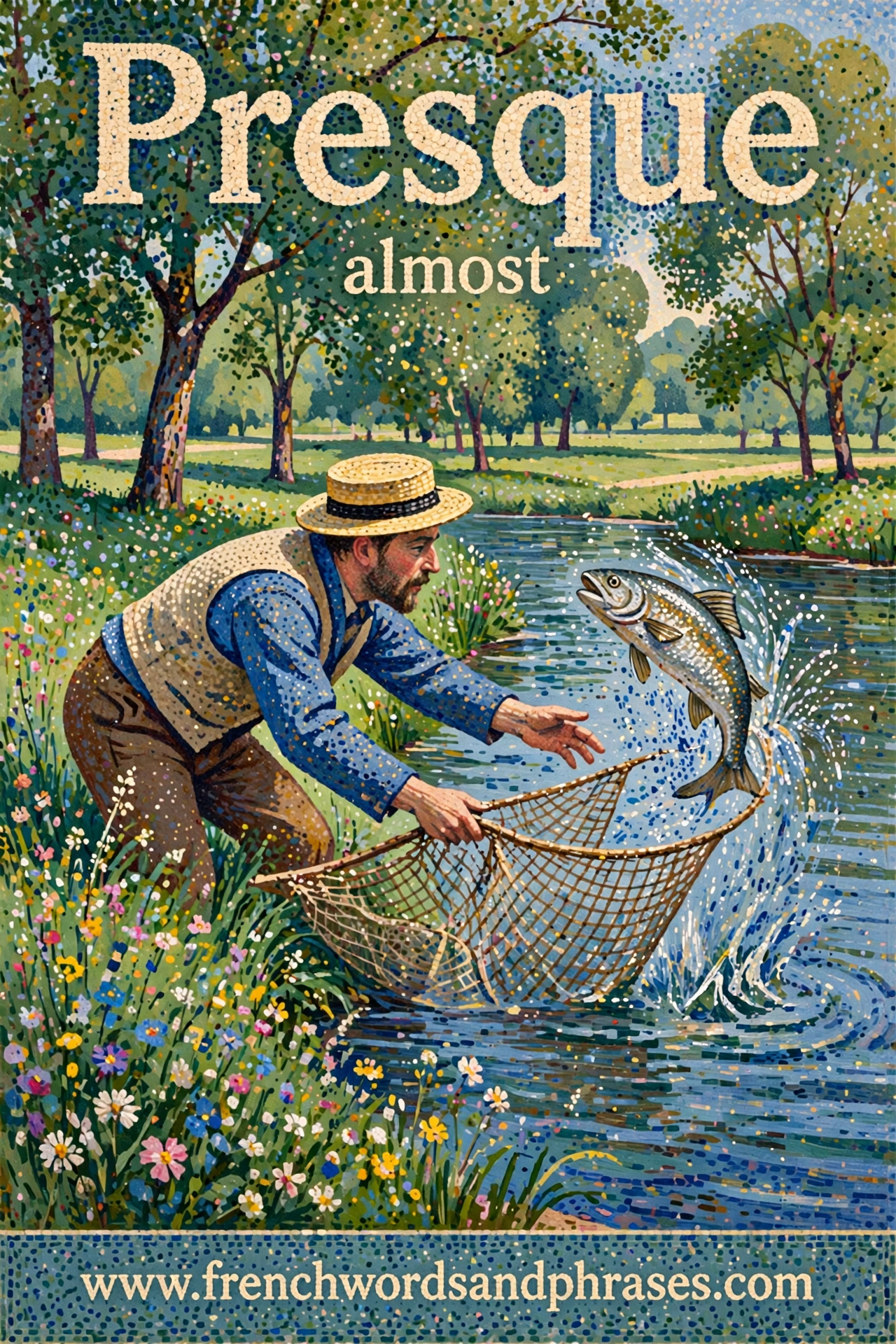
Presque means almost.
The platform clock shows two minutes to departure, and the traveller comes running with her case banging at her heels. « Presque ! » laughs the guard, holding the door — almost there, almost late, almost a story to tell.
In this guide, you’ll learn what presque means in English, how it works before numbers, times and verbs, how presque jamais and presque toujours soften absolutes, and how it differs from à peu près. Explore French examples, English translations, and practice quizzes.
Understanding the French Adverb Presque
Presque is a French adverb of degree and approximation. It stands just short of the finishing line: almost, nearly. It can shrink a number, soften an absolute, or hold a whole action one breath from completion.
It means almost, nearly. Presque midi — almost midday. J’ai presque fini — I have almost finished. Presque is the adverb of the near-miss and the near-arrival: everything it touches is one small step from complete, and that small step is exactly what it measures.
Type: Adverb of degree and approximation
Answers the question: How close? — one step short of complete
Changes form: Never — presque is invariable
English equivalents: Almost; nearly; (presque pas) hardly.
One important usage detail: for a past event that nearly happened — he almost fell — everyday French often prefers faillir: il a failli tomber. Presque still works before nouns, numbers, adjectives and absolutes: presque rien, almost nothing; presque toujours, almost always.
Experience the Word
Presque is the adverb of the held breath — the ball rolling towards the goal, the last page of the novel, the train appearing at the end of the platform.
Imagine the kitchen before the guests arrive: presque prêt, presque parfait — one candle still to light, one chair still to place, and the cook smiling at the door.
You have not just said near. You have measured the last small distance before the finish.
How to Use Presque in French: Complete Guide
Let’s explore how presque works in French, beginning with the whole word on one card.
Presque at a Glance
Before the details, here is the whole word on one card.
The Whole Word on One Card
Meaning, type, position and form — presque in four lines.
| Point | Presque |
|---|---|
| Meaning | almost, nearly |
| Type | adverb of degree and approximation |
| Usual position | before the word it brings close to the line |
| Form | invariable — never changes |
Example
Il est presque midi.
It is almost midday.
Presque Before Numbers and Times
Presque loves a number: it rounds the count up to the edge of the round figure, in ages, prices, distances and hours.
| French | In English |
|---|---|
| presque cent personnes | almost a hundred people |
| presque dix ans | almost ten years |
| presque midi | almost midday |
| presque trois heures | almost three hours, nearly three o’clock |
| presque deux cents euros | almost two hundred euros |
Example
Elle a presque dix ans.
She is almost ten years old.
Quick Quiz 1
True or false: presque midi means exactly midday.
Reveal the answer
False
Presque midi is almost midday — a few minutes short of it.
Il est presque midi, déjeunons bientôt. — It is almost midday, let’s have lunch soon.
Presque with Absolutes: Almost Always, Almost Never
Before the great absolutes — toujours, jamais, rien, tout, personne — presque softens the total into a near-total, and French uses these pairs constantly.
| French | In English |
|---|---|
| presque toujours | almost always |
| presque jamais | almost never |
| presque rien | almost nothing |
| presque tout | almost everything |
| presque personne | almost nobody |
Example
Il ne reste presque rien dans le frigo.
There is almost nothing left in the fridge.
Presque Before Adjectives and Verbs
Presque can stand before an adjective that is nearly true, and before a verb in the present or the perfect to say the action is nearly done.
| Situation | Example |
|---|---|
| Before an adjective | Le travail est presque fini. |
| With the perfect tense | J’ai presque terminé le rapport. |
| Before a place word | Nous sommes presque à la maison. |
| A near state | Elle est presque prête. |
Example
Nous sommes presque arrivés, encore cinq minutes.
We have almost arrived, five more minutes.
Quick Quiz 2
Complete the sentence:
J’ai ______ fini mes devoirs. (almost)
Reveal the answer
presque
J’ai presque fini mes devoirs.
I have almost finished my homework.
Presque Pas: Hardly, Barely
Add pas and presque turns downward: presque pas means hardly, barely — the amount shrinks to nearly nothing.
| French | In English |
|---|---|
| presque pas de bruit | hardly any noise |
| je ne dors presque pas | I hardly sleep |
| presque pas d’argent | hardly any money |
| on ne voit presque pas la mer | you can barely see the sea |
Example
Il fait presque pas de vent aujourd’hui.
There is hardly any wind today.
Presque or À Peu Près? Almost, or Roughly?
Two approximators to keep apart: presque stops just short of the exact figure, while à peu près hovers around it — roughly, more or less.
| Aspect | The Difference |
|---|---|
| presque cent | almost a hundred — just under, approaching |
| à peu près cent | about a hundred — roughly, either side |
| presque prêt | almost ready — completion approaching |
| à peu près prêt | more or less ready — an estimate of state |
Example
Il y avait à peu près cinquante invités, presque tous de la famille.
There were about fifty guests, almost all of them family.
Quick Quiz 3
What does presque pas mean?
Reveal the answer
Hardly, barely
Je ne dors presque pas cette semaine.
I am hardly sleeping this week.
Faillir: The Partner for Near-Misses in the Past
For the dramatic near-miss — he almost fell, she almost missed the train — French reaches for the verb faillir plus an infinitive, a construction presque cannot quite replace.
| French | In English |
|---|---|
| il a failli tomber | he almost fell |
| elle a failli rater le train | she almost missed the train |
| j’ai failli oublier | I almost forgot |
| on a failli gagner | we almost won |
Example
J’ai failli rater le train ce matin !
I almost missed the train this morning!
Watch Out: Presque Never Means the English Presently
A spelling trap for English eyes: presque looks a little like presently, but it means almost — time words live elsewhere in French.
| You want to say | Correct French |
|---|---|
| almost ready | presque prêt |
| currently, at present | actuellement, en ce moment |
| soon | bientôt |
| almost nothing | presque rien |
Example
Le dîner est presque prêt.
Dinner is almost ready.
Quick Quiz 4
Translate: There is almost nothing left.
Reveal the answer
Il ne reste presque rien.
Presque rien — almost nothing — is one of the pairs French uses every day.
Presque in Everyday French: Real-Life Examples
Now that you know the word, let’s see how presque appears in everyday French.
Example 1 — At home
Le dîner est presque prêt.
Dinner is almost ready.
Example 2 — Travel
Nous sommes presque arrivés.
We have almost arrived.
Example 3 — At school
J’ai presque fini mes devoirs.
I have almost finished my homework.
Example 4 — Weather
Il ne pleut presque jamais ici en été.
It almost never rains here in summer.
Example 5 — Shopping
Ce sac coûte presque cent euros.
This bag costs almost a hundred euros.
Example 6 — Feelings
Il ne reste presque rien à faire.
There is almost nothing left to do.
Beyond Translation: The Meaning of Presque
Every language keeps a word for the almost — the near goal, the near disaster, the last page before the end. French presque does it with a shrug of elegance, softening even the absolutes: presque toujours, presque jamais, presque rien.
To say presque is to stand one step from the line and measure the step.
And for the step that nearly went wrong, French keeps a whole verb in reserve — faillir — as if the near-miss deserved a drama of its own.
How to Remember the French Adverb Presque
Remember it this way: Presque means almost — it stands just short of the finishing line, before numbers, absolutes and verbs alike.
- You approach a number — presque midi, presque cent personnes.
- You soften an absolute — presque toujours, presque jamais, presque rien.
- You shrink to nothing — presque pas, hardly at all.
The key idea is almost, nearly — presque + number/adjective/verb; presque pas = hardly; near-miss in the past = faillir.
Test Your Knowledge of Presque
Let’s see how much you’ve learned. Try answering these questions before revealing the answers.
Question 1
What does presque mean?
Reveal the answer
Almost, nearly — one step short of complete.
Question 2
How do you say almost always and almost never in French?
Reveal the answer
Presque toujours and presque jamais.
Question 3
Translate: I have almost finished.
Reveal the answer
J’ai presque fini.
Question 4
What does presque pas mean?
Reveal the answer
Hardly, barely — je ne dors presque pas, I hardly sleep.
Question 5
Complete the sentence:
Il est ______ midi. (almost)
Reveal the answer
presque
Il est presque midi.
It is almost midday.
Your Final Challenge
Can You Use It?
How would you say this in French?
“Dinner is almost ready.”
Reveal the answer
Le dîner est presque prêt.
Dinner is almost ready.
A little French. A little curiosity. A richer everyday life.
LEARN FRENCH ONE WORD AT A TIME