A French Word to Live By
Translate Particulièrement to English
/paʁ.ti.ky.ljɛʁ.mɑ̃/
Particulièrement means particularly, especially.
Everyone at the table liked the dessert, but the grandfather went back twice and asked for the recipe: « Il a particulièrement aimé le gâteau. » Particulièrement is the adverb of the singled-out case — it takes one person, one day, one detail, and lifts it above the general rule.
In this guide, you’ll learn what particulièrement means in English, how it is built from particulier with the -ment ending, where it stands in the sentence, and how it differs from surtout and spécialement. Explore French examples, English translations, and practice quizzes.
Understanding the French Adverb Particulièrement
Particulièrement is a French adverb of degree — built, like most French adverbs, from the adjective particulier (particular) plus the ending -ment: literally « in a particular manner ». It is invariable, as all adverbs are: no gender, no plural, one form for every sentence. It singles out: particulièrement + adjective, or placed before the verb’s object of attention — what follows it is the exception that matters most.
It means particularly, especially — more than the rest, above the general case: particulièrement beau, particularly beautiful; particulièrement difficile, particularly difficult; j’aime particulièrement ce quartier, I particularly like this neighbourhood. In the negative it softens a refusal politely: pas particulièrement, not particularly — the gentle French way of saying « not really » without slamming the door.
Type: Adverb of degree — singling out one case above the rest
Answers the question: À quel point ? — To what degree? Particularly, especially
Changes form: Never — particulièrement is invariable
English equivalents: Particularly; especially; (in the negative) not particularly, not really.
One important usage detail: particulièrement most often stands directly before the adjective it strengthens — particulièrement intéressant, particulièrement fatigué — or before the verb phrase it singles out. For « especially » at the head of a sentence, French usually prefers surtout: Surtout, ne soyez pas en retard. Keep particulièrement for the singled-out detail inside the sentence, and learn the polite negative whole: « Pas particulièrement. »
Experience the Word
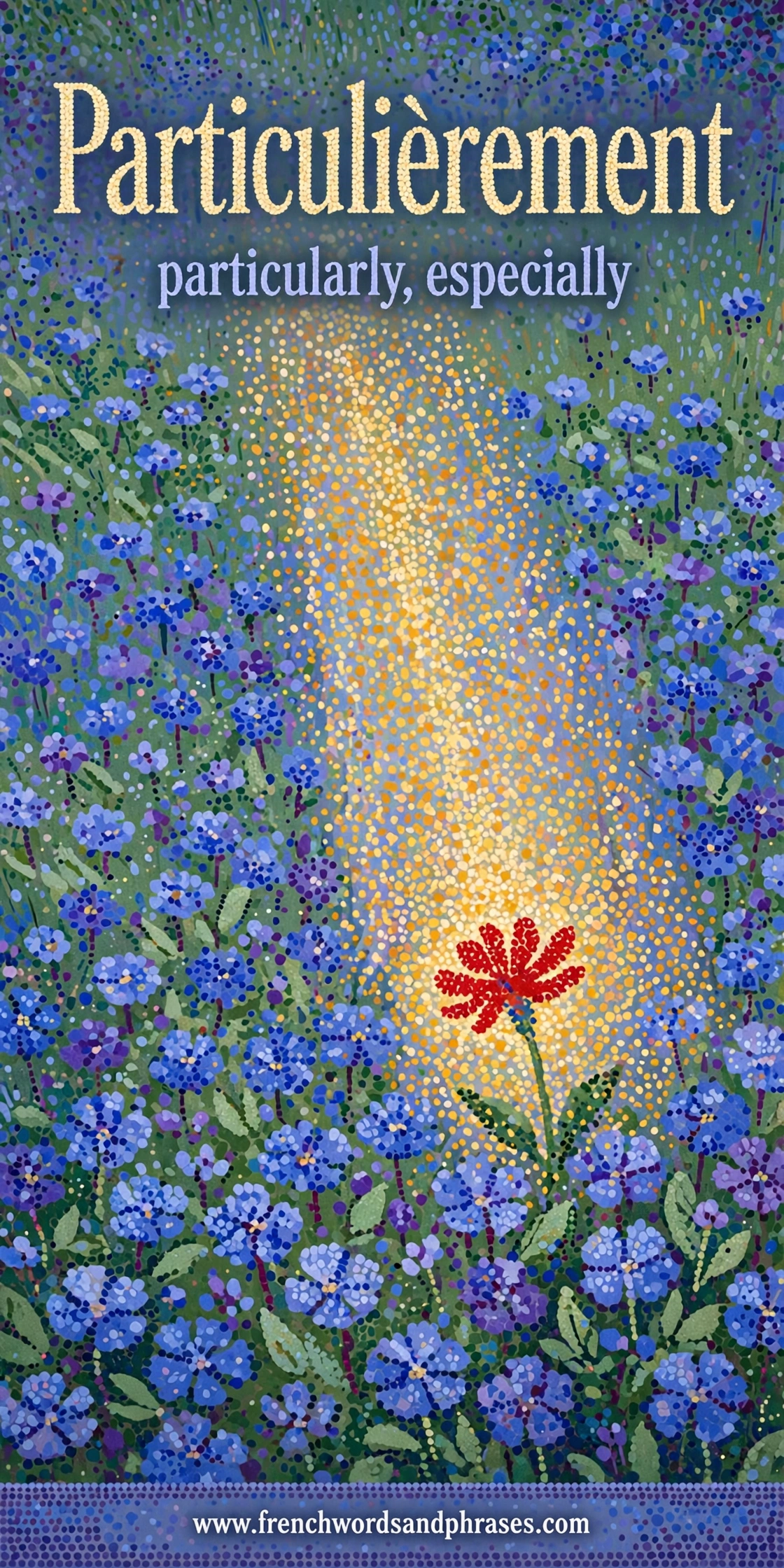
Particulièrement is the adverb of the spotlight: the whole stage is lit, but one figure stands in the brighter circle.
Imagine the teacher reading the class list of good essays and pausing on one name: « Un devoir est particulièrement réussi » — twenty-nine pupils were fine, one was singled out, and the whole room felt the difference.
You have not just strengthened a word. You have pointed at the exception — particulièrement, this one above all.
How to Use Particulièrement in French: Complete Guide
Let’s explore how particulièrement works in French, beginning with the whole word on one card.
Particulièrement at a Glance
Before the details, here is the whole word on one card.
The Whole Word on One Card
Meaning, type, position and form — particulièrement in four lines.
| Point | Particulièrement |
|---|---|
| Meaning | particularly, especially — above the general case |
| Type | adverb of degree — invariable |
| Usual position | before the adjective — particulièrement difficile |
| Form | particulièrement — never changes |
Example
Ce chapitre est particulièrement difficile.
This chapter is particularly difficult.
How Particulièrement Is Built: Particulier + -ment
Particulièrement is particulier with the adverb ending -ment — the standard recipe of French adverbs.
| Piece | Particulièrement |
|---|---|
| The adjective | particulier — particular |
| The ending | -ment — the adverb maker |
| The family | particulièrement, en particulier, un particulier |
| The spelling | the -ière- keeps its accent: particulièrement |
Example
En particulier, j’aime le début du livre.
In particular, I like the beginning of the book.
Quick Quiz 1
From which adjective is particulièrement built?
Reveal the answer
particulier
Particulier + -ment = particulièrement — in a particular manner.
Particularly.
Where Particulièrement Goes: Before the Adjective
Particulièrement stands directly before the word it singles out — most often an adjective or a past participle.
| Pattern | Example |
|---|---|
| Before an adjective | particulièrement beau — particularly beautiful |
| Before a participle | particulièrement aimé — particularly loved |
| With a verb | j’aime particulièrement ce lieu — I particularly like this place |
| At the head of a sentence | Surtout, … — French prefers surtout there |
Example
Elle est particulièrement douée pour la musique.
She is particularly gifted for music.
Particulièrement in the Negative: Pas Particulièrement
The negative form is a small masterpiece of French politeness: pas particulièrement means « not particularly » — a soft no.
| Pattern | Example |
|---|---|
| Not particularly (adjective) | pas particulièrement chaud — not particularly warm |
| Not particularly (answer) | « Tu aimes ? — Pas particulièrement. » — Not particularly. |
| Not particularly interested | pas particulièrement intéressé — not particularly interested |
| Softer than non | pas particulièrement = not really, without harshness |
Example
Il n’est pas particulièrement intéressé par le projet.
He is not particularly interested in the project.
Quick Quiz 2
How do you say ‘particularly difficult’?
Reveal the answer
particulièrement difficile
Particulièrement stands directly before the adjective it strengthens.
Particularly difficult.
More Particulièrement: Comparing with Particulièrement
Particulièrement is itself a strengthener, but French can still grade around it with plus, moins and aussi… que.
| Degree | Example |
|---|---|
| As particularly … as | aussi particulièrement … que — as particularly … as |
| More particularly | plus particulièrement — more particularly, above all |
| Less particularly | moins particulièrement — less particularly |
| Above all (reinforced) | tout particulièrement — most particularly of all |
Example
Je te remercie tout particulièrement pour ton aide.
I thank you most particularly for your help.
Everyday Expressions with Particulièrement
Particulièrement appears wherever French singles something out — praise, warnings and polite refusals.
| Expression | In English |
|---|---|
| particulièrement difficile | particularly difficult |
| tout particulièrement | most particularly, above all |
| pas particulièrement | not particularly, not really |
| en particulier | in particular (the cousin phrase) |
| j’aime particulièrement | I particularly like |
| particulièrement adapté | particularly suited |
Example
Ce livre est particulièrement adapté aux débutants.
This book is particularly suited to beginners.
Quick Quiz 3
What does pas particulièrement mean as a complete answer?
Reveal the answer
Not particularly — not really
Pas particulièrement — the polite, softened no.
Not particularly.
Particulièrement and Its Neighbours
Particulièrement keeps company with the other adverbs of emphasis — each with its own position and flavour.
| French | In English |
|---|---|
| surtout | above all, especially — loves the head of the sentence |
| spécialement | specially, especially — for a special purpose |
| très | very — the plain strengthener |
| vraiment | really, truly |
| en particulier | in particular — the noun phrase cousin |
| notamment | notably, in particular — formal lists |
Example
Surtout en tête de phrase, particulièrement devant l’adjectif.
Surtout at the head of the sentence, particulièrement before the adjective.
Watch Out: The Traps Around Particulièrement
The traps here are position and the false friend: English « particularly » and French particulièrement agree in meaning but not always in place.
| Trap | The truth |
|---|---|
| Opening a sentence with it | for « especially » first, French prefers surtout: Surtout, écoute-moi |
| Forgetting it never changes | particulièrement is invariable — no feminine, no plural, ever |
| Confusing with spécialement | spécialement = for a special purpose; particulièrement = above the general case |
| The spelling | particulièrement keeps the è of particulière + -ment: par-ti-cu-liè-re-ment |
Example
Elle est particulièrement, et non spécialement, douée : c’est un don, pas un but.
She is particularly, not specially, gifted: it is a gift, not a purpose.
Quick Quiz 4
How do you say ‘most particularly, above all’ with particulièrement?
Reveal the answer
tout particulièrement
Tout particulièrement — the reinforced form, for thanks and emphasis.
Most particularly.
Particulièrement in Everyday French: Real-Life Examples
Now that you know the word, let’s see how particulièrement appears in everyday French.
Example 1 — Praise
Ton gâteau est particulièrement réussi.
Your cake is particularly successful.
Example 2 — Weather
Il fait particulièrement froid ce matin.
It is particularly cold this morning.
Example 3 — Taste
J’aime particulièrement ce quartier de la ville.
I particularly like this part of town.
Example 4 — Polite no
Tu veux venir ? — Pas particulièrement.
Do you want to come? — Not particularly.
Example 5 — Work
Ce dossier est particulièrement urgent.
This file is particularly urgent.
Example 6 — Thanks
Merci, tout particulièrement à Marie.
Thank you, most particularly to Marie.
Beyond Translation: The Meaning of Particulièrement
Particulièrement is built on a philosophy word: particulier, the particular, the single case — against général, the general rule. French thought has always loved the tension between the two, and the adverb carries it into daily speech: to say particulièrement is to declare that the general truth is not the whole truth, and that this one case, this one evening, this one person stands out from it. Even its negative is philosophical in its politeness: pas particulièrement — the rule holds, but only just.
Particulièrement is the adverb of the exception that proves the speaker was paying attention.
Learn it beside surtout and en particulier, and you can spotlight anything in French with precision.
How to Remember the French Adverb Particulièrement
Remember it this way: Particulièrement is the particularly adverb — invariable, standing before the adjective, with pas particulièrement as its polite negative.
- You place it before the word — particulièrement difficile, particulièrement aimé.
- You keep it invariable — particulièrement never changes, for anyone, ever.
- You soften refusals with it — pas particulièrement, not particularly, the gentle no.
The key idea is particulièrement means particularly, especially; pas particulièrement = not really.
Test Your Knowledge of Particulièrement
Let’s see how much you’ve learned. Try answering these questions before revealing the answers.
Question 1
What does particulièrement mean?
Reveal the answer
Particularly, especially — above the general case.
Question 2
Does particulièrement change for gender or number?
Reveal the answer
Never — it is an adverb, and adverbs are invariable.
Question 3
Translate: This chapter is particularly difficult.
Reveal the answer
Ce chapitre est particulièrement difficile.
Question 4
Complete the sentence:
Je te remercie ______ pour ton aide. (most particularly)
Reveal the answer
tout particulièrement
Je te remercie tout particulièrement pour ton aide.
I thank you most particularly for your help.
Question 5
Which adverb does French prefer at the head of a sentence for « especially »?
Reveal the answer
surtout — Surtout, ne soyez pas en retard.
Your Final Challenge
Can You Use It?
How would you say this in French?
“Your cake is particularly successful.”
Reveal the answer
Ton gâteau est particulièrement réussi.
Your cake is particularly successful.
A little French. A little curiosity. A richer everyday life.
LEARN FRENCH ONE WORD AT A TIME