A French Word to Live By
Translate Céans to English
/se.ɑ̃s/
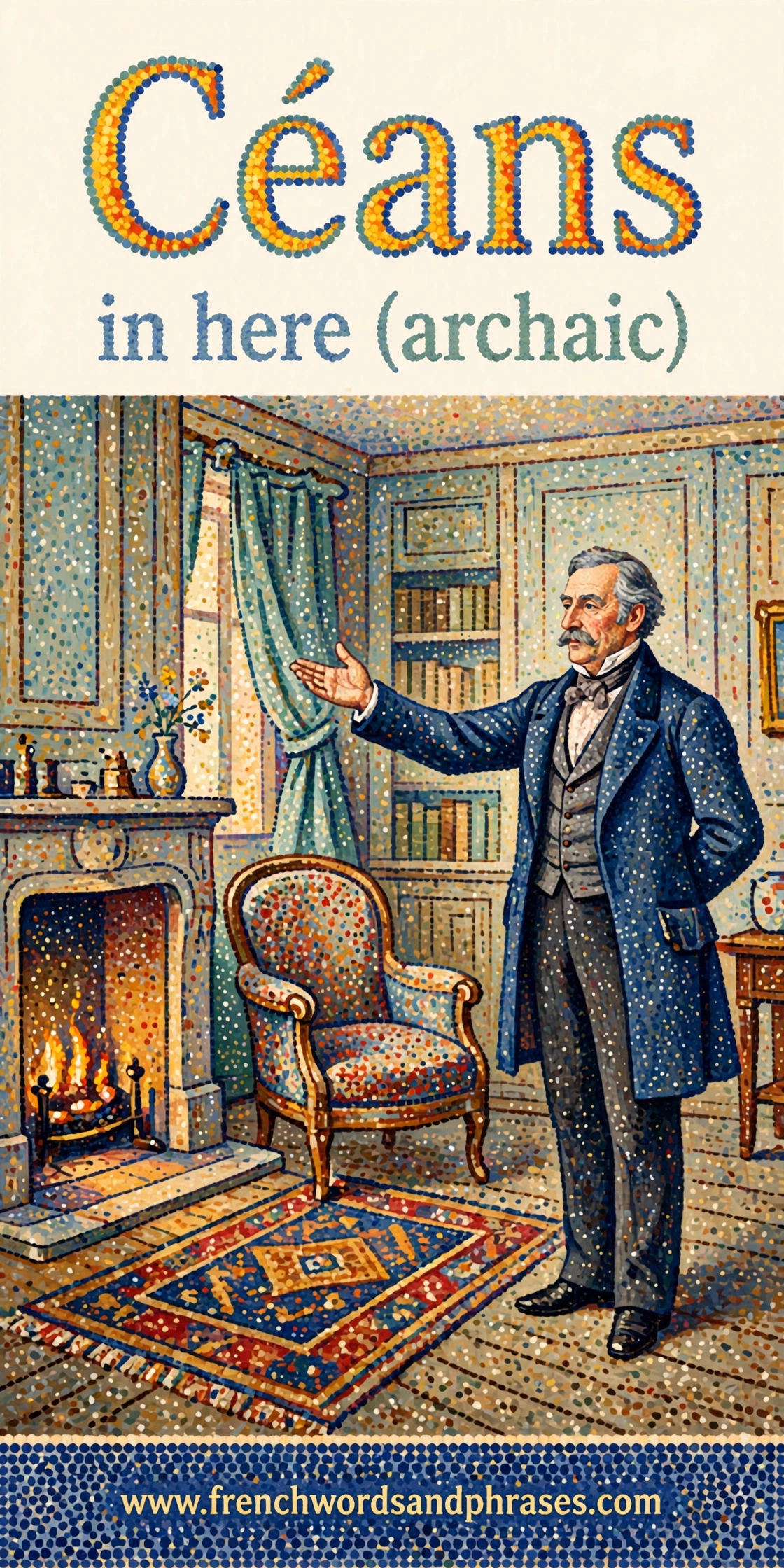
Céans means in here, within (archaic, literary).
The door of the old house swings open, the visitor steps onto the flagstones, and the steward’s voice rings out from the shadow of the hall: « Qui est le maître céans ? » — who is the master in here? Céans is an adverb from another century: it means in here, within this place, and today it survives in novels, plays and mock-solemn jokes — never in the supermarket queue.
In this guide, you’ll learn what céans means in English, where it sat in the sentences of old French, why modern French replaced it with ici and dedans, and how to recognise it — and enjoy it — in classic literature. Explore French examples, English translations, and practice quizzes.
Understanding the French Adverb Céans
Céans is a French adverb of place — and an archaic, literary one. It is built from ce, this, plus the old word enz, inside (from the Latin intus): literally « inside this ». It had a twin, léans, in there, inside that place. Céans means in here, within, inside this house or place: le maître céans, the master of this house; les gens céans, the people within. Modern French says ici, dedans or à l’intérieur — céans belongs to literature and playful archaism.
It means in here, within — inside the place where the speaker stands: qui est le maître céans ?, who is the master in here?; il n’y a personne céans, there is nobody within. It is honest to say plainly: you will read céans in Molière and in old novels, and hear it today only as a joke in period costume. Knowing it is a reader’s skill, not a speaker’s tool — and that is exactly why it is worth a page.
Type: Adverb of place — archaic and literary
Answers the question: Où ? — Where? In here, within this place
Changes form: Never — céans is invariable
English equivalents: In here; within; inside this place (in old-fashioned English: herein, in this house).
One important usage detail: céans is NOT a word for modern conversation — saying it at the bakery would raise smiles, not understanding. Its living homes are classic theatre, historical novels, and humorous imitation of old speech: « Entrez, braves gens, il y a de la soupe céans ! » — come in, good people, there is soup in here! For real life, use ici or dedans.
Experience the Word
Céans is the adverb of the creaking door — a word that arrives wearing a cloak, carrying a candle, and asking for the master of the house.
Imagine a school class reading Molière aloud. Every line is a struggle until the steward enters and demands: « Qui est le maître céans ? » — and suddenly the whole room understands, and laughs, because the word itself is the costume.
You have not just located something. You have stepped three centuries back — the place is the same, but the French is wearing knee-breeches.
How to Use Céans in French: Complete Guide
Let’s explore how céans works in French, beginning with the whole word on one card.
Céans at a Glance
Before the details, here is the whole word on one card.
The Whole Word on One Card
Meaning, type, position and form — céans in four lines.
| Point | Céans |
|---|---|
| Meaning | in here, within — inside this place |
| Type | adverb of place — archaic, literary |
| Usual position | after the noun or verb it completes — le maître céans |
| Form | invariable — never changes |
Example
Qui est le maître céans ?
Who is the master in here?
Where Céans Goes in the Sentence
Céans settles after the word it completes — most famously right after maître, in the question every steward asks at the door.
| Situation | Pattern |
|---|---|
| After a noun | le maître céans — the master of this house |
| After être | personne n’est céans — nobody is within |
| With gens | les gens céans — the people in here, the household |
| In an invitation (old style) | entrez céans — come in here (archaic) |
Example
Les gens céans sont déjà à table.
The people in here are already at table.
Quick Quiz 1
True or false: céans is a normal word for « in here » in today’s spoken French.
Reveal the answer
False
Céans is archaic and literary. Today French says ici or dedans; céans lives in classic plays, novels and jokes in period costume.
Qui est le maître céans ? — Who is the master in here?
Céans in Its World: Doors, Halls and Stewards
Céans serves wherever old French opens a door — in the theatre, the historical novel and the mock-solemn invitation.
| French | In English |
|---|---|
| le maître céans | the master of this house |
| les gens céans | the people within, the household |
| il n’y a personne céans | there is nobody in here |
| rester céans | to stay within (old style) |
| entrez céans, braves gens | come in here, good people (mock-old style) |
Example
Il n’y a personne céans, la maison est vide.
There is nobody within; the house is empty.
Dehors: The Outside Opposite
Say the place is outside, and céans hands its job to dehors — out, outside. The pair divides the old house in two: céans within the walls, dehors beyond the door.
| French | In English |
|---|---|
| céans | in here, within — archaic |
| dehors | outside, out — still fully alive |
| dedans | inside, in — the modern heir of céans |
| là-dehors | out there — modern, everyday |
Example
Céans, on est au chaud ; dehors, la neige tombe.
In here, we are warm; outside, the snow is falling.
Quick Quiz 2
Complete the sentence:
Qui est le maître ______ ? (in here, old style)
Reveal the answer
céans
Qui est le maître céans ?
Céans is the archaic adverb for « in here, within ».
How Céans Is Built: Ce + Enz, This + Inside
Céans is a little fossil with its two parts still visible: ce, this, and the old adverb enz, inside, from the Latin intus. Its twin léans was built the same way on là, there.
| Word | Its modern heir |
|---|---|
| céans (ce + enz) | ici, dedans — in here |
| léans (là + enz) | là-dedans — in there (also archaic) |
| enz (old French) | dedans, à l’intérieur — inside |
| ce | this — unchanged in modern French |
Example
Céans dit « dans ceci » ; léans disait « dans cela ».
Céans says « inside this »; léans said « inside that ».
Céans or Ici? The Old Word and the Modern One
The two overlap in meaning but not in century: céans belongs to literature and play-acting; ici is the word of real life.
| You mean | Correct French |
|---|---|
| in here, in a classic play or old novel | céans — le maître céans |
| in here, in real conversation today | ici — qui est le patron ici ? |
| inside (a box, a room), today | dedans, à l’intérieur — mets-le dedans |
Example
Sur scène on demande le maître céans ; dans la vie, on demande le responsable ici.
On stage one asks for the master céans; in life, one asks for the manager here.
Quick Quiz 3
Which word would a French speaker actually say today for « in here »: céans or ici?
Reveal the answer
Ici
Ici is the living word. Céans is for reading Molière — and for jokes in period costume.
Céans and Its Neighbours
The adverb shelf around place — the living heirs of céans and its old twin.
| French | In English |
|---|---|
| ici | here — the modern word |
| dedans | inside, in — modern and everyday |
| à l’intérieur | inside, indoors — modern and precise |
| léans | in there, within that place — archaic twin of céans |
| dehors | outside — the opposite |
| en ces lieux | in this place — solemn, literary |
Example
Ici et dedans ont remplacé céans ; en ces lieux garde un air de cérémonie.
Ici and dedans replaced céans; en ces lieux keeps a ceremonial air.
Watch Out: The Traps Around Céans
The traps: using céans in real conversation, misreading it in a classic text, and confusing it with séance.
| Mistake | Correct French |
|---|---|
| « céans » at the bakery | say ici — céans in real life sounds like a costume joke |
| « céans » read as a noun | céans is an adverb: it completes maître, gens, être — it is never a thing |
| « séance » for « céans » | une séance is a session or sitting — a different word entirely |
| « céans » for « here » on the map | for a point on a map, French says ici, never céans |
Example
La séance commence à huit heures ; le maître céans arrive à sept.
The session begins at eight; the master of the house arrives at seven.
Quick Quiz 4
Translate: Who is the master in here?
Reveal the answer
Qui est le maître céans ?
The steward’s famous question — céans, in here, in the French of Molière’s century.
Céans in Everyday French: Real-Life Examples
Now that you know the word, let’s see how céans appears in everyday French.
Example 1 — At the door
Qui est le maître céans ?
Who is the master in here?
Example 2 — The empty house
Il n’y a personne céans, tout le monde est sorti.
There is nobody within; everyone has gone out.
Example 3 — The household
Les gens céans dorment déjà.
The people in here are already asleep.
Example 4 — An invitation
Entrez céans, braves gens, la soupe est chaude !
Come in here, good people, the soup is hot!
Example 5 — Staying in
Par cette tempête, restons céans près du feu.
In this storm, let us stay within, by the fire.
Example 6 — In a novel
Le notaire demanda à voir le maître céans.
The notary asked to see the master of the house.
Beyond Translation: The Meaning of Céans
Céans is a fossil you can still hold: ce, this, welded to enz, the old French word for inside, itself from the Latin intus. Old French kept the pair in perfect symmetry — céans for the place you stand in, léans for the place over there — and modern French quietly pensioned them both off, keeping ici and dedans for the work.
To know céans is to hold a key to the theatre of Molière: one small word that tells you the speaker, the house and the century, all at once.
And when a modern French speaker uses it — at a medieval fair, in a role-playing game, over a board game in a castle — it is always with a wink: the word is a costume, and everyone knows it.
How to Remember the French Adverb Céans
Remember it this way: Céans means in here, within — the literary adverb of the old house, replaced in real life by ici and dedans.
- You hear the steward’s question — qui est le maître céans ?
- You keep it for books — céans sur scène, ici dans la vie.
- You remember its twin — céans ici dedans, léans là dedans, tous deux archaïques.
The key idea is céans = in here, within (archaic, literary); modern French says ici / dedans.
Test Your Knowledge of Céans
Let’s see how much you’ve learned. Try answering these questions before revealing the answers.
Question 1
What does céans mean?
Reveal the answer
In here, within — inside this place, in archaic and literary French.
Question 2
Is céans used in modern conversation?
Reveal the answer
No — it is archaic and literary; modern French says ici or dedans.
Question 3
Translate: Who is the master in here?
Reveal the answer
Qui est le maître céans ?
Question 4
What is the archaic twin of céans, meaning « in there »?
Reveal the answer
léans — built the same way, on là, there; also archaic.
Question 5
Complete the sentence:
Il n’y a personne ______ , la maison est vide. (in here, old style)
Reveal the answer
céans
Il n’y a personne céans, la maison est vide.
There is nobody within; the house is empty.
Your Final Challenge
Can You Use It?
How would you say this in French?
“Who is the master in here?”
Reveal the answer
Qui est le maître céans ?
Who is the master in here?
A little French. A little curiosity. A richer everyday life.
LEARN FRENCH ONE WORD AT A TIME