A French Word to Live By
Translate Certainement to English
/sɛʁ.tɛn.mɑ̃/
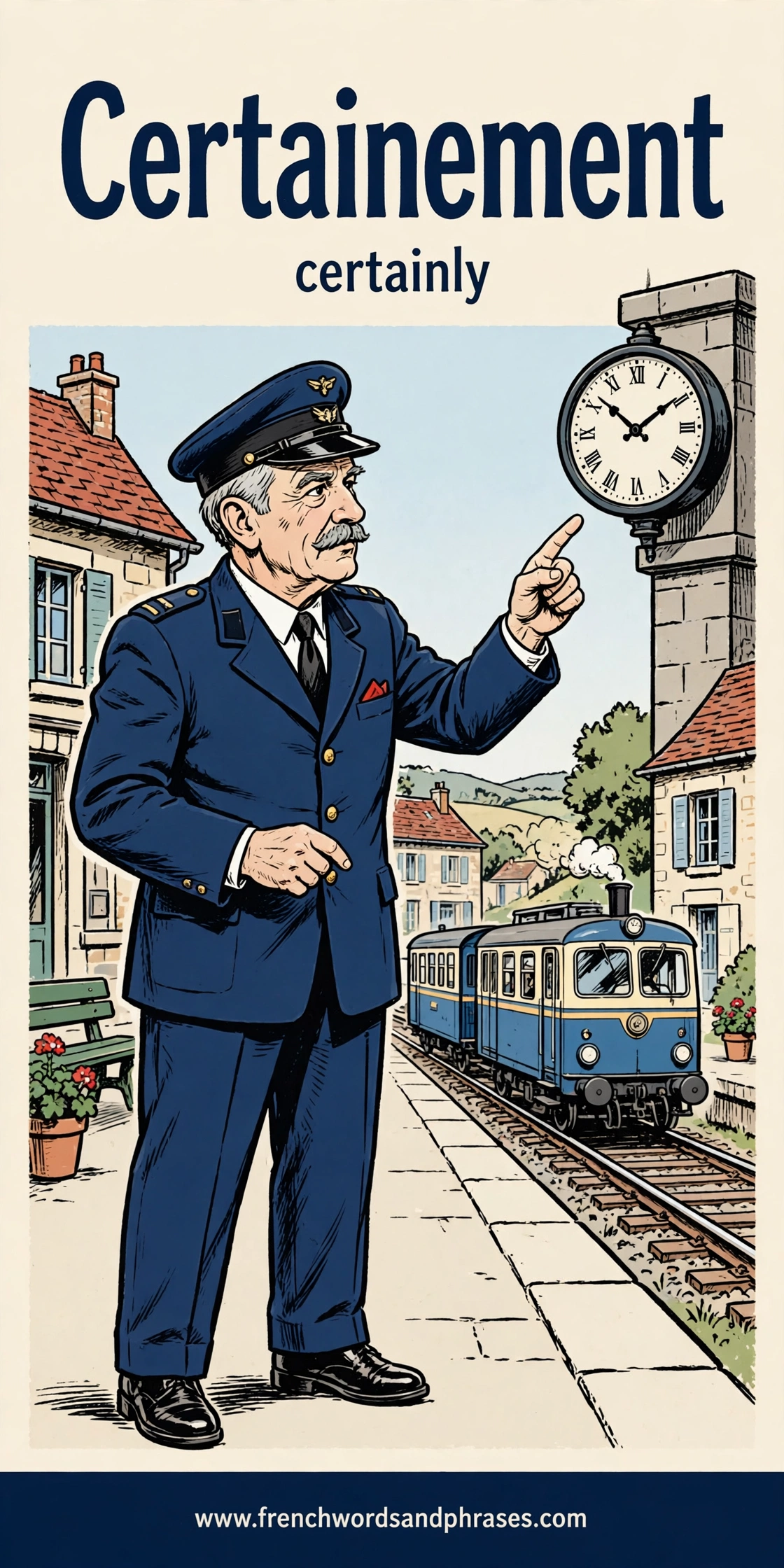
Certainement means certainly.
The old professor looks over his glasses at the nervous student and smiles. « Vous réussirez, certainement » — you will succeed, certainly, without a shadow of doubt in his voice.
In this guide, you’ll learn what certainement means in English, how it answers questions with of course, where it stands in a sentence, and how it compares with sûrement and bien sûr. Explore French examples, English translations, and practice quizzes.
Understanding the French Adverb Certainement
Certainement is a French adverb of certainty — one of the -ment family, built on the adjective certain. It stamps a statement as sure: certainly, definitely, without doubt.
It means certainly, definitely. Il viendra certainement — he will certainly come. Standing alone as an answer, certainement is a warm of course: « Vous pouvez entrer ? — Certainement ! » It is the adverb of the steady voice, a little more formal and deliberate than its everyday cousin sûrement.
Type: Adverb of certainty — affirmation
Answers the question: How sure? — without doubt
Changes form: Never — certainement is invariable
English equivalents: Certainly; definitely; (as an answer) of course.
One important usage detail: certainement pas is the firm way to refuse or deny — certainly not. And in everyday speech, French often reaches for the lighter sûrement or bien sûr where certainement would sound a touch ceremonious.
Experience the Word
Certainement is the adverb of the firm handshake — of promises made in a steady voice, of doors opened with a bow, of the concierge who has never once been in doubt.
Imagine the grand hotel desk at midnight: a late arrival, a tired question — « Vous avez encore une chambre ? — Certainement, monsieur. » — and the register opens like a small ceremony.
You have not just said yes. You have removed every shadow of doubt from the room.
How to Use Certainement in French: Complete Guide
Let’s explore how certainement works in French, beginning with the whole word on one card.
Certainement at a Glance
Before the details, here is the whole word on one card.
The Whole Word on One Card
Meaning, type, position and form — certainement in four lines.
| Point | Certainement |
|---|---|
| Meaning | certainly, definitely |
| Type | adverb of certainty |
| Usual position | after the verb, at the head of the sentence, or standing alone |
| Form | invariable — never changes |
Example
Il viendra certainement demain.
He will certainly come tomorrow.
Where Certainement Goes in the Sentence
Certainement is mobile: it follows the verb in a plain statement, opens a sentence for emphasis, and stands alone as a complete answer.
| Situation | Pattern |
|---|---|
| After the verb | elle réussira certainement — she will certainly succeed |
| Head of the sentence | Certainement, + sentence — Certainement, je vais l’aider |
| Standing alone (an answer) | — Certainement ! — Of course! |
| In the perfect tense | il a certainement oublié — he has certainly forgotten |
Example
Certainement, nous pouvons commencer.
Certainly, we can begin.
Quick Quiz 1
True or false: standing alone, « Certainement ! » can answer a request like of course.
Reveal the answer
True
— Je peux entrer ? — Certainement !
— May I come in? — Of course!
Certainement Pas: Certainly Not
With pas, certainement becomes the firm refusal — polite in form, absolute in content. French reaches for it in arguments and official denials alike.
| French | In English |
|---|---|
| certainement pas | certainly not |
| il ne viendra certainement pas | he will certainly not come |
| ce n’est certainement pas vrai | that is certainly not true |
| certainement pas moi | certainly not me |
Example
Non, certainement pas — je refuse.
No, certainly not — I refuse.
Certainement and Its Cousins of Certainty
French keeps a small committee of certainty words, from the everyday bien sûr to the written sans doute. Each has its register.
| French | In English |
|---|---|
| bien sûr | of course (the everyday favourite) |
| sûrement | surely, certainly (everyday, warmer) |
| certainement | certainly (deliberate, a little formal) |
| sans aucun doute | without any doubt (emphatic) |
| évidemment | obviously, evidently |
Example
Bien sûr, il viendra — certainement même.
Of course he will come — certainly, even.
Quick Quiz 2
Complete the sentence:
Elle réussira ______, j’en suis sûr. (certainly)
Reveal the answer
certainement
Elle réussira certainement, j’en suis sûr.
She will certainly succeed, I am sure of it.
The Certain Family: Certain, Certitude, Certifier
Certainement belongs to a family that runs from the adjective certain to the official stamp of certifier — the whole vocabulary of being sure.
| French | In English |
|---|---|
| certain / certaine | certain, sure (adjective) |
| être sûr de | to be sure of |
| la certitude | certainty (noun) |
| certifier | to certify, to guarantee in writing |
| un fait certain | an established fact |
Example
C’est un fait certain : le train part à huit heures.
It is an established fact: the train leaves at eight o’clock.
Certainement in Polite Service French
In hotels, restaurants and offices, certainement is the polished answer — the verbal equivalent of a door held open.
| Situation | In French |
|---|---|
| Granting a request | Certainement, madame, tout de suite. |
| Confirming a booking | Certainement, votre table est réservée. |
| Offering help | Certainement, je vous écoute. |
| Agreeing warmly | Certainement, avec plaisir. |
Example
Certainement, monsieur, je vous apporte la carte.
Certainly, sir, I will bring you the menu.
Quick Quiz 3
What does certainement pas mean?
Reveal the answer
Certainly not
Ce n’est certainement pas vrai.
That is certainly not true.
Certainement or Sûrement? The Deliberate and the Everyday
Both mean certainly, but they dress differently: certainement is deliberate and a little formal, sûrement is the everyday word — and it can soften into probably.
| Aspect | The Difference |
|---|---|
| Tone | certainement: measured, official, written — sûrement: spoken, warm |
| Strength | certainement admits no doubt; sûrement can mean probably |
| You will hear it in | certainement: hotels, letters, speeches — sûrement: conversation |
| Safe rule | In chat, sûrement; in ceremony, certainement |
Example
Il a sûrement oublié ses clés, mais le directeur viendra certainement.
He has probably forgotten his keys, but the director will certainly come.
Watch Out: Certainement Is Not a Promise Word for Everything
The traps with certainement are traps of register and of negation — sounding like a notary in a café, or dropping the pas that firms the refusal.
| Mistake | Correct French |
|---|---|
| « certainement oui » piled up in casual chat | bien sûr ! — the everyday of course |
| « certainement non » (understandable, but stiff) | certainement pas — certainly not |
| « je suis certainement » (adjective needed) | je suis certain / certaine — I am certain |
| « certainement possible » in a shrug | c’est tout à fait possible — quite possible |
Example
Je suis certaine qu’il viendra certainement.
I am certain that he will certainly come.
Quick Quiz 4
Translate: He will certainly come tomorrow.
Reveal the answer
Il viendra certainement demain.
Certainement follows the verb in a plain statement of certainty.
Certainement in Everyday French: Real-Life Examples
Now that you know the word, let’s see how certainement appears in everyday French.
Example 1 — At the hotel
Certainement, madame, votre chambre est prête.
Certainly, madame, your room is ready.
Example 2 — At work
Le rapport sera certainement prêt vendredi.
The report will certainly be ready on Friday.
Example 3 — An answer
Tu peux m’aider ? — Certainement !
Can you help me? — Of course!
Example 4 — A refusal
Non, certainement pas, je ne suis pas d’accord.
No, certainly not, I do not agree.
Example 5 — Weather
Il fera certainement beau ce week-end.
The weather will certainly be fine this weekend.
Example 6 — Family
Grand-père viendra certainement pour Noël.
Grandfather will certainly come for Christmas.
Beyond Translation: The Meaning of Certainement
English certainly and French certainement are true twins — the same Latin root, the same steady voice. But French keeps certainement a little dressed up, reserving it for the concierge’s bow and the professor’s promise, while bien sûr and sûrement do the everyday work.
To say certainement is to put on the voice of assurance itself.
It is certainty with its collar straight: certainement, madame; certainement, je vais l’aider; certainement pas — the firmest no in the language, wearing gloves.
How to Remember the French Adverb Certainement
Remember it this way: Certainement means certainly — the deliberate, polished word of assurance, and certainement pas is certainly not.
- You assure with it — il viendra certainement, he will certainly come.
- You answer with it — Certainement ! Of course!
- You refuse with it — certainement pas, certainly not.
The key idea is certainly — after the verb or standing alone; certainement pas = certainly not; everyday cousins: sûrement, bien sûr.
Test Your Knowledge of Certainement
Let’s see how much you’ve learned. Try answering these questions before revealing the answers.
Question 1
What does certainement mean?
Reveal the answer
Certainly, definitely — without doubt.
Question 2
How does certainement answer a request?
Reveal the answer
Certainement ! — Of course! A complete, polite answer on its own.
Question 3
Translate: That is certainly not true.
Reveal the answer
Ce n’est certainement pas vrai.
Question 4
Which everyday words share the work of certainement?
Reveal the answer
Sûrement and bien sûr — warmer, more spoken cousins.
Question 5
Complete the sentence:
Elle réussira ______. (certainly)
Reveal the answer
certainement
Elle réussira certainement.
She will certainly succeed.
Your Final Challenge
Can You Use It?
How would you say this in French?
“He will certainly come tomorrow.”
Reveal the answer
Il viendra certainement demain.
He will certainly come tomorrow.
A little French. A little curiosity. A richer everyday life.
LEARN FRENCH ONE WORD AT A TIME