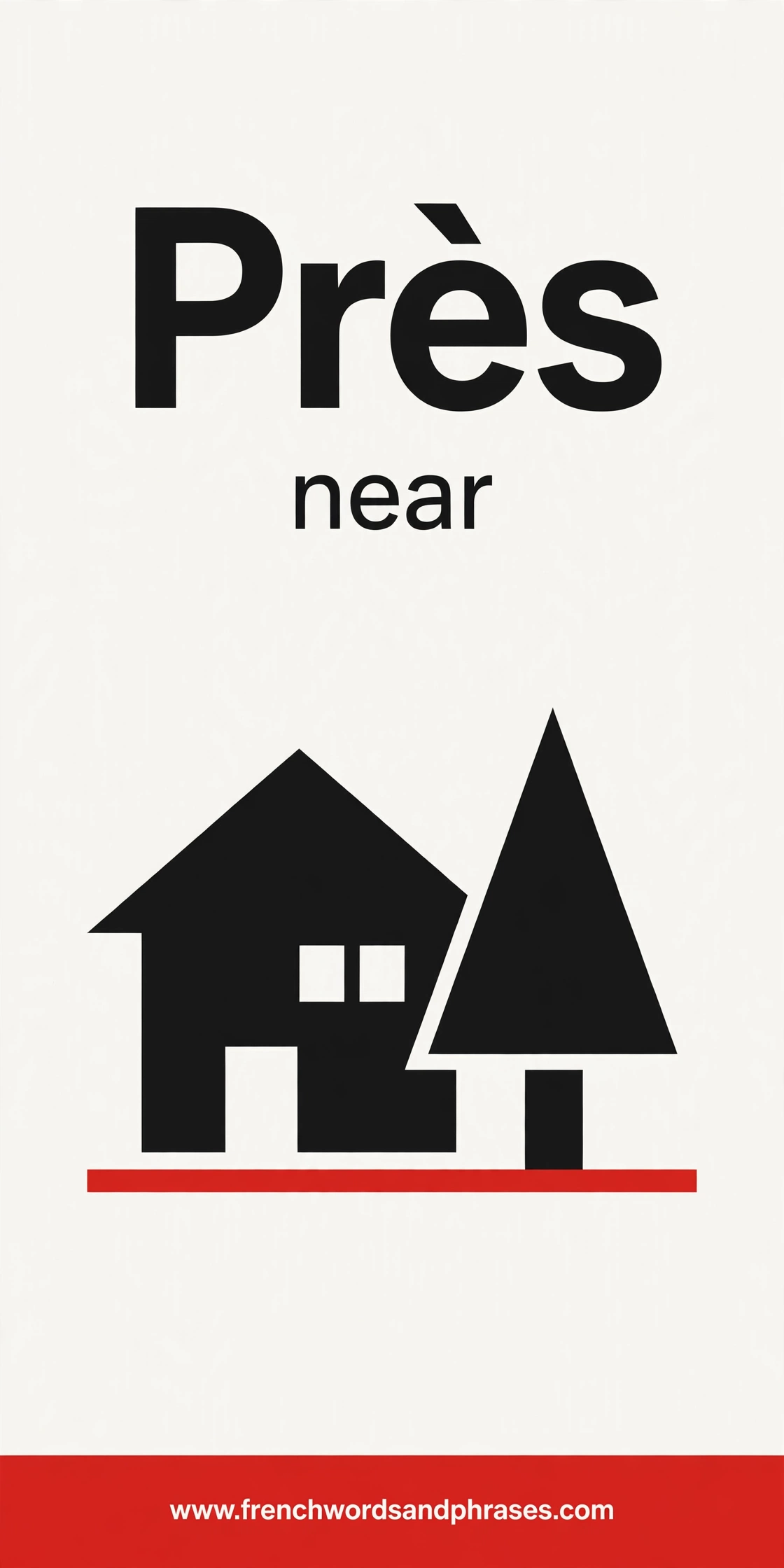
A French Word to Live By
Translate Près to English
/pʁɛ/
Près means near.
The flat-hunter reads the advert one more time and smiles: a bakery downstairs, the park at the corner, the station two streets away — everything près, near, close enough to walk to with a basket on your arm. Near is a small word that changes a whole life.
In this guide, you’ll learn what près means in English, how it measures closeness with près de, how it nearly becomes an adjective in tout près, and the expressions built on it. Explore French examples, English translations, and practice quizzes.
Understanding the French Adverb Près
Près is a French adverb of place — the opposite pole of loin. It measures the smallness of a gap: near, close. It never changes form, and it almost always travels with its partner: près de, near to, close to.
It means near, close. Il habite près — he lives nearby. Près works for space (près de la gare, near the station), for time (près de Noël, near Christmas) and even for numbers in its near-twin à peu près, approximately. Where loin stretches the map, près folds it small.
Type: Adverb of place — closeness
Answers the question: How near? — near, close by
Changes form: Never — près is invariable
English equivalents: Near; close; (tout près) very near; (près de) near to, close to.
One important usage detail: near a named place, French needs the full pattern près de — près de l’école, near the school. Standing alone, près already means nearby: il habite près. And do not confuse it with prêt (ready): près de partir means near to leaving, prêt à partir means ready to leave — one letter, two different travellers.
Experience the Word
Près is the adverb of the neighbourhood — the bakery you can smell, the friend two streets away, the sea at the end of the road. It is distance shrunk to a walk.
Imagine the grandmother giving directions: « C’est tout près, tu verras — la boulangerie, puis la petite place, et tu es arrivée. » Her hand pats the air as if the whole journey fitted in the kitchen.
You have not just shortened a distance. You have made the world walkable.
How to Use Près in French: Complete Guide
Let’s explore how près works in French, beginning with the whole word on one card.
Près at a Glance
Before the details, here is the whole word on one card.
The Whole Word on One Card
Meaning, type, position and form — près in four lines.
| Point | Près |
|---|---|
| Meaning | near, close |
| Type | adverb of place — closeness |
| Usual position | after the verb, or in the pattern près de |
| Form | invariable — never changes |
Example
La pharmacie est près de la place.
The pharmacy is near the square.
Where Près Goes in the Sentence
Près follows the verb, and with de it attaches to the place, the moment or the amount it measures against.
| Situation | Pattern |
|---|---|
| Alone (nearby) | verb + près — elle habite près |
| Near a place | près de + noun — près de la rivière |
| Near a moment | près de + time — près de minuit |
| Very near | tout près — c’est tout près d’ici |
Example
Viens t’asseoir près de moi.
Come and sit near me.
Quick Quiz 1
True or false: près can measure time as well as place.
Reveal the answer
True
Près de Noël, les magasins sont pleins.
Near Christmas, the shops are full.
Près with Everyday Verbs
Près shortens the verbs of living, sitting, being and coming.
| Situation | Example |
|---|---|
| Living | Nous habitons près du marché. |
| Sitting | Assieds-toi près de la fenêtre. |
| Being | Le village est près de la frontière. |
| Coming | Approche-toi, viens plus près. |
| Working | Elle travaille près de chez elle. |
Example
Le chien dort près du feu.
The dog sleeps near the fire.
Everyday Expressions with Près
Près builds phrases of closeness, care and approximation.
| Expression | In English |
|---|---|
| tout près | very near, close by |
| de près | closely, up close (regarder de près) |
| à peu près | approximately, more or less |
| près de + number | nearly, close to (près de cent personnes) |
| au plus près | as close as possible |
Example
Il y avait près de deux cents invités.
There were nearly two hundred guests.
Quick Quiz 2
Complete the sentence:
Elle habite ______ de l’école. (near)
Reveal the answer
près
Elle habite près de l’école.
She lives near the school.
Près and Its Neighbours
Loin is the far pole; à côté de names the next-door spot; proche is the adjective cousin.
| French | In English |
|---|---|
| près | near (adverb) |
| loin | far — the opposite |
| à côté de | next to, beside |
| proche | near, close (adjective — la ville proche) |
Example
La poste est à côté de la mairie, tout près de l’église.
The post office is next to the town hall, very near the church.
Près or Prêt? One Letter, Two Journeys
The trap of this page. Près (with the grave accent) measures distance; prêt (with a circumflex) means ready. Even French speakers pause over these two.
| Word | Example |
|---|---|
| près de + infinitive | près de partir — on the point of leaving, about to leave |
| prêt à + infinitive | prêt à partir — ready to leave |
| près (place) | près de la gare — near the station |
| prêt (state) | Le dîner est prêt. — Dinner is ready. |
Example
À sept heures, tout est prêt, et nous sommes près de partir.
At seven o’clock, everything is ready, and we are about to leave.
Quick Quiz 3
What does à peu près mean?
Reveal the answer
Approximately, more or less
Il y a à peu près trente élèves.
There are approximately thirty pupils.
De Près: Up Close
De près turns près towards attention: to look closely, to follow closely, to know up close.
| Pattern | Example |
|---|---|
| regarder de près | Regarde de près, la signature est là. — Look closely, the signature is there. |
| suivre de près | Elle suit l’affaire de près. — She is following the matter closely. |
| connaître de près | Il connaît le sujet de près. — He knows the subject inside out. |
| de près ou de loin | De près ou de loin, je te soutiens. — Closely or from afar, I support you. |
Example
De près, le tableau montre mille détails.
Up close, the painting shows a thousand details.
Watch Out: Near Is Not Next by Itself
Près says close; à côté de says beside. English near blurs the two, French keeps both tools in the box.
| Mistake | Correct French |
|---|---|
| « près la gare » without de | près de la gare |
| « il est prêt de moi » for he is near me | il est près de moi (prêt = ready) |
| « près » used for next to a specific seat | à côté de — assieds-toi à côté de moi |
| « à peu près » written « a peu prêt » | à peu près — with près, the distance word |
Example
Assieds-toi à côté de moi, tout près.
Sit next to me, nice and close.
Quick Quiz 4
Choose the correct French: ready to leave — ______ à partir (près / prêt).
Reveal the answer
prêt
Prêt à partir means ready to leave.
Près de partir means about to leave — on the point of it.
Près in Everyday French: Real-Life Examples
Now that you know the word, let’s see how près appears in everyday French.
Example 1 — At home
Le chat dort près de la cheminée.
The cat sleeps near the fireplace.
Example 2 — Directions
C’est tout près, cinq minutes à pied.
It is very near, five minutes on foot.
Example 3 — At school
Les enfants s’assoient près du tableau.
The children sit near the board.
Example 4 — Shopping
Il y a une boulangerie près de chez nous.
There is a bakery near our house.
Example 5 — Counting
Près de cinquante personnes sont venues.
Nearly fifty people came.
Example 6 — Nature
Le chemin passe près de la rivière.
The path runs near the river.
Beyond Translation: The Meaning of Près
If loin is the adverb of oceans, près is the adverb of the village: the distance you can walk with a basket, call across, or wave over. French life is measured in près — près de la gare, près du marché, près de chez moi.
To say près is to fold the map until the world fits in a walk.
And its twin prêt waits one letter away, a standing lesson that in French, attention is a form of respect — for words as for neighbours.
How to Remember the French Adverb Près
Remember it this way: Près means near — it folds distance small, and it measures with près de.
- You give directions — c’est tout près, cinq minutes à pied.
- You count the crowd — près de cent personnes.
- You dodge the twin — près is near, prêt is ready.
The key idea is near — près de + place; prêt à = ready to, près de = about to.
Test Your Knowledge of Près
Let’s see how much you’ve learned. Try answering these questions before revealing the answers.
Question 1
What does près mean?
Reveal the answer
Near, close — a small distance away.
Question 2
How do you say near the station?
Reveal the answer
Près de la gare.
Question 3
Translate: It is very near, five minutes on foot.
Reveal the answer
C’est tout près, cinq minutes à pied.
Question 4
What is the difference between près de partir and prêt à partir?
Reveal the answer
Près de partir = about to leave; prêt à partir = ready to leave.
Question 5
Complete the sentence:
Nous habitons ______ du marché. (near)
Reveal the answer
près
Nous habitons près du marché.
We live near the market.
Your Final Challenge
Can You Use It?
How would you say this in French?
“Come and sit near me.”
Reveal the answer
Viens t’asseoir près de moi.
Come and sit near me.
A little French. A little curiosity. A richer everyday life.
LEARN FRENCH ONE WORD AT A TIME