A French Word to Live By
Translate Loin to English
/lwɛ̃/
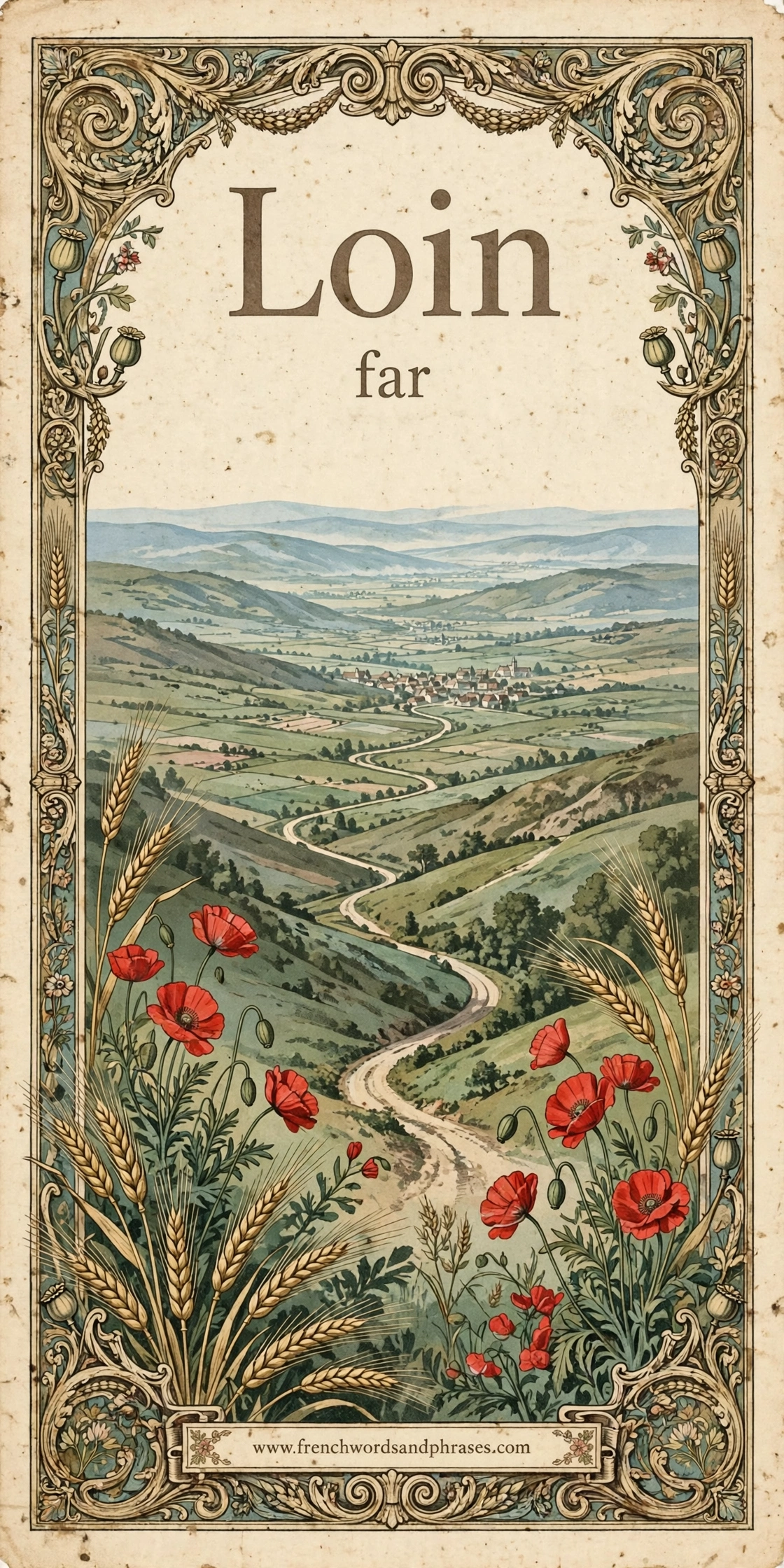
Loin means far.
From the hilltop chapel, the village below looks like a toy: tiny roofs, a thread of river, the road unspooling towards the horizon. Everything down there is loin — far, far from where we stand, small and silent with distance.
In this guide, you’ll learn what loin means in English, how it measures distance in place and time, how it teams up with de, and the everyday expressions built on it. Explore French examples, English translations, and practice quizzes.
Understanding the French Adverb Loin
Loin is a French adverb of place. It measures the gap between here and there — far, a long way. It never changes form, and it almost always travels with its measuring partner: loin de, far from.
It means far, a long way away. Il habite loin — he lives far away. Loin works for space and for time: les vacances sont loin, the holidays are far off; and for ideas too — c’est loin d’être fini, it is far from finished. Distance, in French, is one word for all three maps.
Type: Adverb of place — distance
Answers the question: How far? — far, a long way
Changes form: Never — loin is invariable
English equivalents: Far; far away; (loin de) far from; (de loin) by far.
One important usage detail: English far from becomes loin de — the de is part of the machine: loin de la mer, far from the sea; loin d’être prêt, far from being ready. And for how far, French asks à quelle distance or simply uses loin in the answer: c’est loin ? — is it far?
Experience the Word
Loin is the adverb of the horizon. It shrinks villages to toys, stretches roads to ribbons, and turns next week into a country you cannot yet see.
Imagine the emigrant grandmother at the window, pointing past the fields: « Ton oncle habite loin, très loin, de l’autre côté de l’océan. » The word itself seems to lengthen as she says it.
You have not just measured kilometres. You have felt the distance in the sentence.
How to Use Loin in French: Complete Guide
Let’s explore how loin works in French, beginning with the whole word on one card.
Loin at a Glance
Before the details, here is the whole word on one card.
The Whole Word on One Card
Meaning, type, position and form — loin in four lines.
| Point | Loin |
|---|---|
| Meaning | far, far away |
| Type | adverb of place — distance |
| Usual position | after the verb, often at the end of the sentence |
| Form | invariable — never changes |
Example
La gare est loin d’ici.
The station is far from here.
Where Loin Goes in the Sentence
Loin follows the verb, and with de it builds the measuring phrase loin de + noun or infinitive.
| Situation | Pattern |
|---|---|
| Simple sentence | verb + loin — il habite loin |
| Far from a place | loin de + noun — loin de la ville |
| Far from doing | loin de + infinitive — loin d’être fini |
| In a question | C’est loin ? — Is it far? |
Example
Nous marchons loin, jusqu’au village suivant.
We are walking far, to the next village.
Quick Quiz 1
True or false: loin can measure time as well as distance.
Reveal the answer
True
Les vacances sont loin. — The holidays are far off.
Noël est encore loin — Christmas is still far away.
Loin with Everyday Verbs
Loin stretches the verbs of living, going, seeing and being.
| Situation | Example |
|---|---|
| Living | Elle habite loin de son travail. |
| Going | Ne va pas trop loin tout seul. |
| Seeing | De cette colline, on voit loin. |
| Being in time | Le printemps est encore loin. |
| Throwing | Il lance la balle très loin. |
Example
Les enfants, ne vous éloignez pas trop loin.
Children, do not wander too far away.
Everyday Expressions with Loin
Loin builds phrases of distance, comparison and warning.
| Expression | In English |
|---|---|
| de loin | from far away; by far (de loin le meilleur) |
| au loin | in the distance |
| loin de là | far from it, not at all |
| loin des yeux | out of sight (loin des yeux, loin du cœur — out of sight, out of mind) |
| aller loin | to go far (in life, too) |
Example
Au loin, on entend les cloches du village.
In the distance, you can hear the village bells.
Quick Quiz 2
Complete the sentence:
Il habite ______ de la mer. (far)
Reveal the answer
loin
Il habite loin de la mer.
He lives far from the sea.
Loin and Its Neighbours
Près is the opposite pole; loin’s cousins measure the same map at different scales.
| French | In English |
|---|---|
| loin | far |
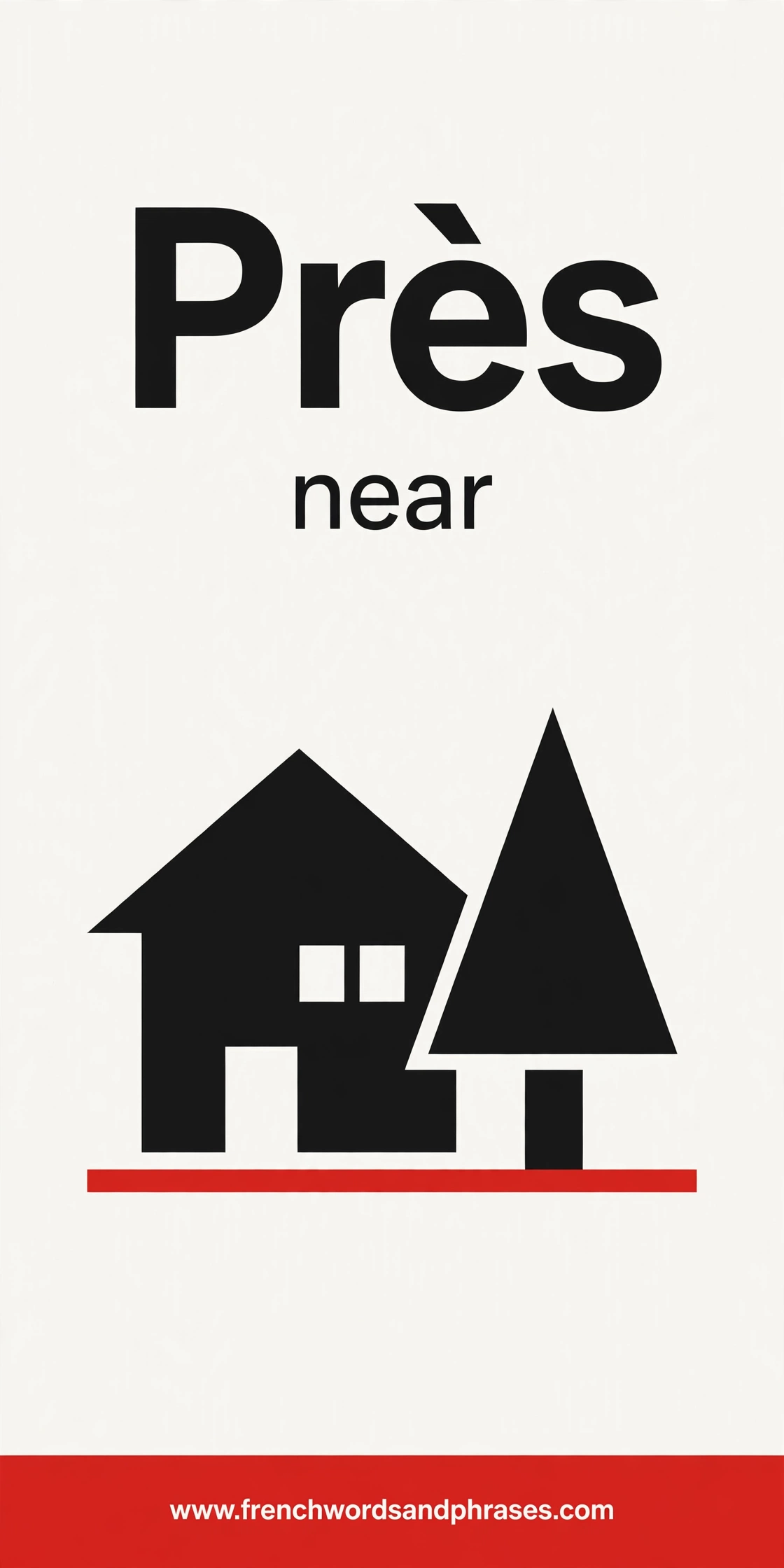
| près | near — the opposite |
| à distance | at a distance, remotely |
| au loin | in the distance (what you see) |
Example
Près ou loin, les amis restent des amis.
Near or far, friends remain friends.
Loin de: Far From, in Three Worlds
One pattern, three kinds of distance: places, qualities and ideas. Loin de handles them all.
| World | Example |
|---|---|
| Place | loin de Paris — far from Paris |
| State | loin d’être prêt — far from being ready |
| Feeling | loin de moi cette idée — far from me that idea (I would never think it) |
| Understatement | C’est loin d’être simple. — It is far from simple. |
Example
Le travail est loin d’être fini.
The work is far from finished.
Quick Quiz 3
What does de loin le meilleur mean?
Reveal the answer
By far the best
C’est de loin le meilleur restaurant du quartier.
It is by far the best restaurant in the neighbourhood.
Loin in Comparisons
Distance compares like everything else in French: plus loin, aussi loin, moins loin.
| Pattern | Example |
|---|---|
| plus loin que | Elle va plus loin que moi. — She goes further than me. |
| aussi loin que | Il voit aussi loin que son frère. — He sees as far as his brother. |
| le plus loin | Qui lance le plus loin ? — Who throws the furthest? |
| si loin | Je ne savais pas que c’était si loin. — I did not know it was so far. |
Example
Le train va plus loin que le bus.
The train goes further than the bus.
Watch Out: Loin Is Not Long
English far and long both stretch; French keeps loin for distance and long for length and time taken.
| Mistake | Correct French |
|---|---|
| « une rue loin » for a long street | une longue rue |
| « le voyage est loin » for the journey is long | le voyage est long (but: la ville est loin) |
| « loin de temps » for a long time | longtemps — il y a longtemps |
| « très loin de être » without the join | loin d’être — de + être becomes d’être |
Example
La route est longue, et le village est loin.
The road is long, and the village is far.
Quick Quiz 4
Translate: It is far from finished.
Reveal the answer
C’est loin d’être fini.
Loin de + infinitive measures the distance between now and done.
Loin in Everyday French: Real-Life Examples
Now that you know the word, let’s see how loin appears in everyday French.
Example 1 — At home
Mon travail est loin de chez moi.
My work is far from my home.
Example 2 — Travel
L’hôtel est loin, il faut prendre un taxi.
The hotel is far, we need to take a taxi.
Example 3 — Nature
Au loin, les montagnes sont blanches.
In the distance, the mountains are white.
Example 4 — Family
Ma sœur habite loin, au Canada.
My sister lives far away, in Canada.
Example 5 — Sport
Il a lancé le ballon très loin.
He threw the ball very far.
Example 6 — Plans
Les examens sont encore loin, ne t’inquiète pas.
The exams are still far off, do not worry.
Beyond Translation: The Meaning of Loin
French loin comes from the Latin longe — far off — and it has kept its long view of the world: one word for the far village, the far-off holiday and the idea that is far from true.
To say loin is to stand still and measure the gap.
It is the adverb of emigrants and hilltop chapels, of bells heard au loin and friends kept près du cœur though loin des yeux — far from the eyes, never from the heart.
How to Remember the French Adverb Loin
Remember it this way: Loin means far — in space, in time and in ideas — and it measures with loin de.
- You measure the map — la gare est loin d’ici.
- You measure the work — c’est loin d’être fini.
- You crown the winner — de loin le meilleur, by far the best.
The key idea is far — loin de + noun or infinitive; de loin = by far.
Test Your Knowledge of Loin
Let’s see how much you’ve learned. Try answering these questions before revealing the answers.
Question 1
What does loin mean?
Reveal the answer
Far, far away — in place, time or degree.
Question 2
How do you say far from the sea?
Reveal the answer
Loin de la mer.
Question 3
Translate: The holidays are far off.
Reveal the answer
Les vacances sont loin.
Question 4
What does au loin mean?
Reveal the answer
In the distance — au loin, on voit la mer.
Question 5
Complete the sentence:
Le travail est ______ d’être fini. (far)
Reveal the answer
loin
Le travail est loin d’être fini.
The work is far from finished.
Your Final Challenge
Can You Use It?
How would you say this in French?
“The station is far from here.”
Reveal the answer
La gare est loin d’ici.
The station is far from here.
A little French. A little curiosity. A richer everyday life.
LEARN FRENCH ONE WORD AT A TIME