A French Word to Live By
Translate Position to English
/po.zi.sjɔ̃/
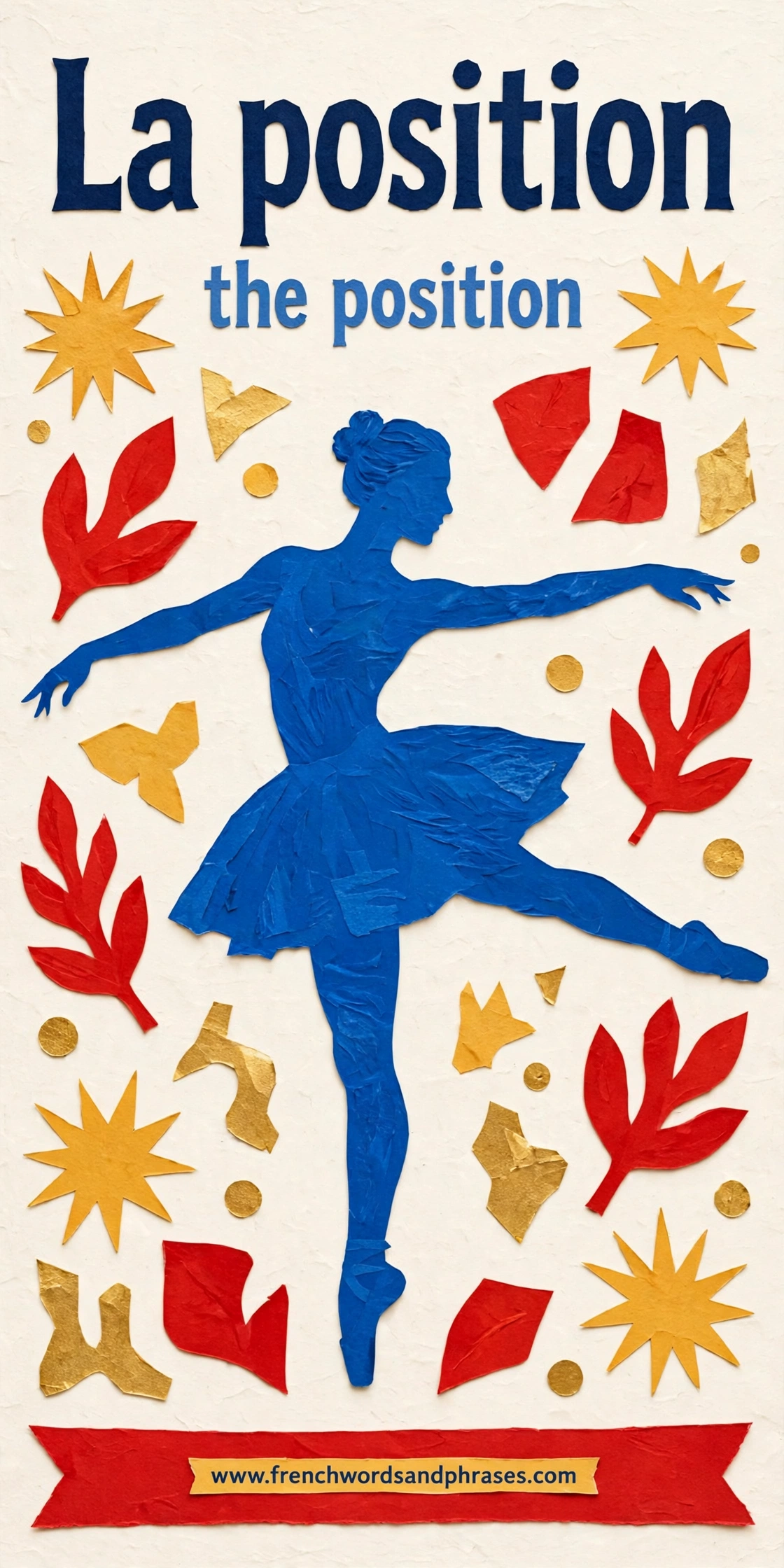
La position means the position.
The dancer’s first position, the chess piece’s square, the satellite’s dot on the screen: la position, the position — where a thing stands, and, just as often, where a person stands on a question.
In this guide, you’ll learn what position means in English, how to use it with its articles, how to form its plural, and how it appears in everyday French. Explore French examples, English translations, and practice quizzes.
Understanding the French Noun Position
Position is a feminine French noun, learned with its article: la position, une position. It comes from the Latin positio, a placing, from ponere, to put. French uses it for places in space, postures of the body, ranks in a race, and opinions held in public — prendre position, to take a stand.
It means position — first in space: la position d’une étoile, the position of a star, en bonne position, in a good position. Then of the body: une position assise, a sitting position, rester en position, to hold the position. Then in contests and debates: la première position of a race, and prendre position sur une question, to take a position on an issue.
Gender: Feminine — la position
Definite article: la — la position (the position)
Indefinite article: une — une position (a position)
Plural: les positions — regular, with a simple -s
Spelling note: from Latin positio, a placing — the same root as poser, to put down
Key verb: prendre position — to take a stand
English equivalents: The position, the place, the stance.
The preposition is en: en position, in position, en bonne position, well placed. For opinions, the verb is prendre: prendre position pour ou contre, to take a stand for or against. For a job vacancy, everyday French more often says un poste — la position is the place, the posture or the stance.
Experience the Word
Position is the word of the held moment: the dancer frozen at the barre, the runner crouched on the line, everyone waiting for the signal.
Imagine the chess club on a wet evening — one board abandoned mid-game, and two old players standing over it in silence, reading la position like a letter from an absent friend.
You have not just named a place. You have named a stance — la position, where things stand and where people stand.
How to Use Position in French: Complete Guide
Let’s explore how position works in French, beginning with its articles — la position, une position, prendre position.
Position with the Definite Article (La, Les)
Used for a specific position — the star’s, the team’s, the one on the map.
| Form | French |
|---|---|
| Feminine singular | la position |
| Plural | les positions |
Example
La position du navire est indiquée sur la carte.
The ship’s position is shown on the map.
Position with the Indefinite Article (Une, Des)
Used for a position in general — any place, posture or stance.
| Form | French |
|---|---|
| Feminine singular | une position |
| Plural | des positions |
Example
Choisis une position confortable pour lire.
Choose a comfortable position for reading.
Position with Kinds and Places (En bonne position…)
Positions are judged good or bad, first or last — French grades them constantly.
| Quantity | French |
|---|---|
| in a good position | en bonne position |
| a sitting position | une position assise |
| the starting position | la position de départ |
| first position | la première position |
| in position | en position |
Example
Les coureurs sont en position de départ.
The runners are in the starting position.
Quick Quiz 1
Complete the sentence:
______ position de l’équipe au classement est excellente. (the)
Reveal the answer
La
La position de l’équipe au classement est excellente.
The team’s position in the standings is excellent — position is feminine, so la.
The Plural of Position
Position takes a regular plural in -s — chess games and debates are full of them.
| Number | French |
|---|---|
| Singular | la position |
| Plural | les positions |
Example
Les positions des deux candidats sont très différentes.
The two candidates’ positions are very different.
Position with Possessive Adjectives (Ma, Ta, Sa…)
Possessives agree with the noun: position is feminine, so ma, ta, sa in the singular.
| Owner | French |
|---|---|
| my | ma position |
| your (tu) | ta position |
| his / her | sa position |
| our | notre position |
| your (vous) | votre position |
| their | leur position |
Example
Je connais sa position sur la question.
I know his position on the question.
Quick Quiz 2
Complete the sentence:
Elle a expliqué ______ position au journaliste. (her)
Reveal the answer
sa
Elle a expliqué sa position au journaliste.
She explained her position to the journalist — sa, because position is feminine.
Position with Demonstrative Adjectives (Cette, Ces)
Used to point: cette position, this position — this posture, this stance.
| Form | French |
|---|---|
| Feminine singular | cette position |
| Plural | ces positions |
Example
Cette position de yoga demande de la souplesse.
This yoga position requires flexibility.
Position with Adjectives
Adjectives agree with position — feminine singular: une position assise, une position stratégique.
| Adjective | With Position |
|---|---|
| assise (sitting) | une position assise |
| de départ (starting) | la position de départ |
| inconfortable (uncomfortable) | une position inconfortable |
| stratégique (strategic) | une position stratégique |
| première (first) | la première position |
Example
Une position inconfortable empêche de dormir.
An uncomfortable position prevents sleep.
Quick Quiz 3
Complete the sentence:
Reste dans une position ______ pour lire. (comfortable)
Reveal the answer
confortable
Reste dans une position confortable pour lire.
Stay in a comfortable position for reading — confortable has the same form for masculine and feminine.
Everyday Expressions with Position
Barres, boards and debates — the position phrases of daily life.
| Expression | In English |
|---|---|
| prendre position | to take a stand |
| en position | in position, ready |
| une position assise | a sitting position |
| changer de position | to change position |
| la position de départ | the starting position |
Example
Le maire a pris position contre le projet.
The mayor took a stand against the project.
Words from the Same Family as Position
Placing and standing — the words that travel with position.
| French | In English |
|---|---|
| poser | to put down, to place (the verb) |
| la posture | the posture |
| situé | situated, located |
| un emplacement | a location, a spot |
| se tenir | to stand, to hold oneself |
Example
Le village est situé en bonne position, près de la rivière.
The village is situated in a good position, near the river.
Quick Quiz 4
What does prendre position mean?
Reveal the answer
To take a stand — to declare where you stand on a question.
Elle a pris position pour la réforme.
She took a stand in favour of the reform.
Position in Everyday French: Real-Life Examples
Now that you know the word, let’s see how position appears in everyday French.
Example 1 — Sport
Les coureurs prennent la position de départ.
The runners take the starting position.
Example 2 — Reading
Change de position, tu es mal assis.
Change position, you are sitting badly.
Example 3 — Debate
Je connais sa position sur ce sujet.
I know his position on this subject.
Example 4 — Dance
La première position commence pieds joints.
First position begins with heels together.
Example 5 — Navigation
Le capitaine vérifie la position du navire.
The captain checks the ship’s position.
Example 6 — Standings
L’équipe garde la première position.
The team keeps first position.
Beyond Translation: The Meaning of Position
Position is Latin order made visible: positio, the act of placing, became the place where a thing was placed, then the posture of a body, then the opinion of a mind — French followed the whole journey without ever changing the word. A dancer, a chess player and a deputy all hold une position, and all three know the same truth: a position is only yours if you can hold it.
To say position is to say where something stands — in space, in a race, in an argument.
It evokes the frozen dancer, the chessboard at midnight, and the speaker rising to say: voici ma position.
How to Remember the French Noun Position
Remember it this way: Position is the position — feminine: la position, in space, in posture and in debate, with prendre position for taking a stand.
- Always feminine — la position, une position, ma position.
- The readiness phrase — en position, en bonne position.
- The opinion verb — prendre position pour ou contre, to take a stand.
The key idea is la position — the position, feminine; prendre position = to take a stand.
Test Your Knowledge of Position
Let’s see how much you’ve learned. Try answering these questions before revealing the answers.
Question 1
Is position masculine or feminine?
Reveal the answer
Feminine — la position, une position.
Question 2
How do you say to take a stand?
Reveal the answer
Prendre position.
Question 3
Translate: The runners are in the starting position.
Reveal the answer
Les coureurs sont en position de départ.
Question 4
What is une position assise?
Reveal the answer
A sitting position — the posture of someone seated.
Question 5
Complete the sentence:
______ positions des candidats sont différentes. (the)
Reveal the answer
Les
Les positions des candidats sont différentes.
The candidates’ positions are different.
Your Final Challenge
Can You Use It?
How would you say this in French?
“The mayor took a stand against the project.”
Reveal the answer
Le maire a pris position contre le projet.
The mayor took a stand against the project.
A little French. A little curiosity. A richer everyday life.
LEARN FRENCH ONE WORD AT A TIME