
A French Word to Live By
Translate Large to English
/laʁʒ/
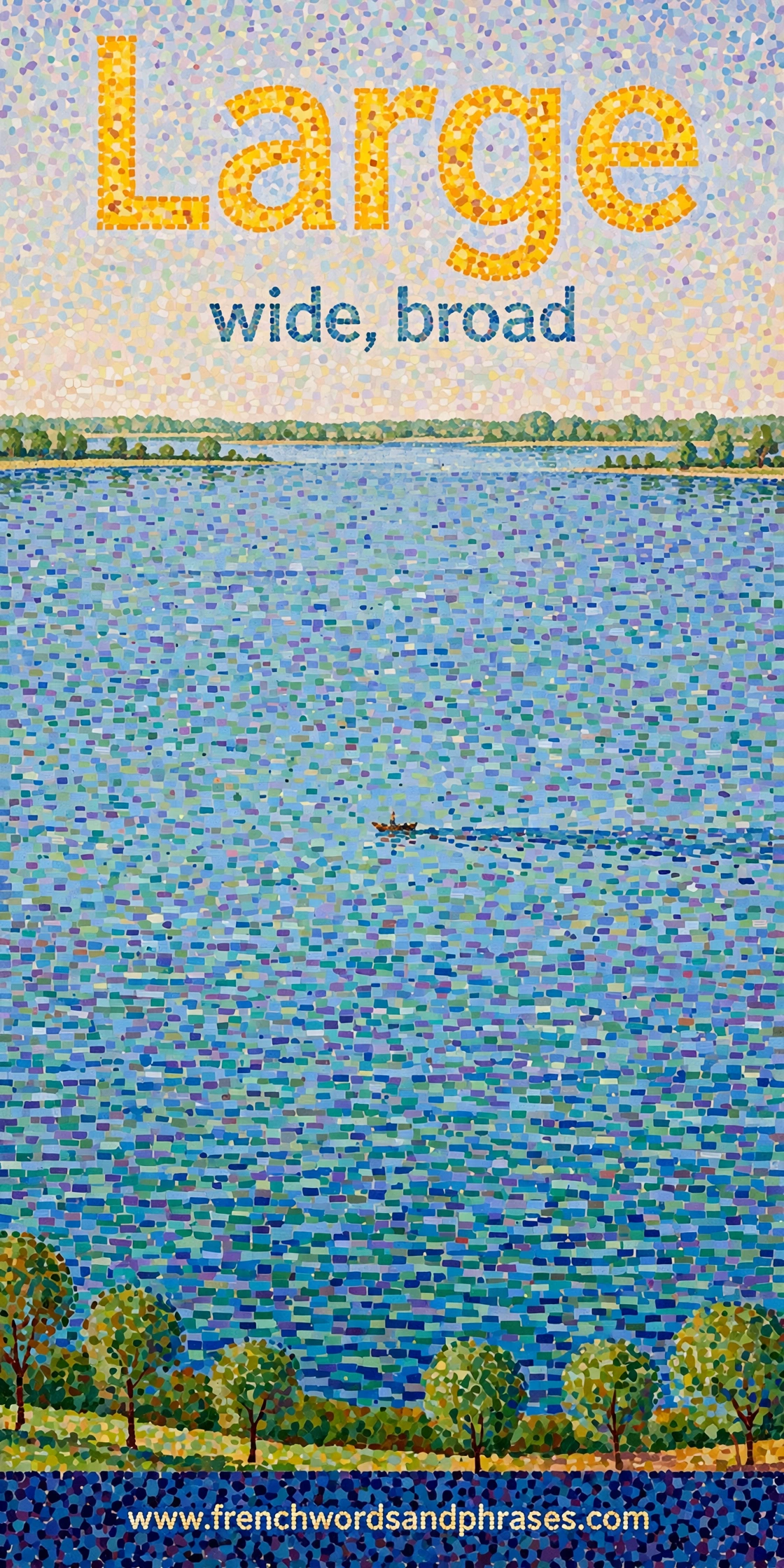
Large means wide, broad.
The river opening out below the bridge, the avenue built for processions, the smile that takes the whole face: large, wide — the adjective of breadth, of everything that spreads generously from side to side.
In this guide, you’ll learn what large means in English, why it is a famous false friend, how its feminine never changes, and the seafaring phrase au large. Explore French examples, English translations, and practice quizzes.
Understanding the French Adjective Large
Large is a French adjective of breadth. It comes from the Latin largus, abundant, generous — breadth as a form of generosity. It is invariable in gender, because it already ends in -e: un fleuve large, une rue large, des épaules larges. Only the plural changes, adding an s. Its noun is la largeur, width.
It means wide, broad — measured across: une large avenue, a wide avenue; un large choix, a wide choice; un large sourire, a broad smile. It does NOT usually mean big in general — that is grand or gros — and this is the famous trap: a large room, in French, is une grande pièce, while une pièce large is a wide one. At sea, the word becomes a place: au large, offshore, out at sea.
Type: Adjective of breadth — wide across; generous in range
Answers the question: How wide is it? — large, broad from side to side
Changes form: Invariable in gender — large for him and for her; plural larges
English equivalents: Wide, broad — NOT simply big.
The false friend deserves a plaque: English large (big) is usually grand or gros in French — une grande maison, un gros chien. Large measures the span across a thing: a street, a river, a choice, a smile. And remember the sea: au large is offshore, and prendre le large is to slip away, to head out.
Experience the Word
Large is the adjective of the open arms — breadth as welcome, the door, the river and the smile all widening at once.
Imagine the estuary at low tide, the river suddenly a kilometre of shining mud and sky. Le fleuve est si large ici que l’autre rive semble un autre pays.
You have not just measured something. You have praised its span — large, wide, broad, generous across.
How to Use Large in French: Complete Guide
Let’s explore how large works in French, beginning with the whole word on one card.
Large at a Glance
Before the details, here is the whole word on one card.
The Whole Word on One Card
Meaning, type, position and forms — large in four lines.
| Point | Large |
|---|---|
| Meaning | wide, broad — measured across, generous in span |
| Type | adjective of breadth |
| Usual position | after the noun — une rue large; before in un large choix |
| Form | large for both genders — larges in the plural |
Example
Une large avenue mène à la gare.
A wide avenue leads to the station.
The Four Forms of Large
Large already ends in -e, so masculine and feminine are identical; only the plural adds an s.
| Form | Large | Example |
|---|---|---|
| Masculine singular | large | un fleuve large — a wide river |
| Feminine singular | large | une rue large — a wide street |
| Masculine plural | larges | des chemins larges — wide paths |
| Feminine plural | larges | des avenues larges — wide avenues |
Example
Des avenues larges traversent le nouveau quartier.
Wide avenues cross the new district.
Quick Quiz 1
What is the feminine of large?
Reveal the answer
large
Une rue large — the word already ends in -e, so the feminine changes nothing.
A wide street.
The Feminine of Large: The Same Word
Large keeps one single form for him and for her, like all adjectives ending in -e — only the plural adds its s.
| Situation | Example |
|---|---|
| Masculine | un sourire large — a broad smile |
| Feminine | une porte large — identical: the -e is already there |
| Why | adjectives ending in -e do not change for the feminine |
| The plural | add s — des portes larges, wide doors |
Example
Une porte large laisse passer les meubles.
A wide door lets the furniture through.
Where Large Goes: After the Noun — and Before It
Large usually follows the noun, but in set figurative phrases it happily steps in front: un large choix, un large public.
| Pattern | Example |
|---|---|
| After the noun | une avenue large — a wide avenue |
| After être | le fleuve est large — the river is wide |
| Before the noun (set phrases) | un large choix — a wide choice |
| At sea | au large — offshore, out at sea |
Example
Le magasin offre un large choix de fromages.
The shop offers a wide choice of cheeses.
Quick Quiz 2
How do you say ‘a wide street’ — une large rue or une rue large?
Reveal the answer
une rue large
For physical width, large stands after the noun in ordinary French.
A wide street.
More Large: Comparing with Large
Large compares the regular way, with plus, moins and aussi — a scale of breadth.
| Degree | Example |
|---|---|
| As wide as | aussi large que — as wide as |
| Wider | plus large — wider |
| Less wide | moins large — less wide |
| The widest (masc.) | le plus large — le plus large des fleuves |
| The widest (fem.) | la plus large — la plus large des rues |
Example
Cette rivière est plus large que la route.
This river is wider than the road.
Everyday Expressions with Large
Streets, smiles and the open sea — large at its broad posts.
| Expression | In English |
|---|---|
| un large choix | a wide choice |
| un large sourire | a broad smile |
| au large | offshore, out at sea |
| prendre le large | to slip away, to head out to sea |
| un large public | a wide audience |
| être au large | to be comfortably off, at ease |
Example
Le bateau est déjà au large.
The boat is already out at sea.
Quick Quiz 3
What does au large mean?
Reveal the answer
Offshore, out at sea
Au large — away from the coast, on the open water.
Out at sea.
Large and Its Neighbours
Large keeps company with the other words of size — and must not be confused with its big cousins.
| French | In English |
|---|---|
| vaste | vast, extensive |
| ample | ample, roomy (of clothes) |
| grand | big, tall — size in general |
| gros | big, fat — bulk |
| étroit | narrow — the opposite |
| la largeur | width — the noun |
Example
Grand dit la taille, large dit la largeur.
Grand states the size, large states the width.
Watch Out: The Traps Around Large
The great trap is the false friend: English large is usually grand or gros, while French large measures the span across.
| Trap | The truth |
|---|---|
| The false friend | a large room = une grande pièce — large alone means wide, not big |
| The feminine | une rue large — no new form: large is invariable in gender |
| The plural | des rues larges — the plural still adds s, for both genders |
| The sea phrase | prendre le large = to slip away, not to take something large |
Example
Ce n’est pas une grande pièce, mais elle est large et lumineuse.
It is not a big room, but it is wide and bright.
Quick Quiz 4
How do you say ‘wide avenues’?
Reveal the answer
des avenues larges
Large follows the noun and takes the plural s: larges.
Wide avenues.
Large in Everyday French: Real-Life Examples
Now that you know the word, let’s see how large appears in everyday French.
Example 1 — Streets
Une rue large traverse le village.
A wide street crosses the village.
Example 2 — Rivers
Le fleuve est très large à cet endroit.
The river is very wide at this point.
Example 3 — Choice
Le menu offre un large choix de plats.
The menu offers a wide choice of dishes.
Example 4 — Smiles
Elle accueille les invités avec un large sourire.
She welcomes the guests with a broad smile.
Example 5 — At sea
Les pêcheurs sont partis au large.
The fishermen have gone out to sea.
Example 6 — Shoulders
C’est un homme aux épaules larges.
He is a man with broad shoulders.
Beyond Translation: The Meaning of Large
Large began as generosity: Latin largus meant abundant, free-giving, and the word still carries the gift inside the measurement — a large choix is generous, a large sourire is generous, and even the wide river seems to give more than it must. French politely refuses the English shortcut: big is a judgement, wide is a measurement, and large keeps the tape in its hand.
Large is breadth with good manners — the adjective that measures across and gives generously.
Learn it beside étroit, its opposite, and grand, its false friend, and no French street, river or menu will ever confuse you again.
How to Remember the French Adjective Large
Remember it this way: Large is the wide adjective — one form for him and for her, an s in the plural, and never a translation of English big.
- You learn it once for both genders — un fleuve large, une rue large.
- You refuse the false friend — large = wide; big = grand ou gros.
- You remember the sea — au large, offshore; prendre le large, to slip away.
The key idea is large means wide and broad; invariable in gender, plural larges; au large = offshore.
Test Your Knowledge of Large
Let’s see how much you’ve learned. Try answering these questions before revealing the answers.
Question 1
What does large mean?
Reveal the answer
Wide, broad — measured across, not big in general.
Question 2
What is the feminine of large?
Reveal the answer
large — unchanged: the word already ends in -e.
Question 3
Translate: a wide street.
Reveal the answer
Une rue large.
Question 4
Complete the sentence:
Des épaules ______ et un large sourire.
Reveal the answer
larges
Des épaules larges et un large sourire.
Broad shoulders and a broad smile.
Question 5
How do you say a large room in French?
Reveal the answer
Une grande pièce — large is a false friend: it means wide, not big.
Your Final Challenge
Can You Use It?
How would you say this in French?
“A wide avenue leads to the station.”
Reveal the answer
Une large avenue mène à la gare.
A wide avenue leads to the station.
A little French. A little curiosity. A richer everyday life.
LEARN FRENCH ONE WORD AT A TIME




