
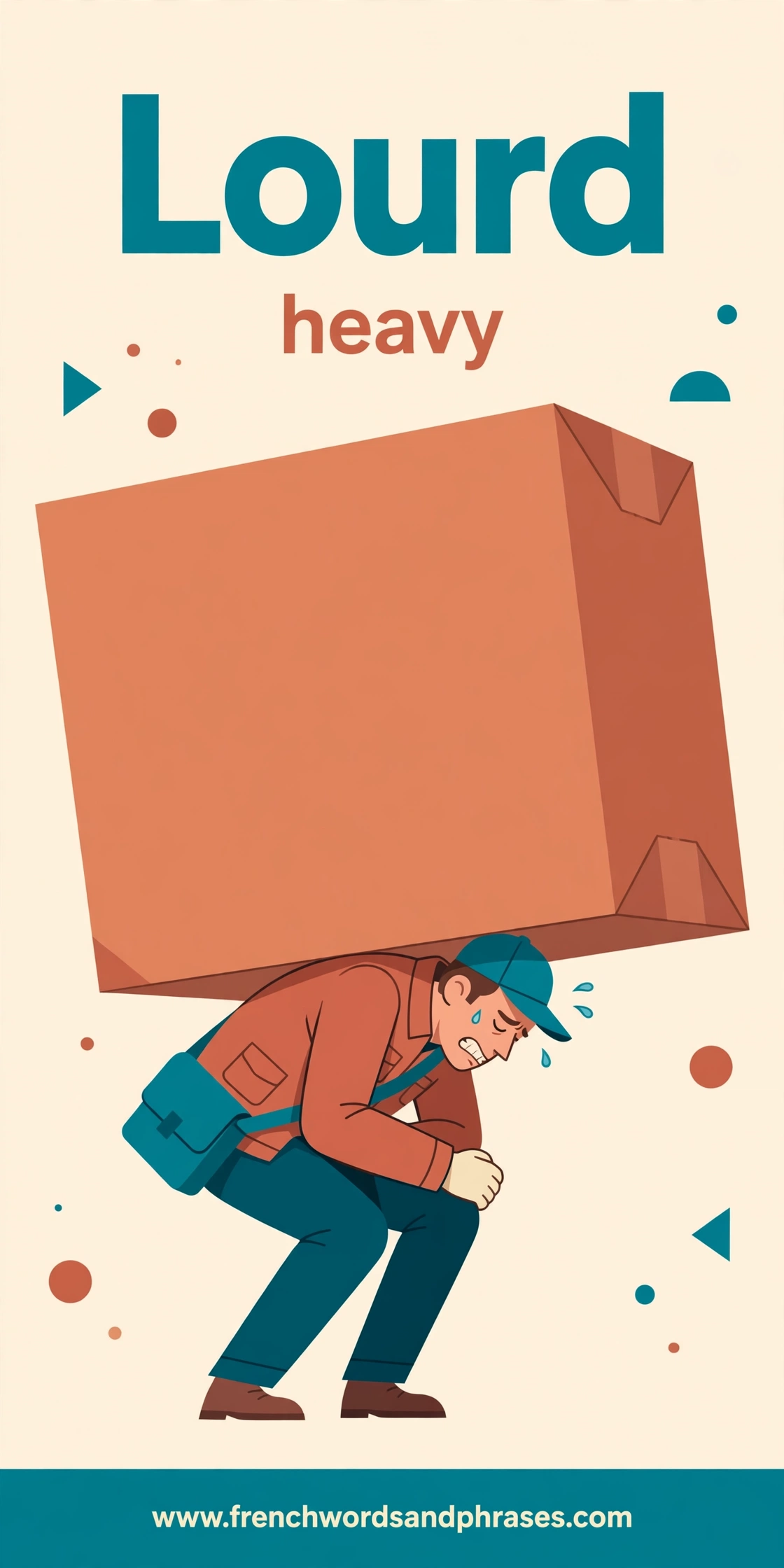
A French Word to Live By
Translate Lourd to English
/luʁ/
Lourd means heavy.
The suitcase that will not lift, the silence after bad news, the August air before the storm: lourd, heavy — the adjective of everything that presses down, on the arms, on the chest, on the room.
In this guide, you’ll learn what lourd means in English, how its feminine lourde is formed, the weather sense le temps est lourd, and when heavy turns into clumsy. Explore French examples, English translations, and practice quizzes.
Understanding the French Adjective Lourd
Lourd is a French adjective of weight and pressure. Its feminine is lourde: un sac lourd, une valise lourde, des cartons lourds, des portes lourdes. Beyond physical weight, French stretches it over everything that weighs: un repas lourd, a heavy meal; un silence lourd, a heavy silence; le temps est lourd, the weather is close and muggy. Its noun is la lourdeur, heaviness.
It means heavy — weighing a lot: une charge lourde, a heavy load; trop lourd à porter, too heavy to carry. Then heavy in effect: une lourde tâche, a heavy task; une lourde perte, a heavy loss; une atmosphère lourde, a heavy, tense atmosphere. And heavy in manner: une plaisanterie lourde is a clumsy, tactless joke — weight without grace.
Type: Adjective of weight — physical, figurative and social heaviness
Answers the question: What is it like? — heavy to lift, to bear, to digest, to hear
Changes form: Feminine lourde — lourds / lourdes in the plural
English equivalents: Heavy; burdensome, clumsy (of humour).
One important usage detail: for weather, French says le temps est lourd — the air is heavy, close, threatening rain; it never means the time is heavy. And keep the social sense in your ear: un humour lourd, une remarque lourde — heavy-handed, tactless. Lourd is rarely a compliment outside the gym.
Experience the Word
Lourd is the adjective of the bent back and the held breath — the box, the news and the joke all pressing the same way.
Imagine the déménagement, moving day, third floor, no lift: the wardrobe arrives at the landing one step at a time, and the whole team agrees without discussion — c’est le meuble le plus lourd de la maison.
You have not just weighed something. You have named the pressure itself — lourd, heavy, in the arms and in the air.
How to Use Lourd in French: Complete Guide
Let’s explore how lourd works in French, beginning with the whole word on one card.
Lourd at a Glance
Before the details, here is the whole word on one card.
The Whole Word on One Card
Meaning, type, position and forms — lourd in four lines.
| Point | Lourd |
|---|---|
| Meaning | heavy — in weight, in effect, in manner |
| Type | adjective of weight and pressure |
| Usual position | after the noun — une valise lourde |
| Form | lourd / lourde — lourds / lourdes in the plural |
Example
Cette valise est trop lourde pour moi.
This suitcase is too heavy for me.
The Four Forms of Lourd
Lourd follows the regular pattern: the feminine adds -e, and both plurals add -s.
| Form | Lourd | Example |
|---|---|---|
| Masculine singular | lourd | un sac lourd — a heavy bag |
| Feminine singular | lourde | une valise lourde — a heavy suitcase |
| Masculine plural | lourds | des cartons lourds — heavy boxes |
| Feminine plural | lourdes | des portes lourdes — heavy doors |
Example
Des portes lourdes ferment le vieux château.
Heavy doors close the old castle.
Quick Quiz 1
What is the feminine of lourd?
Reveal the answer
lourde
Une charge lourde — the feminine adds -e to lourd.
A heavy load.
The Feminine of Lourd: Lourde
Lourde is not a separate word to learn later — it is half of this word’s life, from suitcases to consequences.
| Situation | Example |
|---|---|
| Masculine | un paquet lourd — a heavy parcel |
| Feminine | une tâche lourde — a heavy task |
| Why | the feminine adds -e: lourd, lourde |
| The plural | add s to each — des tâches lourdes, heavy tasks |
Example
Une lourde tâche attend la nouvelle équipe.
A heavy task awaits the new team.
Where Lourd Goes: After the Noun
Lourd follows the noun it describes, like most French adjectives, and it sits naturally after être for the great weigh-ins.
| Pattern | Example |
|---|---|
| After the noun | une valise lourde — a heavy suitcase |
| After être | ce sac est lourd — this bag is heavy |
| The weather | le temps est lourd — the weather is close, muggy |
| Before the noun | un lourd sac — only in elevated, literary style |
Example
Le temps est lourd, l’orage approche.
The weather is heavy, the storm is coming.
Quick Quiz 2
How do you say ‘a heavy suitcase’ — une lourde valise or une valise lourde?
Reveal the answer
une valise lourde
Lourd stands after the noun in ordinary French, in its feminine form lourde.
A heavy suitcase.
More Lourd: Comparing with Lourd
Lourd compares the regular way, with plus, moins and aussi — a scale of weight.
| Degree | Example |
|---|---|
| As heavy as | aussi lourd que — as heavy as |
| Heavier | plus lourd — heavier |
| Less heavy | moins lourd — less heavy |
| The heaviest (masc.) | le plus lourd — le plus lourd des sacs |
| The heaviest (fem.) | la plus lourde — la plus lourde des valises |
Example
Ton sac est plus lourd que le mien.
Your bag is heavier than mine.
Everyday Expressions with Lourd
Suitcases, weather and silences — lourd at its heavy posts.
| Expression | In English |
|---|---|
| une valise lourde | a heavy suitcase |
| le temps est lourd | the weather is close, muggy |
| un silence lourd | a heavy silence |
| un repas lourd | a heavy meal |
| une lourde perte | a heavy loss |
| une plaisanterie lourde | a clumsy, tactless joke |
Example
Un silence lourd a suivi l’annonce.
A heavy silence followed the announcement.
Quick Quiz 3
What does le temps est lourd mean?
Reveal the answer
The weather is close and muggy
Le temps est lourd — the air is heavy, a storm is threatening.
The weather is heavy.
Lourd and Its Neighbours
Lourd keeps company with the other words of weight — and faces its floating opposite.
| French | In English |
|---|---|
| pesant | heavy, weighty — literary cousin |
| épais | thick, dense |
| grave | serious, grave |
| accablant | overwhelming, oppressive |
| léger | light — the opposite |
| la lourdeur | heaviness — the noun |
Example
Léger comme une plume, lourd comme le plomb.
Light as a feather, heavy as lead.
Watch Out: The Traps Around Lourd
The traps here are the weather phrase and the social sense: lourd can accuse a joke as surely as it weighs a bag.
| Trap | The truth |
|---|---|
| The weather | le temps est lourd — muggy, close air; never « heavy time » |
| The joke | une plaisanterie lourde is clumsy and tactless — lourd judges manner, not weight |
| The feminine | une valise lourde — do not forget the -e |
| Not « loud » | lourd does not mean loud — that is fort or bruyant |
Example
Sa remarque lourde a jeté un froid dans la salle.
His tactless remark cast a chill over the room.
Quick Quiz 4
How do you say ‘heavy doors’?
Reveal the answer
des portes lourdes
Feminine plural: lourde adds an s — lourdes.
Heavy doors.
Lourd in Everyday French: Real-Life Examples
Now that you know the word, let’s see how lourd appears in everyday French.
Example 1 — Travel
Ma valise est beaucoup trop lourde.
My suitcase is far too heavy.
Example 2 — Weather
Le temps est lourd depuis ce matin.
The weather has been heavy since this morning.
Example 3 — Silence
Un silence lourd remplissait la pièce.
A heavy silence filled the room.
Example 4 — Food
Évite les repas lourds le soir.
Avoid heavy meals in the evening.
Example 5 — Work
Une lourde tâche attend les bénévoles.
A heavy task awaits the volunteers.
Example 6 — Humour
Sa plaisanterie lourde n’a fait rire personne.
His clumsy joke made nobody laugh.
Beyond Translation: The Meaning of Lourd
Lourd is French’s most physical metaphor: everything the language cannot weigh, it weighs anyway — grief is lourd, silence is lourd, August air is lourd, and a joke can be lourd when it lands without grace. The word teaches a whole French instinct: that pressure is one thing, whether it arrives through the arms, the chest or the ears.
Lourd is the adjective of pressure — the word French uses when the world sits down on something.
Learn it beside léger, its opposite, and pesant, its literary cousin, and you can weigh anything in French — including the weather and the conversation.
How to Remember the French Adjective Lourd
Remember it this way: Lourd is the heavy adjective — lourde for her, and le temps est lourd for the muggy air before a storm.
- You learn the pair together — un sac lourd, une valise lourde.
- You feel the pressure — un silence lourd, un repas lourd, une tâche lourde.
- You watch the weather — le temps est lourd, the air is close and heavy.
The key idea is lourd / lourde means heavy; le temps est lourd = the weather is muggy.
Test Your Knowledge of Lourd
Let’s see how much you’ve learned. Try answering these questions before revealing the answers.
Question 1
What does lourd mean?
Reveal the answer
Heavy — in weight, in effect, and in manner.
Question 2
What is the feminine of lourd?
Reveal the answer
lourde — une valise lourde.
Question 3
Translate: This suitcase is too heavy for me.
Reveal the answer
Cette valise est trop lourde pour moi.
Question 4
Complete the sentence:
Des cartons ______ remplissent le couloir.
Reveal the answer
lourds
Des cartons lourds remplissent le couloir.
Heavy boxes fill the corridor.
Question 5
What is une plaisanterie lourde?
Reveal the answer
A clumsy, tactless joke — humour that lands with weight and without grace.
Your Final Challenge
Can You Use It?
How would you say this in French?
“The weather is heavy, the storm is coming.”
Reveal the answer
Le temps est lourd, l’orage approche.
The weather is heavy, the storm is coming.
A little French. A little curiosity. A richer everyday life.
LEARN FRENCH ONE WORD AT A TIME




