A French Word to Live By
Translate Charmant to English
/ʃaʁmɑ̃/
Charmant means charming.
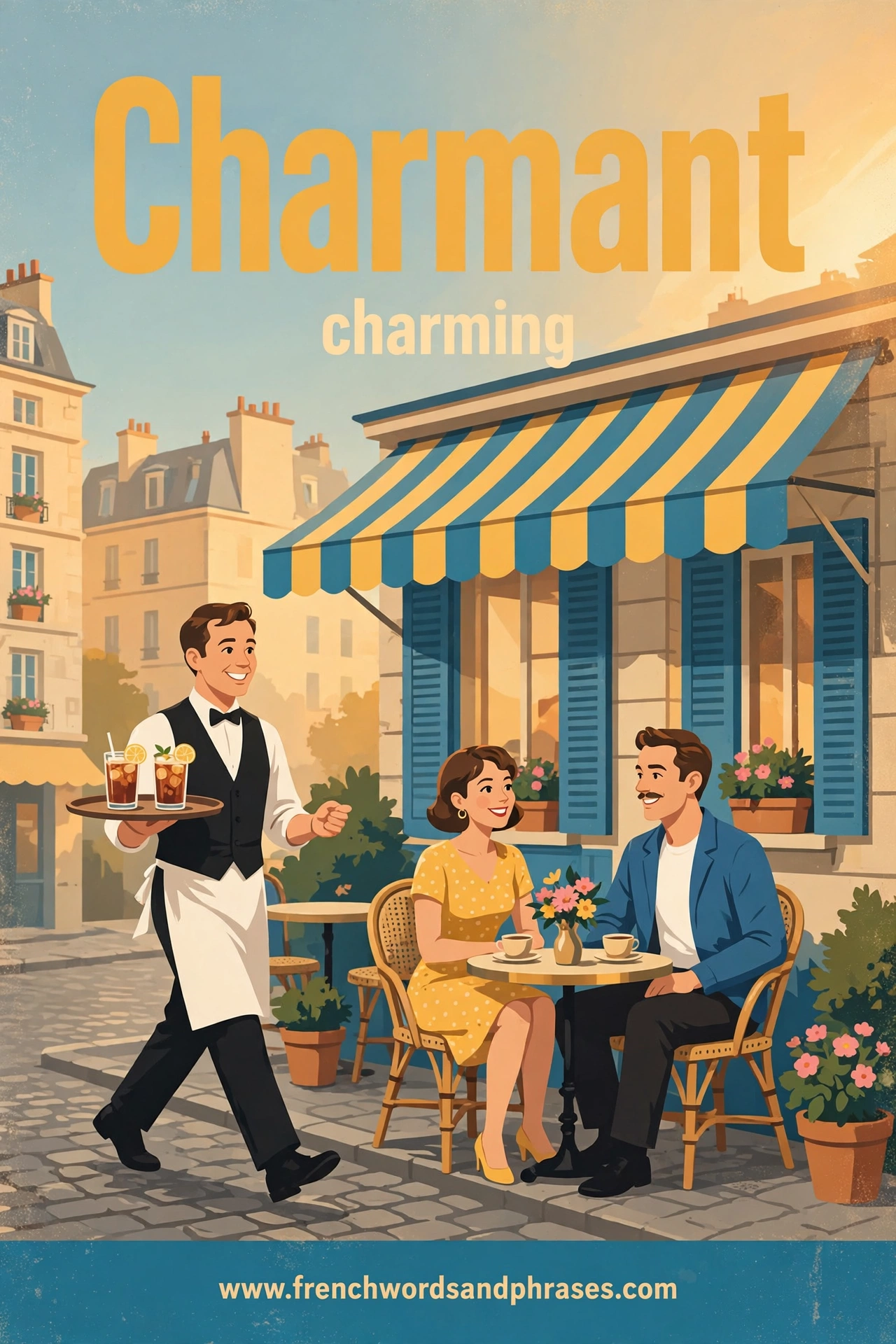
A small town square at golden hour: the café owner greets every table by name, the baker waves from his doorway, and a stranger is handed directions with a smile and a story. The place does not try to impress you — it simply makes you not want to leave. French calls that charmant.
In this guide, you’ll learn what charmant means in English, how its feminine charmante is formed, where it stands in the sentence, and how the same word can be sincere — or gloriously ironic. Explore French examples, English translations, and practice quizzes.
Understanding the French Adjective Charmant
Charmant is a French adjective of quality — the adjective of delight and seduction. It agrees in the regular -ant way: charmant, charmante, charmants, charmantes. Un village charmant is a town that wins you over without trying.
It means charming — delightful, pleasant, full of appeal. It describes towns (un village charmant, a charming village), streets (une rue charmante), squares, houses and people. And like the English word, it can turn ironic: « Charmant ! » with a raised eyebrow means just the opposite.
Type: Adjective of quality — charm and appeal
Answers the question: What is the place like? — charming
Changes form: Yes — charmant, charmante, charmants, charmantes
English equivalents: Charming; delightful; lovely.
One important usage detail: charmant stands AFTER the noun — un village charmant, une rue charmante. Watch its tone: said warmly, charmant is a compliment; said with a sigh after bad news, charmant ! is pure irony — charming, indeed.
Experience the Word
Charmant is the adjective of the town you meant to pass through and ended up staying in — the square you crossed at noon and were still sitting in at dusk, watching the light change.
Imagine a village of one street, one fountain and one café, where the waitress remembers how you take your coffee after a single visit. Nothing is grand, nothing is famous — and yet everything makes you smile.
You have not just described a nice place. You have described a place that seduced you gently.
How to Use Charmant in French: Complete Guide
Let’s explore how charmant works in French, beginning with the whole word on one card.
Charmant at a Glance
Before the details, here is the whole word on one card.
The Whole Word on One Card
Meaning, type, position and forms — charmant in four lines.
| Point | Charmant |
|---|---|
| Meaning | charming |
| Type | adjective of quality — charm and appeal |
| Usual position | after the noun — un village charmant |
| Form | charmant / charmante / charmants / charmantes |
Example
C’est un village charmant.
It’s a charming village.
The Four Forms of Charmant
Charmant agrees with the noun it describes. The feminine adds -te, so charmant becomes charmante — and unlike many adjectives, you can hear the difference.
| Form | Charmant | Example |
|---|---|---|
| Masculine singular | charmant | un village charmant — a charming village |
| Feminine singular | charmante | une rue charmante — a charming street |
| Masculine plural | charmants | des villages charmants — charming villages |
| Feminine plural | charmantes | des rues charmantes — charming streets |
Example
Le village est charmant et la rue est charmante.
The village is charming and the street is charming.
Quick Quiz 1
Which form of charmant goes with rue (feminine)?
Reveal the answer
charmante
Une rue charmante.
A charming street.
Charmante: The Feminine in -ante
Adjectives ending in -ant build their feminine in -ante. The change is visible and audible: the silent t of charmant wakes up in charmante.
| Situation | Example |
|---|---|
| The rule | add -te — charmant → charmante |
| The sound | charmant ends in a nasal sound; charmante sounds its t |
| Masculine plural | charmants — des villages charmants |
| Feminine plural | charmantes — des maisons charmantes |
Example
C’est une petite maison charmante, près du port.
It’s a charming little house, near the port.
Where Charmant Goes: After the Noun
Charmant follows the noun it describes, like most French adjectives, and it is perfectly at home after être, with an adverb in front of it.
| Pattern | Example |
|---|---|
| After the noun | un village charmant — a charming village |
| After être | cette rue est charmante — this street is charming |
| With an adverb | un village très charmant — a very charming village |
| Before the noun | un charmant village — not in everyday French |
Example
Le vieux port est très charmant le soir.
The old port is very charming in the evening.
Quick Quiz 2
Where does charmant stand — before or after the noun?
Reveal the answer
After
Un village charmant, une rue charmante.
A charming village, a charming street.
More Charming: Comparing with Charmant
Charmant compares the regular way, with plus, moins and aussi — and the superlative agrees as usual: le plus charmant, la plus charmante.
| Degree | Example |
|---|---|
| As charming as | aussi charmant que — as charming as |
| More charming | plus charmant — more charming |
| Less charming | moins charmant — less charming |
| The most charming (masc.) | le plus charmant — le plus charmant des villages |
| The most charming (fem.) | la plus charmante — la plus charmante des rues |
Example
Cette rue est plus charmante que la nôtre.
This street is more charming than ours.
Everyday Expressions with Charmant
Charmant belongs to small places, kind people and fairy tales — with one famous prince at the head of the list.
| Expression | In English |
|---|---|
| un village charmant | a charming village |
| une rue charmante | a charming street |
| le prince charmant | Prince Charming |
| une soirée charmante | a delightful evening |
| charmant ! | charming! — said warmly, or with irony |
| un accueil charmant | a warm, charming welcome |
Example
L’accueil était charmant, nous revenons chaque année.
The welcome was charming, we come back every year.
Quick Quiz 3
Who is le prince charmant?
Reveal the answer
Prince Charming
Le prince charmant is the fairy-tale prince.
Prince Charming.
Charmant and Its Neighbours
Charmant shares its appeal with agréable and pittoresque; at the other end, désagréable and quelconque describe the places that leave you cold.
| French | In English |
|---|---|
| agréable | pleasant, agreeable — the everyday neighbour |
| pittoresque | picturesque — charming enough to paint |
| accueillant | welcoming — of people and places |
| séduisant | seductive, attractive — charm with intention |
| désagréable | unpleasant — the opposite |
| quelconque | ordinary, nothing special — the dull opposite |
Example
Le village est charmant et accueillant, jamais quelconque.
The village is charming and welcoming, never ordinary.
Watch Out: The Traps Around Charmant
The traps here are the raised eyebrow, and a relative who casts spells.
| Trap | The truth |
|---|---|
| Irony | « Charmant ! » with a sigh means the opposite — like English ‘charming, isn’t it’ |
| le charme | the noun is le charme — le charme d’un village, the charm of a village |
| charmer | the verb charmer means to charm, to enchant — il a charmé tout le village |
| Agreement | villages are feminine in the plural too: des rues charmantes, never charmant |
Example
Il pleut, la chambre est froide — charmant !
It’s raining, the room is cold — charming!
Quick Quiz 4
How do you say ‘a charming village’?
Reveal the answer
un village charmant
Charmant follows the noun and agrees with it.
A charming village.
Charmant in Everyday French: Real-Life Examples
Now that you know the word, let’s see how charmant appears in everyday French.
Example 1 — A village
C’est un village charmant, avec une petite place.
It’s a charming village, with a little square.
Example 2 — A street
Nous logeons dans une rue charmante, près du marché.
We’re staying in a charming street, near the market.
Example 3 — A welcome
L’accueil dans ce village est charmant.
The welcome in this village is charming.
Example 4 — An evening
Nous avons passé une soirée charmante au café.
We spent a delightful evening at the café.
Example 5 — Houses
Les maisons charmantes bordent le port.
Charming houses line the harbour.
Example 6 — Irony
La chambre est sans eau chaude — charmant !
The room has no hot water — charming!
Beyond Translation: The Meaning of Charmant
English says charming for the meaning of charmant — and both languages keep the old magic inside the word: Latin carmen, a song, a spell. To be charmant is to work like a song — gently, without effort, and hard to resist.
A charmant town does not try to impress you; it wins you by singing.
That is why the word also turns on its heel so easily: said with warmth, it is a compliment; said with a sigh, it is a spell reversed — charm that has failed, delight turned to dust.
How to Remember the French Adjective Charmant
Remember it this way: Charmant is the song-spell adjective — built on charme, with a feminine charmante that sounds its t, its place behind the noun, and a meaning that flips with a sigh.
- You hear the song inside it — charmant comes from charme, a spell.
- You wake the t in the feminine — une rue charmante.
- You watch the tone — charmant ! with a sigh means the opposite.
The key idea is charmant means charming, its feminine is charmante, and with irony it means the opposite.
Test Your Knowledge of Charmant
Let’s see how much you’ve learned. Try answering these questions before revealing the answers.
Question 1
What does charmant mean?
Reveal the answer
Charming — delightful, pleasant, full of appeal.
Question 2
What is the feminine of charmant?
Reveal the answer
charmante — add -te: une rue charmante.
Question 3
Translate: a charming village.
Reveal the answer
Un village charmant.
Question 4
Complete the sentence:
Les maisons ______ bordent le port.
Reveal the answer
charmantes
Les maisons charmantes bordent le port.
Charming houses line the harbour.
Question 5
Who is le prince charmant?
Reveal the answer
Prince Charming — the fairy-tale prince.
Your Final Challenge
Can You Use It?
How would you say this in French?
“It’s a charming village: the streets are pretty and everyone says hello.”
Reveal the answer
C’est un village charmant : les rues sont jolies et tout le monde dit bonjour.
It’s a charming village: the streets are pretty and everyone says hello.
A little French. A little curiosity. A richer everyday life.
LEARN FRENCH ONE WORD AT A TIME