A French Word to Live By
Translate Oui to English
/wi/
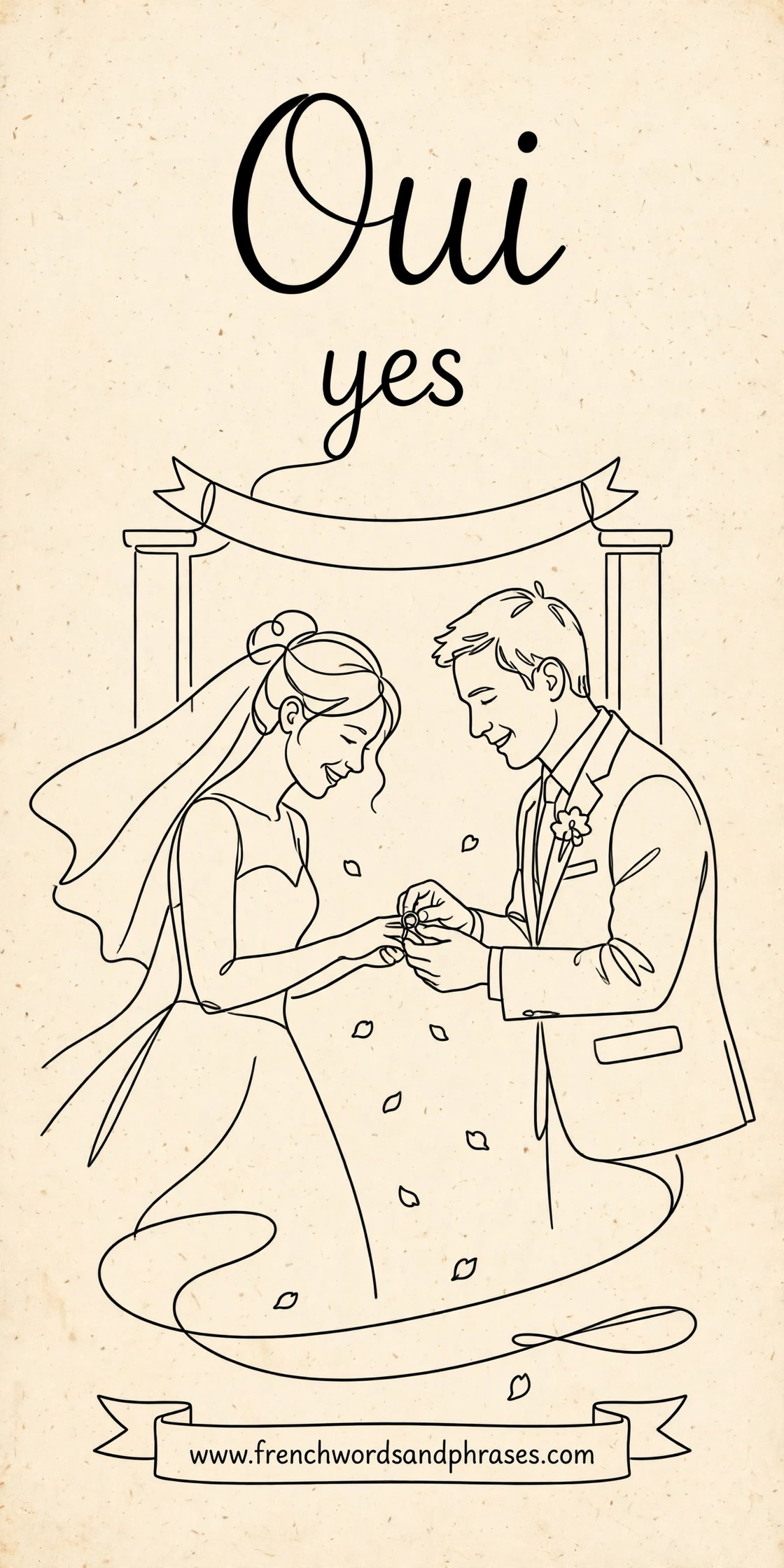
Oui means yes.
The smallest word in French carries weddings, contracts and cups of coffee on its back: « Oui. » A bride says it before a whole village, a child says it before a plate of spinach — well, sometimes — and a thousand times a day France agrees, accepts and answers with this one bright syllable: oui, yes.
Let’s explore how oui works in French, beginning with the whole answer on one card.
Understanding the French Interjection Oui
Oui is a French interjection and answer-word — the affirmative particle of the language. It descends from the Latin hoc ille worn down through Old French oïl, the word that once named the whole northern half of French speech: la langue d’oïl. Its great partner and secret is si, the special yes that contradicts a negative question.
It means yes — agreement, acceptance, and the answer to a question: Tu viens ? — Oui. Vous désirez un café ? — Oui, merci. But oui is a family, not a syllable: mais oui is of course, ben oui is well, obviously yes, ah oui is oh yes, I see, and oui oui, said quickly, can mean yes, yes, I am listening — or stop nagging me. Tone and company decide, as everywhere in French.
Type: Interjection — the affirmative answer-word
Answers the need: Saying yes — agreeing, accepting, answering
Register: Neutral — safe everywhere, from the town hall to the kitchen
Strength: Complete — one syllable that signs, marries and accepts
One important usage detail: after a NEGATIVE question or statement, French does not answer oui but si: Tu ne viens pas ? — Si, je viens ! (Yes I am coming!). Answering oui there would agree with the negative — yes, I am not coming. It is the most famous small trap in French, and the one natives will gently correct forever.
Experience the Word
Oui is the hinge on which French doors open — one syllable, and the answer is given, the coffee is coming, the marriage is made.
Imagine the village wedding: the mayor asks the old question, the church holds its breath, and the bride’s « oui » — small, clear, unhurried — rearranges two families forever. The same syllable, an hour later, orders the champagne.
You have not just agreed to something. You have performed the oldest speech act in French — oui, yes, I do, I will, I am.
How to Use Oui in French: Complete Guide
Let’s explore how oui works in French, beginning with the whole answer on one card.
Oui at a Glance
The Whole Answer on One Card
Meaning, job, register and strength — oui in four lines.
| Point | Oui |
|---|---|
| Meaning | yes — agreement, acceptance, affirmation |
| Job | answers questions, accepts offers, gives consent |
| Register | neutral — welcome everywhere |
| Strength | total: it can marry, sign and order |
Example
Oui, je le veux.
Yes, I do.
When You Say It: The Trigger Moments
Oui fires whenever the world asks a question with a yes-shaped hole in it.
| Situation | Example |
|---|---|
| Answering a question | tu viens ? — oui, j’arrive — are you coming? yes, I’m on my way |
| Accepting an offer | un café ? — oui, merci — a coffee? yes, please |
| Giving consent | oui, je le veux — yes, I do (the wedding) |
| Agreeing with a fact | oui, c’est vrai — yes, that’s true |
| On the phone | oui, allô, c’est moi — yes, hello, it’s me |
| Encouraging | oui, continue, je t’écoute — yes, go on, I’m listening |
Example
Oui, bien sûr, je t’aide.
Yes, of course, I’ll help you.
Quick Quiz 1
Someone offers: « Un café ? » What is the complete polite yes?
Reveal the answer
Oui, merci — or oui, s’il vous plaît.
Oui, merci, avec plaisir.
Yes please, with pleasure.
Oui or Si? The Great Distinction
French owns two yeses: oui affirms, si contradicts a negative. It is the most useful small rule in the language.
| Situation | Example |
|---|---|
| Positive question | tu viens ? — oui — are you coming? yes |
| Negative question, you ARE coming | tu ne viens pas ? — si, je viens ! — aren’t you coming? yes I am! |
| Negative question, you are NOT coming | tu ne viens pas ? — non, je ne viens pas — no, I’m not |
| Contradicting a negative statement | ce n’est pas vrai ! — mais si ! — that’s not true! oh yes it is! |
Example
Tu n’as pas faim ? — Si, un peu !
Aren’t you hungry? — Yes, a little!
Where It Goes: At the Head of the Answer
Oui leads; the sentence follows. It can also stand entirely alone — French trusts it to carry the whole reply.
| Pattern | Example |
|---|---|
| Alone | oui. — yes. (a complete answer) |
| Oui + sentence | oui, je viens demain — yes, I’m coming tomorrow |
| Oui + reinforcement | mais oui, évidemment — why yes, obviously |
| Repeated | oui oui, j’ai compris — yes yes, I understood |
Example
Oui, je signe où ?
Yes, where do I sign?
Quick Quiz 2
« Tu ne manges pas ? » You ARE eating. Do you answer oui or si?
Reveal the answer
Si
Si, je mange ! — si is the yes that contradicts a negative question.
Yes, I am eating!
Everyday Expressions with Oui
Oui travels with companions that tune its warmth, its surprise and its impatience.
| Expression | In English |
|---|---|
| mais oui | of course, why yes |
| ben oui (familiar) | well yes, obviously |
| ah oui ? | oh yes? oh really? (interest, surprise) |
| oui oui | yes yes (listening — or impatient) |
| dire oui | to say yes, to agree |
| un oui franc | a frank, wholehearted yes |
Example
Mais oui, entrez, la porte est ouverte !
Of course, come in, the door is open!
Close Cousins: The Other Ways to Say Yes
French grades its yeses from the town hall to the café terrace.
| French | In English |
|---|---|
| bien sûr | of course, certainly |
| évidemment | obviously, of course |
| volontiers | gladly, with pleasure (accepting) |
| d’accord | all right, agreed, OK |
| ouais (familiar) | yeah — the relaxed yes of friends |
Example
Volontiers, un café me fera du bien.
Gladly, a coffee will do me good.
Quick Quiz 3
What does ouais mean, and where does it belong?
Reveal the answer
Yeah — the familiar, relaxed yes, for friends and family, not for the mayor or the examiner.
Ouais, je viens, deux minutes.
Yeah, I’m coming, two minutes.
Oui and Its Neighbours
Oui stands at the head of the answer family — learn the whole row at once.
| French | In English |
|---|---|
| oui | yes — the standard affirmation |
| si | yes — against a negative |
| non | no |
| peut-être | maybe, perhaps |
| absolument | absolutely |
| pas du tout | not at all — the strong no |
Example
Peut-être demain, mais aujourd’hui, c’est non.
Maybe tomorrow, but today it’s no.
Watch Out: The Traps Around Oui
The traps are si after negatives, and the tones that turn oui into its own opposites.
| Trap | The truth |
|---|---|
| Negative questions | answer si, not oui, when you contradict: tu ne viens pas ? — si ! |
| Oui oui repeated flatly | can sound impatient — yes, yes, I heard you — mind the tone |
| Ouais at the office | ouais is familiar; official France says oui |
| Oui = I do | at a wedding the answer is oui, je le veux — the oui itself performs the marriage |
Example
Tu n’es pas fatigué ? — Si, un peu.
Aren’t you tired? — Yes, a little.
Quick Quiz 4
How do you say ‘of course’ with oui?
Reveal the answer
Mais oui
Mais oui, c’est évident !
Of course, it’s obvious!
Oui in Everyday French: Real-Life Examples
Now that you know the word, let’s see how oui appears in everyday French.
Example 1 — The offer
Un café ? — Oui, merci, volontiers.
A coffee? — Yes please, gladly.
Example 2 — The question
Tu viens demain ? — Oui, à neuf heures.
Are you coming tomorrow? — Yes, at nine.
Example 3 — The contradiction
Tu n’as pas faim ? — Si, un peu !
Aren’t you hungry? — Yes, a little!
Example 4 — The wedding
Oui, je le veux, pour toujours.
Yes, I do, forever.
Example 5 — Interest
Ah oui ? Raconte-moi tout !
Oh yes? Tell me everything!
Example 6 — Among friends
Ouais, d’accord, on se voit à la gare.
Yeah, OK, see you at the station.
Beyond Translation: The Meaning of Oui
Oui is not merely a word but a former border: medieval France was divided by its yeses — the north said oïl, ancestor of oui, the south said òc — and Dante himself classified the Romance languages by them. The langue d’oïl became standard French, and its little yes inherited a kingdom. It still governs the two most solemn minutes of French life, the wedding and the referendum, with the same unadorned syllable it spends on coffee.
To say oui is to speak the word that named a language.
Learn it with si, its shadow-twin, and French agreement is yours — from the café terrace to the altar.
How to Remember the French Interjection Oui
Remember it this way: Oui is yes — one syllable for every agreement, except after a negative question, where French answers si.
- You answer with oui — agreement, acceptance, consent: oui, merci.
- You contradict a negative with si — tu ne viens pas ? — Si, je viens !
- You tune it with company — mais oui, of course; ouais, yeah, for friends only.
The key idea is oui means yes; after a negative question, the yes that contradicts is si.
Test Your Knowledge of Oui
Let’s see how much you’ve learned. Try answering these questions before revealing the answers.
Question 1
What does oui mean?
Reveal the answer
Yes — agreement, acceptance, affirmation.
Question 2
How do you answer Tu ne viens pas ? when you ARE coming?
Reveal the answer
Si, je viens ! — si contradicts the negative question.
Question 3
Translate: Yes, of course, I’ll help you.
Reveal the answer
Oui, bien sûr, je t’aide.
Question 4
What is the familiar, relaxed form of oui?
Reveal the answer
Ouais — yeah, for friends and family.
Question 5
Complete the exchange:
— Tu n’as pas soif ? — ______, un peu, je prendrai de l’eau. (Yes, a little)
Reveal the answer
Si
Si, un peu, je prendrai de l’eau.
Yes, a little, I’ll have some water.
Can You Use It?
How would you say this in French?
“Yes, of course, I am coming tomorrow at nine.”
Reveal the answer
Oui, bien sûr, je viens demain à neuf heures.
Yes, of course, I am coming tomorrow at nine.
A little French. A little curiosity. A richer everyday life.
LEARN FRENCH ONE WORD AT A TIME