A French Word to Live By
Translate Lointain to English
/lwɛ̃.tɛ̃/
Lointain means distant, far-off.
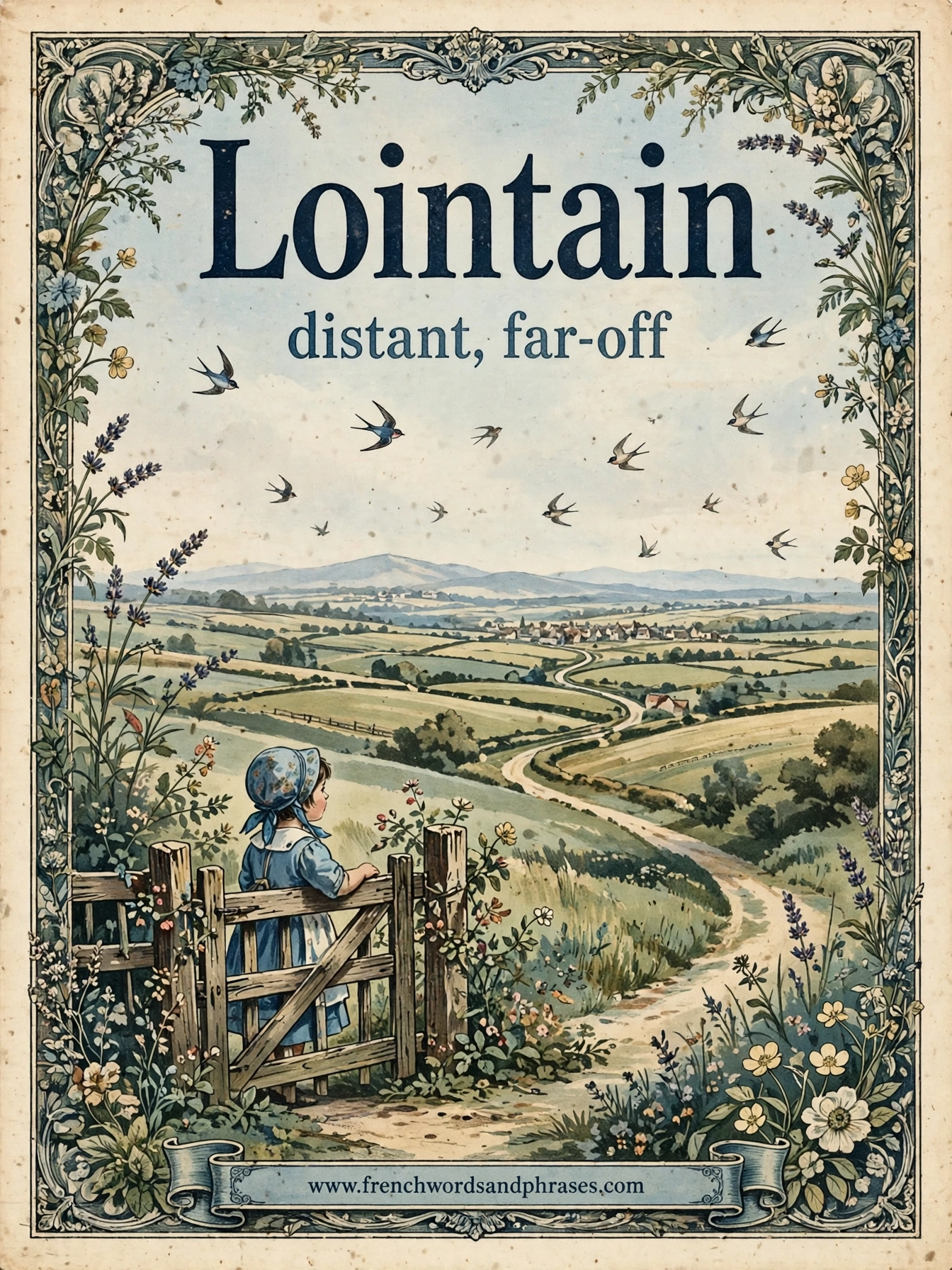
A village blue on the horizon, a cousin’s voice thin on an old recording, a century you can barely imagine: lointain, distant, far-off — the adjective of everything the eye, the ear or the heart can only just reach.
In this guide, you’ll learn what lointain means in English, how its feminine lointaine is formed, where it stands in the sentence, and how it differs from plain loin. Explore French examples, English translations, and practice quizzes.
Understanding the French Adjective Lointain
Lointain is a French adjective of distance — in space, in time and in family. It is built on loin, far, with the suffix -ain of belonging. Its feminine is lointaine: lointain /lwɛ̃.tɛ̃/, lointaine /lwɛ̃.tɛn/. As a noun, le lointain is the far distance itself, the blue depth at the end of a view.
It means distant, far-off, remote. In space: un village lointain, a distant village; des pays lointains, faraway countries; une île lointaine, a remote island. In time: un passé lointain, a distant past; dans un avenir lointain, in the distant future. In family: un cousin lointain, a distant cousin — kinship measured like geography. And in feeling: un regard lointain, a faraway look, un air lointain, a distant, dreamy air — the eyes somewhere else entirely.
Type: Adjective of distance — space, time, kinship, feeling
Answers the question: How far? — distant, far-off, remote
Changes form: lointain / lointaine / lointains / lointaines — the feminine hears the n
English equivalents: Distant; far-off; remote; faraway.
One important usage detail: lointain agrees and follows its noun — une île lointaine — but it is a more literary word than loin, which is an adverb: loin d’ici, far from here, never lointain d’ici. Choose lointain to describe a noun (un pays lointain), loin to measure a journey (habiter loin). As a noun, dans le lointain means in the distance, on the horizon.
Experience the Word
Lointain is the adjective of the blue end of the view — where outlines soften, sounds thin out, and imagination takes over from the eyes.
Imagine the walker on the ridge at evening: below, the valley; beyond, range behind range of mountains, each paler than the last, until the furthest is only a rumour of blue. Des montagnes lointaines — distant mountains, more colour than stone.
You have not just measured kilometres. You have named the poetry of far — lointain, where the world turns to watercolour.
How to Use Lointain in French: Complete Guide
Let’s explore how lointain works in French, beginning with the whole word on one card.
Lointain at a Glance
Before the details, here is the whole word on one card.
The Whole Word on One Card
Meaning, type, position and forms — lointain in four lines.
| Point | Lointain |
|---|---|
| Meaning | distant, far-off, remote — in space, time and family |
| Type | adjective of distance |
| Usual position | after the noun — un village lointain |
| Forms | lointain, lointaine, lointains, lointaines |
Example
Un village lointain brille dans la vallée.
A distant village shines in the valley.
The Four Forms of Lointain
The feminine lointaine opens the nasal and hears the n: lointain /lwɛ̃.tɛ̃/, lointaine /lwɛ̃.tɛn/.
| Form | Lointain | Example |
|---|---|---|
| Masculine singular | lointain | un pays lointain — a faraway country |
| Feminine singular | lointaine | une île lointaine — a remote island |
| Masculine plural | lointains | des pays lointains — faraway countries |
| Feminine plural | lointaines | des îles lointaines — remote islands |
Example
Des îles lointaines apparaissent sur la carte de l’océan.
Remote islands appear on the map of the ocean.
Quick Quiz 1
What is the feminine of lointain?
Reveal the answer
lointaine
Une étoile lointaine — the n is heard in the feminine: /lwɛ̃.tɛn/.
A distant star.
The Feminine of Lointain: Lointaine
Lointaine belongs to the -ain / -aine family — certain, certaine and prochain, prochaine keep it company.
| Situation | Example |
|---|---|
| Masculine | un souvenir lointain — a distant memory |
| Feminine | une époque lointaine — a distant era |
| Why | the written e wakes the final n |
| The plural | add s — des époques lointaines, distant eras |
Example
Une époque lointaine revit dans ce vieux film.
A distant era lives again in this old film.
Where Lointain Goes: After the Noun
Lointain follows the noun it describes; for journeys and measures, French switches to the adverb loin.
| Pattern | Example |
|---|---|
| After the noun | un village lointain — a distant village |
| After être | le village est lointain — the village is far away (literary) |
| As a noun | dans le lointain — in the distance |
| Not for measures | loin d’ici — far from here (loin, the adverb) |
Example
Dans le lointain, on entend les cloches du village.
In the distance, you can hear the village bells.
Quick Quiz 2
How do you say ‘a remote island’ — un lointain île or une île lointaine?
Reveal the answer
une île lointaine
Lointain stands after the noun and agrees with it: île is feminine, so lointaine.
A remote island.
More Lointain: Comparing with Lointain
Distance compares the regular way — and the superlative belongs to stars and ancestors.
| Degree | Example |
|---|---|
| As distant as | aussi lointain que — as distant as |
| More distant | plus lointain — more distant |
| Less distant | moins lointain — less distant |
| The most distant (masc.) | le plus lointain — le plus lointain des villages |
| The most distant (fem.) | la plus lointaine — la plus lointaine des étoiles |
Example
C’est l’étoile la plus lointaine que l’on puisse voir.
It is the most distant star that can be seen.
Everyday Expressions with Lointain
Lointain travels through geography, genealogy and daydreams.
| Expression | In English |
|---|---|
| un pays lointain | a faraway country |
| un cousin lointain | a distant cousin |
| un passé lointain | a distant past |
| dans le lointain | in the distance, far away |
| un regard lointain | a faraway look |
| une lointaine ressemblance | a remote resemblance |
Example
Elle regardait la mer avec un regard lointain.
She was looking at the sea with a faraway look.
Quick Quiz 3
What does un cousin lointain mean?
Reveal the answer
A distant cousin
Un cousin lointain — a cousin far out on the family tree.
A distant cousin.
Lointain and Its Neighbours
Lointain keeps company with the words of far — and faces proche, its near opposite.
| French | In English |
|---|---|
| loin | far — the adverb: loin d’ici |
| éloigné | distant, removed, out-of-the-way |
| distant | distant — of manners, aloof |
| reculé | remote, secluded (a place) |
| proche | near, close — the opposite |
| voisin | neighbouring, nearby |
Example
Un village reculé, loin de tout, semble toujours lointain.
A remote village, far from everything, always seems distant.
Watch Out: The Traps Around Lointain
The traps are loin the adverb (for measures), and distant, which in French describes cold manners more than far places.
| Trap | The truth |
|---|---|
| Far from here | loin d’ici — loin is the adverb; lointain describes a noun |
| A distant person | un homme distant is an aloof man, not a faraway one — for the look in the eyes, say un regard lointain |
| The feminine sound | lointaine hears its n: /lwɛ̃.tɛn/ — do not nasalise it |
| Register | lointain is a touch literary; everyday speech often prefers loin or éloigné |
Example
Il habite loin, dans un village lointain des Alpes.
He lives far away, in a distant village in the Alps.
Quick Quiz 4
How do you say ‘faraway countries’?
Reveal the answer
des pays lointains
Lointain follows the noun and agrees, masculine plural: lointains.
Faraway countries.
Lointain in Everyday French: Real-Life Examples
Now that you know the word, let’s see how lointain appears in everyday French.
Example 1 — Travel
Ils rêvent de pays lointains et de mers chaudes.
They dream of faraway countries and warm seas.
Example 2 — Family
Un cousin lointain d’Amérique nous a écrit.
A distant cousin from America wrote to us.
Example 3 — History
Dans un passé lointain, la mer couvrait la plaine.
In a distant past, the sea covered the plain.
Example 4 — The view
Dans le lointain, les montagnes deviennent bleues.
In the distance, the mountains turn blue.
Example 5 — Daydream
Elle écoute avec un regard lointain, l’esprit ailleurs.
She listens with a faraway look, her mind elsewhere.
Example 6 — Sound
Le son lointain des cloches annonce la fête.
The distant sound of the bells announces the festival.
Beyond Translation: The Meaning of Lointain
Lointain is the adjective French painting would have invented if the language had not: the word of the arrière-plan, of perspective itself — the blue that distance paints over everything far. It governs three geographies at once: the map’s (pays lointains), the calendar’s (passé lointain) and the family tree’s (cousin lointain), as if space, time and blood were one single scale of far.
Lointain is where the certain ends and the imagined begins.
Learn it against proche and beside loin, and you can place anything in French — a village, a century, a cousin — at its true distance.
How to Remember the French Adjective Lointain
Remember it this way: Lointain is distant and far-off — feminine lointaine: un pays lointain, une île lointaine, and dans le lointain for in the distance.
- The four forms — lointain, lointaine, lointains, lointaines; the feminine hears the n.
- Three distances — space (un village lointain), time (un passé lointain), family (un cousin lointain).
- Adjective, not adverb — for far from here, French says loin d’ici.
The key idea is lointain means distant, far-off; feminine lointaine, dans le lointain = in the distance.
Test Your Knowledge of Lointain
Let’s see how much you’ve learned. Try answering these questions before revealing the answers.
Question 1
What does lointain mean?
Reveal the answer
Distant, far-off, remote — in space, time and family.
Question 2
What is the feminine of lointain?
Reveal the answer
lointaine — une île lointaine, with the n pronounced.
Question 3
Translate: a distant cousin.
Reveal the answer
Un cousin lointain.
Question 4
Complete the sentence:
Des montagnes ______ ferment l’horizon.
Reveal the answer
lointaines
Des montagnes lointaines ferment l’horizon.
Distant mountains close the horizon.
Question 5
How do you say far from here?
Reveal the answer
Loin d’ici — with the adverb loin, not the adjective lointain.
Can You Use It?
How would you say this in French?
“In the distance, the mountains turn blue.”
Reveal the answer
Dans le lointain, les montagnes deviennent bleues.
In the distance, the mountains turn blue.
A little French. A little curiosity. A richer everyday life.
LEARN FRENCH ONE WORD AT A TIME