A French Word to Live By
Translate Merci to English
/mɛʁ.si/
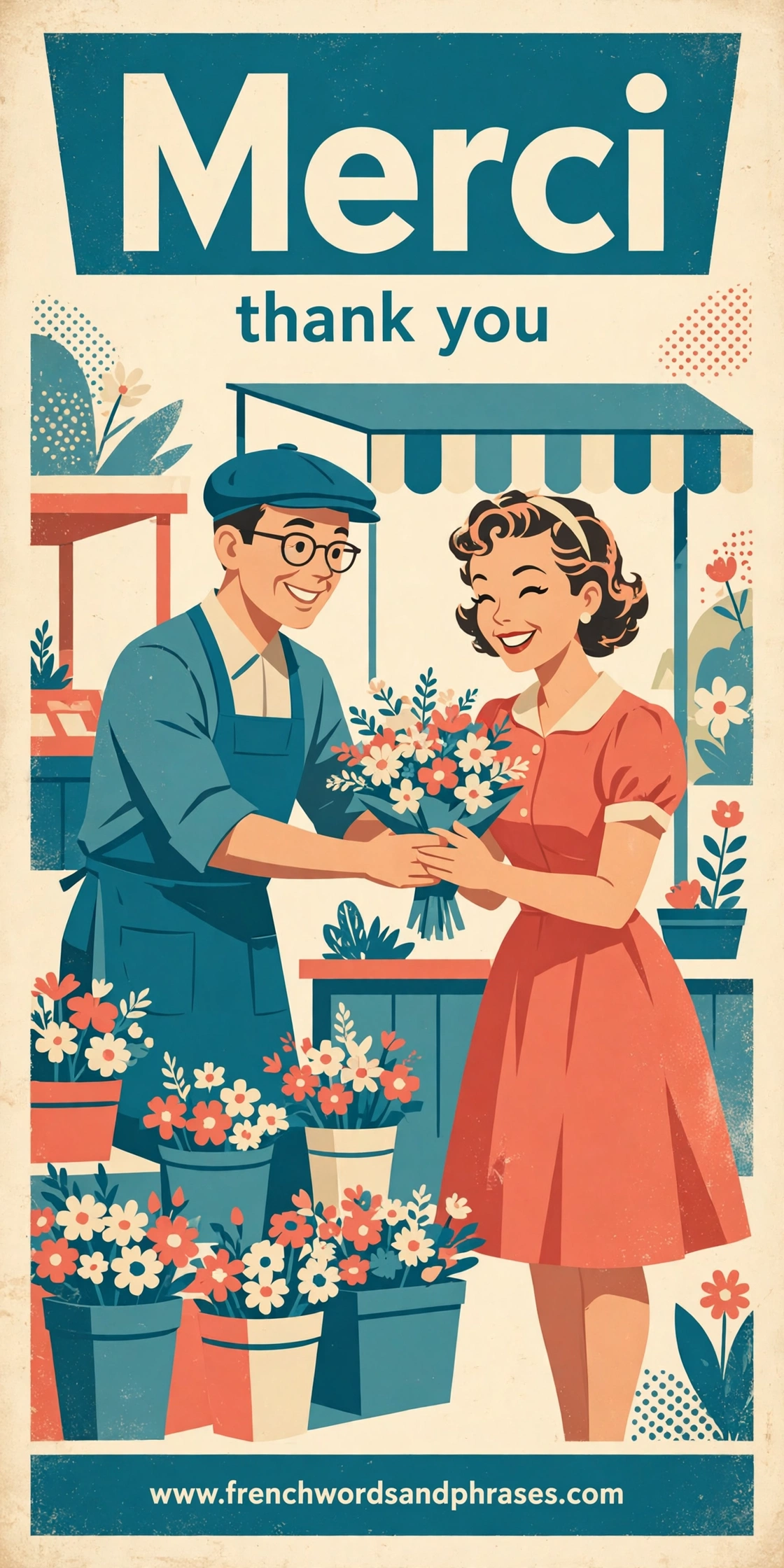
Merci means thank you.
The baker hands over the warm baguette, the stranger holds the door, the bus driver waits the extra three seconds — and one small word answers them all: « Merci ! » Merci is the most useful word in French: the thank-you that opens doors, softens days, and costs absolutely nothing.
Let’s explore how merci works in French, beginning with the whole reaction on one card.
Understanding the French Interjection Merci
Merci is a French interjection — the word of gratitude, complete in itself: no verb, no agreement, no plural. It descends from the Latin merces, a reward or favour: to say merci was originally to acknowledge a grace received. Today it is the automatic music of French daily life — said to bakers, bus drivers, strangers and friends, dozens of times a day, and expected every single time.
It means thank you — the thanks for anything received: a thing, a service, a kindness, a moment of patience: « Merci pour le café », thank you for the coffee; « Merci de votre aide », thank you for your help. It also serves, with a smile and a raised hand, as the polite refusal: « Encore du gâteau ? — Merci. » — no thank you. And in its older, literary life, merci is also a noun of mercy: être à la merci de quelqu’un, to be at someone’s mercy — the favour and the thanks were once the same word.
Type: Interjection — gratitude (thanks and polite refusal)
Answers the need: Thanking — acknowledging anything received, great or small
Register: Universal — every age, every situation, every day
Strength: Small and constant — its power is in never being forgotten
One important usage detail: merci takes pour for a thing received and de before a verb — merci pour le cadeau, merci de m’aider (or merci de votre aide, with a noun). The strengthened forms are merci beaucoup, many thanks, and mille mercis or merci mille fois, a thousand thanks. In France, forgetting merci is noticed far more than saying it too often.
Experience the Word
Merci is the smallest coin of French politeness — minted fresh at every counter, and accepted everywhere without change.
Imagine the morning round of a village: the baker, the postman, the neighbour with the gate — six mercis before nine o’clock, and the whole day runs more smoothly for them, like a door kept oiled.
You have not performed a courtesy. You have acknowledged a gift — merci, the word that says: I noticed, and it mattered.
How to Use Merci in French: Complete Guide
Let’s explore how merci works in French, beginning with the whole reaction on one card.
Merci at a Glance
The Whole Reaction on One Card
Meaning, job, register and strength — merci in four lines.
| Point | Merci |
|---|---|
| Meaning | thank you — and, with a smile, no thank you |
| Job | acknowledges anything received: thing, service, kindness |
| Register | universal — said by everyone, to everyone, every day |
| Strength | small and constant; strengthened by beaucoup or mille fois |
Example
Merci beaucoup pour votre aide !
Thank you very much for your help!
When You Say It: The Trigger Moments
Merci fires whenever something is received — and French life offers the occasion a dozen times a day.
| Situation | Example |
|---|---|
| Receiving a thing | merci pour le cadeau — thank you for the present |
| Receiving a service | merci de m’avoir aidé — thank you for helping me |
| At the counter | merci, au revoir ! — thank you, goodbye! |
| The polite refusal | encore du café ? — merci. — more coffee? — no thank you. |
| Deep gratitude | merci mille fois — a thousand thanks |
Example
Merci de votre patience, monsieur.
Thank you for your patience, sir.
Quick Quiz 1
A stranger holds the door for you. What do you say?
Reveal the answer
Merci !
Merci, monsieur !
Thank you, sir! — in France, the merci to a stranger is never optional.
The Delivery: Smile, Eyes and Timing
Merci is short, so the delivery carries the warmth — a smile, a look, and no delay.
| Delivery | What it does |
|---|---|
| With a smile and eye contact | the complete merci — received as real gratitude |
| Murmured while rushing past | polite, but thin — better than nothing, barely |
| With beaucoup | merci beaucoup — the everyday strengthening |
| With mille fois | merci mille fois — for the great services and rescues |
| Followed by the reason | merci pour… / merci de… — says exactly what is being thanked |
Example
Merci beaucoup, c’est très gentil !
Thank you very much, that is very kind!
Where It Goes: Merci Pour, Merci De
Merci takes pour for a thing and de before a verb or an abstract noun — the small grammar of gratitude.
| Position / pattern | Example |
|---|---|
| Before a thing (pour) | merci pour le livre — thank you for the book |
| Before a verb (de) | merci de venir — thank you for coming |
| Before a noun of service (de) | merci de votre aide — thank you for your help |
| Alone, as a refusal | du thé ? — merci. — some tea? — no thank you. |
Example
Merci pour tout, vraiment.
Thank you for everything, truly.
Quick Quiz 2
« Encore du gâteau ? — Merci. » Is the speaker accepting the cake?
Reveal the answer
No — merci alone, with a smile, is the polite refusal: no thank you.
Non merci, c’était délicieux.
No thank you, it was delicious.
Everyday Expressions with Merci
A small family of set phrases grades French gratitude from the counter to the rescue.
| Expression | In English |
|---|---|
| merci beaucoup | thank you very much |
| merci mille fois / mille mercis | a thousand thanks |
| merci d’avance | thank you in advance |
| merci pour tout | thank you for everything |
| non merci | no thank you — the refusal made explicit |
| merci de votre compréhension | thank you for your understanding (letters and notices) |
Example
Merci d’avance pour votre réponse.
Thank you in advance for your reply.
Close Cousins: The Other Words of Gratitude
Merci rules daily life, but French keeps a few other ways to be grateful.
| Word | The difference |
|---|---|
| je vous remercie | I thank you — the full verb form, formal and written |
| merci infiniment | thank you infinitely — warm, slightly elevated |
| c’est gentil | that’s kind — gratitude aimed at the person, not the gift |
| avec plaisir | with pleasure — the answer to a merci, like « you’re welcome » |
| de rien | it’s nothing, don’t mention it — the other classic answer |
Example
— Merci ! — De rien, avec plaisir.
— Thank you! — Don’t mention it, with pleasure.
Quick Quiz 3
Someone thanks you warmly. Give two classic French answers.
Reveal the answer
De rien and avec plaisir
— Merci beaucoup ! — De rien, avec plaisir.
— Thank you very much! — It’s nothing, with pleasure.
Merci and Its Neighbours
From the counter’s murmur to the rescue’s embrace — the scale of French gratitude.
| French | In English |
|---|---|
| merci | thank you — the everyday word |
| merci beaucoup | thank you very much |
| merci mille fois | a thousand thanks |
| je vous remercie infiniment | I thank you infinitely — formal, heartfelt |
| merci, vous me sauvez la vie | thank you, you are saving my life — the grateful exaggeration |
Example
Merci, tu me sauves la vie, vraiment.
Thank you, you are truly saving my life.
Watch Out: The Traps Around Merci
The traps: the wrong preposition, the forgotten merci, and the mercy hiding inside the word’s history.
| Trap | The truth |
|---|---|
| merci pour + verb | before a verb, use de: merci de venir, not merci pour venir |
| forgetting it with strangers | in France the merci to the baker and the bus driver is obligatory politeness |
| reading merci as only modern thanks | à la merci de quelqu’un still means at someone’s mercy — the old noun survives |
| answering merci with silence | the expected replies are de rien, avec plaisir, or je vous en prie |
Example
Sans merci, la journée commence mal.
Without a thank-you, the day starts badly.
Quick Quiz 4
True or false: merci pour venir is correct French for « thank you for coming ».
Reveal the answer
False — before a verb, merci takes de: merci de venir.
Merci de venir si tôt.
Thank you for coming so early.
Merci in Everyday French: Real-Life Examples
Now that you know the word, let’s see how merci appears in everyday French.
Example 1 — At the bakery
Merci, au revoir !
Thank you, goodbye!
Example 2 — A present
Merci beaucoup pour ce beau livre !
Thank you very much for this lovely book!
Example 3 — Refusing politely
Non merci, je n’ai plus faim.
No thank you, I am not hungry any more.
Example 4 — For help
Merci de m’avoir aidé à porter la valise.
Thank you for helping me carry the suitcase.
Example 5 — Great service
Merci mille fois, vraiment.
A thousand thanks, truly.
Example 6 — In a letter
Merci de votre compréhension.
Thank you for your understanding.
Beyond Translation: The Meaning of Merci
Merci began its life as a word of power: Latin merces was the wage, the reward, the favour granted by someone stronger — and to cry merci was to beg for grace. The word slid gently down the centuries from the battlefield to the bakery, carrying its old meaning in one surviving phrase: être à la merci de, to be at the mercy of. What never changed is the exchange at its heart: something given freely, something acknowledged freely. France runs on the exchange — a merci is the receipt the whole society signs, a dozen times a day.
To say merci is to complete the gift: received, noticed, and answered.
That is why it is the first word taught to every child and every learner — and why, of all the words on this site, it may be the one that opens the most doors.
How to Remember the French Interjection Merci
Remember it this way: Merci is thank you — pour for a thing, de before a verb, beaucoup to strengthen it, and a smile to complete it.
- You answer everything received — merci pour le cadeau, merci de votre aide.
- You choose the preposition — pour the thing, de before the verb: merci de venir.
- You never skip it — in France, the forgotten merci is remembered longer than the said one.
The key idea is merci means thank you; merci pour (thing), merci de (verb); replies: de rien, avec plaisir.
Test Your Knowledge of Merci
Let’s see how much you’ve learned. Try answering these questions before revealing the answers.
Question 1
What does merci mean?
Reveal the answer
Thank you — and, alone with a smile, no thank you.
Question 2
How do you say thank you very much?
Reveal the answer
Merci beaucoup.
Question 3
Translate: Thank you for coming.
Reveal the answer
Merci de venir.
Question 4
What are the two classic replies to a merci?
Reveal the answer
De rien (it’s nothing) and avec plaisir (with pleasure).
Question 5
Complete the sentence:
______ pour le cadeau, il me plaît beaucoup ! (thank you)
Reveal the answer
Merci
Merci pour le cadeau, il me plaît beaucoup !
Thank you for the present, I like it very much!
Your Final Challenge
Can You Use It?
How would you say this in French?
“Thank you very much for your help!”
Reveal the answer
Merci beaucoup pour votre aide !
Thank you very much for your help!
A little French. A little curiosity. A richer everyday life.
LEARN FRENCH ONE WORD AT A TIME