A French Word to Live By
Translate Hé to English
/e/
Hé means hey!.
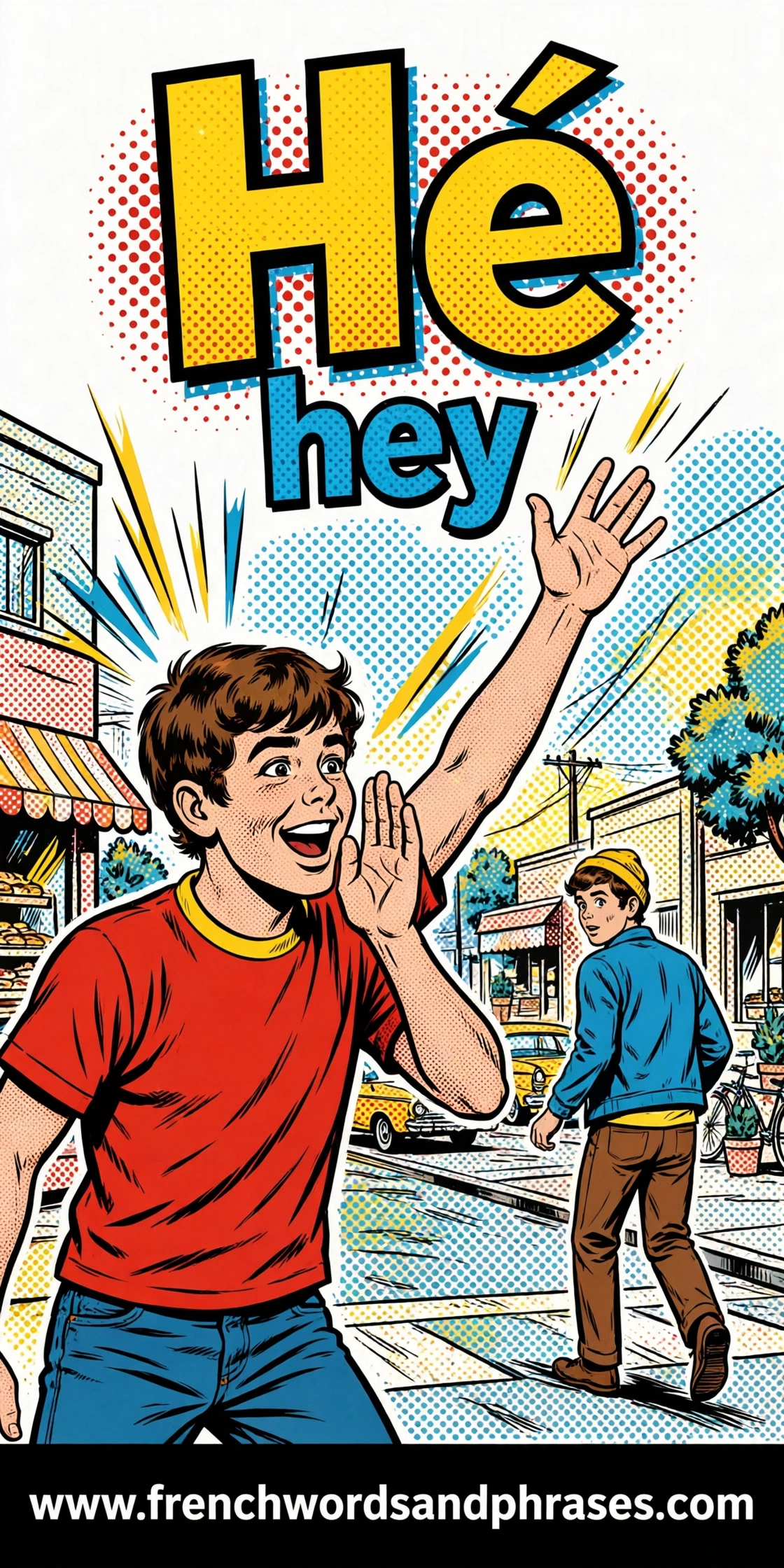
A boy races down a village street, cap in hand, waving at the friend who has just turned the corner ahead of him. « Hé ! Attends-moi ! » Hey! Wait for me! The friend stops, turns, and grins. Hé is the French call across a distance — one syllable thrown like a paper plane, meant to catch an ear and make a head turn.
Let’s explore how hé works in French, beginning with the whole word on one card.
Understanding the French Interjection Hé
Hé is a French interjection of appeal — a call used to attract attention, hail someone, or protest mildly. It does not describe anything and it needs no grammar: it is a voice reaching out across a gap, and it is the direct cousin of English “hey”.
It means hey! — the sound you make when someone you need is walking away, looking the wrong way, or about to miss something. Said brightly, it is a greeting and a wave in one syllable; said sharply, it is a warning or a small protest — « hé, doucement ! » (hey, gently!). The volume and the tone decide which hé it is.
Type: Interjection — call for attention / hailing
Answers the need: Catching someone — making a person look, stop or listen
Register: Informal and direct — for friends, family and children; too blunt for formal address
Strength: Volume-tuned — a soft hé calls a friend; a loud HÉ ! stops or protests
One important usage detail: hé is for people you know. To catch a stranger politely, French switches to « pardon ! » or « excusez-moi ! ». Shouting hé at an unknown adult can sound rude — it is the verbal equivalent of grabbing a sleeve, and it belongs to familiar relationships.
Experience the Word
Hé is a voice thrown like a ball — one syllable, aimed at one pair of ears, across a street, a playground or a crowded kitchen.
Imagine a fisherman on a quay spotting his friend’s boat heading out: « Hé ! Tu as oublié ton panier ! » Hey! You forgot your basket! The basket is saved by a single syllable arriving faster than any sentence could.
You have not explained anything. You have done the first and most urgent job: you have been heard.
How to Use Hé in French: Complete Guide
Let’s explore how hé works in French, beginning with the whole word on one card.
Hé at a Glance
The Whole Word on One Card
Meaning, job, register and strength — hé in four lines.
| Point | Hé |
|---|---|
| Meaning | hey! — a call that means ‘look at me / listen’ |
| Job | catches attention across a distance or inside a conversation |
| Register | informal — for friends, family, children; too blunt for strangers |
| Strength | volume-tuned: soft hé greets; loud HÉ ! warns or protests |
Example
Hé, regarde ça !
Hey, look at that!
When You Say It: The Trigger Moments
Hé is thrown at moments like these — whenever an ear must be caught, fast.
| Situation | Example |
|---|---|
| Calling a friend across the street | hé, Paul, par ici ! — hey, Paul, over here! |
| Stopping someone leaving | hé, attends, tu as oublié ça — hey, wait, you forgot this |
| Pointing something out | hé, regarde, un arc-en-ciel ! — hey, look, a rainbow! |
| A gentle protest | hé, c’est à moi, ça ! — hey, that’s mine! |
| A warning | hé, attention, la marche ! — hey, careful, the step! |
Example
Hé, vous avez fait tomber votre gant.
Hey, you dropped your glove.
Quick Quiz 1
What is hé actually doing when you shout it across a street?
Reveal the answer
Catching attention — it is a call first and a message later; the head must turn before anything else can be said.
Hé ! Par ici !
Hey! Over here!
The Reaction Question: Volume, Tone and the Protest Edge
Hé is one syllable with a whole range — its temperature is set entirely by how it is thrown.
| Delivery | What it does |
|---|---|
| Bright, smiling hé ! | a greeting and a wave — ‘hey, it’s me!’ |
| Calling hé + name | hailing someone by name: hé, Marie ! |
| Sharp, loud HÉ ! | a stop signal — warning or alarm |
| Indignant hé ! | a protest — ‘hey, that’s not fair / that’s mine’ |
| Soft hé, repeated | hé, hé — calming or teasing, ‘hey, hey, easy now’ |
Example
Hé ! Doucement, tu vas tout casser !
Hey! Gently, you’ll break everything!
Where It Goes: First, Loudest, and Followed by the Message
Hé always goes first — it is the doorbell; the sentence after it is the visitor.
| Position / pattern | Example |
|---|---|
| Opening a call | hé, tu m’entends ? — hey, can you hear me? |
| Hé + a name | hé, Lucas, viens voir ! — hey, Lucas, come and see! |
| Hé + là | hé là, qu’est-ce que tu fais ? — hey there, what are you doing? |
| Hé + oh pairing | hé oh, je suis là ! — hey oh, I’m over here! (calling across distance) |
| Standalone protest | hé ! — one sharp syllable, no sentence needed |
Example
Hé, Sophie, ton téléphone sonne !
Hey, Sophie, your phone is ringing!
Quick Quiz 2
Which pairing doubles the call across a long distance — hé + what?
Reveal the answer
oh — hé oh ! is the classic long-distance hail.
Hé oh ! On est là-bas !
Hey oh! We’re over there!
Everyday Expressions with Hé
Hé has a small family of set phrases — each one a different kind of call.
| Expression | In English |
|---|---|
| hé oh ! | hey oh! (hailing across a distance) |
| hé là ! | hey there! (surprise or mild protest) |
| hé, attends ! | hey, wait! |
| hé, doucement ! | hey, gently! / easy now! |
| hé, ça va ? | hey, how’s it going? (friendly opening) |
Example
Hé là, pas si vite !
Hey there, not so fast!
Close Cousins: The Other Ways to Catch an Ear
French catches attention in several ways — hé is the familiar shout; its cousins mind their manners differently.
| Word | The difference |
|---|---|
| hé | hey! — the direct, familiar call to someone you know |
| pardon ! | excuse me! — the polite call for strangers |
| tiens | look! / hey! — surprise at something appearing, not a call for help |
| ohé | ahoy! / hey there! — the old sailor’s hail, now playful |
| allô | hello? — the phone call, never used face to face |
Example
Pardon, monsieur, vous avez perdu ceci ?
Excuse me, sir, did you lose this?
Quick Quiz 3
To catch a stranger’s attention politely, which cousin replaces hé?
Reveal the answer
pardon ! — hé is for people you know; pardon ! keeps the distance polite.
Pardon, madame, c’est à vous ?
Excuse me, madam, is this yours?
Hé and Its Neighbours
The attention shelf, from the politest tap to the sharpest stop.
| French | In English |
|---|---|
| pardon ! | excuse me! (polite, for strangers) |
| hé | hey! (familiar call) |
| hé oh ! | hey oh! (long-distance hail) |
| tiens ! | look! (surprise) |
| hé ! (sharp) | hey! (warning / protest) |
Example
Hé, tiens, voilà ton frère qui arrive.
Hey, look, here comes your brother.
Watch Out: The Traps Around Hé
The traps: shouting it at strangers, the wrong tone, and confusing it with its written twins.
| Trap | The truth |
|---|---|
| Shouting hé at a stranger | it can sound rude — use pardon ! or excusez-moi ! for people you don’t know |
| The protest tone by accident | a loud, sharp HÉ ! sounds like an accusation — keep greetings bright and smiling |
| Confusing hé, et and est | hé (hey) is not et (and) or est (is) — the accent and the shout give it away |
| Using allô face to face | allô belongs to the telephone; hé is its street-corner cousin |
Example
Hé, pardon, je me suis trompé de siège.
Hey — sorry, I took the wrong seat.
Quick Quiz 4
True or false: shouting hé ! at an unknown adult is the polite way to get their attention.
Reveal the answer
False — hé is for people you know; for strangers, pardon ! is the polite call.
Hé, toi, viens ici !
Hey, you, come here! (fine for a friend, rude for a stranger)
Hé in Everyday French: Real-Life Examples
Now that you know the word, let’s see how hé appears in everyday French.
Example Example 1 — Across the street
Hé, Nina, attends-moi !
Hey, Nina, wait for me!
Example Example 2 — A discovery
Hé, regardez, il neige !
Hey, look, it’s snowing!
Example Example 3 — Protest
Hé, c’est mon tour !
Hey, it’s my turn!
Example Example 4 — Warning
Hé, attention à la flaque !
Hey, watch out for the puddle!
Example Example 5 — Greeting
Hé, salut, ça fait longtemps !
Hey, hi, it’s been a while!
Example Example 6 — Calming
Hé, hé, doucement, tout va bien.
Hey, hey, gently, everything’s fine.
Beyond Translation: The Meaning of Hé
Hé is one of the oldest sounds in any language — a shout is older than grammar. French shares it with English “hey”, and the two are close enough that a learner can use hé on day one and be perfectly understood. But hé has its own French manners: it is warm among friends, thrilling from a playground, and just a little too familiar for strangers, where pardon does the same job in a politer coat.
To say hé is to throw your voice first and your message second.
It is also the purest interjection of the set: euh thinks, ben leans, voyons examines, hmm weighs — and hé simply reaches. Every conversation, after all, has to begin with somebody being heard.
How to Remember the French Interjection Hé
Remember it this way: Remember it this way: Hé is a paper plane for the voice — one syllable thrown across a gap to make a head turn.
- You throw it first — hé opens the call; the message follows after the head turns.
- You tune it by volume — soft hé greets a friend, loud HÉ ! warns or protests.
- You keep it for friends — for strangers, polite pardon ! does the job instead.
The key idea is hé means hey: a familiar call for attention, tuned by volume, and too blunt for strangers.
Test Your Knowledge of Hé
Let’s see how much you’ve learned. Try answering these questions before revealing the answers.
Question 1
What does hé mean?
Reveal the answer
Hey! — a call used to catch someone’s attention, hail a friend, or protest mildly.
Question 2
What does a loud, sharp HÉ ! usually signal?
Reveal the answer
A warning or a protest — ‘hey, stop!’ or ‘hey, that’s mine!’ — volume turns the greeting into an alarm.
Question 3
Translate: Hey, wait for me!
Reveal the answer
Hé, attends-moi !
Question 4
What should you shout to a stranger instead of hé?
Reveal the answer
Pardon ! — hé is for people you know; pardon ! is the polite way to catch a stranger’s ear.
Question 5
Complete the sentence:
______ , regarde, un cerf-volant ! (Hey, look, a kite!)
Reveal the answer
Hé
Hé, regarde, un cerf-volant !
Hey, look, a kite!
Your Final Challenge
Can You Use It?
How would you say this in French?
“How would you say this in French?”
Reveal the answer
Hé, viens voir ça !
Hey, come and see this!
A little French. A little curiosity. A richer everyday life.
LEARN FRENCH ONE WORD AT A TIME