A French Word to Live By
Translate Os to English
/ɔs/
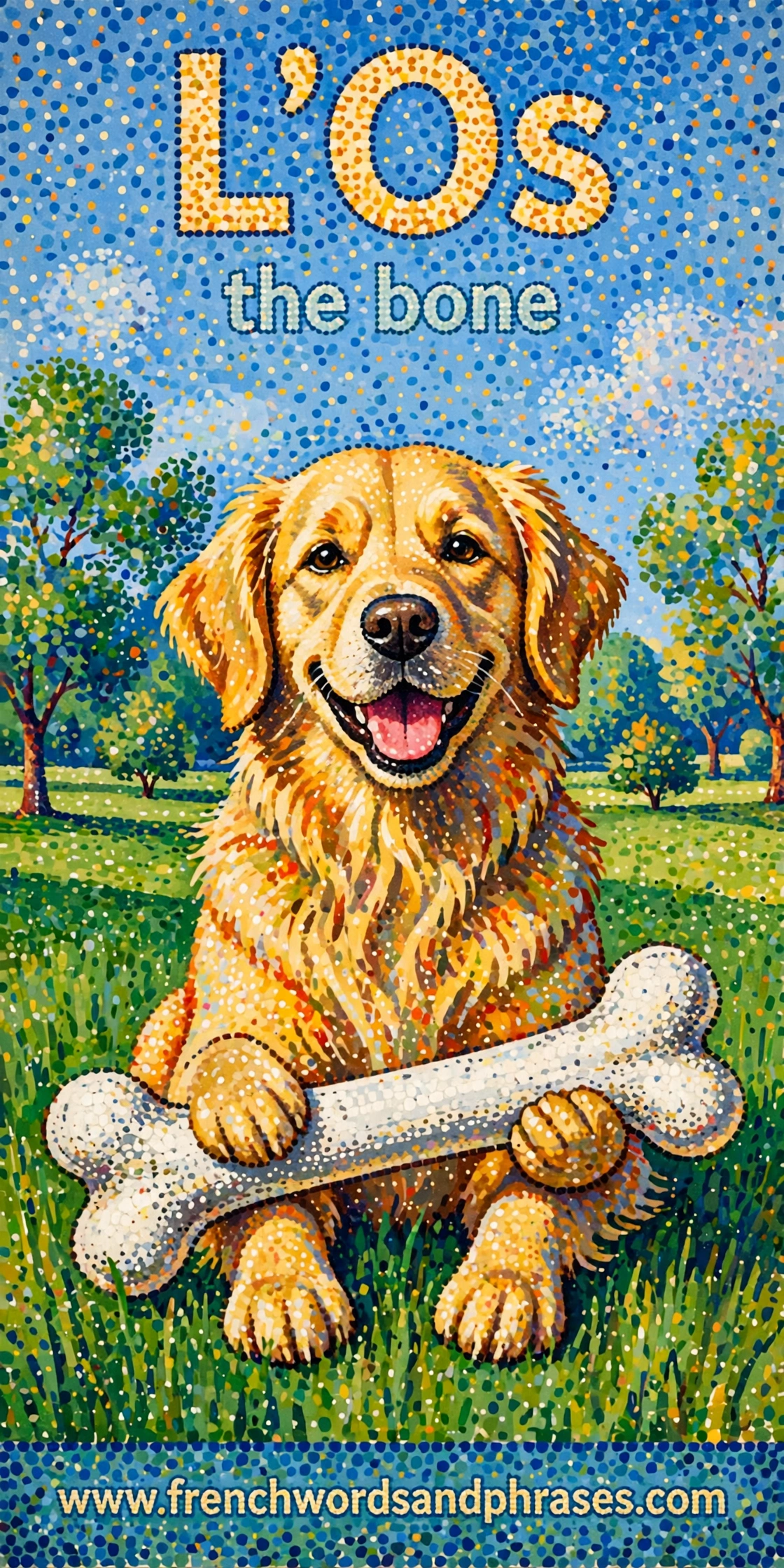
L’os means the bone.
The dog waits under the table with the patience of a saint, eyes fixed on your plate. He knows exactly what he wants, and so does every child who has ever finished a roast chicken: l’os.
In this guide, you’ll learn what os means in English, how to use it with its articles, how to form its plural, and how it appears in everyday French. Explore French examples, English translations, and practice quizzes.
Understanding the French Noun Os
Os is a masculine French noun. It begins with a vowel, so the article shrinks: l’os, un os. Here is its famous trick: the word is spelled exactly the same in the plural — les os — only the article tells you how many bones you are talking about.
It means the bone — one of the hard pieces that build le squelette (the skeleton); an adult body counts 206 of them. Bones meet the kitchen, too: un os à ronger is a bone to gnaw, and a good stock begins with des os. In everyday speech the word also goes figurative — il y a un os means there is a snag, a problem nobody expected.
Gender: Masculine
Definite article: l’ — l’os (the bone)
Indefinite article: un — un os (a bone)
Plural: les os — the spelling never changes
Sound: The final -s is heard in the singular (un os) but falls silent in the plural (des os)
The count: An adult human skeleton is built from 206 os
English equivalents: The bone.
Two traps, one word. First, the spelling: les os looks singular but is plural — trust the article, not the ending. Second, the sound: say the -s in un os, drop it in des os. And listen out for the figurative gift: « Il y a un os ! » — there’s a problem, a bone in the road.
Experience the Word
L’os is the body’s architecture — the beams and pillars you never see, holding everything up in the dark. Break one and you learn its name in a day: le bras, la jambe, and suddenly, l’os cassé.
Imagine the museum: a dinosaur towering over the hall, three storeys of os assembled like a cathedral, children whispering underneath.
You have not just named a bone. You have touched the frame of the whole building — l’ossature, the hidden carpentry of a person.
How to Use Os in French: Complete Guide
Let’s explore how os works in French, beginning with its articles — a short word with a long list of surprises.
Os with the Definite Article (L’, Les)
Os begins with a vowel, so le shrinks to l’ — and in the plural, les does all the work, because the noun itself never changes.
| Form | French |
|---|---|
| Singular | l’os |
| Plural | les os |
Example
L’os du bras s’appelle l’humérus.
The bone of the arm is called the humerus.
Os with the Indefinite Article (Un, Des)
Used for a bone in general — un os cassé, a broken bone, the classic X-ray verdict.
| Form | French |
|---|---|
| Singular | un os |
| Plural | des os |
Example
Le chien cherche un os dans le jardin.
The dog is looking for a bone in the garden.
Os with Quantities (Chaque, 206…)
Bones are counted, not scooped — French numbers them, all 206 in the body.
| Quantity | French |
|---|---|
| a broken bone | un os cassé |
| strong bones | des os solides |
| every bone | chaque os |
| 206 bones | 206 os |
| a bone to gnaw | un os à ronger |
Example
Le corps humain compte 206 os chez l’adulte.
The human body has 206 bones in an adult.
Quick Quiz 1
Complete the sentence:
Le squelette est formé de nombreux ______.
Reveal the answer
os
Le squelette est formé de nombreux os.
The skeleton is made of many bones — os is spelled the same in the plural.
The Plural of Os
The most discreet plural in French: os adds nothing at all — les os, with the -s gone silent.
| Number | French |
|---|---|
| Singular | l’os |
| Plural | les os |
Example
Les os des mains et des pieds sont nombreux et petits.
The bones of the hands and feet are many and small.
Os with Possessive Adjectives (Mon, Ton, Son…)
A vowel start keeps things simple: mon os, ton os, son os — the same forms for everyone.
| Owner | French |
|---|---|
| my | mon os |
| your (tu) | ton os |
| his / her | son os |
| our | notre os |
| your (vous) | votre os |
| their | leur os |
Example
Le chien garde son os entre ses pattes.
The dog keeps his bone between his paws.
Quick Quiz 2
Complete the sentence:
Il s’est cassé ______ os de la jambe en skiant.
Reveal the answer
un
Il s’est cassé un os de la jambe en skiant.
He broke a bone in his leg while skiing.
Os with Demonstrative Adjectives (Cet, Ces)
Used to point — and the vowel start gives cet: cet os, this bone.
| Form | French |
|---|---|
| Singular | cet os |
| Plural | ces os |
Example
Cet os appartient à un très grand animal.
This bone belongs to a very large animal.
Os with Adjectives
Adjectives agree with os, masculine: cassé, solide, fragile.
| Adjective | With Os |
|---|---|
| cassé (broken) | un os cassé |
| solide (strong) | un os solide |
| long (long) | un os long |
| fragile (fragile) | un os fragile |
| gros (big) | un gros os |
Example
Un os fragile se casse facilement chez les personnes âgées.
A fragile bone breaks easily in elderly people.
Quick Quiz 3
Someone says « Il y a un os ! » about a plan. What do they mean?
Reveal the answer
There is a snag, a problem — the figurative os, a bone in the road.
Tout allait bien, et puis il y a eu un os.
Everything was going well, and then a problem came up.
Everyday Expressions with Os
Snags, soakings and fractures — the os phrases of daily life.
| Expression | In English |
|---|---|
| se casser un os | to break a bone |
| trempé jusqu’aux os | soaked to the bone |
| tomber sur un os | to hit a snag |
| un os à ronger | a bone to gnaw |
| il y a un os | there’s a problem, a catch |
Example
Sous l’orage, nous sommes rentrés trempés jusqu’aux os.
In the storm, we came home soaked to the bone.
Words from the Same Family as Os
Skeletons, frames and marrow — the words that travel with os.
| French | In English |
|---|---|
| osseux | bony, of the bone |
| l’ossature | the frame, the structure |
| désosser | to bone, to remove the bones |
| l’ostéoporose | osteoporosis |
| le squelette | the skeleton |
| la moelle | the marrow |
Example
L’ossature du squelette soutient tout le corps.
The framework of the skeleton supports the whole body.
Quick Quiz 4
What does trempé jusqu’aux os mean?
Reveal the answer
Soaked to the bone — wet through, completely drenched.
Après l’averse, les enfants étaient trempés jusqu’aux os.
After the downpour, the children were soaked to the bone.
Os in Everyday French: Real-Life Examples
Now that you know the word, let’s see how os appears in everyday French.
Example 1 — An accident
Il s’est cassé un os du poignet en tombant.
He broke a bone in his wrist when he fell.
Example 2 — The dog’s treasure
Le chien enterre son os au fond du jardin.
The dog buries his bone at the bottom of the garden.
Example 3 — Rain
Nous sommes rentrés trempés jusqu’aux os.
We came home soaked to the bone.
Example 4 — A problem
Le projet avançait bien, puis nous sommes tombés sur un os.
The project was going well, then we hit a snag.
Example 5 — Strong bones
Le lait et le fromage donnent des os solides.
Milk and cheese give you strong bones.
Example 6 — At the museum
Ces os de dinosaure ont des millions d’années.
These dinosaur bones are millions of years old.
Beyond Translation: The Meaning of Os
Few French words work as hard as os. It builds the body, flavours the soup — un bouillon d’os — and then steps into metaphor: a difficulty is un os, a miser counts his sous but a stubborn problem is always os-shaped. Even drenched misery borrows it: trempé jusqu’aux os, soaked to the bone, is how French describes a rain that left nothing dry.
To say os is to name the hardest, oldest, most patient part of you.
It evokes dinosaur halls and dogs in gardens, X-rays and winter rain — the frame that outlasts everything built on it.
How to Remember the French Noun Os
Remember it this way: Os is the bone — l’os, and the plural hides in plain sight: les os, same spelling, silent -s.
- You trust the article — l’os is one, les os are many, the word never changes.
- You tune the sound — the -s speaks in un os and sleeps in des os.
- You keep the metaphor — il y a un os, there’s a snag.
The key idea is l’os, les os — the bone, spelled one way for one and many.
Test Your Knowledge of Os
Let’s see how much you’ve learned. Try answering these questions before revealing the answers.
Question 1
Is os masculine or feminine?
Reveal the answer
Masculine — l’os, un os.
Question 2
What is the plural of os?
Reveal the answer
Les os — the spelling is identical; only the article changes, and the final -s falls silent.
Question 3
Translate: He broke a bone.
Reveal the answer
Il s’est cassé un os.
Question 4
What does « il y a un os » mean?
Reveal the answer
There is a snag, a problem — the figurative use of os.
Question 5
Complete the sentence:
Le chien ronge ______ os.
Reveal the answer
un
Le chien ronge un os.
The dog is gnawing a bone.
Your Final Challenge
Can You Use It?
How would you say this in French?
“The dog buries his bone at the bottom of the garden.”
Reveal the answer
Le chien enterre son os au fond du jardin.
The dog buries his bone at the bottom of the garden.
A little French. A little curiosity. A richer everyday life.
LEARN FRENCH ONE WORD AT A TIME