A French Word to Live By
Translate Soi to English
/swa/
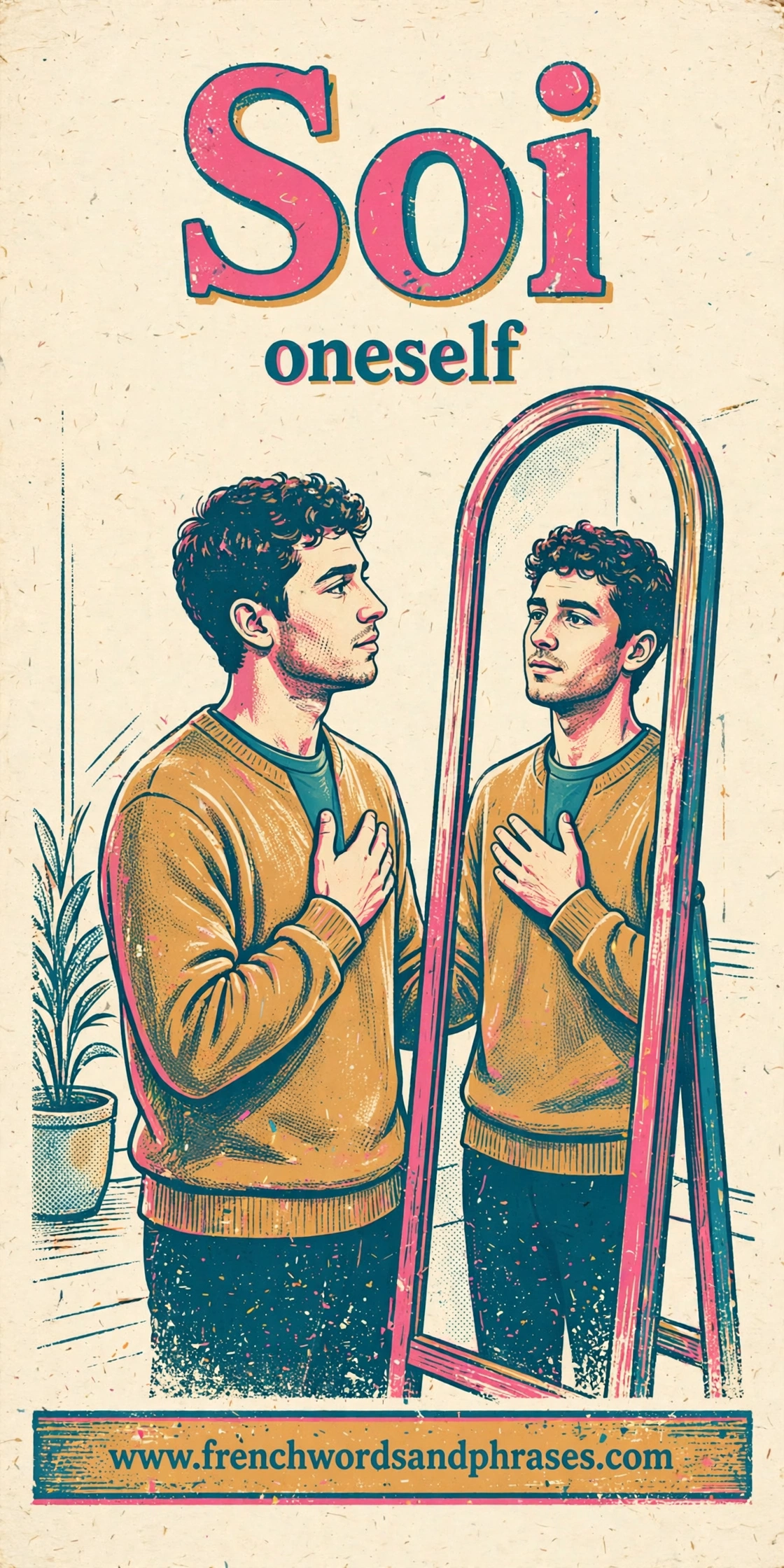
Soi means oneself, self — the stressed reflexive pronoun for an indefinite subject.
A traveller alone at a mountain refuge, repairing his own boots, cooking his own soup, answering to nobody. « Chacun pour soi. » — each for himself. Soi is the pronoun of the self when the subject is everyone, no one in particular, or the person one is talking about in general: oneself.
Let’s explore how soi works in French, beginning with the whole word on one card.
Understanding the French Pronoun Soi
Soi is a French stressed reflexive pronoun. It is the form of ‘oneself’ used when the subject is indefinite — on, chacun, personne, tout le monde — or in set phrases: chacun pour soi, each for himself; être chez soi, to be at home, at one’s own place. After prepositions with a definite person, French switches to soi’s cousins: moi, toi, lui, elle, nous, vous, eux.
It means oneself, himself, herself — but only for the general, unnamed subject. On pense à soi, one thinks of oneself; il faut avoir confiance en soi, you must have confidence in yourself. The moment the subject is a named person, soi steps aside: elle pense à elle, she thinks of herself — never ‘à soi’ for a definite she.
Type: Stressed reflexive pronoun — indefinite subject
Answers the question: Pour qui ? Chez qui ? — For whom? At whose place? (when the answer is ‘oneself, in general’)
Its territory: after on, chacun, personne, tout le monde — and in fixed phrases
Watch the pair: soi (oneself, general) vs lui / elle (himself / herself, a definite person)
One important usage detail: chez soi means at home — one’s own home, whoever one is: rentrer chez soi, to go back home. It is the phrase every French letter and diary loves, and it works for any subject at all: elle rentre chez elle for a definite woman, but the general truth stays chez soi.
Experience the Word
Soi is the pronoun of the inner room — the self considered in general, the way proverbs consider it.
Imagine the old saying travelling from kitchen to kitchen for three hundred years: « Charité bien ordonnée commence par soi-même. » Well-ordered charity begins with oneself. Soi is the self of the proverb: not me, not you — anyone.
You have not pointed at a person. You have named the self that everyone carries.
How to Use Soi in French: Complete Guide
Let’s explore how soi works in French, beginning with the whole word on one card.
Soi at a Glance
The Whole Word on One Card
Meaning, job, territory and family — soi in four lines.
| Point | Soi |
|---|---|
| Meaning | oneself — the self of a general, indefinite subject |
| Job | stands for the subject itself after a preposition |
| Territory | after on, chacun, personne, tout le monde |
| Its family | soi-même (oneself, emphatic), chez soi (at home) |
Example
Il faut penser à soi de temps en temps.
You have to think of yourself from time to time.
The Pattern in Action: After the Indefinite Subject
Soi appears where the subject is everybody or nobody in particular — on, chacun, personne, tout le monde.
| Pattern | Example |
|---|---|
| with on | on ne parle pas toujours de soi — one does not always talk about oneself |
| with chacun | chacun pour soi — each for himself |
| with personne | personne ne peut vivre que pour soi — nobody can live only for themselves |
| with tout le monde | tout le monde rentre chez soi — everyone goes home |
Example
Chacun garde son jardin pour soi.
Everyone keeps their garden to themselves.
Quick Quiz 1
After on, which pronoun: soi or lui?
Reveal the answer
soi — on is indefinite, so the reflexive stressed form is soi.
On pense à soi.
One thinks of oneself.
Chez soi: The Home Phrase
Soi’s most famous address is chez soi — at one’s own home, the general home of anyone at all.
| Pattern | Example |
|---|---|
| to be at home | être chez soi — to be at home |
| to go home | rentrer chez soi — to go back home |
| to feel at home | se sentir chez soi — to feel at home |
| from home | travailler de chez soi — to work from home |
Example
Après le voyage, quel bonheur d’être chez soi !
After the trip, what happiness to be at home!
Soi-même: The Emphatic Self
With -même added, soi becomes soi-même — oneself in person, with emphasis, the star of the proverbs.
| Pattern | Example |
|---|---|
| by oneself | le faire soi-même — to do it oneself |
| for oneself | garder pour soi-même — to keep for oneself |
| the proverb | charité bien ordonnée commence par soi-même — charity begins at home |
| in oneself | en soi-même — in oneself, deep down |
Example
Elle a construit sa maison soi-même.
She built her house herself.
Quick Quiz 2
How do you say ‘to be at home’ in general?
Reveal the answer
être chez soi
On est bien chez soi.
There’s no place like home.
Everyday Expressions with Soi
Proverbs, homes and quiet confidences — soi in the phrases of the language.
| Expression | In English |
|---|---|
| chez soi | at home, at one’s own place |
| chacun pour soi | each for himself, every man for himself |
| avoir confiance en soi | to have self-confidence |
| en soi | in itself, per se |
| de soi | of oneself, from oneself |
| soi-disant | so-called, self-styled |
Example
Il faut avoir confiance en soi pour réussir.
You must have confidence in yourself to succeed.
Close Cousins: The Stressed Pronouns
When the subject is a definite person, soi hands over to its cousins — the stressed set.
| Word | The difference |
|---|---|
| soi | oneself — indefinite subject only: on, chacun |
| moi / toi | me / you — definite people: elle pense à moi |
| lui / elle | him / her, himself / herself: il parle de lui |
| eux / elles | them, themselves: ils gardent pour eux |
Example
Elle parle d’elle, mais on parle de soi en général.
She talks about herself, but one talks about oneself in general.
Quick Quiz 3
“She thinks of herself” — à soi or à elle?
Reveal the answer
à elle — the subject is a definite person, so soi steps aside.
Elle pense à elle.
She thinks of herself.
Soi and Its Neighbours
The self shelf: oneself, himself, yourself and the reflexive se.
| French | In English |
|---|---|
| soi | oneself (indefinite) |
| se | oneself as a verb’s reflexive: on se lève |
| lui-même / elle-même | himself / herself (definite, emphatic) |
| soi-disant | so-called |
Example
On se lève tôt quand on travaille pour soi.
You get up early when you work for yourself.
Watch Out: The Traps Around Soi
The traps: using soi for a definite person, and confusing soi with soit.
| Trap | The truth |
|---|---|
| saying ‘elle pense à soi’ | a definite subject takes lui/elle: elle pense à elle |
| confusing soi and soit | soit is a form of être (so be it); soi is the pronoun oneself |
| dropping soi after chacun | chacun pour soi is the fixed frame — soi is required |
| translating ‘myself’ as soi | for a definite je, the stressed form is moi: je le garde pour moi |
Example
Chacun pour soi, et le travail pour tous.
Each for himself, and the work for everyone.
Quick Quiz 4
What does chacun pour soi mean?
Reveal the answer
Each for himself — everyone for themselves.
Dans la course, c’est chacun pour soi.
In the race, it’s every man for himself.
Soi in Everyday French: Real-Life Examples
Now that you know the word, let’s see how soi appears in everyday French.
Example 1 — A proverb
Charité bien ordonnée commence par soi-même.
Well-ordered charity begins with oneself.
Example 2 — At home
On est tellement bien chez soi.
There is nowhere like home.
Example 3 — Confidence
Elle a confiance en soi avant l’examen.
She has confidence in herself before the exam.
Example 4 — The race
Dans cette course, c’est chacun pour soi.
In this race, it’s every man for himself.
Example 5 — Keeping
Il garde toujours un peu de temps pour soi.
He always keeps a little time for himself.
Example 6 — Working
Travailler pour soi demande du courage.
Working for yourself takes courage.
Beyond Translation: The Meaning of Soi
Soi is the philosopher’s pronoun: the self in general, the one every proverb addresses. French psychology built a monument on it — le soi is ‘the self’ in translation of Freud and Jung — and everyday French keeps it humble in chez soi, the home each of us means by it.
Soi is the mirror held up to everyone at once.
Its discipline is exact: the moment a real person steps into the sentence, soi bows out and leaves the place to moi, toi, lui, elle — the general self yielding to the particular one.
How to Remember the French Pronoun Soi
Remember it this way: Soi is oneself — the stressed reflexive for indefinite subjects only: on, chacun, personne.
- You use it in general — on pense à soi, one thinks of oneself.
- You go home with it — rentrer chez soi, to go back home.
- You step aside with it — for a definite person, use lui, elle, eux.
The key idea is soi means oneself (indefinite subjects); chez soi = at home; chacun pour soi = each for himself.
Test Your Knowledge of Soi
Let’s see how much you’ve learned. Try answering these questions before revealing the answers.
Question 1
What does soi mean?
Reveal the answer
Oneself — the self of an indefinite subject: on, chacun, personne.
Question 2
How do you say at home (in general)?
Reveal the answer
Chez soi.
Question 3
Translate: One thinks of oneself.
Reveal the answer
On pense à soi.
Question 4
Why not ‘elle pense à soi’?
Reveal the answer
Elle is a definite subject — French says elle pense à elle; soi is only for indefinite subjects.
Question 5
Complete the sentence:
Chacun garde son secret pour ______.
Reveal the answer
soi
Chacun garde son secret pour soi.
Everyone keeps their secret to themselves.
Your Final Challenge
Can You Use It?
How would you say this in French?
“There is nowhere like home.”
Reveal the answer
On est tellement bien chez soi.
There is nowhere like home.
A little French. A little curiosity. A richer everyday life.
LEARN FRENCH ONE WORD AT A TIME