A French Word to Live By
Translate Présent to English
/pʁe.zɑ̃/
Présent means present.
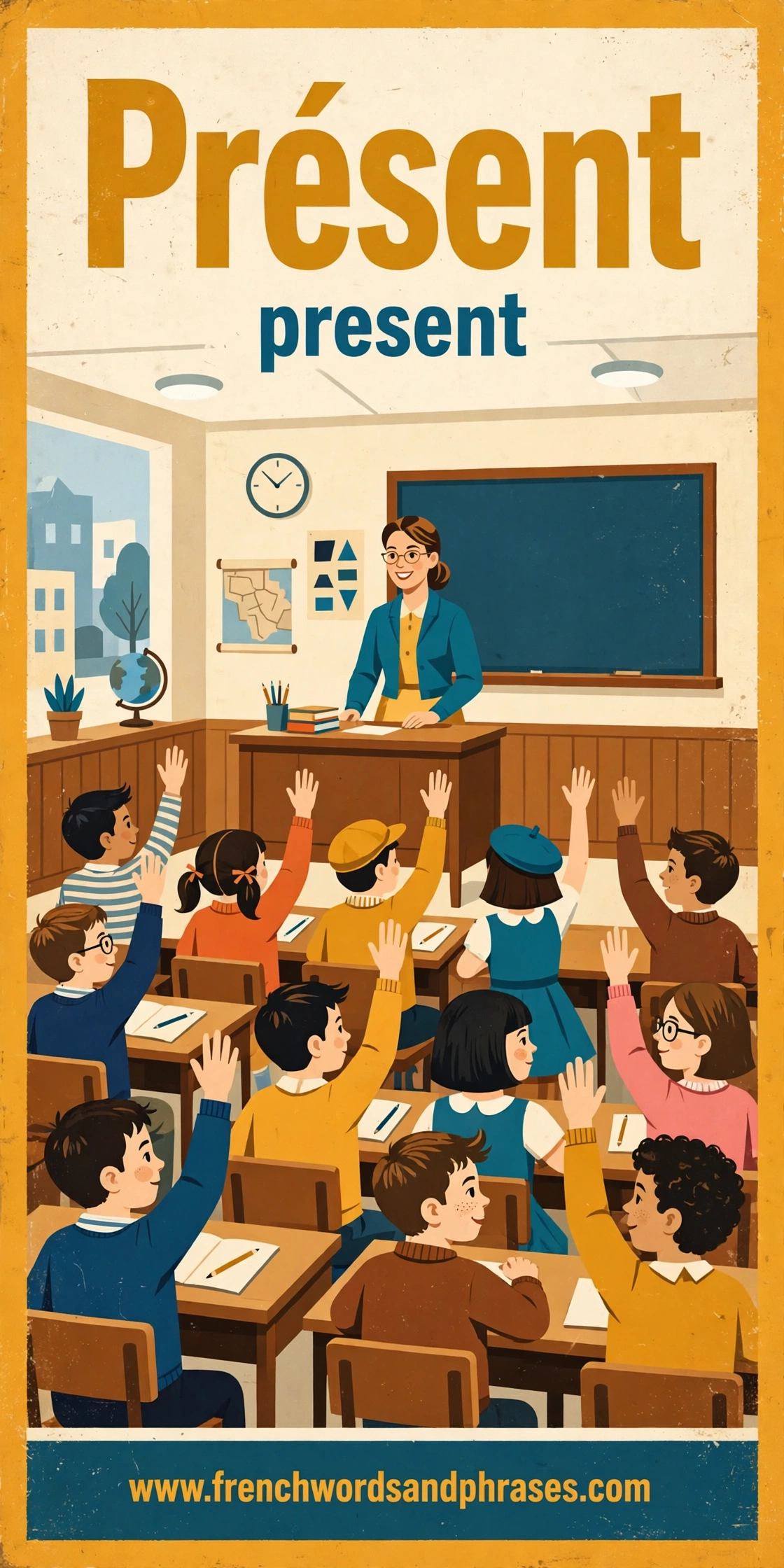
The teacher calls the register, name after name, and each voice answers the same small word: « Présent ! » — présent, present, here, in the room, accounted for. The adjective of attendance, and of everything that is here and now.
In this guide, you’ll learn what présent means in English, how its feminine présente is formed, the register-call answer, and its double life as a noun — the present moment, and even a gift. Explore French examples, English translations, and practice quizzes.
Understanding the French Adjective Présent
Présent is a French adjective of presence. It comes from the Latin praesens, being before one, at hand. Its feminine is présente: un élève présent, une élève présente, des témoins présents, des personnes présentes. As a noun, le présent is both the present time and — a graceful surprise — a gift: offrir un présent, to offer a present.
It means present — here, in attendance, not absent: être présent à une réunion, to attend a meeting; les personnes présentes, those present; un élève présent, a pupil in class. It also means present in time: le moment présent, the present moment. The register call made it famous: the teacher reads the name, the pupil answers présent, masculine, or présente, feminine.
Type: Adjective of presence — here, in attendance; of the present time
Answers the question: Is he/she here? — présent, present, accounted for
Changes form: Feminine présente — présents / présentes in the plural
English equivalents: Present; in attendance, here.
One important usage detail: after être, présent agrees like any adjective — elle est présente, ils sont présents. But in the register answer it stands alone as a complete sentence: « Présent ! » The noun uses repay a visit: à présent means now, jusqu’à présent means up to now, and un présent on a birthday table is a gift.
Experience the Word
Présent is the adjective of the answered name — the small daily proof that you are here, counted, and part of the room.
Imagine the one-room school in 1900, the stove ticking, the register open like a Bible. L’instituteur lit les noms, et chaque enfant répond, fier comme un soldat : « Présent ! » Nobody in that room is absent from their own life.
You have not just said here. You have answered for yourself — présent, present, present in body and in moment.
How to Use Présent in French: Complete Guide
Let’s explore how présent works in French, beginning with the whole word on one card.
Présent at a Glance
Before the details, here is the whole word on one card.
The Whole Word on One Card
Meaning, type, position and forms — présent in four lines.
| Point | Présent |
|---|---|
| Meaning | present — here, in attendance; of the present time |
| Type | adjective of presence |
| Usual position | after the noun — un élève présent; after être — elle est présente |
| Form | présent / présente — présents / présentes in the plural |
Example
Tous les élèves sont présents ce matin.
All the pupils are present this morning.
The Four Forms of Présent
Présent follows the regular pattern: the feminine adds -e, and both plurals add -s.
| Form | Présent | Example |
|---|---|---|
| Masculine singular | présent | un témoin présent — a witness present |
| Feminine singular | présente | une personne présente — a person present |
| Masculine plural | présents | des témoins présents — witnesses present |
| Feminine plural | présentes | des personnes présentes — people present |
Example
Les personnes présentes ont signé le registre.
The people present signed the register.
Quick Quiz 1
What is the feminine of présent?
Reveal the answer
présente
Une élève présente — the feminine adds -e to présent.
A pupil (girl) present.
The Feminine of Présent: Présente
Présente is not a separate word to learn later — it is half of this word’s life, heard every morning in every classroom register in France.
| Situation | Example |
|---|---|
| Masculine | un élève présent — a pupil (boy) present |
| Feminine | une élève présente — a pupil (girl) present |
| Why | the feminine adds -e: présent, présente |
| The plural | add s to each — des élèves présents, des élèves présentes |
Example
À l’appel, elle a répondu : « Présente ! »
At roll call, she answered: ‘Present!’
Where Présent Goes: After the Noun, and After Être
Présent follows the noun it describes, and its natural home is after être — the verb of attendance itself.
| Pattern | Example |
|---|---|
| After the noun | les personnes présentes — those present |
| After être | il est présent — he is present |
| With à | présent à la réunion — present at the meeting |
| Alone, at roll call | « Présent ! » — ‘Present!’ |
Example
Le directeur était présent à la réunion.
The director was present at the meeting.
Quick Quiz 2
How do you say ‘those present’ — les présents personnes or les personnes présentes?
Reveal the answer
les personnes présentes
Présent stands after the noun and agrees with it: présentes, feminine plural.
Those present.
More Présent: Comparing with Présent
Présent barely compares — one is present or absent — but French can still grade attention and attendance with adverbs.
| Degree | Example |
|---|---|
| Fully present | tout à fait présent — completely present |
| Always present | toujours présent — always there |
| Physically present | présent physiquement — present in body |
| Present in spirit | présent en pensée — present in thought |
| Barely present | à peine présent — barely there |
Example
Même loin, elle reste présente en pensée.
Even far away, she remains present in thought.
Everyday Expressions with Présent
Registers, meetings and the present moment — présent at its daily posts.
| Expression | In English |
|---|---|
| être présent | to be present, to attend |
| les personnes présentes | those present |
| à présent | now, at present |
| jusqu’à présent | up to now, so far |
| le moment présent | the present moment |
| un présent | a present, a gift (the noun) |
Example
Jusqu’à présent, tout va bien.
So far, everything is fine.
Quick Quiz 3
What does jusqu’à présent mean?
Reveal the answer
Up to now, so far
Jusqu’à présent, aucun retard — up to now, no delay.
So far.
Présent and Its Neighbours
Présent keeps company with the other words of here and now — and faces its one great opposite.
| French | In English |
|---|---|
| absent | absent — the opposite |
| là | there, here — the everyday word |
| actuel | current, present-day |
| assistant (à) | attending — présent à une cérémonie |
| le présent | the present (time) — the noun |
| un cadeau | a gift — the everyday word for un présent |
Example
Présent ou absent, il faut le noter sur la liste.
Present or absent, it must be noted on the list.
Watch Out: The Traps Around Présent
The traps here are the noun’s double life — le présent is both the present time and a gift — and agreement after être.
| Trap | The truth |
|---|---|
| The gift | un présent is a gift in elegant French — le présent on the table may be wrapped |
| Agreement | elle est présente, ils sont présents — présent agrees after être like any adjective |
| Not a verb | présent is not « he presents » — the verb is présenter |
| À présent | à présent means now — a fixed phrase, no agreement |
Example
Elle a offert un présent à son professeur.
She offered a present to her teacher.
Quick Quiz 4
How do you say ‘the people present’?
Reveal the answer
les personnes présentes
Présent follows the noun, feminine plural: présentes.
The people present.
Présent in Everyday French: Real-Life Examples
Now that you know the word, let’s see how présent appears in everyday French.
Example 1 — Roll call
À l’appel, chacun répond : « Présent ! »
At roll call, everyone answers: ‘Present!’
Example 2 — Meetings
Le maire était présent à la cérémonie.
The mayor was present at the ceremony.
Example 3 — So far
Jusqu’à présent, il n’y a aucun problème.
So far, there is no problem.
Example 4 — Now
À présent, écoutez bien la suite.
Now, listen carefully to what follows.
Example 5 — The moment
Vis le moment présent, sans regret.
Live in the present moment, without regret.
Example 6 — A gift
Elle a reçu un présent de sa grand-mère.
She received a present from her grandmother.
Beyond Translation: The Meaning of Présent
Présent is Latin praesens — prae, before, plus ens, being: the being that stands before you. French unfolded the whole word: the pupil before the teacher, the moment before the mind, and the gift placed before the guest — un présent is literally something set in someone’s presence. Three senses, one picture: what is here, now, in front of us.
Présent is the adjective of the answered name and the unwrapped moment — here, now, and given.
Learn it beside absent, its shadow, and à présent and jusqu’à présent stop being phrases to memorise and become the same word, simply turned towards time.
How to Remember the French Adjective Présent
Remember it this way: Présent is the present adjective — présente for her, and a noun that means both the present moment and a gift.
- You learn the pair together — un élève présent, une élève présente.
- You answer the register — « Présent ! », « Présente ! »
- You keep the phrases — à présent, now; jusqu’à présent, so far; un présent, a gift.
The key idea is présent / présente means present; un présent is also a gift.
Test Your Knowledge of Présent
Let’s see how much you’ve learned. Try answering these questions before revealing the answers.
Question 1
What does présent mean?
Reveal the answer
Present — here, in attendance; of the present time.
Question 2
What is the feminine of présent?
Reveal the answer
présente — une personne présente.
Question 3
Translate: All the pupils are present this morning.
Reveal the answer
Tous les élèves sont présents ce matin.
Question 4
Complete the sentence:
Elle était ______ à la réunion.
Reveal the answer
présente
Elle était présente à la réunion.
She was present at the meeting.
Question 5
What else can un présent mean, besides the present time?
Reveal the answer
A gift — offrir un présent, to offer a present.
Your Final Challenge
Can You Use It?
How would you say this in French?
“At roll call, everyone answers: ‘Present!'”
Reveal the answer
À l’appel, chacun répond : « Présent ! »
At roll call, everyone answers: ‘Present!’
A little French. A little curiosity. A richer everyday life.
LEARN FRENCH ONE WORD AT A TIME