A French Word to Live By
Translate Jusqu’à maintenant to English
/ʒys.ka mɛ̃t.nɑ̃/
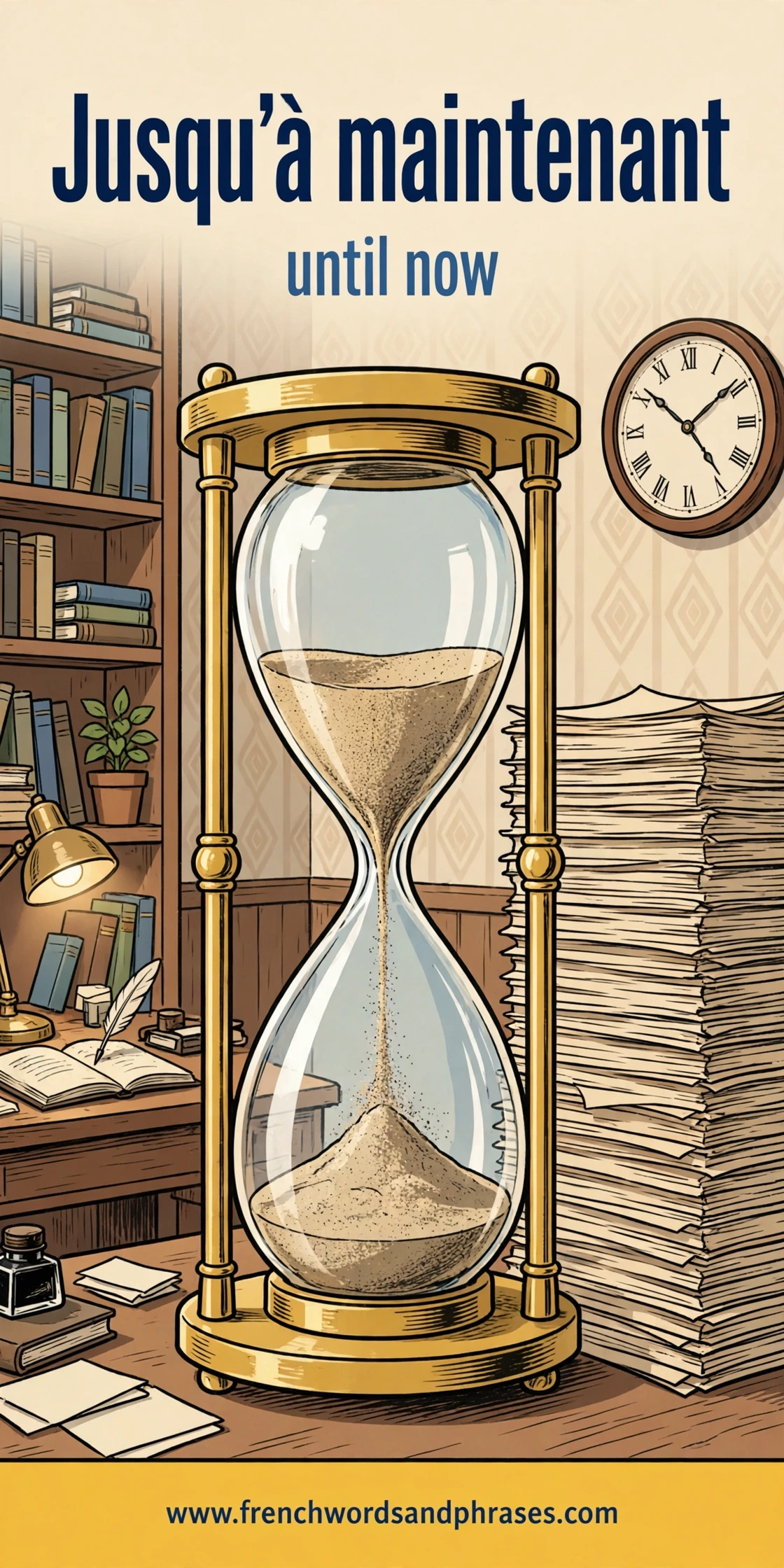
Jusqu’à maintenant means until now.
The builder wipes his hands, looks at the half-renovated kitchen and gives his report with a shrug of satisfaction: « Jusqu’à maintenant, tout se passe bien. » — Until now, up to this very moment, everything is going well.
In this guide, you’ll learn what jusqu’à maintenant means in English, how it draws a line from the past up to the present moment, how its shorter twin jusqu’ici works, and where the phrase stands in the sentence. Explore French examples, English translations, and practice quizzes.
Understanding the French Adverb Jusqu’à maintenant
Jusqu’à maintenant is a French adverbial phrase of time. It is built from jusqu’à (until, up to — a preposition that elides before a vowel) and maintenant (now — an adverb that has its own page on this site). Together they measure a stretch of time that runs right up to the present moment.
It means until now, so far, up to now. Jusqu’à maintenant, je n’ai rien reçu — until now, I have received nothing. Tout va bien jusqu’à maintenant — so far, so good. The phrase always looks backwards along a line that ends exactly here, at this moment.
Type: Adverbial phrase of time — duration up to the present
Answers the question: Depuis quand et jusqu’à quand ? — Over what stretch, ending now?
Changes form: Never — but jusqu’à elides to jusqu’ before a vowel
English equivalents: Until now; so far; up to now.
One important usage detail: jusqu’à drops its final vowel before a word starting with a vowel — jusqu’ici, until here, its shorter twin. Before maintenant there is no elision, because maintenant begins with a consonant: jusqu’à maintenant, in full. Both phrases mean the same thing; jusqu’ici is simply brisker.
Experience the Word
Jusqu’à maintenant is the phrase of progress reports, journeys half done and patients recovering — it takes stock of the road travelled so far.
Imagine the train conductor walking the carriage at dusk: « Jusqu’à maintenant, le voyage se passe bien. » The sentence carries a small, honest suspense — so far, so good, and the rest of the line still to come.
You have not just marked a moment. You have drawn a line from the beginning of the story to this exact second — and left the future unwritten.
How to Use Jusqu’à maintenant in French: Complete Guide
Let’s explore how jusqu’à maintenant works in French, beginning with the whole phrase on one card.
Jusqu’à maintenant at a Glance
Before the details, here is the whole phrase on one card.
The Whole Phrase on One Card
Meaning, type, position and form — jusqu’à maintenant in four lines.
| Point | Jusqu’à maintenant |
|---|---|
| Meaning | until now — so far, up to the present moment |
| Type | adverbial phrase of time |
| Usual position | at the start or the end of the sentence |
| Form | invariable — jusqu’à elides only before a vowel |
Example
Jusqu’à maintenant, tout va bien.
So far, everything is fine.
Where Jusqu’à maintenant Goes in the Sentence
The phrase frames the sentence from either end: at the front, set off by a comma, or at the back, as a quiet conclusion.
| Situation | Pattern |
|---|---|
| At the start | jusqu’à maintenant, + sentence — Jusqu’à maintenant, je n’ai rien entendu |
| At the end | sentence + jusqu’à maintenant — tout se passe bien jusqu’à maintenant |
| With a negative | ne… pas / rien + jusqu’à maintenant — je n’ai rien reçu jusqu’à maintenant |
| In a question | et jusqu’à maintenant ? — and so far? (asking for a progress report) |
Example
Nous n’avons eu aucun problème jusqu’à maintenant.
We have had no problem so far.
Quick Quiz 1
True or false: jusqu’à maintenant looks forward into the future.
Reveal the answer
False
It looks backwards: it measures everything from a starting point up to the present moment.
Jusqu’à maintenant, il a toujours été ponctuel. — Until now, he has always been on time.
Jusqu’à maintenant in Daily Life: Taking Stock
The phrase serves wherever someone sums up how things have gone up to this point.
| French | In English |
|---|---|
| jusqu’à maintenant, tout va bien | so far, everything is fine |
| je n’ai rien reçu jusqu’à maintenant | I have received nothing so far |
| jusqu’à maintenant, il n’a jamais menti | until now, he has never lied |
| elle a gagné tous ses matchs jusqu’à maintenant | she has won all her matches so far |
| jusqu’à maintenant, personne ne sait | so far, nobody knows |
Example
Jusqu’à maintenant, le nouveau système fonctionne bien.
So far, the new system is working well.
Jusqu’ici: The Shorter Twin
Jusqu’ici — literally until here — says exactly the same thing in two syllables less, and it is the more conversational of the pair.
| French | In English |
|---|---|
| jusqu’ici, tout va bien | so far, everything is fine |
| je n’ai rien vu jusqu’ici | I have seen nothing so far |
| jusqu’ici, il a toujours dit oui | until now, he has always said yes |
| on a bien travaillé jusqu’ici | we have worked well up to now |
Example
Jusqu’ici, l’hiver a été doux.
So far, the winter has been mild.
Quick Quiz 2
Complete the sentence:
______ maintenant, je n’ai reçu aucune réponse. (until)
Reveal the answer
Jusqu’à
Jusqu’à maintenant, je n’ai reçu aucune réponse.
No elision before maintenant — it begins with a consonant.
Jusqu’à maintenant and the Present Perfect Idea
English reaches for the present perfect with this phrase — have done, has been — and French answers most often with the passé composé or the present, depending on whether the action is finished or still running.
| French | In English |
|---|---|
| jusqu’à maintenant, j’ai écrit trois lettres | so far, I have written three letters (finished actions) |
| jusqu’à maintenant, il pleut tous les jours | so far, it rains every day (a pattern still running) |
| jusqu’à maintenant, elle travaille ici | she has worked here up to now (still true) |
Example
Jusqu’à maintenant, j’ai lu la moitié du livre.
So far, I have read half of the book.
Looking Forward Instead: The Opposites
Jusqu’à maintenant closes the past; its neighbours open the future or hold the present still.
| Expression | The difference |
|---|---|
| jusqu’à maintenant | until now — the stretch behind this moment |
| désormais / à partir de maintenant | from now on — the stretch ahead of this moment |
| pour le moment | for the moment — the present, held still |
| à l’avenir | in the future — the general road ahead |
Example
Jusqu’à maintenant je marchais ; désormais, je prendrai le bus.
Until now I walked; from now on, I will take the bus.
Quick Quiz 3
Which phrase means from now on — jusqu’à maintenant or désormais?
Reveal the answer
Désormais
Jusqu’à maintenant looks back to this moment; désormais looks forward from it.
Jusqu’à maintenant and Its Neighbours
The time shelf around the phrase — beginnings, middles and ends of the story so far.
| French | In English |
|---|---|
| jusqu’ici | until here — so far (the short twin) |
| depuis | since, for (depuis lundi — since Monday) |
| pour le moment | for the moment |
| désormais | from now on |
| enfin | finally, at last |
Example
Depuis lundi, et jusqu’à maintenant, il n’a pas plu.
Since Monday, and up to now, it has not rained.
Watch Out: The Traps Around Jusqu’à maintenant
The traps: eliding where no vowel follows, translating English word for word, and pointing the phrase the wrong way.
| Mistake | Correct French |
|---|---|
| « jusqu’ maintenant » (elision before a consonant) | jusqu’à maintenant — elision happens only before a vowel: jusqu’ici |
| « jusqu’à présent » as the everyday form | jusqu’à présent exists but is more formal; everyday French says jusqu’à maintenant or jusqu’ici |
| using it for the future | for from now on, say désormais or à partir de maintenant |
| « jusqu’à maintenant » with a simple future tense | the phrase sums up the past — pair it with the passé composé or the present |
Example
Jusqu’à maintenant, personne n’a téléphoné.
So far, nobody has phoned.
Quick Quiz 4
Translate: So far, I have received nothing.
Reveal the answer
Jusqu’à maintenant, je n’ai rien reçu.
Or, with the short twin: je n’ai rien reçu jusqu’ici.
Jusqu’à maintenant in Everyday French: Real-Life Examples
Now that you know the word, let’s see how jusqu’à maintenant appears in everyday French.
Example 1 — Progress report
Jusqu’à maintenant, les travaux avancent bien.
So far, the work is progressing well.
Example 2 — Waiting for news
Je n’ai rien reçu jusqu’à maintenant.
I have received nothing so far.
Example 3 — On a journey
Jusqu’ici, le voyage se passe très bien.
So far, the journey is going very well.
Example 4 — At work
Elle a répondu à tous les messages jusqu’à maintenant.
She has answered all the messages so far.
Example 5 — Sport
Jusqu’à maintenant, notre équipe n’a perdu aucun match.
So far, our team has not lost a single match.
Example 6 — Health
Le médecin dit que, jusqu’à maintenant, tout est normal.
The doctor says that, so far, everything is normal.
Beyond Translation: The Meaning of Jusqu’à maintenant
English so far measures distance, as if time were a road walked in miles. French jusqu’à maintenant measures the same road but names its end honestly: maintenant, now, this very moment, the moving line where the past stops and the future has not yet begun.
To say jusqu’à maintenant is to take stock without pretending to know the ending.
It is one of the most honest phrases in the language — tout va bien jusqu’à maintenant carries both gratitude and suspense in a single breath.
How to Remember the French Adverb Jusqu’à maintenant
Remember it this way: Jusqu’à maintenant means until now — it draws a line from the start of the story to this exact moment, and its short twin is jusqu’ici.
- You sum up the road so far — jusqu’à maintenant, tout va bien.
- You elide only before a vowel — jusqu’ici, but jusqu’à maintenant in full.
- You turn the phrase around for the future — désormais, from now on.
The key idea is until now, so far — jusqu’à maintenant (long) = jusqu’ici (short); désormais = from now on.
Test Your Knowledge of Jusqu’à maintenant
Let’s see how much you’ve learned. Try answering these questions before revealing the answers.
Question 1
What does jusqu’à maintenant mean?
Reveal the answer
Until now, so far — everything from a starting point up to the present moment.
Question 2
What is the shorter twin of jusqu’à maintenant?
Reveal the answer
Jusqu’ici — literally until here, with jusqu’à elided before the vowel of ici.
Question 3
Translate: So far, everything is fine.
Reveal the answer
Jusqu’à maintenant, tout va bien.
Question 4
Which phrase means the opposite, from now on?
Reveal the answer
Désormais (or à partir de maintenant) — it opens the future instead of closing the past.
Question 5
Complete the sentence:
______ maintenant, je n’ai rien entendu. (until)
Reveal the answer
Jusqu’à
Jusqu’à maintenant, je n’ai rien entendu.
Until now, I have heard nothing.
Your Final Challenge
Can You Use It?
How would you say this in French?
“So far, I have received nothing.”
Reveal the answer
Jusqu’à maintenant, je n’ai rien reçu.
So far, I have received nothing.
A little French. A little curiosity. A richer everyday life.
LEARN FRENCH ONE WORD AT A TIME