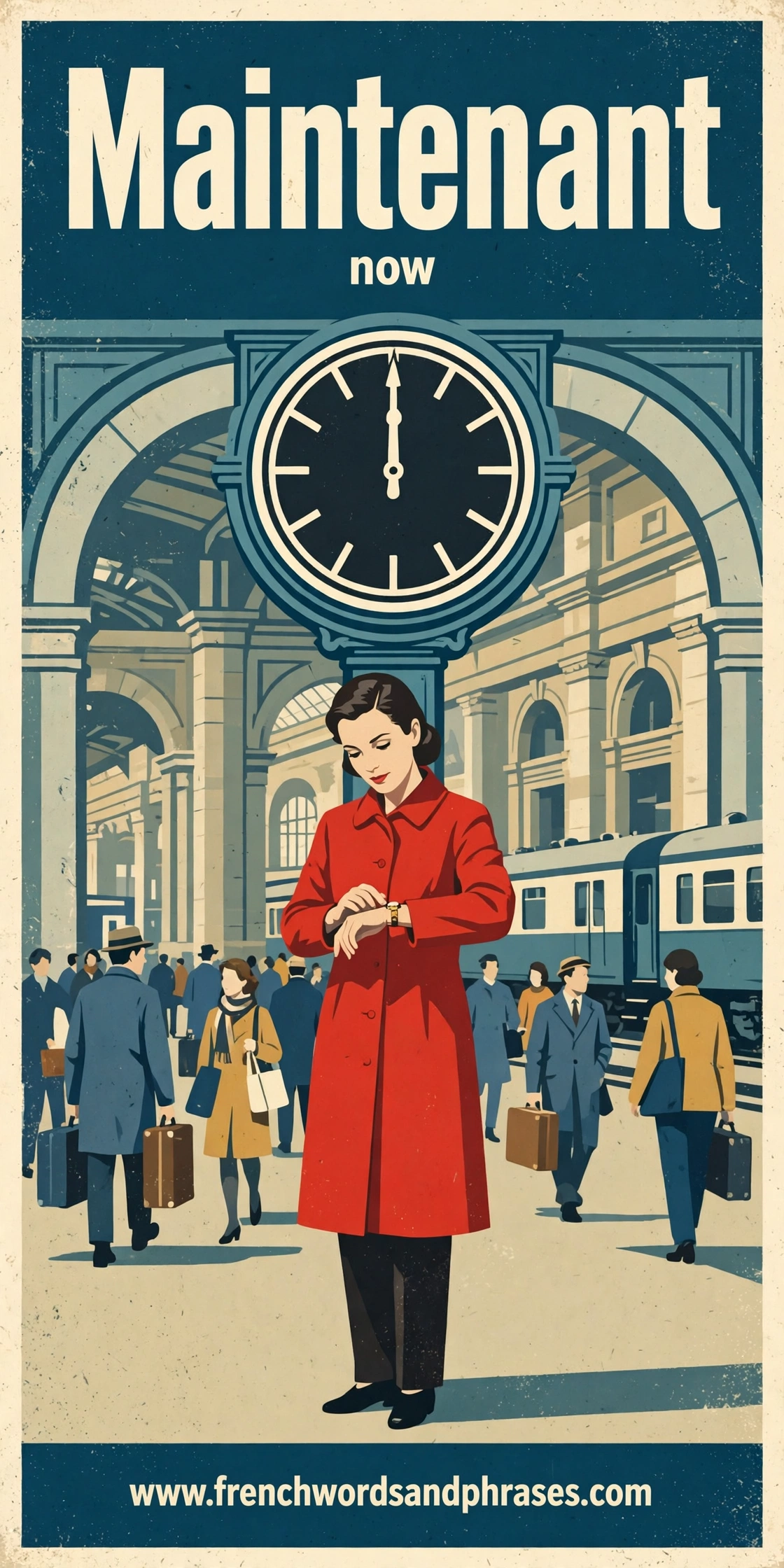
A French Word to Live By
Translate Maintenant to English
/mɛ̃t.nɑ̃/
Maintenant means now.
The letter has been written and rewritten for a week, the suitcase stands by the door, and the train is whistling at the end of the platform. Not yesterday, not tomorrow — maintenant. The moment has arrived, and it will not wait.
In this guide, you’ll learn what maintenant means in English, where it sits in a sentence, how maintenant que opens a door in a conversation, and why you must never say goodbye with it. Explore French examples, English translations, and practice quizzes.
Understanding the French Adverb Maintenant
Maintenant is a French adverb of time — the adverb of the present moment. It never changes its form. It points straight at the instant you are standing in: not before, not after, now.
It means now. It answers the question when? with the shortest possible answer. Je pars maintenant — I am leaving now. Joined to que, it becomes maintenant que — now that — the little hinge French uses to turn a fact into a reason.
Type: Adverb of time — the present moment
Answers the question: When?
Changes form: Never — maintenant is invariable
English equivalents: Now; (maintenant que) now that.
One important usage detail: maintenant names the moment, but it cannot say goodbye. To mean « see you in a moment », French says à tout de suite or à tout à l’heure — never « à maintenant ». Learners invent it every day; the French never use it.
Experience the Word
Maintenant is the adverb of the turning point — the instant when the plan becomes the act.
Imagine a diver at the top of the cliff above a Breton cove: the bag is packed, the tide is right, the friends are watching. Everything before was preparation. Maintenant — and she jumps.
You have not just named a time. You have stepped into the present.
How to Use Maintenant in French: Complete Guide
Let’s explore how maintenant works in French, beginning with the whole word on one card.
Maintenant at a Glance
Before the details, here is the whole word on one card.
Meaning, type, position and hinge — the essentials first.
| Point | Maintenant |
|---|---|
| Meaning | now |
| Type | adverb of time |
| Position | beginning, middle or end of the sentence |
| Its hinge | maintenant que — now that |
Example
Maintenant, je comprends la règle.
Now, I understand the rule.
Where Maintenant Goes in the Sentence
Maintenant is the most mobile of adverbs — it can open a sentence like a curtain, or close it like a door.
| Situation | Pattern |
|---|---|
| Head of sentence | Maintenant, + phrase — Maintenant, tout change |
| End of sentence | phrase + maintenant — je pars maintenant |
| Compound tenses | participle + maintenant — tout a changé maintenant |
| With an infinitive | infinitive + maintenant — il faut partir maintenant |
Example
Les enfants jouent maintenant dans le jardin.
The children are now playing in the garden.
Quick Quiz 1
Place maintenant in this sentence:
______, le magasin est fermé. (Now)
Reveal the answer
Maintenant
Maintenant, le magasin est fermé.
Now, the shop is closed. (Maintenant loves the head of the sentence.)
Maintenant que: Now That…
Add que, and maintenant stops pointing at the clock and starts giving a reason — now that things are so, something else follows.
| French | In English |
|---|---|
| maintenant que tu es là | now that you are here |
| maintenant qu’il fait beau | now that the weather is fine |
| maintenant que je sais | now that I know |
| maintenant que c’est fini | now that it is over |
| maintenant que nous sommes prêts | now that we are ready |
Example
Maintenant qu’il fait beau, sortons !
Now that the weather is fine, let’s go out!
The Road Through Now
Maintenant is the centre point of the timeline — everything in French time is measured before or after it.
| French | When? |
|---|---|
| hier | yesterday (one step back) |
| ce matin | this morning (earlier today) |
| maintenant | now (the centre) |
| tout de suite | right away (the next second) |
| bientôt | soon |
| demain | tomorrow |
Example
Hier, je ne savais pas; maintenant, je sais; demain, je déciderai.
Yesterday, I did not know; now, I know; tomorrow, I will decide.
Quick Quiz 2
Which comes first: bientôt or demain?
Reveal the answer
Bientôt — soon.
Demain is tomorrow; bientôt can be any moment from now.
Maintenant or Tout de Suite?
Two ways of saying now, two different speeds. Maintenant is the new situation; tout de suite is this very second.
| French | The nuance |
|---|---|
| maintenant | now — the moment, the new state of things |
| tout de suite | right away, immediately — no delay at all |
| en ce moment | at the moment, these days — a stretch of present |
| à présent | now (the formal twin of maintenant) |
| désormais | from now on (looking forward from now) |
Example
Je ne peux pas venir maintenant, mais je te rappelle tout de suite.
I can’t come now, but I’ll call you back right away.
Everyday Expressions with Maintenant
Maintenant turns up in the phrases of decision and farewell all over France.
| Expression | In English |
|---|---|
| dès maintenant | from now on |
| jusqu’à maintenant | until now, so far |
| maintenant ou jamais | now or never |
| et maintenant ? | and now what? |
| pour maintenant | for now (enough for the moment) |
| à partir de maintenant | from now on (starting from this moment) |
Example
Jusqu’à maintenant, tout s’est bien passé.
So far, everything has gone well.
Quick Quiz 3
What does maintenant ou jamais mean?
Reveal the answer
Now or never
C’est maintenant ou jamais !
It’s now or never!
Maintenant and Its Neighbours
Learn maintenant with the other words for now, and you can fine-tune any moment in French.
| French | In English |
|---|---|
| à présent | now (formal) |
| en ce moment | at the moment |
| actuellement | currently (careful: it does not mean « actually ») |
| désormais | henceforth, from now on |
| dorénavant | from now on (formal, literary) |
Example
En ce moment, elle travaille à Paris; désormais, elle vivra à Lyon.
At the moment, she works in Paris; from now on, she will live in Lyon.
Watch Out: Maintenant Traps
Now is a simple moment, but it has three traps that catch English speakers again and again.
| Mistake | Better French |
|---|---|
| Saying « à maintenant » when you leave | à tout de suite (see you in a moment) or à tout à l’heure — « à maintenant » does not exist |
| Translating « actually » by actuellement | actuellement means currently — « actually » is en fait or en réalité |
| Using maintenant for « for now » | for now is pour l’instant or pour le moment |
| Misspelling it « maintenent » | maintenant — main-te-nant, three steady beats |
Example
En fait, je suis occupé maintenant.
Actually, I am busy now.
Quick Quiz 4
Choose the correct goodbye:
à maintenant ou à tout de suite ?
Reveal the answer
à tout de suite
À tout de suite !
See you in a moment! (« À maintenant » doesn’t exist in French.)
Maintenant in Everyday French: Real-Life Examples
Now that you know the word, let’s see how maintenant appears in everyday French.
Example At home
Je fais la vaisselle maintenant.
I am doing the washing-up now.
Example An order
Range ta chambre, maintenant !
Tidy your room, now!
Example Good news
Le bébé marche maintenant !
The baby is walking now!
Example At work
La réunion commence maintenant.
The meeting is starting now.
Example A decision
Maintenant que nous sommes prêts, nous partons.
Now that we are ready, we are leaving.
Example A question
Tu veux du café maintenant ou après le dîner ?
Do you want coffee now or after dinner?
Beyond Translation: The Meaning of Maintenant
English says now in one syllable and hurries on, but French gives the moment three syllables to stand on: main-te-nant.
To say maintenant is to plant a flag in the present.
It is the word of decisions and doorbells, of trains leaving and divers jumping — everything in life that was preparation a second ago, and is history a second later.
How to Remember the French Adverb Maintenant
Remember it this way: Maintenant is now — the centre of the timeline — with maintenant que as its hinge, and no role at all in goodbyes.
- You plant it at the head of the sentence — Maintenant, tout change.
- You open a reason with its hinge — maintenant que tu es là…
- You never say goodbye with it — à tout de suite, jamais « à maintenant ».
The key idea is now — maintenant que for now that, à tout de suite for see you soon.
Test Your Knowledge of Maintenant
Let’s see how much you’ve learned. Try answering these questions before revealing the answers.
Question 1
What does maintenant mean?
Reveal the answer
Now — the present moment.
Question 2
What does maintenant que mean?
Reveal the answer
Now that — Maintenant que tu es là, nous commençons.
Question 3
Translate: I am leaving now.
Reveal the answer
Je pars maintenant.
Question 4
How do you say see you in a moment?
Reveal the answer
À tout de suite ! (Never « à maintenant ».)
Question 5
Complete the sentence:
______, je comprends tout.
Reveal the answer
Maintenant
Maintenant, je comprends tout.
Now, I understand everything.
Your Final Challenge
Can You Use It?
How would you say this in French?
“Now that you are here, we can have dinner.”
Reveal the answer
Maintenant que tu es là, nous pouvons dîner.
Now that you are here, we can have dinner.
A little French. A little curiosity. A richer everyday life.
LEARN FRENCH ONE WORD AT A TIME