A French Word to Live By
How to Conjugate Geler in French
/ʒə.le/
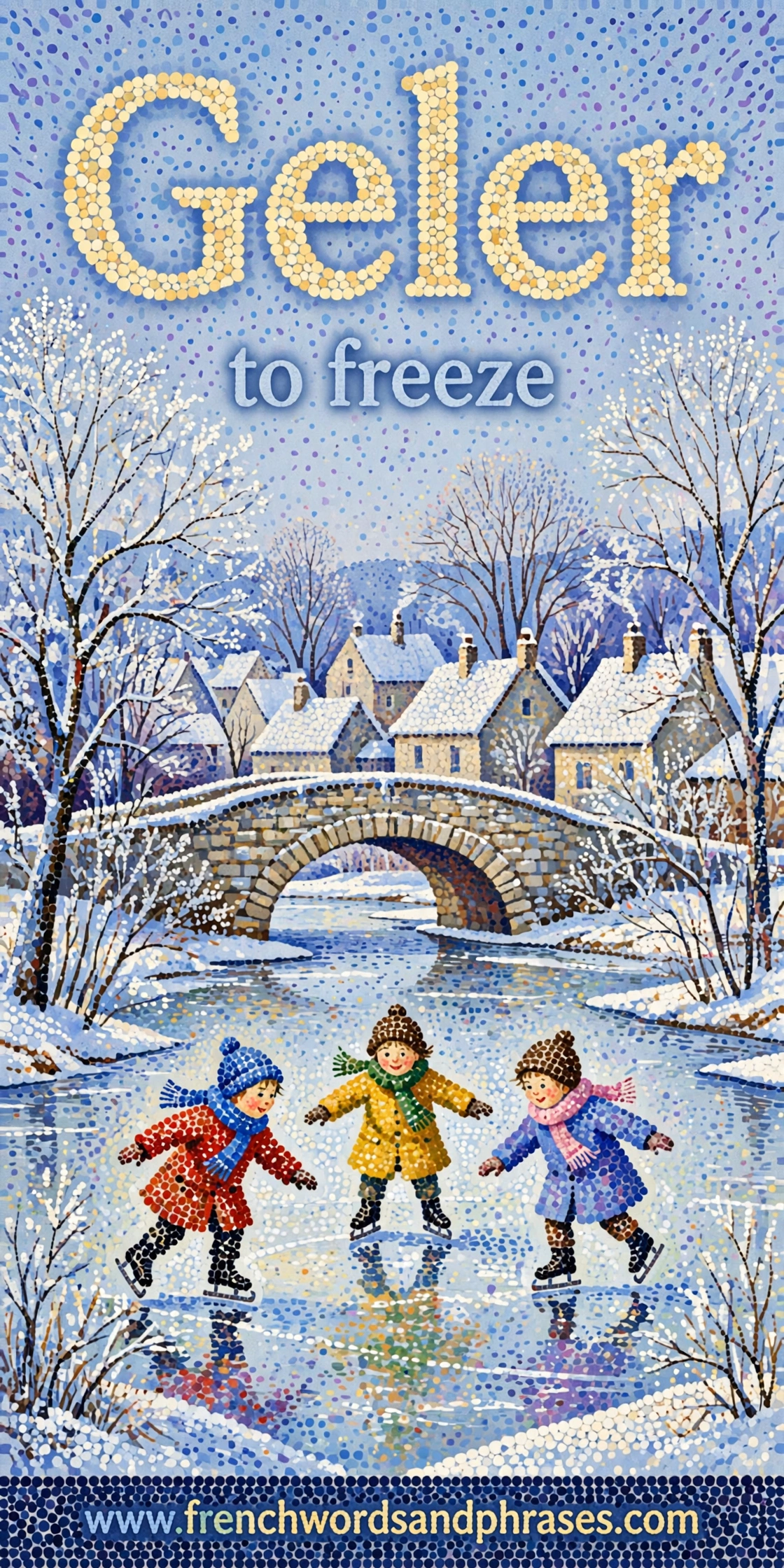
Geler means to freeze — the moment water turns to ice, fingers go numb, and a whole lake locks itself under a white, silent skin.
A pond at dawn with a crust of ice across it, breath smoking in the cold air, the gardener’s heart sinking at a white lawn in April — geler is the verb of freezing: of water hardening, of buds dying in a spring frost, and of people standing at a bus stop, frozen to the bone.
In this guide, you’ll learn how to conjugate geler in all the major French tenses and moods. Explore complete conjugation tables, French examples, English translations, and practice quizzes.
Understanding the French Verb Geler
Geler is a regular French verb belonging to the first group of verbs, those ending in-er.
It means to freeze. Geler works on three levels: the weather report (il gèle ce matin — there is a frost this morning), the physical world (le lac gèle, les tuyaux ont gelé), and the figurative one, where governments gèlent les prix (freeze prices) and a frightened witness se sent geler (feels frozen stiff).
Verb classification: First group (-er)
Auxiliary verb: Avoir
Past participle: gelé
Present participle: gelant
English equivalents: To freeze, to be frozen, to be freezing cold; il gèle — it is freezing; l’eau gèle à zéro degré — water freezes at zero degrees; geler en profondeur — to freeze solid; geler les prix — to freeze prices; avoir les mains gelées — to have frozen hands.
One important detail: geler is a peser-type verb — the plain e of the stem deepens to è wherever the next syllable is mute: je gèle, tu geles, il gèle, ils gèlent, and all through the future and the conditional: je gèlerai, il gèlerait. The plain e survives wherever the ending is sounded: nous gelons, vous gelez, je gelais, en gelant, and in the past participle gelé. The subjunctive splits along the same line: que je gèle, but que nous gelions.
Experience the Word
Geler is the verb of the world turning hard — water into stone, breath into smoke, fingers into wood.
Imagine a market gardener in April, walking his rows at six in the morning. The grass is white, the air bites, and every young shoot wears a coat of frost. Il a gelé cette nuit — it froze in the night — and a whole month of spring lies glittering and ruined at his feet.
The sun is already melting it. But it froze — il a gelé — and the garden will remember all summer.
How to Conjugate Geler: Complete French Conjugation Guide
Let’s explore every major conjugation of geler, beginning with the indicative mood.
How to Conjugate Geler in the Indicative Mood
The indicative mood is used to express facts, observations, actions, and events.
How to Conjugate Geler in the Present Tense (Présent)
Used for actions happening now, habitual actions, and general truths.
| Subject | Conjugation |
|---|---|
| je | gèle |
| tu | geles |
| il / elle | gèle |
| nous | gelons |
| vous | gelez |
| ils / elles | gèlent |
Example
En janvier, le lac gèle presque chaque nuit.
In January, the lake freezes almost every night.
Quick Quiz 1
Complete the sentence:
En hiver, le lac ______ dès la tombée de la nuit.
Reveal the answer
gèle
En hiver, le lac gèle dès la tombée de la nuit.
In winter, the lake freezes as soon as night falls.
How to Conjugate Geler in the Passé Composé
Used for completed actions in the past. Geler takes the auxiliary verb avoir.
| Subject | Conjugation |
|---|---|
| j’ | ai gelé |
| tu | as gelé |
| il / elle | a gelé |
| nous | avons gelé |
| vous | avez gelé |
| ils / elles | ont gelé |
Example
Cette nuit, l’eau des tuyaux a gelé.
Last night, the water in the pipes froze.
How to Conjugate Geler in the Imparfait (Imperfect Tense)
Used for habitual past actions, descriptions, and ongoing situations in the past.
| Subject | Conjugation |
|---|---|
| je | gelais |
| tu | gelais |
| il / elle | gelait |
| nous | gelions |
| vous | geliez |
| ils / elles | gelaient |
Example
Autrefois, la rivière gelait tout l’hiver.
In the old days, the river used to freeze all winter.
Quick Quiz 2
Choose the correct form:
It is freezing tonight.
Il ______ ce soir. (gèle / gelons)
Reveal the answer
gèle
Il gèle ce soir.
Before the mute ending, the stem vowel deepens: je gèle, il gèle.
How to Conjugate Geler in the Plus-que-parfait
Used to describe an action that had already been completed before another past event.
| Subject | Conjugation |
|---|---|
| j’ | avais gelé |
| tu | avais gelé |
| il / elle | avait gelé |
| nous | avions gelé |
| vous | aviez gelé |
| ils / elles | avaient gelé |
Example
Le sol avait gelé avant les premières neiges.
The ground had frozen before the first snows.
How to Conjugate Geler in the Passé Simple
Primarily used in formal writing, literature, and historical narratives. It is rarely used in everyday conversation.
| Subject | Conjugation |
|---|---|
| je | gelai |
| tu | gelas |
| il / elle | gela |
| nous | gelâmes |
| vous | gelâtes |
| ils / elles | gelèrent |
Example
Cette nuit-là, le lac gela entièrement.
That night, the lake froze over completely.
How to Conjugate Geler in the Passé Antérieur
A literary tense used to express an action completed immediately before another past action, generally in the passé simple.
| Subject | Conjugation |
|---|---|
| j’ | eus gelé |
| tu | eus gelé |
| il / elle | eut gelé |
| nous | eûmes gelé |
| vous | eûtes gelé |
| ils / elles | eurent gelé |
Example
Quand la mare eut gelé, les enfants sortirent leurs patins.
When the pond had frozen, the children got out their skates.
How to Conjugate Geler in the Future Tense (Futur Simple)
Used to describe actions that will take place in the future.
| Subject | Conjugation |
|---|---|
| je | gèlerai |
| tu | gèleras |
| il / elle | gèlera |
| nous | gèlerons |
| vous | gèlerez |
| ils / elles | gèleront |
Example
Si le froid continue, les vignes gèleront au printemps.
If the cold goes on, the vines will freeze in spring.
How to Conjugate Geler in the Futur Antérieur (Future Perfect)
Used for an action that will have been completed before a particular point in the future.
| Subject | Conjugation |
|---|---|
| j’ | aurai gelé |
| tu | auras gelé |
| il / elle | aura gelé |
| nous | aurons gelé |
| vous | aurez gelé |
| ils / elles | auront gelé |
Example
Demain matin, la rosée aura gelé sur les toits.
Tomorrow morning, the dew will have frozen on the roofs.
How to Conjugate Geler in the Near Future (Futur Proche)
Used to describe something that is going to happen soon. Formed with aller + infinitive.
| Subject | Conjugation |
|---|---|
| je | vais geler |
| tu | vas geler |
| il / elle | va geler |
| nous | allons geler |
| vous | allez geler |
| ils / elles | vont geler |
Example
Attention, la route va geler ce soir.
Careful, the road is going to freeze over tonight.
How to Conjugate Geler in the Conditional Mood
The conditional mood expresses what would happen under certain circumstances. It is also frequently used to make polite requests or express wishes.
How to Conjugate Geler in the Present Conditional
| Subject | Conjugation |
|---|---|
| je | gèlerais |
| tu | gèlerais |
| il / elle | gèlerait |
| nous | gèlerions |
| vous | gèleriez |
| ils / elles | gèleraient |
Example
Avec deux degrés de moins, le fleuve gèlerait.
With two degrees less, the river would freeze.
How to Conjugate Geler in the Past Conditional
| Subject | Conjugation |
|---|---|
| j’ | aurais gelé |
| tu | aurais gelé |
| il / elle | aurait gelé |
| nous | aurions gelé |
| vous | auriez gelé |
| ils / elles | auraient gelé |
Example
Les fleurs auraient gelé sans la couverture de paille.
The flowers would have frozen without the straw covering.
Geler in the Literary Past Conditional Form
This less common literary form uses the imperfect subjunctive of avoir.
| Subject | Conjugation |
|---|---|
| j’ | eusse gelé |
| tu | eusses gelé |
| il / elle | eût gelé |
| nous | eussions gelé |
| vous | eussiez gelé |
| ils / elles | eussent gelé |
Example
Le lac eût gelé jusqu’au fond, cet hiver-là.
The lake would have frozen to the bottom, that winter.
How to Conjugate Geler in the Subjunctive Mood
The subjunctive is used to express wishes, emotions, doubts, necessity, and uncertainty. It frequently follows expressions such as il faut que (it is necessary that) or bien que (although).
How to Conjugate Geler in the Present Subjunctive
| Subject | Conjugation |
|---|---|
| que je | gèle |
| que tu | geles |
| qu’il / qu’elle | gèle |
| que nous | gelions |
| que vous | geliez |
| qu’ils / qu’elles | gèlent |
Example
Je crains que les bourgeons ne gèlent cette nuit.
I fear the buds will freeze tonight.
Quick Quiz 3
Complete the sentence using the subjunctive:
Je crains que les fleurs ne ______ cette nuit.
Reveal the answer
gèlent
Je crains que les fleurs ne gèlent cette nuit.
I fear the flowers will freeze tonight.
How to Conjugate Geler in the Imperfect Subjunctive
A literary tense, rarely encountered in modern spoken French.
| Subject | Conjugation |
|---|---|
| que je | gelasse |
| que tu | gelasses |
| qu’il / qu’elle | gelât |
| que nous | gelassions |
| que vous | gelassiez |
| qu’ils / qu’elles | gelassent |
Example
On ne pensait pas que le sol gelât si tôt dans la saison.
Nobody thought the ground would freeze so early in the season.
How to Conjugate Geler in the Pluperfect Subjunctive
A literary construction used to express an action completed before another past action.
| Subject | Conjugation |
|---|---|
| que j’ | eusse gelé |
| que tu | eusses gelé |
| qu’il / qu’elle | eût gelé |
| que nous | eussions gelé |
| que vous | eussiez gelé |
| qu’ils / qu’elles | eussent gelé |
Example
Au matin, il semblait que tout eût gelé pendant la nuit.
In the morning, it seemed that everything had frozen during the night.
How to Conjugate Geler in the Past Subjunctive
| Subject | Conjugation |
|---|---|
| que j’ | aie gelé |
| que tu | aies gelé |
| qu’il / qu’elle | ait gelé |
| que nous | ayons gelé |
| que vous | ayez gelé |
| qu’ils / qu’elles | aient gelé |
Example
Je regrette que les tomates aient gelé.
I am sorry the tomatoes froze.
How to Conjugate Geler in the Imperative
The imperative is used to give commands, instructions, invitations, or suggestions. Subject pronouns are omitted.
How to Conjugate Geler in the Present Imperative
| Person | Conjugation |
|---|---|
| (tu) | gèle |
| (nous) | gelons |
| (vous) | gelez |
Example
Gèle bien cette nuit, petit lac, les patineurs comptent sur toi !
Freeze hard tonight, little lake, the skaters are counting on you!
Quick Quiz 4
How would you say Freeze hard tonight, little pond (tu form)?
Reveal the answer
Gèle bien cette nuit, petit étang !
French Participles of Geler
Participles are verb forms that can be used in compound tenses and other grammatical constructions.
Present Participle of Geler
gelant
En gelant, l’eau des canalisations peut les faire éclater.
By freezing, the water in the pipes can make them burst.
Past Participle of Geler
gelé
Gelée jusqu’au cœur, la fontaine s’est tue pour l’hiver.
Frozen to its heart, the fountain has fallen silent for the winter.
Geler in Everyday French: Real-Life Examples
Now that you know the conjugations, let’s see how geler appears in everyday French.
Example 1 — Present
Le lac gèle en janvier.
The lake freezes in January.
Example 2 — Passé composé
L’eau des tuyaux a gelé cette nuit.
The water in the pipes froze last night.
Example 3 — Imparfait
La rivière gelait tout l’hiver.
The river used to freeze all winter.
Example 4 — Future
Les vignes gèleront si le froid continue.
The vines will freeze if the cold goes on.
Example 5 — Conditional
Le fleuve gèlerait avec deux degrés de moins.
The river would freeze with two degrees less.
Example 6 — Imperative
Gèle bien cette nuit, petit lac !
Freeze hard tonight, little lake!
Beyond Translation: The Meaning of Geler
Geler descends from Latin gelare, to freeze — the same root that gives French le gel (frost), la gelée (a frost, and also jelly, because it sets like ice), and English gel, jelly and congeal.
Cold that sets things is gel.
Water sets into ice, fruit juice sets into jelly, prices set under a freeze — in French, one family of words holds them all together, and geler is the verb at its heart.
How to Remember the French Verb Geler
Remember it this way: Geler is about the April gardener at dawn, staring at his white, frozen rows.
- The stem vowel deepens before a mute syllable: je gèle, ils gèlent, je gèlerai — but nous gelons, je gelais, gelé.
- For the weather, French says simply il gèle — it is freezing, there is a frost.
- Past participle gelé, with plain é: les tuyaux ont gelé, les mains gelées.
The key idea is the April gardener at dawn, staring at his white, frozen rows.
Test Your Knowledge of Geler
Let’s see how much you’ve learned. Try answering these questions before revealing the answers.
Question 1
Why does je gèle carry a grave accent while nous gelons does not?
Reveal the answer
The peser-type rule — the stem vowel deepens to è before a mute syllable (je gèle, je gèlerai), and stays plain e where the ending is sounded (nous gelons, je gelais).
Question 2
How do you say The lake freezes in January in French?
Reveal the answer
Le lac gèle en janvier.
Question 3
Translate: The water in the pipes froze last night.
Reveal the answer
L’eau des tuyaux a gelé cette nuit.
Question 4
What is the past participle of geler?
Reveal the answer
Gelé — with a plain é, not è.
Question 5
Complete the sentence:
Je crains que les bourgeons ne ______ cette nuit.
Reveal the answer
gèlent
Je crains que les bourgeons ne gèlent cette nuit.
I fear the buds will freeze tonight.
Your Final Challenge
Can You Use It?
How would you say this in French?
The lake freezes in silence, and the village awaits spring beneath the ice.
Reveal the answer
Le lac gèle en silence, et le village attend le printemps sous la glace.
The lake freezes in silence, and the village awaits spring beneath the ice.
A little French. A little curiosity. A richer everyday life.
LEARN FRENCH ONE WORD AT A TIME