A French Word to Live By
How to Conjugate Dormir in French
/dɔʁ.miʁ/
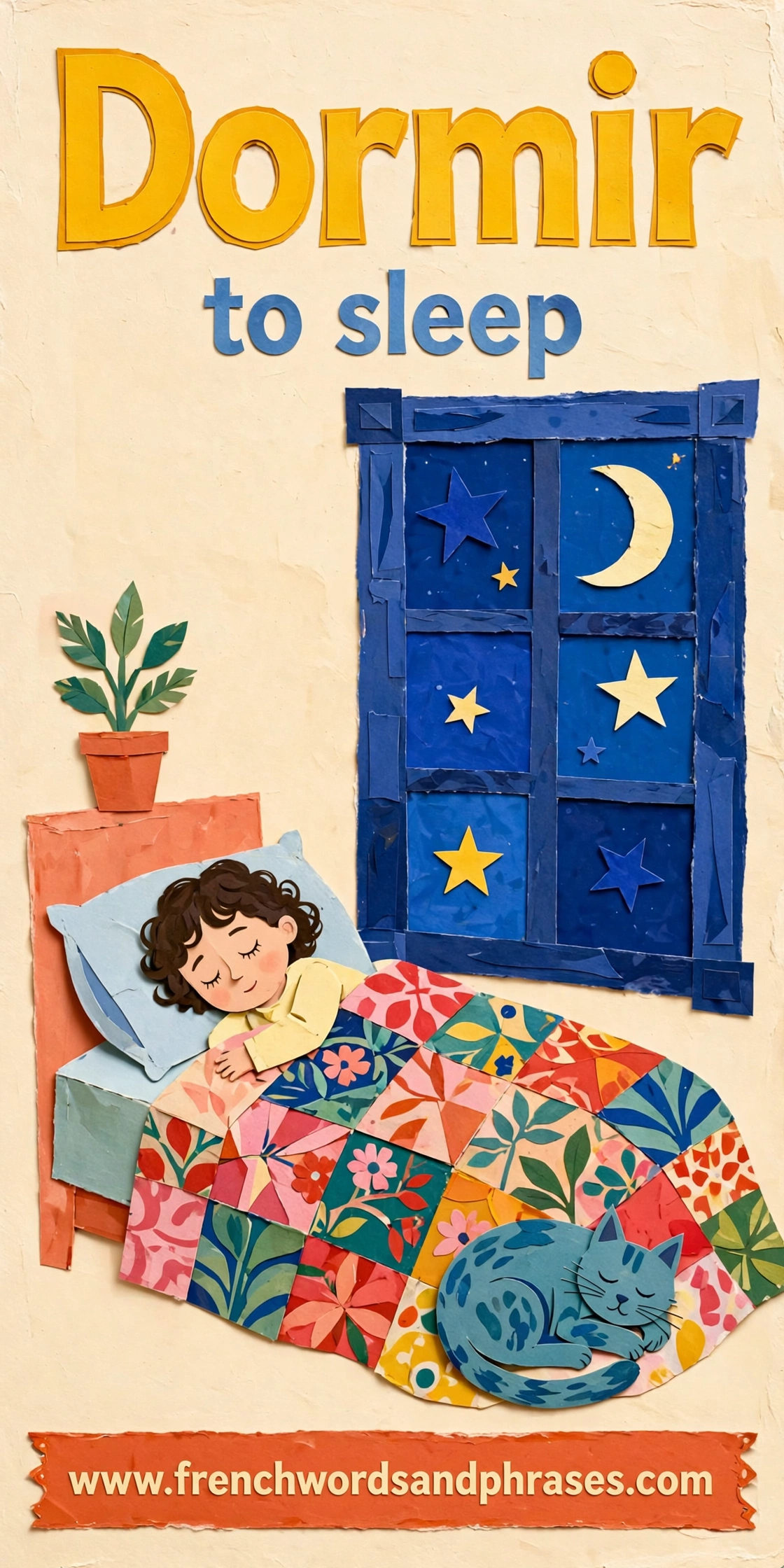
Dormir means to sleep — to close your eyes, let the day go, and leave the world to itself for a few hours.
A baby finally quiet in his cradle, a cat folded into the warm hollow of an armchair, a whole village dark behind its shutters — dormir is the verb of sleep itself: the great nightly departure that every living creature makes, and from which every morning is a return.
In this guide, you’ll learn how to conjugate dormir in all the major French tenses and moods. Explore complete conjugation tables, French examples, English translations, and practice quizzes.
Understanding the French Verb Dormir
Dormir is an irregular French verb ending in -ir, conjugated exactly like partir.
It means to sleep. Dormir is used first of real sleep — people, babies, animals — then figuratively of anything lying quiet and unused: un village qui dort (a sleeping village), l’argent qui dort (money sitting idle in an account), un volcan qui dort (a dormant volcano). If it is still and waiting, French says it dort.
Verb classification: Irregular (-ir)
Auxiliary verb: Avoir
Past participle: dormi
Present participle: dormant
English equivalents: To sleep, to be asleep; dormir profondément — to sleep soundly; dormir comme un bébé — to sleep like a baby; dormir sur ses deux oreilles — to sleep soundly, without a worry in the world; dormir debout — to be dead on one’s feet; une histoire à dormir debout — a tall story, a tale that sends you to sleep standing up.
One important detail: dormir belongs to the small dormir family of -ir verbs (partir, sortir, sentir, servir, mentir) whose singular drops the last letter of the stem: je dors, tu dors, il dort — the m of dorm- is heard in the plural only: nous dormons, vous dormez, ils dorment. There is never an -iss- anywhere: that belongs to finir-type verbs. And mind the neighbours: dormir is to be asleep, s’endormir is to fall asleep, and se rendormir is to drop off again.
Experience the Word
Dormir is the verb of the world switched off — no effort, no plans, just the deep, regular breathing of a creature at rest.
Imagine a farmhouse at midnight in January. The fire is out, the dog is curled against the door, the children are buried to the chin in their duvets, and even the grandfather, who swore he never sleeps, dort dans son fauteuil, la bouche ouverte. The whole house dort, and the snow keeps watch outside.
Nobody in that house is doing anything at all. They are sleeping — ils dorment — and it is the most important work of the night.
How to Conjugate Dormir: Complete French Conjugation Guide
Let’s explore every major conjugation of dormir, beginning with the indicative mood.
How to Conjugate Dormir in the Indicative Mood
The indicative mood is used to express facts, observations, actions, and events.
How to Conjugate Dormir in the Present Tense (Présent)
Used for actions happening now, habitual actions, and general truths.
| Subject | Conjugation |
|---|---|
| je | dors |
| tu | dors |
| il / elle | dort |
| nous | dormons |
| vous | dormez |
| ils / elles | dorment |
Example
Le bébé dort enfin dans son berceau.
The baby is finally sleeping in his cradle.
Quick Quiz 1
Complete the sentence:
Nous ______ jusqu’à midi le dimanche.
Reveal the answer
dormons
Nous dormons jusqu’à midi le dimanche.
We sleep until noon on Sundays.
How to Conjugate Dormir in the Passé Composé
Used for completed actions in the past. Dormir takes the auxiliary verb avoir.
| Subject | Conjugation |
|---|---|
| j’ | ai dormi |
| tu | as dormi |
| il / elle | a dormi |
| nous | avons dormi |
| vous | avez dormi |
| ils / elles | ont dormi |
Example
Nous avons dormi dix heures d’affilée.
We slept ten hours straight.
How to Conjugate Dormir in the Imparfait (Imperfect Tense)
Used for habitual past actions, descriptions, and ongoing situations in the past.
| Subject | Conjugation |
|---|---|
| je | dormais |
| tu | dormais |
| il / elle | dormait |
| nous | dormions |
| vous | dormiez |
| ils / elles | dormaient |
Example
Quand j’étais enfant, je dormais jusqu’à midi.
When I was a child, I used to sleep until noon.
Quick Quiz 2
Choose the correct form:
He slept ten hours.
Il ______ dix heures. (a dormi / est dormi)
Reveal the answer
a dormi
Il a dormi dix heures.
Dormir takes avoir.
How to Conjugate Dormir in the Plus-que-parfait
Used to describe an action that had already been completed before another past event.
| Subject | Conjugation |
|---|---|
| j’ | avais dormi |
| tu | avais dormi |
| il / elle | avait dormi |
| nous | avions dormi |
| vous | aviez dormi |
| ils / elles | avaient dormi |
Example
Elle avait dormi à peine deux heures avant l’examen.
She had slept barely two hours before the exam.
How to Conjugate Dormir in the Passé Simple
Primarily used in formal writing, literature, and historical narratives. It is rarely used in everyday conversation.
| Subject | Conjugation |
|---|---|
| je | dormis |
| tu | dormis |
| il / elle | dormit |
| nous | dormîmes |
| vous | dormîtes |
| ils / elles | dormirent |
Example
Le roi dormit profondément jusqu’au matin.
The king slept soundly until morning.
How to Conjugate Dormir in the Passé Antérieur
A literary tense used to express an action completed immediately before another past action, generally in the passé simple.
| Subject | Conjugation |
|---|---|
| j’ | eus dormi |
| tu | eus dormi |
| il / elle | eut dormi |
| nous | eûmes dormi |
| vous | eûtes dormi |
| ils / elles | eurent dormi |
Example
Quand il eut dormi une heure, il se remit au travail.
When he had slept for an hour, he got back to work.
How to Conjugate Dormir in the Future Tense (Futur Simple)
Used to describe actions that will take place in the future.
| Subject | Conjugation |
|---|---|
| je | dormirai |
| tu | dormiras |
| il / elle | dormira |
| nous | dormirons |
| vous | dormirez |
| ils / elles | dormiront |
Example
Ce soir, vous dormirez dans un vrai lit.
Tonight, you will sleep in a real bed.
How to Conjugate Dormir in the Futur Antérieur (Future Perfect)
Used for an action that will have been completed before a particular point in the future.
| Subject | Conjugation |
|---|---|
| j’ | aurai dormi |
| tu | auras dormi |
| il / elle | aura dormi |
| nous | aurons dormi |
| vous | aurez dormi |
| ils / elles | auront dormi |
Example
Quand le train arrivera, j’aurai dormi trois heures.
When the train arrives, I will have slept three hours.
How to Conjugate Dormir in the Near Future (Futur Proche)
Used to describe something that is going to happen soon. Formed with aller + infinitive.
| Subject | Conjugation |
|---|---|
| je | vais dormir |
| tu | vas dormir |
| il / elle | va dormir |
| nous | allons dormir |
| vous | allez dormir |
| ils / elles | vont dormir |
Example
Chut ! Le chat va dormir sur tes genoux.
Shh! The cat is going to sleep on your knees.
How to Conjugate Dormir in the Conditional Mood
The conditional mood expresses what would happen under certain circumstances. It is also frequently used to make polite requests or express wishes.
How to Conjugate Dormir in the Present Conditional
| Subject | Conjugation |
|---|---|
| je | dormirais |
| tu | dormirais |
| il / elle | dormirait |
| nous | dormirions |
| vous | dormiriez |
| ils / elles | dormiraient |
Example
Sans ce bruit, je dormirais beaucoup mieux.
Without this noise, I would sleep much better.
How to Conjugate Dormir in the Past Conditional
| Subject | Conjugation |
|---|---|
| j’ | aurais dormi |
| tu | aurais dormi |
| il / elle | aurait dormi |
| nous | aurions dormi |
| vous | auriez dormi |
| ils / elles | auraient dormi |
Example
Elle aurait dormi plus longtemps sans le réveil.
She would have slept longer without the alarm clock.
Dormir in the Literary Past Conditional Form
This less common literary form uses the imperfect subjunctive of avoir.
| Subject | Conjugation |
|---|---|
| j’ | eusse dormi |
| tu | eusses dormi |
| il / elle | eût dormi |
| nous | eussions dormi |
| vous | eussiez dormi |
| ils / elles | eussent dormi |
Example
Elle eût dormi toute la journée si on l’avait laissée faire.
She would have slept all day if they had let her.
How to Conjugate Dormir in the Subjunctive Mood
The subjunctive is used to express wishes, emotions, doubts, necessity, and uncertainty. It frequently follows expressions such as il faut que (it is necessary that) or bien que (although).
How to Conjugate Dormir in the Present Subjunctive
| Subject | Conjugation |
|---|---|
| que je | dorme |
| que tu | dormes |
| qu’il / qu’elle | dorme |
| que nous | dormions |
| que vous | dormiez |
| qu’ils / qu’elles | dorment |
Example
Il est tard, il faut que les enfants dorment.
It is late, the children must sleep.
Quick Quiz 3
Complete the sentence using the subjunctive:
Il faut que tu ______ tôt ce soir.
Reveal the answer
dormes
Il faut que tu dormes tôt ce soir.
You must sleep early tonight.
How to Conjugate Dormir in the Imperfect Subjunctive
A literary tense, rarely encountered in modern spoken French.
| Subject | Conjugation |
|---|---|
| que je | dormisse |
| que tu | dormisses |
| qu’il / qu’elle | dormît |
| que nous | dormissions |
| que vous | dormissiez |
| qu’ils / qu’elles | dormissent |
Example
Je ne croyais pas qu’il dormît si tard.
I did not think he would sleep so late.
How to Conjugate Dormir in the Pluperfect Subjunctive
A literary construction used to express an action completed before another past action.
| Subject | Conjugation |
|---|---|
| que j’ | eusse dormi |
| que tu | eusses dormi |
| qu’il / qu’elle | eût dormi |
| que nous | eussions dormi |
| que vous | eussiez dormi |
| qu’ils / qu’elles | eussent dormi |
Example
On s’étonnait qu’il eût dormi pendant tout le voyage.
People were surprised that he had slept through the whole journey.
How to Conjugate Dormir in the Past Subjunctive
| Subject | Conjugation |
|---|---|
| que j’ | aie dormi |
| que tu | aies dormi |
| qu’il / qu’elle | ait dormi |
| que nous | ayons dormi |
| que vous | ayez dormi |
| qu’ils / qu’elles | aient dormi |
Example
Je suis content que tu aies bien dormi.
I am glad you slept well.
How to Conjugate Dormir in the Imperative
The imperative is used to give commands, instructions, invitations, or suggestions. Subject pronouns are omitted.
How to Conjugate Dormir in the Present Imperative
| Person | Conjugation |
|---|---|
| (tu) | dors |
| (nous) | dormons |
| (vous) | dormez |
Example
Dors, maintenant, et ne pense plus à rien !
Sleep now, and think of nothing more!
Quick Quiz 4
How would you say Sleep well (tu form)?
Reveal the answer
Dors bien !
French Participles of Dormir
Participles are verb forms that can be used in compound tenses and other grammatical constructions.
Present Participle of Dormir
dormant
En dormant, le corps récupère des fatigues de la journée.
By sleeping, the body recovers from the day’s tiredness.
Past Participle of Dormir
dormi
Dormie sous les étoiles, cette nuit-là reste son plus beau souvenir.
Slept under the stars, that night remains her finest memory.
Dormir in Everyday French: Real-Life Examples
Now that you know the conjugations, let’s see how dormir appears in everyday French.
Example 1 — Present
Le bébé dort dans son berceau.
The baby is sleeping in his cradle.
Example 2 — Passé composé
Nous avons dormi dix heures.
We slept ten hours.
Example 3 — Imparfait
Je dormais jusqu’à midi.
I used to sleep until noon.
Example 4 — Future
Vous dormirez dans un vrai lit.
You will sleep in a real bed.
Example 5 — Conditional
Je dormirais mieux sans ce bruit.
I would sleep better without this noise.
Example 6 — Imperative
Dormez bien, les enfants !
Sleep well, children!
Beyond Translation: The Meaning of Dormir
Dormir comes straight from Latin dormire, to sleep, and English keeps the family in dormitory — the sleeping place — and dormant, asleep and waiting, exactly like a French volcan qui dort.
The French sleep soundly in their own way.
To sleep without a single worry is dormir sur ses deux oreilles — to sleep on both ears — and a story so tall it cannot be believed is une histoire à dormir debout, a story to make you sleep standing up.
How to Remember the French Verb Dormir
Remember it this way: Dormir is about the whole farmhouse asleep under the snow, even the dog by the door.
- The singular drops the stem’s last letter: je dors, tu dors, il dort — but nous dormons, vous dormez, ils dorment.
- No -iss- anywhere: dormir is not a finir-type verb; its past participle is dormi.
- Dormir is to BE asleep; s’endormir is to FALL asleep — first the falling, then the sleeping.
The key idea is the whole farmhouse asleep under the snow, even the dog by the door.
Test Your Knowledge of Dormir
Let’s see how much you’ve learned. Try answering these questions before revealing the answers.
Question 1
Why is je dors written without the m of dorm-?
Reveal the answer
The singular drops the stem’s last consonant — je dors, tu dors, il dort; the full stem dorm- returns in the plural: nous dormons, ils dorment.
Question 2
How do you say The baby is sleeping in French?
Reveal the answer
Le bébé dort.
Question 3
Translate: We slept ten hours straight.
Reveal the answer
Nous avons dormi dix heures d’affilée.
Question 4
What is the past participle of dormir?
Reveal the answer
Dormi — dormi, dormie, dormis, dormies.
Question 5
Complete the sentence:
Il faut que les enfants ______ tôt ce soir.
Reveal the answer
dorment
Il faut que les enfants dorment tôt ce soir.
The children must sleep early tonight.
Your Final Challenge
Can You Use It?
How would you say this in French?
The village sleeps beneath the snow, and even the bell tower seems to hold its breath.
Reveal the answer
Le village dort sous la neige, et même le clocher semble retenir son souffle.
The village sleeps beneath the snow, and even the bell tower seems to hold its breath.
A little French. A little curiosity. A richer everyday life.
LEARN FRENCH ONE WORD AT A TIME