A French Word to Live By
How to Conjugate Lâcher in French
/lɑ.ʃe/
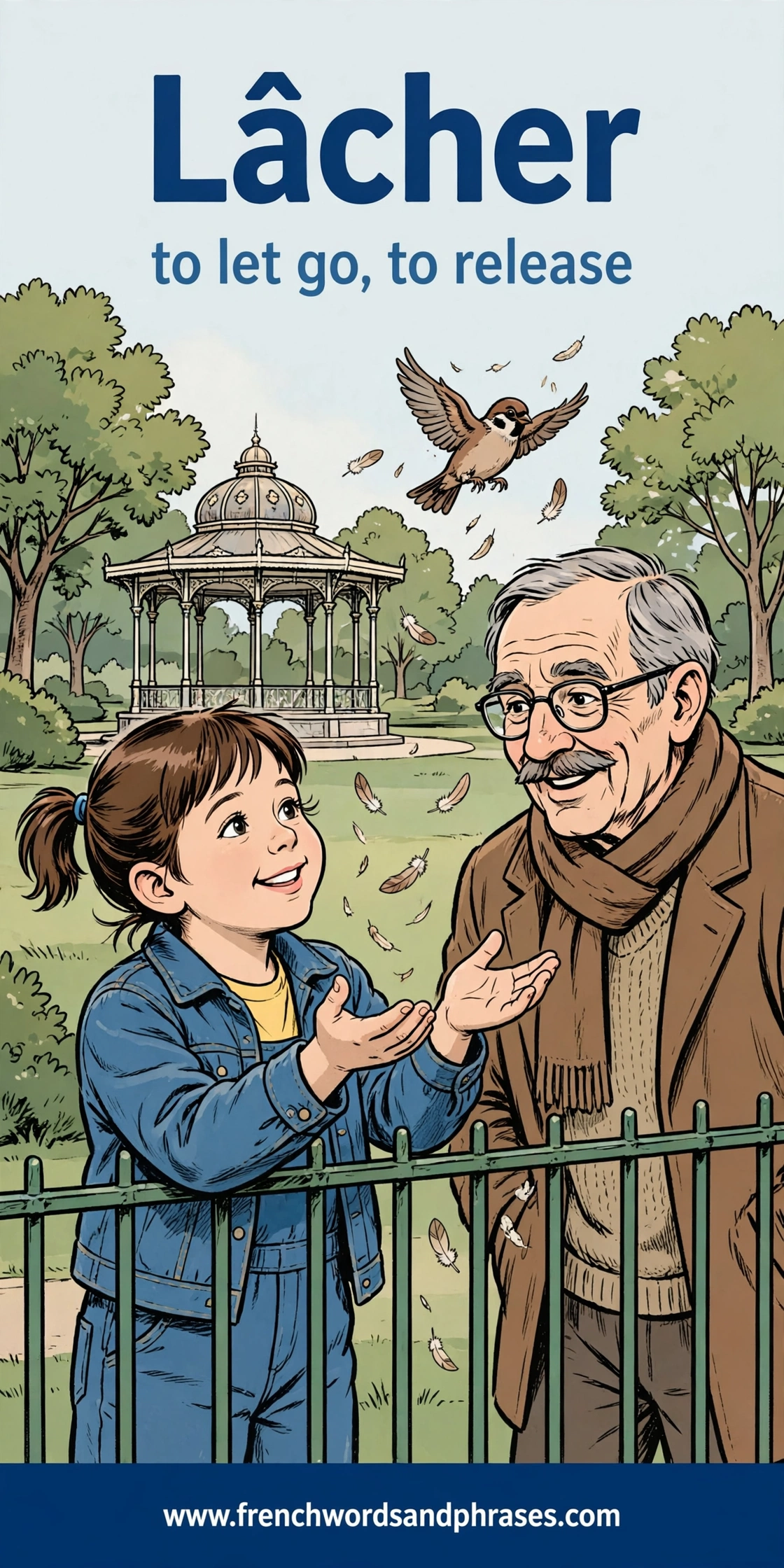
Lâcher means to let go, to release — to open the hand, loosen the grip, and let the thing fly, fall or run free.
A child at a fair letting a balloon climb into the blue, a fisherman opening his hands over the water, a climber’s fingers slipping from the rope — lâcher is the verb of the loosened grip: everything that was held, and is held no longer, has been lâché.
In this guide, you’ll learn how to conjugate lâcher in all the major French tenses and moods. Explore complete conjugation tables, French examples, English translations, and practice quizzes.
Understanding the French Verb Lâcher
Lâcher is a regular French verb belonging to the first group of verbs, those ending in-er.
It means to let go, to release. Lâcher covers the physical release (lâcher la corde, lâcher les chiens — to unleash the dogs), the sudden emission (lâcher un cri, lâcher un soupir — to let out a cry, a sigh), and the moral surrender of lâcher prise or lâcher l’affaire, letting a matter drop. Between laisser (to leave, to allow) and lâcher, the difference is the grip: what is lâché was being held tight.
Verb classification: First group (-er)
Auxiliary verb: Avoir
Past participle: lâché
Present participle: lâchant
English equivalents: To let go of, to release, to drop, to let out; lâcher prise — to let go, to give up one’s grip (in every sense); lâcher la bride à quelqu’un — to give someone free rein; lâcher un cri — to let out a cry; lâcher l’affaire — to drop the matter; ne me lâche pas ! — don’t let go of me!
One important detail: lâcher keeps its circumflex on the â in every form — je lâche, nous lâchons, je lâchais, lâché — a small roof over the vowel that never moves. Then mind its favourite phrase: lâcher prise, to let go of one’s hold, is used of hands on ropes and of minds that finally stop clinging: il faut savoir lâcher prise. In familiar French, lâcher quelqu’un can also mean to drop someone, to ditch them — and se lâcher is to let oneself go at last.
Experience the Word
Lâcher is the verb of the opening hand — the instant when holding stops and the thing, whatever it is, goes free.
Imagine a small boy at a village fête, a red balloon string wound three times round his wrist. His mother is calling, the candyfloss is ready — and he looks up, unwinds the string, and opens his fingers. Il lâche le ballon. For three seconds the whole square watches it climb; then it is a red point, then nothing, and the boy is laughing with his empty hand in the air.
He has lost his balloon and gained the sky. He let go — il a lâché — and letting go turned out to be the best part.
How to Conjugate Lâcher: Complete French Conjugation Guide
Let’s explore every major conjugation of lâcher, beginning with the indicative mood.
How to Conjugate Lâcher in the Indicative Mood
The indicative mood is used to express facts, observations, actions, and events.
How to Conjugate Lâcher in the Present Tense (Présent)
Used for actions happening now, habitual actions, and general truths.
| Subject | Conjugation |
|---|---|
| je | lâche |
| tu | lâches |
| il / elle | lâche |
| nous | lâchons |
| vous | lâchez |
| ils / elles | lâchent |
Example
Ne lâche pas la main de ta sœur dans la foule.
Do not let go of your sister’s hand in the crowd.
Quick Quiz 1
Complete the sentence:
Nous ne ______ jamais la main des enfants dans la foule.
Reveal the answer
lâchons
Nous ne lâchons jamais la main des enfants dans la foule.
We never let go of the children’s hands in the crowd.
How to Conjugate Lâcher in the Passé Composé
Used for completed actions in the past. Lâcher takes the auxiliary verb avoir.
| Subject | Conjugation |
|---|---|
| j’ | ai lâché |
| tu | as lâché |
| il / elle | a lâché |
| nous | avons lâché |
| vous | avez lâché |
| ils / elles | ont lâché |
Example
Il a lâché la corde au dernier moment.
He let go of the rope at the last moment.
How to Conjugate Lâcher in the Imparfait (Imperfect Tense)
Used for habitual past actions, descriptions, and ongoing situations in the past.
| Subject | Conjugation |
|---|---|
| je | lâchais |
| tu | lâchais |
| il / elle | lâchait |
| nous | lâchions |
| vous | lâchiez |
| ils / elles | lâchaient |
Example
Le chien lâchait rarement son os.
The dog rarely let go of his bone.
Quick Quiz 2
Choose the correct form:
She let go of the rope.
Elle ______ la corde. (a lâché / est lâchée)
Reveal the answer
a lâché
Elle a lâché la corde.
Lâcher takes avoir.
How to Conjugate Lâcher in the Plus-que-parfait
Used to describe an action that had already been completed before another past event.
| Subject | Conjugation |
|---|---|
| j’ | avais lâché |
| tu | avais lâché |
| il / elle | avait lâché |
| nous | avions lâché |
| vous | aviez lâché |
| ils / elles | avaient lâché |
Example
Elle avait lâché le guidon pour saluer ses amis.
She had let go of the handlebars to wave to her friends.
How to Conjugate Lâcher in the Passé Simple
Primarily used in formal writing, literature, and historical narratives. It is rarely used in everyday conversation.
| Subject | Conjugation |
|---|---|
| je | lâchai |
| tu | lâchas |
| il / elle | lâcha |
| nous | lâchâmes |
| vous | lâchâtes |
| ils / elles | lâchèrent |
Example
Le pêcheur lâcha le poisson trop petit et le regarda repartir.
The fisherman released the fish that was too small and watched it swim away.
How to Conjugate Lâcher in the Passé Antérieur
A literary tense used to express an action completed immediately before another past action, generally in the passé simple.
| Subject | Conjugation |
|---|---|
| j’ | eus lâché |
| tu | eus lâché |
| il / elle | eut lâché |
| nous | eûmes lâché |
| vous | eûtes lâché |
| ils / elles | eurent lâché |
Example
Dès qu’elle eut lâché la rampe, elle descendit l’escalier toute seule.
As soon as she had let go of the handrail, she came down the stairs all by herself.
How to Conjugate Lâcher in the Future Tense (Futur Simple)
Used to describe actions that will take place in the future.
| Subject | Conjugation |
|---|---|
| je | lâcherai |
| tu | lâcheras |
| il / elle | lâchera |
| nous | lâcherons |
| vous | lâcherez |
| ils / elles | lâcheront |
Example
Je ne te lâcherai pas avant l’aéroport.
I will not let go of you before the airport.
How to Conjugate Lâcher in the Futur Antérieur (Future Perfect)
Used for an action that will have been completed before a particular point in the future.
| Subject | Conjugation |
|---|---|
| j’ | aurai lâché |
| tu | auras lâché |
| il / elle | aura lâché |
| nous | aurons lâché |
| vous | aurez lâché |
| ils / elles | auront lâché |
Example
À midi, les enfants auront lâché leurs ballons dans le ciel.
By noon, the children will have released their balloons into the sky.
How to Conjugate Lâcher in the Near Future (Futur Proche)
Used to describe something that is going to happen soon. Formed with aller + infinitive.
| Subject | Conjugation |
|---|---|
| je | vais lâcher |
| tu | vas lâcher |
| il / elle | va lâcher |
| nous | allons lâcher |
| vous | allez lâcher |
| ils / elles | vont lâcher |
Example
Attention, tu vas lâcher ton verre !
Careful, you are going to drop your glass!
How to Conjugate Lâcher in the Conditional Mood
The conditional mood expresses what would happen under certain circumstances. It is also frequently used to make polite requests or express wishes.
How to Conjugate Lâcher in the Present Conditional
| Subject | Conjugation |
|---|---|
| je | lâcherais |
| tu | lâcherais |
| il / elle | lâcherait |
| nous | lâcherions |
| vous | lâcheriez |
| ils / elles | lâcheraient |
Example
Sans toi, je lâcherais tout.
Without you, I would let everything go.
How to Conjugate Lâcher in the Past Conditional
| Subject | Conjugation |
|---|---|
| j’ | aurais lâché |
| tu | aurais lâché |
| il / elle | aurait lâché |
| nous | aurions lâché |
| vous | auriez lâché |
| ils / elles | auraient lâché |
Example
Elle aurait lâché l’affaire si on le lui avait demandé.
She would have dropped the matter if she had been asked.
Lâcher in the Literary Past Conditional Form
This less common literary form uses the imperfect subjunctive of avoir.
| Subject | Conjugation |
|---|---|
| j’ | eusse lâché |
| tu | eusses lâché |
| il / elle | eût lâché |
| nous | eussions lâché |
| vous | eussiez lâché |
| ils / elles | eussent lâché |
Example
Il eût lâché prise plutôt que de céder au chantage.
He would have let go rather than give in to blackmail.
How to Conjugate Lâcher in the Subjunctive Mood
The subjunctive is used to express wishes, emotions, doubts, necessity, and uncertainty. It frequently follows expressions such as il faut que (it is necessary that) or bien que (although).
How to Conjugate Lâcher in the Present Subjunctive
| Subject | Conjugation |
|---|---|
| que je | lâche |
| que tu | lâches |
| qu’il / qu’elle | lâche |
| que nous | lâchions |
| que vous | lâchiez |
| qu’ils / qu’elles | lâchent |
Example
Il faut que tu lâches ce projet impossible.
You must let go of this impossible project.
Quick Quiz 3
Complete the sentence using the subjunctive:
Il faut que vous ______ prise, maintenant.
Reveal the answer
lâchiez
Il faut que vous lâchiez prise, maintenant.
You must let go now.
How to Conjugate Lâcher in the Imperfect Subjunctive
A literary tense, rarely encountered in modern spoken French.
| Subject | Conjugation |
|---|---|
| que je | lâchasse |
| que tu | lâchasses |
| qu’il / qu’elle | lâchât |
| que nous | lâchassions |
| que vous | lâchassiez |
| qu’ils / qu’elles | lâchassent |
Example
Le directeur ne voulait pas qu’on lâchât l’affaire.
The director did not want the matter to be dropped.
How to Conjugate Lâcher in the Pluperfect Subjunctive
A literary construction used to express an action completed before another past action.
| Subject | Conjugation |
|---|---|
| que j’ | eusse lâché |
| que tu | eusses lâché |
| qu’il / qu’elle | eût lâché |
| que nous | eussions lâché |
| que vous | eussiez lâché |
| qu’ils / qu’elles | eussent lâché |
Example
On a regretté qu’il eût lâché prise si tôt.
People regretted that he had let go so soon.
How to Conjugate Lâcher in the Past Subjunctive
| Subject | Conjugation |
|---|---|
| que j’ | aie lâché |
| que tu | aies lâché |
| qu’il / qu’elle | ait lâché |
| que nous | ayons lâché |
| que vous | ayez lâché |
| qu’ils / qu’elles | aient lâché |
Example
Je suis étonné qu’elle ait lâché son poste si vite.
I am surprised she gave up her job so quickly.
How to Conjugate Lâcher in the Imperative
The imperative is used to give commands, instructions, invitations, or suggestions. Subject pronouns are omitted.
How to Conjugate Lâcher in the Present Imperative
| Person | Conjugation |
|---|---|
| (tu) | lâche |
| (nous) | lâchons |
| (vous) | lâchez |
Example
Lâche cette corde, elle va casser !
Let go of that rope, it is going to snap!
Quick Quiz 4
How would you say Let go of that rope (tu form)?
Reveal the answer
Lâche cette corde !
French Participles of Lâcher
Participles are verb forms that can be used in compound tenses and other grammatical constructions.
Present Participle of Lâcher
lâchant
En lâchant les ballons, les enfants ont crié de joie.
By releasing the balloons, the children shouted with joy.
Past Participle of Lâcher
lâché
Lâchée par son équipe, elle a fini le travail toute seule.
Let down by her team, she finished the work all alone.
Lâcher in Everyday French: Real-Life Examples
Now that you know the conjugations, let’s see how lâcher appears in everyday French.
Example 1 — Present
Ne lâche pas la main de ta sœur.
Do not let go of your sister’s hand.
Example 2 — Passé composé
Il a lâché la corde au dernier moment.
He let go of the rope at the last moment.
Example 3 — Imparfait
Le chien lâchait rarement son os.
The dog rarely let go of his bone.
Example 4 — Future
Je ne te lâcherai pas avant l’aéroport.
I will not let go of you before the airport.
Example 5 — Conditional
Sans toi, je lâcherais tout.
Without you, I would let everything go.
Example 6 — Imperative
Lâche cette corde !
Let go of that rope!
Beyond Translation: The Meaning of Lâcher
Lâcher comes from a Latin verb meaning to loosen and slacken, and its family in French still carries the idea of the loosened knot: lâche as an adjective means loose, slack — and, of a person, cowardly, the one who let go.
French measures character by the grip.
To hold on is honourable, to lâcher prise can be wisdom or surrender — and the whole moral weight of the verb sits in knowing which of the two it is, this time.
How to Remember the French Verb Lâcher
Remember it this way: Lâcher is about the boy at the fête opening his fingers and watching the red balloon climb.
- Lâcher is the loosened grip: what is lâché was being held — a rope, a hand, a matter, a hope.
- Its great phrase is lâcher prise, to let go — of a rope, of a worry, of a fight.
- Regular -er under the circumflex: je lâche, nous lâchons, past participle lâché, â in every form.
The key idea is the boy at the fête opening his fingers and watching the red balloon climb.
Test Your Knowledge of Lâcher
Let’s see how much you’ve learned. Try answering these questions before revealing the answers.
Question 1
What does the phrase lâcher prise mean?
Reveal the answer
To let go — literally to release one’s grip, and figuratively to stop clinging to a worry, a fight or a hope.
Question 2
How do you say Do not let go of your sister’s hand in French?
Reveal the answer
Ne lâche pas la main de ta sœur.
Question 3
Translate: He let go of the rope at the last moment.
Reveal the answer
Il a lâché la corde au dernier moment.
Question 4
What is the past participle of lâcher?
Reveal the answer
Lâché — the circumflex on the â never moves.
Question 5
Complete the sentence:
Il faut que tu ______ ce projet impossible.
Reveal the answer
lâches
Il faut que tu lâches ce projet impossible.
You must let go of this impossible project.
Your Final Challenge
Can You Use It?
How would you say this in French?
He lets go of the red balloon, and the whole village watches it climb into the sky.
Reveal the answer
Il lâche le ballon rouge, et tout le village le regarde monter dans le ciel.
He lets go of the red balloon, and the whole village watches it climb into the sky.
A little French. A little curiosity. A richer everyday life.
LEARN FRENCH ONE WORD AT A TIME