A French Word to Live By
Translate Frein à main to English
/fʁɛ̃ a mɛ̃/
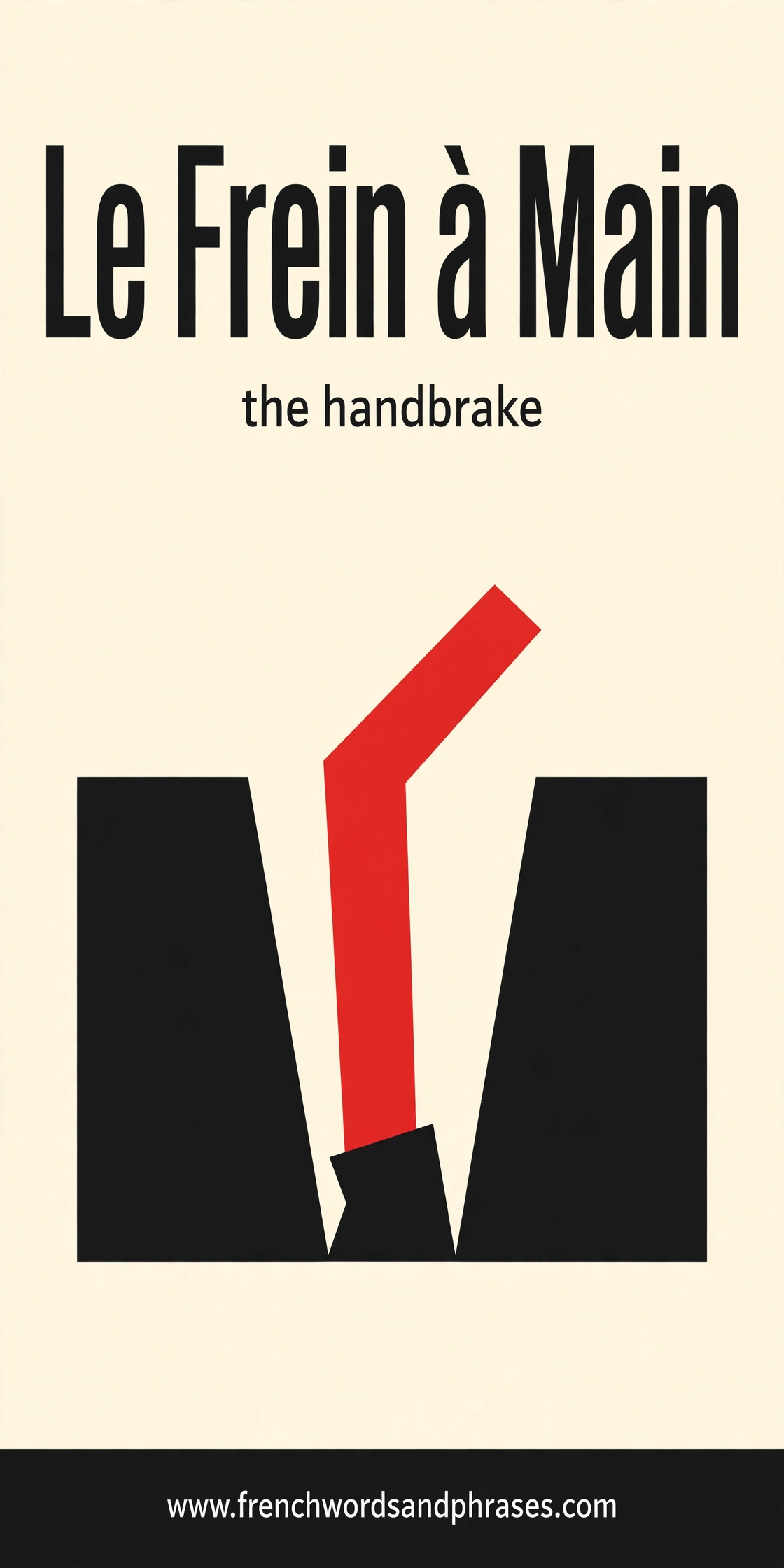
Le frein à main means the handbrake.
Parking on a steep little street in an old hill town: the driver turns the wheels towards the kerb, pulls the lever up with a satisfying series of clicks, and pats it like an old friend — le frein à main, the handbrake.
In this guide, you’ll learn what frein à main means in English, how to use it with its articles, how to form its plural, and how it appears in everyday French. Explore French examples, English translations, and practice quizzes.
Understanding the French Noun Frein à main
Frein à main is a masculine French noun, built from le frein, the brake, and la main, the hand. It is learned together with its article: le frein à main, un frein à main. The à never changes, and the plural touches only frein: les freins à main.
It means the handbrake — the lever, usually between the front seats, that locks the wheels when the car is parked. You serrez it, pull it on, when you stop, and you desserrez it, release it, before driving away. On hill starts it is the learner’s best friend: hold the car on the frein à main, find the clutch’s bite, release, and roll forward without slipping back.
Gender: Masculine
Definite article: le — le frein à main (the handbrake)
Indefinite article: un — un frein à main (a handbrake)
Plural: les freins à main
English equivalents: The handbrake; in American English, the parking brake or emergency brake.
One important usage detail: the frein à main has two faithful verbs — serrer le frein à main, to pull it on, and desserrer le frein à main, to release it. Forget the second and the car will complain all the way down the street. On many new cars the lever has become a small button, le frein de stationnement électrique, the electric parking brake — same job, no clicks.
Experience the Word
Frein à main is more than a lever. It is the sound of a journey ending safely — that ratchet of clicks that says the car stays exactly where you left it.
Imagine the hill start on the test: traffic behind you, the slope against you, and the frein à main holding everything still while you breathe, balance the pedals, and pull away cleanly at last.
You have not just parked a car. You have beaten the hill.
How to Use Frein à main in French: Complete Guide
Let’s explore how frein à main works in French, beginning with its articles.
Frein à main with the Definite Article (Le, Les)
Used for the handbrake everyone in the conversation knows — the one in this car, between the seats.
| Number | French |
|---|---|
| Singular | le frein à main |
| Plural | les freins à main |
Example
Le frein à main est entre les deux sièges avant.
The handbrake is between the two front seats.
Frein à main with the Indefinite Article (Un, Des)
Used for a handbrake in general — the one a model offers, the one a learner learns to trust.
| Number | French |
|---|---|
| Singular | un frein à main |
| Plural | des freins à main |
Example
Cette voiture électrique a un frein à main automatique.
This electric car has an automatic handbrake.
Frein à main with the Partitive Article (Des, De — Some and None)
Count nouns meet the partitive family through des in the plural, de after a negative, and du for a part of the whole mechanism.
| Situation | French |
|---|---|
| Some (in the plural) | des freins à main |
| None (after a negative) | pas de frein à main |
| A lot of them | beaucoup de freins à main |
| Part of the handbrake | une partie du frein à main |
Example
Dans ce modèle, il n’y a pas de frein à main classique, juste un bouton.
In this model, there is no classic handbrake, just a button.
Quick Quiz 1
You park on a hill. Do you serrer or desserrer the frein à main?
Reveal the answer
Serrer — you pull it on to hold the car. Desserrer is the release, for the moment you drive away.
En côte, serre toujours le frein à main.
On a hill, always pull the handbrake on.
The Plural of Frein à main
Only frein takes the -s — à main never changes: les freins à main.
| Number | French |
|---|---|
| Singular | le frein à main |
| Plural | les freins à main |
Example
Les freins à main des voitures anciennes demandent de la force.
The handbrakes of old cars need strength.
Frein à main with Possessive Adjectives (Mon, Ton, Son…)
Possessives agree with the noun, not with the owner — and frein à main is masculine, so it takes mon, ton, son.
| Owner | French |
|---|---|
| my | mon frein à main |
| your (tu) | ton frein à main |
| his / her | son frein à main |
| our | notre frein à main |
| your (vous) | votre frein à main |
| their | leur frein à main |
Example
Il a oublié de serrer son frein à main sur la pente.
He forgot to pull his handbrake on, on the slope.
Quick Quiz 2
Complete the sentence:
Desserre ______ frein à main avant de partir ! (your, tu form)
Reveal the answer
ton
Desserre ton frein à main avant de partir !
Release your handbrake before setting off!
Frein à main with Demonstrative Adjectives (Ce, Ces)
Used to point: this handbrake here, those handbrakes there.
| Number | French |
|---|---|
| Singular | ce frein à main |
| Plural | ces freins à main |
Example
Ce frein à main est trop dur pour un enfant.
This handbrake is too stiff for a child.
Frein à main with Adjectives
Adjectives agree with frein, masculine — serré, dur, électrique.
| Adjective | With Frein à main |
|---|---|
| serré (pulled on, tight) | un frein à main serré |
| desserré (released) | un frein à main desserré |
| dur (stiff) | un frein à main dur |
| électrique (electric) | un frein à main électrique |
| efficace (effective) | un frein à main efficace |
Example
Un frein à main serré tient la voiture même sur une forte pente.
A handbrake pulled on tight holds the car even on a steep slope.
Quick Quiz 3
Complete the sentence:
Sa nouvelle voiture a un frein à main ______, sans levier. (electric)
Reveal the answer
électrique
Sa nouvelle voiture a un frein à main électrique, sans levier.
His new car has an electric handbrake, with no lever.
Everyday Expressions with Frein à main
Pulling on, letting off and starting on hills — the frein à main phrases of daily driving.
| Expression | In English |
|---|---|
| serrer le frein à main | to pull the handbrake on |
| desserrer le frein à main | to release the handbrake |
| démarrer en côte | to do a hill start |
| le frein de stationnement | the parking brake |
| oublier le frein à main | to forget the handbrake |
| tenir la voiture | to hold the car (on a slope) |
Example
Pour démarrer en côte, garde le frein à main serré.
For a hill start, keep the handbrake on.
Words from the Same Family as Frein à main
Brakes, hands and holding still — the words that travel with frein à main.
| French | In English |
|---|---|
| le frein | the brake |
| freiner | to brake |
| la pédale de frein | the brake pedal |
| le freinage | braking |
| la main | the hand |
| serrer | to tighten, to pull tight |
Example
La pédale de frein et le frein à main ne font pas le même travail.
The brake pedal and the handbrake do not do the same job.
Quick Quiz 4
The instructor says: « Desserre le frein à main ! » What does he want you to do?
Reveal the answer
Release the handbrake. Serrer puts it on, desserrer takes it off — the two verbs of every departure.
Desserre le frein à main et démarre doucement.
Release the handbrake and set off gently.
Frein à main in Everyday French: Real-Life Examples
Now that you know the word, let’s see how frein à main appears in everyday French.
Example 1 — Parking on a hill
Sur cette pente, serre bien le frein à main.
On this slope, pull the handbrake on properly.
Example 2 — The hill start
Avec le frein à main, le démarrage en côte est facile.
With the handbrake, the hill start is easy.
Example 3 — The classic mistake
Il a oublié le frein à main et la voiture a reculé.
He forgot the handbrake and the car rolled backwards.
Example 4 — Setting off
Desserre le frein à main avant d’accélérer.
Release the handbrake before accelerating.
Example 5 — The modern car
Son frein à main est un petit bouton près du levier.
His handbrake is a small button near the gear lever.
Example 6 — At the garage
Le garagiste règle le frein à main en dix minutes.
The mechanic adjusts the handbrake in ten minutes.
See le frein à main in a story: The Car: French Vocabulary (La Voiture) — a family road trip.
Beyond Translation: The Meaning of Frein à main
The frein à main belongs to the age of the lever and the cable — a purely mechanical promise that the car will stay put. As buttons and motors take its place, the clicks are disappearing, but French drivers still say serrer le frein à main, even when there is nothing left to pull.
To say frein à main is to hear the ratchet of a safe arrival.
It evokes hill towns, driving tests, and the small ceremony of parking well: wheels to the kerb, lever up, journey over.
How to Remember the French Noun Frein à main
Remember it this way: Frein à main is the handbrake — masculine, with le and un, pulled on with serrer and released with desserrer.
- You pull it on — serrer le frein à main, masculine with le, before you leave the car.
- You let it off — desserrer le frein à main, before the car moves an inch.
- You trust it on hills — the démarrage en côte begins with the frein à main holding everything still.
The key idea is serrer to park it — desserrer to drive it.
Test Your Knowledge of Frein à main
Let’s see how much you’ve learned. Try answering these questions before revealing the answers.
Question 1
Is frein à main masculine or feminine?
Reveal the answer
Masculine — le frein à main, un frein à main.
Question 2
What does serrer le frein à main mean?
Reveal the answer
To pull the handbrake on — desserrer is its opposite, to release it.
Question 3
Translate: Release your handbrake before setting off.
Reveal the answer
Desserre ton frein à main avant de partir.
Question 4
What is un démarrage en côte?
Reveal the answer
A hill start — setting off on a slope, with the frein à main holding the car.
Question 5
Complete the sentence:
Il a serré ______ frein à main sur la pente. (his)
Reveal the answer
son
Il a serré son frein à main sur la pente.
He pulled his handbrake on, on the slope.
Your Final Challenge
Can You Use It?
How would you say this in French?
“Always pull the handbrake on when you park on a hill.”
Reveal the answer
Sers toujours le frein à main quand tu te gares en côte.
Always pull the handbrake on when you park on a hill.
A little French. A little curiosity. A richer everyday life.
LEARN FRENCH ONE WORD AT A TIME