A French Word to Live By
Translate Fourchette to English
/fuʁ.ʃɛt/
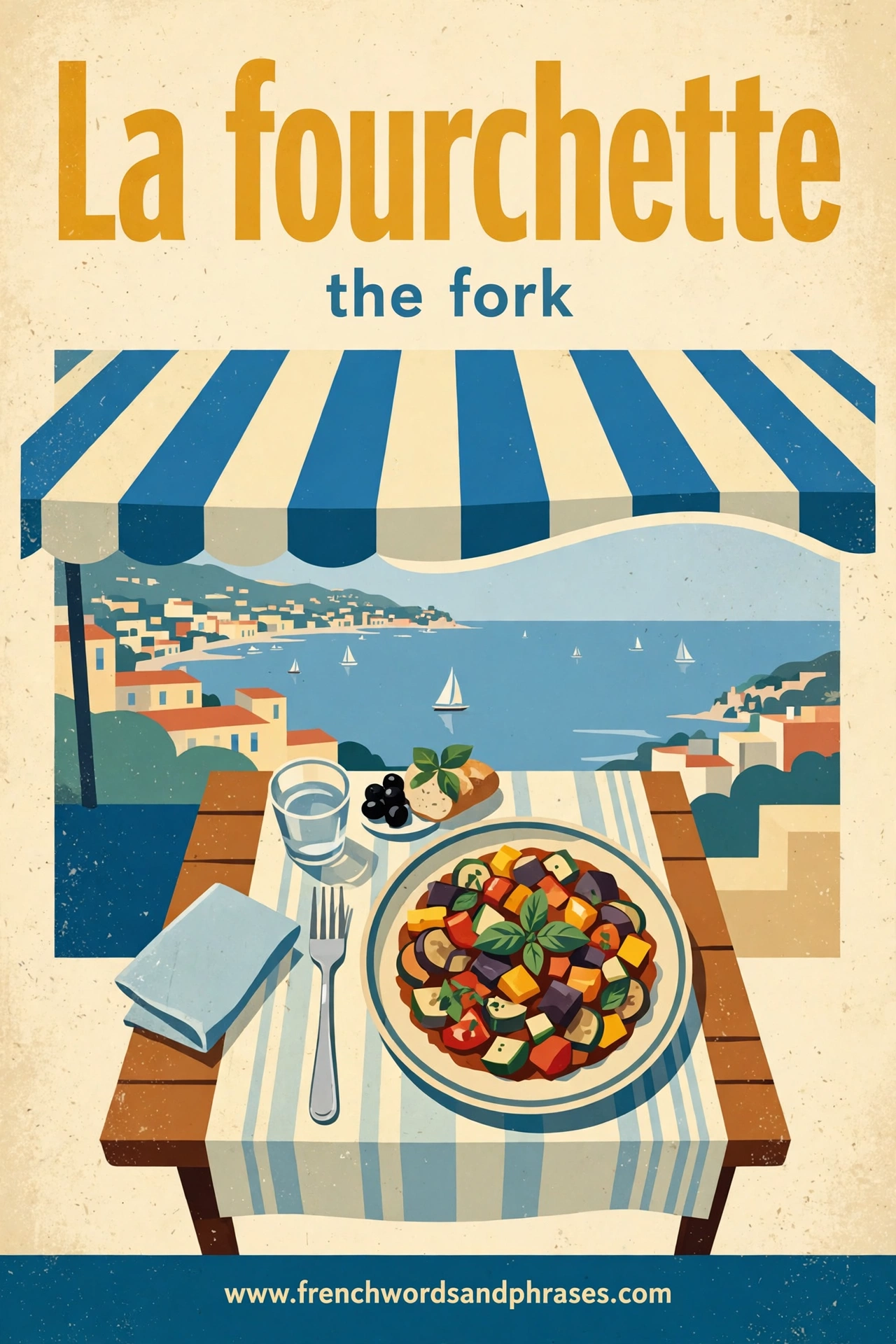
La fourchette means the fork.
The table is set for Sunday lunch: plates, glasses, knives on the right — and on the left of every plate, waiting politely for the first course, la fourchette.
In this guide, you’ll learn what fourchette means in English, how to use it with its articles, how to form its plural, and how it appears in everyday French. Explore French examples, English translations, and practice quizzes.
Understanding the French Noun Fourchette
Fourchette is a feminine French noun, learned with its article: la fourchette, une fourchette. It is built from fourche, a pitchfork — the fourchette is simply its little sister, the small fork you eat with.
It means the fork — the table utensil with prongs, used to hold and lift food. At a French table the fourchette sits on the left of the plate, prongs traditionally turned down towards the table, and it works as a team with le couteau (the knife) and la cuillère (the spoon). Together they are les couverts, the cutlery.
Gender: Feminine
Definite article: la — la fourchette (the fork)
Indefinite article: une — une fourchette (a fork)
Plural: les fourchettes
Word origin: From fourche, a pitchfork — fourchette is the little fork
English equivalents: The fork; a fork.
One important usage detail: un coup de fourchette is a hearty appetite — « Il a un bon coup de fourchette » means he eats well and with pleasure. And the whole set of knife, fork and spoon is never « cutlery » word for word: French says les couverts, as in mettre le couvert, to set the table.
Experience the Word
Fourchette is more than an utensil. It is table manners made visible: held in the left hand, never waved in the air, laid across the plate when the meal is finished to say, silently, that you have eaten well.
Imagine a child’s first proper dinner: the fourchette too big for the hand, the peas escaping in every direction, and a grandparent showing the trick of pushing them onto the fork with a piece of bread.
You have not just eaten a meal. You have dined — à la française, fork in the left hand.
How to Use Fourchette in French: Complete Guide
Let’s explore how fourchette works in French, beginning with its articles.
Fourchette with the Definite Article (La, Les)
Used for the fork in front of you — the one by your plate.
| Form | French |
|---|---|
| Singular | la fourchette |
| Plural | les fourchettes |
Example
La fourchette est à gauche de l’assiette.
The fork is on the left of the plate.
Fourchette with the Indefinite Article (Une, Des)
Used for a fork in general — une fourchette, any fork at all.
| Form | French |
|---|---|
| Singular | une fourchette |
| Plural | des fourchettes |
Example
Il manque une fourchette pour l’invité.
There is a fork missing for the guest.
Fourchette with the Partitive and Quantities (De la, Un peu de…)
You do not eat forks, but you eat forkfuls — une fourchette de pâtes is a forkful of pasta.
| French | In English |
|---|---|
| une fourchette de pâtes | a forkful of pasta |
| une fourchette de salade | a forkful of salad |
| deux fourchettes de riz | two forkfuls of rice |
| une petite fourchette de légumes | a small forkful of vegetables |
| une dernière fourchette de gâteau | one last forkful of cake |
| sans fourchette | without a fork |
Example
Elle prend une dernière fourchette de gâteau au chocolat.
She takes one last forkful of chocolate cake.
Quick Quiz 1
Complete the sentence:
Passe-moi ______ fourchette, s’il te plaît. (a)
Reveal the answer
une
Passe-moi une fourchette, s’il te plaît.
Pass me a fork, please — fourchette is feminine, so a fork is une fourchette.
The Plural of Fourchette
Fourchette adds an -s in the plural — les fourchettes, a drawer full of them.
| Number | French |
|---|---|
| Singular | la fourchette |
| Plural | les fourchettes |
Example
Les fourchettes sont dans le tiroir de la cuisine.
The forks are in the kitchen drawer.
Fourchette with Possessive Adjectives (Ma, Ta, Sa…)
Possessives agree with the noun: fourchette is feminine, so it takes ma, ta, sa in the singular.
| Owner | French |
|---|---|
| my | ma fourchette |
| your (tu) | ta fourchette |
| his / her | sa fourchette |
| our | notre fourchette |
| your (vous) | votre fourchette |
| their | leur fourchette |
Example
L’enfant tient sa fourchette dans la main gauche.
The child holds his fork in his left hand.
Quick Quiz 2
Complete the sentence:
______ fourchette est tombée sous la table. (My)
Reveal the answer
Ma
Ma fourchette est tombée sous la table.
My fork has fallen under the table — ma, because fourchette is feminine.
Fourchette with Demonstrative Adjectives (Cette, Ces)
Used to point: cette fourchette, this fork — this one here.
| Form | French |
|---|---|
| Singular | cette fourchette |
| Plural | ces fourchettes |
Example
Cette fourchette est en argent, un cadeau de ma grand-mère.
This fork is silver, a present from my grandmother.
Fourchette with Adjectives
Adjectives agree with fourchette: feminine forms, propre becomes propre, grande takes its -e.
| Adjective | With Fourchette |
|---|---|
| propre (clean) | une fourchette propre |
| sale (dirty) | une fourchette sale |
| grande (big) | une grande fourchette |
| petite (small) | une petite fourchette |
| en argent (silver) | une fourchette en argent |
Example
Prends une fourchette propre dans le tiroir.
Take a clean fork from the drawer.
Quick Quiz 3
Complete the sentence:
Pour le dessert, on prend une ______ fourchette. (small)
Reveal the answer
petite
Pour le dessert, on prend une petite fourchette.
For dessert, we take a small fork — petite, in the feminine.
Everyday Expressions with Fourchette
Appetites and table settings — the fourchette phrases of daily life.
| Expression | In English |
|---|---|
| un bon coup de fourchette | a hearty appetite |
| mettre le couvert | to set the table |
| une fourchette à dessert | a dessert fork |
| une fourchette à salade | a salad fork |
| manger avec une fourchette | to eat with a fork |
| les couverts | the cutlery |
Example
Mon grand-père a un bon coup de fourchette, surtout le dimanche.
My grandfather has a hearty appetite, especially on Sundays.
Words from the Same Family as Fourchette
Cutlery, tables and meals — the words that travel with fourchette.
| French | In English |
|---|---|
| la fourche | the pitchfork |
| le couteau | the knife |
| la cuillère | the spoon |
| l’assiette | the plate |
| le couvert | the place setting; a cover (at a restaurant) |
| la table | the table |
Example
Le couteau est à droite, la fourchette à gauche.
The knife is on the right, the fork on the left.
Quick Quiz 4
What are les couverts?
Reveal the answer
The cutlery — the knife, fork and spoon together.
Elle met les couverts sur la table.
She is putting the cutlery on the table.
Fourchette in Everyday French: Real-Life Examples
Now that you know the word, let’s see how fourchette appears in everyday French.
Example 1 — Setting the table
Mets les fourchettes à gauche des assiettes.
Put the forks on the left of the plates.
Example 2 — At dinner
Il mange ses pâtes avec une fourchette et une cuillère.
He eats his pasta with a fork and a spoon.
Example 3 — A dropped fork
Excusez-moi, ma fourchette est tombée par terre.
Excuse me, my fork has fallen on the floor.
Example 4 — Washing up
Les fourchettes sont propres, range-les dans le tiroir.
The forks are clean, put them away in the drawer.
Example 5 — A good appetite
Depuis son retour de randonnée, il a un sacré coup de fourchette.
Since he got back from his hike, he has quite an appetite.
Example 6 — Dessert time
Pour la tarte, prenez une petite fourchette à dessert.
For the tart, take a small dessert fork.
Beyond Translation: The Meaning of Fourchette
The fourchette arrived late at the French table. For centuries people ate with a knife, a spoon and their fingers; the fork travelled from Italy in the sixteenth century and was mocked at first as an affectation — before France made it its own and fixed the rules: fork in the left hand, prongs down, knife in the right. Those rules still set every formal French table today.
To say fourchette is to name good manners you can hold in one hand.
It evokes the polished silver of a Sunday lunch, the child learning to tame runaway peas, and the quiet clink of a meal eaten properly, together.
How to Remember the French Noun Fourchette
Remember it this way: Fourchette is the fork — the little sister of la fourche, the pitchfork, and feminine like her: la fourchette, une fourchette.
- You set the table — la fourchette à gauche, le couteau à droite.
- You ask for one — « Passe-moi une fourchette, s’il te plaît. »
- You eat heartily — un bon coup de fourchette, a hearty appetite.
The key idea is la fourchette — the little fork, always on the left.
Test Your Knowledge of Fourchette
Let’s see how much you’ve learned. Try answering these questions before revealing the answers.
Question 1
Is fourchette masculine or feminine?
Reveal the answer
Feminine — la fourchette, une fourchette.
Question 2
Where does the fork go on a French table?
Reveal the answer
On the left of the plate — the knife goes on the right.
Question 3
Translate: Pass me a fork, please.
Reveal the answer
Passe-moi une fourchette, s’il te plaît.
Question 4
What is un bon coup de fourchette?
Reveal the answer
A hearty appetite — someone with un bon coup de fourchette eats well and with pleasure.
Question 5
Complete the sentence:
Les ______ sont dans le tiroir.
Reveal the answer
fourchettes
Les fourchettes sont dans le tiroir.
The forks are in the drawer.
Your Final Challenge
Can You Use It?
How would you say this in French?
“The fork is on the left of the plate.”
Reveal the answer
La fourchette est à gauche de l’assiette.
The fork is on the left of the plate.
A little French. A little curiosity. A richer everyday life.
LEARN FRENCH ONE WORD AT A TIME