A French Word to Live By
Translate Flûte to English
/flyt/
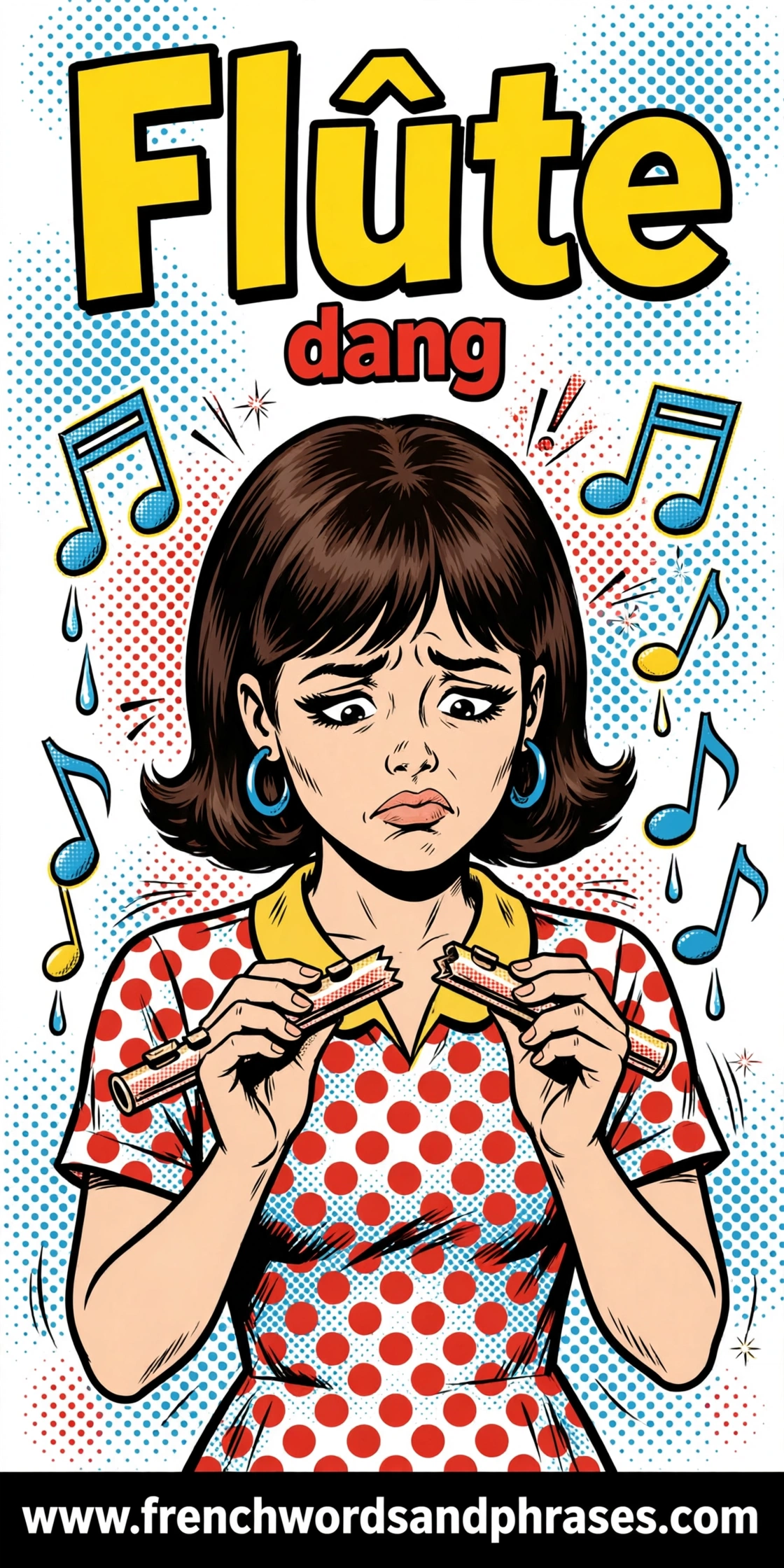
Flûte means dang!.
A street musician in Lyon opens her case and lifts her instrument to play the first note of the morning — and a pigeon lands squarely on the music stand, scattering the pages into the fountain. She stares, sighs, and then laughs: « Flûte ! » Not a swear word, not quite. Flûte is the polite little explosion French speakers keep ready for life’s small disasters, safe in any company.
Let’s explore how flûte works in French, beginning with the whole reaction on one card.
Understanding the French Interjection Flûte
Flûte is a French interjection of mild annoyance. It began life as a polite stand-in for a much ruder word, and it still does that job today: it lets you complain out loud, in public, without actually swearing.
It means dang! or drat! — the sound of a small plan going wrong. A missed bus, a dropped pen, a cake that sinks in the middle: flûte is sized for everyday disappointments, not real tragedies, and it carries a smile somewhere inside it.
Type: Interjection — annoyance (mild, euphemistic)
Answers the need: Complaining out loud — about a mishap, a mistake, a small frustration
Register: Polite and slightly old-fashioned — safe with children, teachers and grandparents
Strength: Gentle — the softest rung on the annoyance ladder, below zut and mince
One important usage detail: flûte is a euphemism — it stands in for merde the way English “sugar” or “drat” stands in for stronger words. Everybody understands the feeling behind it, but the word itself stays clean, which is exactly why adults reach for it in front of children.
Experience the Word
Flûte is the sound of a plan meeting a puddle — a small splash, not a flood.
Imagine a grandfather threading a needle for the third time, the thread bending away again at the very last second. He shakes his head, half annoyed and half amused: « Flûte ! »
You have not cursed the world. You have just let off a tiny, polite puff of steam.
How to Use Flûte in French: Complete Guide
Let’s explore how flûte works in French, beginning with the whole reaction on one card.
Flûte at a Glance
The Whole Reaction on One Card
Meaning, job, register and strength — flûte in four lines.
| Point | Flûte |
|---|---|
| Meaning | dang! / drat! — a small thing has gone wrong |
| Job | lets off steam about a mishap without swearing |
| Register | polite, clean, a little old-fashioned — safe everywhere |
| Strength | gentle — the mildest of the annoyance family |
Example
Flûte, j’ai renversé mon café !
Drat, I’ve spilt my coffee!
When You Say It: The Trigger Moments
Flûte fires at small disasters — the ones you can laugh about a minute later.
| Situation | Example |
|---|---|
| You miss the bus | flûte, le bus part sans nous ! — drat, the bus is leaving without us! |
| You drop something | flûte, mes clés sont tombées dans l’herbe — dang, my keys fell in the grass |
| You make a silly mistake | flûte, j’ai mis du sel au lieu du sucre — drat, I used salt instead of sugar |
| The weather turns | flûte, il pleut encore — dang, it’s raining again |
| You lose a game | flûte, battu d’un point ! — drat, beaten by one point! |
Example
Flûte, la boulangerie vient de fermer !
Dang, the bakery has just closed!
Quick Quiz 1
Is flûte a rude word or a polite one?
Reveal the answer
Polite — it is a clean stand-in for a much ruder word.
Flûte, j’ai oublié mon parapluie.
Drat, I forgot my umbrella.
The Reaction Question: A Small Word With a Sigh Built In
Flûte is short, round and musical — how you deliver it sets the temperature.
| Delivery | What it does |
|---|---|
| Quick and light, with a smile | amused annoyance — no real anger |
| With a long sigh before it | tired resignation — ‘not again’ |
| Repeated: flûte, flûte, flûte | growing frustration, still comic |
| Flûte alors ! with wide eyes | surprise joins the annoyance |
| Said to yourself, quietly | a private grumble, thinking out loud |
Example
Flûte alors, je ne m’y attendais pas !
Well drat, I wasn’t expecting that!
Where It Goes: Standalone, Doubled, Dressed Up
Flûte needs no grammar around it — it stands alone, opens a sentence, or puts on its alors.
| Position / pattern | Example |
|---|---|
| Standalone | flûte ! — just the reaction, nothing else needed |
| Opening a sentence | flûte, j’ai raté le train — drat, I missed the train |
| With alors for surprise | flûte alors ! — well, drat it all! |
| Doubled with zut | zut et flûte ! — drat and double drat! |
Example
Zut et flûte, encore un retard !
Drat and double drat, another delay!
Quick Quiz 2
Which phrase means “drat and double drat” — flûte alors or zut et flûte?
Reveal the answer
zut et flûte — two polite stand-ins stacked for double effect.
Zut et flûte, j’ai perdu mes gants !
Drat and double drat, I’ve lost my gloves!
Everyday Expressions with Flûte
Flûte dresses up in a few set phrases — each one a small comic ceremony of annoyance.
| Expression | In English |
|---|---|
| flûte alors ! | well, drat it all! |
| et flûte ! | and drat it! (giving up on something) |
| zut et flûte ! | drat and double drat! |
| flûte à la fin ! | oh, for goodness’ sake! |
| mince et flûte | shoot and drat (a double helping) |
Example
Et flûte, je recommencerai demain.
And drat it, I’ll start again tomorrow.
Close Cousins: The Polite Annoyance Family
French keeps a whole shelf of clean complaints — flûte is the most old-fashioned and charming of them.
| Word | The difference |
|---|---|
| flûte | dang! — the gentlest, slightly old-school |
| zut | damn-lite — the classic, a touch stronger than flûte |
| mince | shoot! — the everyday favourite, modern and neutral |
| purée | gosh! — another food-word stand-in, warm and comic |
| saperlipopette | goodness gracious! — very old-fashioned, said with a wink |
Example
Mince, zut, flûte — j’ai tout essayé !
Shoot, drat, dang — I’ve tried everything!
Quick Quiz 3
Which cousin is the everyday modern favourite — flûte or mince?
Reveal the answer
mince — flûte is charming but a little old-fashioned.
Mince, j’ai raté l’arrêt !
Shoot, I missed my stop!
Flûte and Its Neighbours
The annoyance shelf around flûte, from the shrug to the cheer it wishes it could give.
| French | In English |
|---|---|
| bof | meh (the shrug — nothing went wrong, you just don’t care) |
| flûte ! | dang! (a small mishap, politely) |
| mince ! | shoot! (the everyday complaint) |
| zut ! | damn-lite (a notch more feeling) |
| super ! | awesome! (the opposite shelf entirely) |
Example
Flûte, pas super, ce résultat.
Dang, not great, this result.
Watch Out: The Traps Around Flûte
The traps: the instrument, the tragedy, and expecting flûte to sound tough.
| Trap | The truth |
|---|---|
| thinking of the instrument | la flûte is the flute (and une flûte is also a champagne glass) — as a reaction, flûte stands alone with its exclamation mark |
| using it for real bad news | flûte is far too light for genuine grief — say je suis désolé instead |
| thinking it is rude | it is the opposite — flûte is what you say to AVOID the rude word |
| expecting it everywhere | younger speakers use mince and zut more — flûte sounds charmingly retro |
Example
Flûte, ce n’est pas grave, on recommence.
Drat, it doesn’t matter, let’s start again.
Quick Quiz 4
True or false: flûte is what French speakers say to avoid swearing.
Reveal the answer
True — it is a clean euphemism that carries the feeling without the rude word.
Flûte, encore une erreur !
Dang, another mistake!
Flûte in Everyday French: Real-Life Examples
Now that you know the word, let’s see how flûte appears in everyday French.
Example Example 1 — Transport
Flûte, le bus part sans nous !
Drat, the bus is leaving without us!
Example Example 2 — Kitchen
Flûte, j’ai mis trop de sel dans la soupe.
Dang, I put too much salt in the soup.
Example Example 3 — Weather
Flûte, il pleut et je n’ai pas de parapluie.
Drat, it’s raining and I have no umbrella.
Example Example 4 — School
Flûte, j’ai oublié mon cahier à la maison.
Dang, I left my notebook at home.
Example Example 5 — Games
Flûte, tu as gagné encore une fois !
Drat, you won again!
Example Example 6 — Shopping
Flûte, la boulangerie est fermée.
Dang, the bakery is closed.
Beyond Translation: The Meaning of Flûte
English says “drat” and “darn”; French reaches into the kitchen and the orchestra pit — mince, purée, flûte. Flûte is the most musical of the polite explosions, borrowed from the slender instrument (and the champagne glass of the same shape) and put to work as a complaint that offends nobody.
To say flûte is to complain with your gloves on.
That is its charm and its limit: flûte belongs to spilt coffee and missed buses. For anything heavier, French has stronger words — and everyone in the room knows exactly which word flûte is politely not saying.
How to Remember the French Interjection Flûte
Remember it this way: Remember it this way: Flûte is the polite puff of steam — a complaint that stays clean.
- You hear the music in it — flûte is the instrument, borrowed as a tidy little complaint.
- You keep it small — missed buses and spilt coffee, never real tragedies.
- You stack it for comedy — zut et flûte when one drat is not enough.
The key idea is flûte means dang, it is a polite euphemism, and it belongs to small everyday mishaps.
Test Your Knowledge of Flûte
Let’s see how much you’ve learned. Try answering these questions before revealing the answers.
Question 1
What does flûte mean?
Reveal the answer
Dang! / Drat! — a mild, polite explosion at a small mishap.
Question 2
Why do French speakers say flûte instead of a stronger word?
Reveal the answer
To stay polite — flûte is a clean euphemism that carries the annoyance without swearing.
Question 3
Translate: Drat, I missed my stop!
Reveal the answer
Flûte, j’ai raté mon arrêt !
Question 4
Which is stronger: flûte or zut?
Reveal the answer
Zut — flûte is the gentlest rung on the annoyance ladder; zut carries a little more feeling.
Question 5
Complete the sentence:
______ , j’ai raté mon train ! (Drat, I missed my train!)
Reveal the answer
Flûte
Flûte, j’ai raté mon train !
Drat, I missed my train!
Your Final Challenge
Can You Use It?
How would you say this in French?
“How would you say this in French?”
Reveal the answer
Flûte, j’ai oublié mes clés !
Drat, I forgot my keys!
A little French. A little curiosity. A richer everyday life.
LEARN FRENCH ONE WORD AT A TIME