A French Word to Live By
Translate Fils to English
/fis/
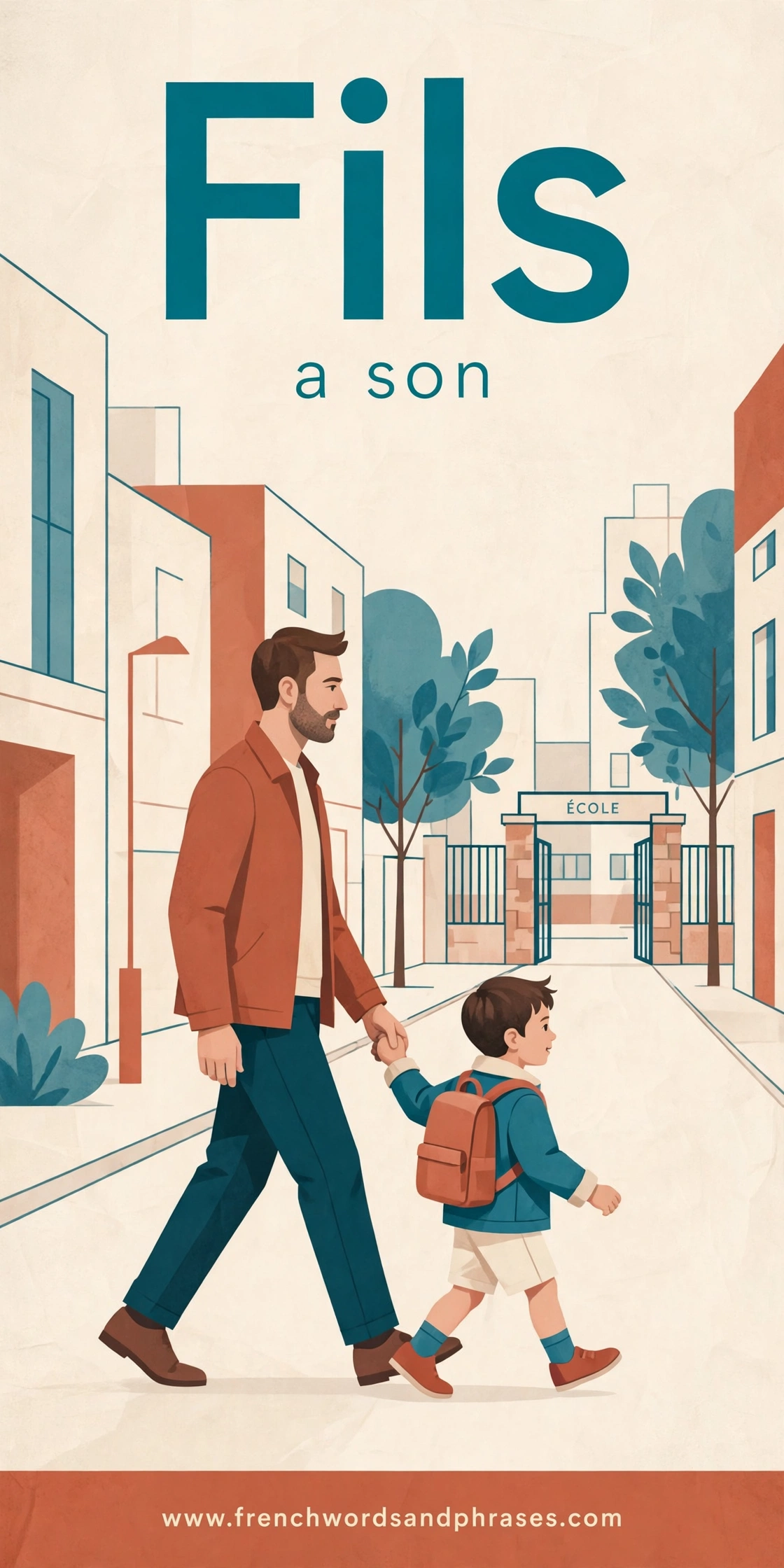
Un fils means a son.
A teenager carrying a violin case across the schoolyard, a young man telephoning home on Sunday, an old photograph of a christening — French gives the son a short, proud word with a secret inside it: un fils, pronounced /fis/.
In this guide, you’ll learn what fils means in English, how to use it with its articles, how to form its plural, and how it appears in everyday French. Explore French examples, English translations, and practice quizzes.
Understanding the French Noun Fils
Fils is a masculine French noun. Like every French noun, it has a gender, and it is learned together with its article: le fils.
It means a son — the boy or man in his role as somebody’s child: le fils de Paul, Paul’s son. Where fille covers both girl and daughter, fils is only ever the son: for a boy in general, French says un garçon.
Gender: Masculine
Definite article: le — le fils (the son)
Indefinite article: un — un fils (a son)
Plural: les fils (the sons) — spelled exactly like the singular
English equivalents: A son.
One important detail: fils is pronounced /fis/ — the l is silent, and the final s is heard. Better still, the plural is spelled exactly like the singular: un fils, des fils, both pronounced /fis/. Only the little word in front — un, des, les — tells you whether there is one son or several.
Experience the Word
Fils is more than a child. He is the name carried forward — the boy who answers to his father’s surname and, one day, answers the telephone when his own children call.
Imagine a christening photograph passed hand to hand: the baby, a few years from the first violin lesson, forty years from the grey at the temples — the same fils, at every age, in one unchanging word.
You have not just counted a child. You have seen a family continue.
How to Use Fils in French: Complete Guide
Let’s explore how fils works in French, beginning with its articles — and its famous silent letter.
Fils and Its Articles
French nouns are almost never used alone. The small word in front of the noun — the article — does a great deal of work.
Fils with the Definite Article (Le, Les)
Used for a particular son both speakers know about, or for sons in general. Watch the plural: the spelling does not change.
| Number | French |
|---|---|
| Singular | le fils |
| Plural | les fils |
Example
Le fils de Paul est très sportif.
Paul’s son is very sporty.
Fils with the Indefinite Article (Un, Des)
Used for a son not yet identified — one son, or some sons. Again, only the article changes: fils itself stays the same.
| Number | French |
|---|---|
| Singular | un fils |
| Plural | des fils |
Example
Elle a un fils et une fille.
She has one son and one daughter.
Counting with Fils: Quantities
Fils is a count noun, so it has no partitive article. Numbers do the counting — and they are the only clue, since fils never changes its spelling.
| Meaning | French |
|---|---|
| one son | un fils |
| two sons | deux fils |
| several sons | plusieurs fils |
| many sons | beaucoup de fils |
| each son | chaque fils |
| all the sons | tous les fils |
Example
Elle a deux fils et une fille.
She has two sons and a daughter.
Quick Quiz 1
How do you pronounce fils?
Reveal the answer
/fis/
The l is silent and the final s is heard: un fils, des fils — always /fis/.
The Plural of Fils
Fils is one of the rare French nouns that do not change at all in the plural: same spelling, same sound. The article carries the number.
| Number | French |
|---|---|
| Singular | le fils |
| Plural | les fils |
Example
Ses fils habitent à l’étranger.
Her sons live abroad.
Fils with Possessive Adjectives (Mon, Ton, Son…)
Possessives agree with the noun, not with the owner — and fils is masculine, so it takes mon, ton, son.
| Owner | French |
|---|---|
| my | mon fils |
| your (tu) | ton fils |
| his / her | son fils |
| our | notre fils |
| your (vous) | votre fils |
| their | leur fils |
Example
Leur fils, Noah, apprend le piano depuis septembre.
Their son, Noah, has been learning the piano since September.
Quick Quiz 2
Complete the sentence:
Leur ______, Noah, apprend le piano depuis septembre.
Reveal the answer
fils
Leur fils, Noah, apprend le piano depuis septembre.
Their son, Noah, has been learning the piano since September.
Fils with Demonstrative Adjectives (Ce, Ces)
Used to point: this son here, those sons there.
| Number | French |
|---|---|
| Singular | ce fils |
| Plural | ces fils |
Example
Ce fils ressemble à son père.
This son looks like his father.
Fils with Adjectives
Adjectives agree with fils, masculine — and family adjectives tell you his exact place among the children.
| Adjective | With Fils |
|---|---|
| aîné (older, eldest) | un fils aîné |
| cadet (younger, youngest) | un fils cadet |
| unique (only) | un fils unique |
| gentil (kind) | un fils gentil |
| sage (well-behaved) | un fils sage |
| formidable (wonderful) | un fils formidable |
Example
Mon fils aîné étudie à l’université.
My eldest son studies at university.
Quick Quiz 3
Complete the sentence:
C’est mon fils ______ (eldest).
Reveal the answer
aîné
C’est mon fils aîné.
He is my eldest son. (The adjective agrees with fils, masculine.)
Everyday Expressions with Fils
Fils appears in the proverb every French father hears at least once.
| Expression | In English |
|---|---|
| tel père, tel fils | like father, like son |
| de père en fils | from father to son |
| un fils unique | an only son |
| le fils de Paul | Paul’s son |
| un fils aîné | an eldest son |
Example
Tel père, tel fils : il adore le jardinage.
Like father, like son: he loves gardening.
Words from the Same Family as Fils
Learn these together and the whole family falls into place.
| French | In English |
|---|---|
| une fille | a girl / a daughter |
| un petit-fils | a grandson |
| un beau-fils | a stepson / a son-in-law |
| un filleul | a godson |
| un garçon | a boy |
| un enfant | a child |
Example
Son petit-fils a cinq ans.
Her grandson is five.
Quick Quiz 4
What does tel père, tel fils mean?
Reveal the answer
Like father, like son
Tel père, tel fils : il adore le jardinage.
Like father, like son: he loves gardening.
Fils in Everyday French: Real-Life Examples
Now that you know the word, let’s see how fils appears in everyday French.
Example 1 — Learning piano
Leur fils, Noah, apprend le piano depuis septembre.
Their son, Noah, has been learning the piano since September.
Example 2 — The eldest
Mon fils aîné étudie à l’université.
My eldest son studies at university.
Example 3 — Counting children
Elle a deux fils et une fille.
She has two sons and a daughter.
Example 4 — Someone’s son
Le fils de Paul est très sportif.
Paul’s son is very sporty.
Example 5 — A proverb
Tel père, tel fils !
Like father, like son!
Example 6 — Far away
Ses fils habitent à l’étranger.
Her sons live abroad.
Beyond Translation: The Meaning of Fils
English says son for the meaning of fils — but the French word is a small lesson in the language itself. It keeps a silent l from its Latin grandfather filius, it sounds its final s when almost every other noun swallows it, and it refuses to change by so much as a letter between one son and ten.
To say fils is to hear French history in a single syllable.
It evokes inheritance and resemblance — tel père, tel fils — and the quiet pride of a name handed down. Learn its sound, /fis/, and you will never misread it again.
How to Remember the French Noun Fils
Remember it this way: Fils is the masculine word for a son — short, proud, and pronounced /fis/ with a silent l.
- You say it with a silent l — un fils, /fis/, never with the l.
- You count without changing it — un fils, deux fils, les fils.
- You hear it in the proverb — tel père, tel fils.
The key idea is fils is always /fis/ — the l is silent and the word never changes.
Test Your Knowledge of Fils
Let’s see how much you’ve learned. Try answering these questions before revealing the answers.
Question 1
Is fils masculine or feminine?
Reveal the answer
Masculine — le fils.
Question 2
How is fils pronounced?
Reveal the answer
/fis/ — the l is silent, the final s is heard.
Question 3
Translate: Their son has been learning the piano since September.
Reveal the answer
Leur fils apprend le piano depuis septembre.
Question 4
What is the plural of fils?
Reveal the answer
Fils — the spelling never changes: un fils, des fils.
Question 5
Complete the sentence:
Tel père, tel ______ !
Reveal the answer
fils
Tel père, tel fils !
Like father, like son!
Your Final Challenge
Can You Use It?
How would you say this in French?
“Like father, like son!”
Reveal the answer
Tel père, tel fils !
Like father, like son!
A little French. A little curiosity. A richer everyday life.
LEARN FRENCH ONE WORD AT A TIME