A French Word to Live By
Translate Feu arrière to English
/fø aʁ.jɛʁ/
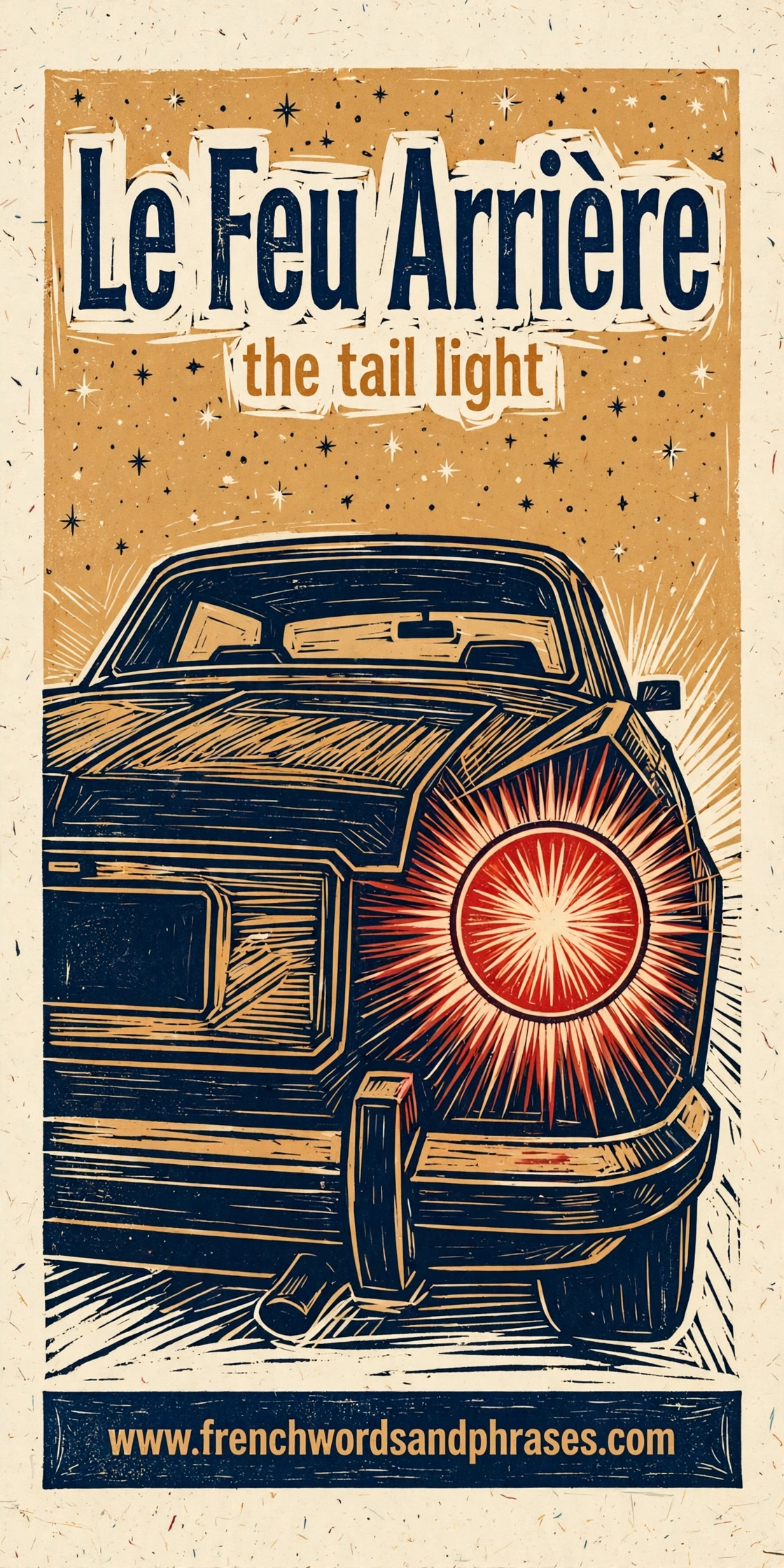
Le feu arrière means the tail light.
Evening traffic, brake lights blooming red all down the avenue: every car speaks to the one behind with the same small red voice — le feu arrière, the tail light, glowing at the back of the car so the night knows you are there.
In this guide, you’ll learn what feu arrière means in English, how to use it with its articles, how to form its plural, and how it appears in everyday French. Explore French examples, English translations, and practice quizzes.
Understanding the French Noun Feu arrière
Feu arrière is a masculine French noun phrase. It is learned together with its article: le feu arrière, un feu arrière. Feu is the interesting half: it means fire, and from fire it came to mean any light that burns or shines — the same word gives les feux, the traffic lights, and le feu de freinage, the brake light.
It means the tail light — the red light, or pair of lights, at the back of the car. It burns whenever the headlights are on, and its family at the rear of the car does the talking to following traffic: les feux de freinage flare when you brake, le feu de recul shines white when you reverse, and the indicators flash their orange warnings.
Gender: Masculine
Definite article: le — le feu arrière (the tail light)
Indefinite article: un — un feu arrière (a tail light)
Plural: les feux arrière
English equivalents: The tail light, the rear light; feu alone is fire, or a traffic light.
One important usage detail: in the plural, arrière never changes — les feux arrière, never « arrières ». And learn the whole rear-light family together, because the garage will use them all: le feu de freinage (brake light), le feu de recul (reversing light), les feux de détresse (hazard lights).
Experience the Word
Feu arrière is more than a car part. It is the car’s voice to everyone behind — a red glow that says I am here, I am slowing, I am turning, without a word.
Imagine the drive home through the dark countryside: ahead, two red points belonging to a stranger’s car, keeping their distance, blinking brighter at every bend where he brakes and you brake after him.
You have not just followed a light. You have read the road in feux arrière — the red punctuation of the night journey.
How to Use Feu arrière in French: Complete Guide
Let’s explore how feu arrière works in French, beginning with its articles.
Feu Arrière with the Definite Article (Le, Les)
Used for the tail light everyone in the conversation knows — the one glowing at the back of your car.
| Number | French |
|---|---|
| Singular | le feu arrière |
| Plural | les feux arrière |
Example
Le feu arrière droit est cassé depuis l’accrochage.
The right tail light has been broken since the bump.
Feu Arrière with the Indefinite Article (Un, Des)
Used for a tail light in general — a new one, a spare one, one at the garage.
| Number | French |
|---|---|
| Singular | un feu arrière |
| Plural | des feux arrière |
Example
Il a commandé un feu arrière neuf pour sa vieille voiture.
He has ordered a new tail light for his old car.
Feu Arrière with the Partitive Article (Du, Des)
The partitive du meets feu arrière in phrases of light and place — la lumière du feu arrière, the light of the tail light — rather than for a quantity of light.
| Number | French |
|---|---|
| Singular | du feu arrière |
| Plural | des feux arrière |
Example
La lueur rouge du feu arrière se reflète sur la route mouillée.
The red glow of the tail light reflects on the wet road.
Quick Quiz 1
What is le feu de freinage?
Reveal the answer
The brake light — the rear light that flares bright when the driver presses the brake.
Ton feu de freinage s’allume dès que tu touches la pédale.
Your brake light comes on as soon as you touch the pedal.
The Plural of Feu Arrière
Feu becomes feux, but arrière never changes — les feux arrière, with no -s on arrière, ever.
| Number | French |
|---|---|
| Singular | le feu arrière |
| Plural | les feux arrière |
Example
Les feux arrière brillent dans la nuit comme deux yeux rouges.
The tail lights shine in the night like two red eyes.
Feu Arrière with Possessive Adjectives (Mon, Ton, Son…)
Possessives agree with feu, which is masculine — mon feu arrière, ton feu arrière.
| Owner | French |
|---|---|
| my | mon feu arrière |
| your (tu) | ton feu arrière |
| his / her | son feu arrière |
| our | notre feu arrière |
| your (vous) | votre feu arrière |
| their | leur feu arrière |
Example
Vérifie ton feu arrière avant le long trajet de nuit.
Check your tail light before the long night journey.
Quick Quiz 2
Complete the sentence:
______ feu arrière est cassé, il faut le remplacer. (My)
Reveal the answer
Mon
Mon feu arrière est cassé, il faut le remplacer.
My tail light is broken, it has to be replaced.
Feu Arrière with Demonstrative Adjectives (Ce, Ces)
Used to point: this tail light here, those tail lights there.
| Number | French |
|---|---|
| Singular | ce feu arrière |
| Plural | ces feux arrière |
Example
Ce feu arrière clignote au lieu de rester allumé.
This tail light flickers instead of staying on.
Feu Arrière with Adjectives
Adjectives agree with feu, masculine — and arrière itself stays frozen in every form.
| Adjective | With Feu Arrière |
|---|---|
| rouge (red) | un feu arrière rouge |
| cassé (broken) | un feu arrière cassé |
| gauche (left) | le feu arrière gauche |
| droit (right) | le feu arrière droit |
| neuf (new) | un feu arrière neuf |
Example
Un feu arrière rouge et brillant se voit de très loin.
A red, bright tail light can be seen from very far away.
Quick Quiz 3
Spot the trap: « les feux arrières » — what is wrong?
Reveal the answer
Arrière never takes an -s — it is invariable. Only feu changes: les feux arrière.
Les feux arrière de la voiture brillent dans le noir.
The car’s tail lights shine in the dark.
Everyday Expressions with Feu Arrière
Braking, reversing and warning — the feu arrière phrases of daily life.
| Expression | In English |
|---|---|
| le feu de freinage | the brake light |
| le feu de recul | the reversing light |
| les feux de détresse | the hazard warning lights |
| un feu arrière cassé | a broken tail light |
| vérifier les feux | to check the lights |
| les feux (tout court) | the traffic lights |
Example
Mets tes feux de détresse si tu t’arrêtes sur la bande d’arrêt d’urgence.
Put your hazard lights on if you stop on the hard shoulder.
Words from the Same Family as Feu Arrière
Fire, light and the back of the car — the words that travel with feu arrière.
| French | In English |
|---|---|
| le feu | fire; a light; a traffic light |
| la lumière | the light |
| freiner | to brake |
| arrière | back, rear (invariable) |
| le clignotant | the indicator |
| briller | to shine |
Example
Quand il freine, tous ses feux arrière s’illuminent.
When he brakes, all his tail lights light up.
Quick Quiz 4
At the crossroads, « le feu est rouge ». Is anything burning?
Reveal the answer
No — it is the traffic light. Feu means fire, but les feux are also the traffic lights, and this one is red.
Arrête-toi, le feu est rouge !
Stop, the light is red!
Feu arrière in Everyday French: Real-Life Examples
Now that you know the word, let’s see how feu arrière appears in everyday French.
Example 1 — Night check
Avant de partir, vérifie tes feux arrière.
Before leaving, check your tail lights.
Example 2 — In traffic
Les feux arrière de la voiture devant nous s’allument sans cesse.
The tail lights of the car in front of us keep lighting up.
Example 3 — A breakdown
Feu arrière cassé : le garagiste le change demain.
Broken tail light: the mechanic is replacing it tomorrow.
Example 4 — Reversing
Le feu de recul s’allume quand elle passe la marche arrière.
The reversing light comes on when she engages reverse.
Example 5 — Hazards
Sur l’autoroute en panne, mets tes feux de détresse.
Broken down on the motorway, put your hazard lights on.
Example 6 — The plural trap
On dit les feux arrière, sans s à arrière.
You say les feux arrière, with no s on arrière.
See le feu arrière in a story: The Car: French Vocabulary (La Voiture) — a family road trip.
Beyond Translation: The Meaning of Feu arrière
Feu is a traveller of a word: born as fire, it became the lamp, then the light itself, then the traffic light that rules every French crossroads. The feu arrière is its quietest posting — no blaze, no drama, just a faithful red presence at the back of the car, flaring when the brakes speak. Follow any car at night and you read its journey in those lights.
To say feu arrière is to speak to the driver behind you.
It evokes the red glow on wet roads, the discipline of the brake, and the little grammar trap — arrière, which never, ever takes an -s.
How to Remember the French Noun Feu arrière
Remember it this way: Feu arrière is the tail light — masculine, with le and un, red at the back of the car, with a plural that changes only half the phrase.
- You check it at night — le feu arrière, masculine with le.
- You double it carefully — les feux arrière, feu changes, arrière never does.
- You meet the family — le feu de freinage, le feu de recul, les feux de détresse.
The key idea is le feu arrière glows — les feux arrière, and arrière stands still.
Test Your Knowledge of Feu arrière
Let’s see how much you’ve learned. Try answering these questions before revealing the answers.
Question 1
Is feu arrière masculine or feminine?
Reveal the answer
Masculine — le feu arrière, un feu arrière.
Question 2
What is the plural of le feu arrière?
Reveal the answer
Les feux arrière — feu takes an -x, arrière never changes.
Question 3
Translate: Check your tail light before leaving.
Reveal the answer
Vérifie ton feu arrière avant de partir.
Question 4
What is le feu de freinage?
Reveal the answer
The brake light — it flares when the driver brakes.
Question 5
Complete the sentence:
Les ______ arrière brillent dans la nuit. (tail lights)
Reveal the answer
feux
Les feux arrière brillent dans la nuit.
The tail lights shine in the night.
Your Final Challenge
Can You Use It?
How would you say this in French?
“The tail lights shine in the night like two red eyes.”
Reveal the answer
Les feux arrière brillent dans la nuit comme deux yeux rouges.
The tail lights shine in the night like two red eyes.
A little French. A little curiosity. A richer everyday life.
LEARN FRENCH ONE WORD AT A TIME