A French Word to Live By
Translate Fête to English
/fɛt/
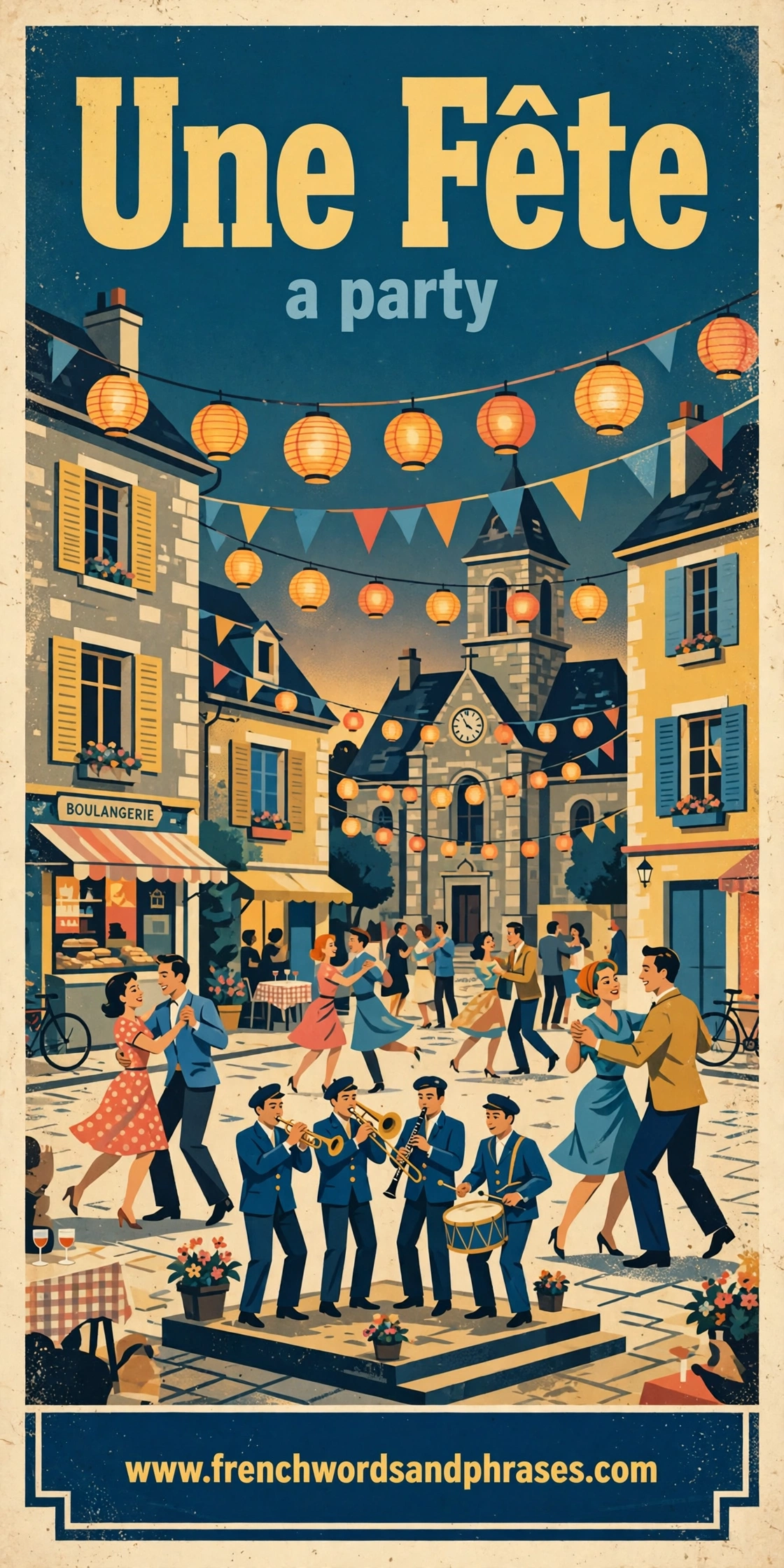
Une fête means a party.
Streamers over the village square, a band tuning up on the bandstand, and tables appearing in the street as if by magic. Someone’s birthday, someone’s wedding, the first day of summer — whatever the reason, France finds it: that is la fête.
In this guide, you’ll learn what fête means in English, how to use it with its articles, how to form its plural, and how it appears in everyday French. Explore French examples, English translations, and practice quizzes.
Understanding the French Noun Fête
Fête is a feminine French noun. Like every French noun, it has a gender, and it is learned together with its article: une fête.
It means a party. It covers the birthday party at home, the village festival in the square, and the great national celebrations of the calendar. Fête is also the word for a saint’s day — and because French first names are tied to saints, everyone has a fête as well as a birthday.
Gender: Feminine
Definite article: la — la fête (the party)
Indefinite article: une — une fête (a party)
Plural: les fêtes (the parties, the festivities)
English equivalents: A party; a celebration; a festival; a saint’s day.
One important distinction: organiser une fête is to throw a party, but faire la fête is to party — to celebrate, dance and stay up too late. The article changes the meaning: une fête is the event you organise, la fête is the celebrating you do.
Experience the Word
Fête is more than an event in France. It is a national talent — the ability to turn a date on the calendar into an evening nobody wants to end.
Imagine the village square on the first warm night of June: strings of lights, a small band, long tables, and three generations eating, dancing and arguing happily until the music stops.
You have not just attended an event. You have shared the fête.
How to Use Fête in French: Complete Guide
Let’s explore how fête works in French, beginning with its articles.
Fête and Its Articles
French nouns are almost never used alone. The small word in front of the noun — the article — does a great deal of work.
Fête with the Definite Article (La, Les)
Used for a particular party both speakers know about, or for festivities in general.
| Number | French |
|---|---|
| Singular | la fête |
| Plural | les fêtes |
Example
La fête commence à vingt heures.
The party starts at eight o’clock.
Fête with the Indefinite Article (Une, Des)
Used to introduce a party: one party, or some parties.
| Number | French |
|---|---|
| Singular | une fête |
| Plural | des fêtes |
Example
Ils organisent des fêtes tout l’été.
They throw parties all summer.
Fête with Quantities (Beaucoup de, Trop de…)
Fête is a count noun, so amounts are counted — and after words like beaucoup, the article shrinks to de.
| Meaning | French |
|---|---|
| one party | une fête |
| two parties | deux fêtes |
| lots of parties | beaucoup de fêtes |
| at every party | à chaque fête |
Example
Il y a beaucoup de fêtes en été dans notre village.
There are lots of parties in summer in our village.
Quick Quiz 1
How do you say lots of parties in French?
Reveal the answer
beaucoup de fêtes
Il y a beaucoup de fêtes en été.
There are lots of parties in summer.
The Plural of Fête
Like most French nouns, fête simply adds an -s in the plural — a letter you see but do not hear.
| Number | French |
|---|---|
| Singular | la fête |
| Plural | les fêtes |
Example
Les fêtes de fin d’année approchent.
The end-of-year festivities are approaching.
Fête with Possessive Adjectives (Ma, Ta, Sa…)
Possessives agree with the noun, not with the owner — and fête is feminine, so it takes ma, ta, sa. Watch out: ma fête can also mean my name day.
| Owner | French |
|---|---|
| my | ma fête |
| your (tu) | ta fête |
| his / her | sa fête |
| our | notre fête |
| your (vous) | votre fête |
| their | leur fête |
Example
Demain, c’est sa fête : on lui offre des fleurs.
Tomorrow is her name day: we are giving her flowers.
Quick Quiz 2
Complete the sentence:
Le 21 juin, c’est la ______ de la musique.
Reveal the answer
fête
Le 21 juin, c’est la fête de la musique.
On 21 June, it is the national music festival.
Fête with Demonstrative Adjectives (Cette, Ces)
Used to point: this party here, those parties there.
| Number | French |
|---|---|
| Singular | cette fête |
| Plural | ces fêtes |
Example
Cette fête est la plus belle de l’année.
This party is the finest of the year.
Fête with Adjectives
Adjectives agree with fête — feminine. Some regulars come before it (grande, belle, petite), others after it (surprise, réussie).
| Adjective | With Fête |
|---|---|
| grande (big) | une grande fête |
| belle (lovely) | une belle fête |
| petite (small) | une petite fête |
| surprise (surprise) | une fête surprise |
| réussie (successful) | une fête réussie |
| nationale (national) | la fête nationale |
Example
Ils ont organisé une fête surprise pour son départ.
They organised a surprise party for his leaving.
Quick Quiz 3
Complete the sentence:
Nous avons organisé une fête ______ pour son anniversaire.
Reveal the answer
surprise
Nous avons organisé une fête surprise pour son anniversaire.
We organised a surprise party for his birthday.
Everyday Expressions with Fête
Fête appears in the phrases France celebrates by — from the national day to the village hall.
| Expression | In English |
|---|---|
| faire la fête | to party, to celebrate |
| la fête nationale | the national day, Bastille Day (14 July) |
| la fête de la musique | the national music day (21 June) |
| la fête foraine | a funfair |
| un jour de fête | a feast day, a holiday |
| ne pas être à la fête | to be having a hard time |
Example
Le 14 juillet, tout le pays fait la fête.
On 14 July, the whole country parties.
Words from the Same Family as Fête
Learn these together and the whole French calendar falls into place.
| French | In English |
|---|---|
| fêter | to celebrate |
| un festival | a festival |
| festif | festive |
| un festin | a feast |
| un jour férié | a public holiday |
| une célébration | a celebration |
Example
On fête son anniversaire samedi.
We are celebrating his birthday on Saturday.
Quick Quiz 4
What happens all over France on 21 June?
Reveal the answer
La fête de la musique
Le 21 juin, c’est la fête de la musique.
On 21 June, it is the fête de la musique — a nationwide day of free music.
Fête in Everyday French: Real-Life Examples
Now that you know the word, let’s see how fête appears in everyday French.
Example 1 — A wedding anniversary
Mes parents préparent une fête pour leurs quarante ans de mariage.
My parents are preparing a party for their fortieth wedding anniversary.
Example 2 — Partying all night
Samedi soir, nous avons fait la fête jusqu’à trois heures du matin.
On Saturday night, we partied until three in the morning.
Example 3 — The village festival
La fête du village a lieu le premier week-end d’août.
The village festival takes place on the first weekend of August.
Example 4 — A surprise
Ses amis préparent une fête surprise pour ses trente ans.
Her friends are preparing a surprise party for her thirtieth birthday.
Example 5 — A name day
C’est la fête de sainte Catherine aujourd’hui : bonne fête, Catherine !
Today is Saint Catherine’s day: happy name day, Catherine!
Example 6 — The national day
Le 14 juillet, il y a un feu d’artifice après la fête.
On 14 July, there are fireworks after the celebrations.
Beyond Translation: The Meaning of Fête
English says party for the meaning of fête — but the French word is bigger than a party. It is the village festival, the national day, the saint’s day with your name on it, and the music that fills every street on 21 June.
To say fête is to say France celebrating.
It evokes lights in the square, long tables, dancing until the band packs up — a country that treats celebration not as a luxury but as a duty shared by everyone.
How to Remember the French Noun Fête
Remember it this way: Fête is the party, the festival and the celebration, all in one feminine word.
- You plan a birthday — tu organises une fête.
- You dance until three in the morning — tu fais la fête.
- Your name matches the saint of the day — c’est ta fête.
The key idea is une fête to organise, la fête to celebrate.
Test Your Knowledge of Fête
Let’s see how much you’ve learned. Try answering these questions before revealing the answers.
Question 1
Is fête masculine or feminine?
Reveal the answer
Feminine — la fête, une fête.
Question 2
How do you say the parties in French?
Reveal the answer
Les fêtes.
Question 3
What does faire la fête mean?
Reveal the answer
To party, to celebrate.
Question 4
Translate: We are throwing a party on Saturday.
Reveal the answer
Nous organisons une fête samedi.
Question 5
Complete the sentence:
Le 14 juillet, c’est la fête ______.
Reveal the answer
nationale
Le 14 juillet, c’est la fête nationale.
14 July is the national day.
Your Final Challenge
Can You Use It?
How would you say this in French?
“We are having a party at home on Saturday night.”
Reveal the answer
Nous organisons une fête à la maison samedi soir.
We are having a party at home on Saturday night.
A little French. A little curiosity. A richer everyday life.
LEARN FRENCH ONE WORD AT A TIME