A French Word to Live By
Translate Facile to English
/fa.sil/
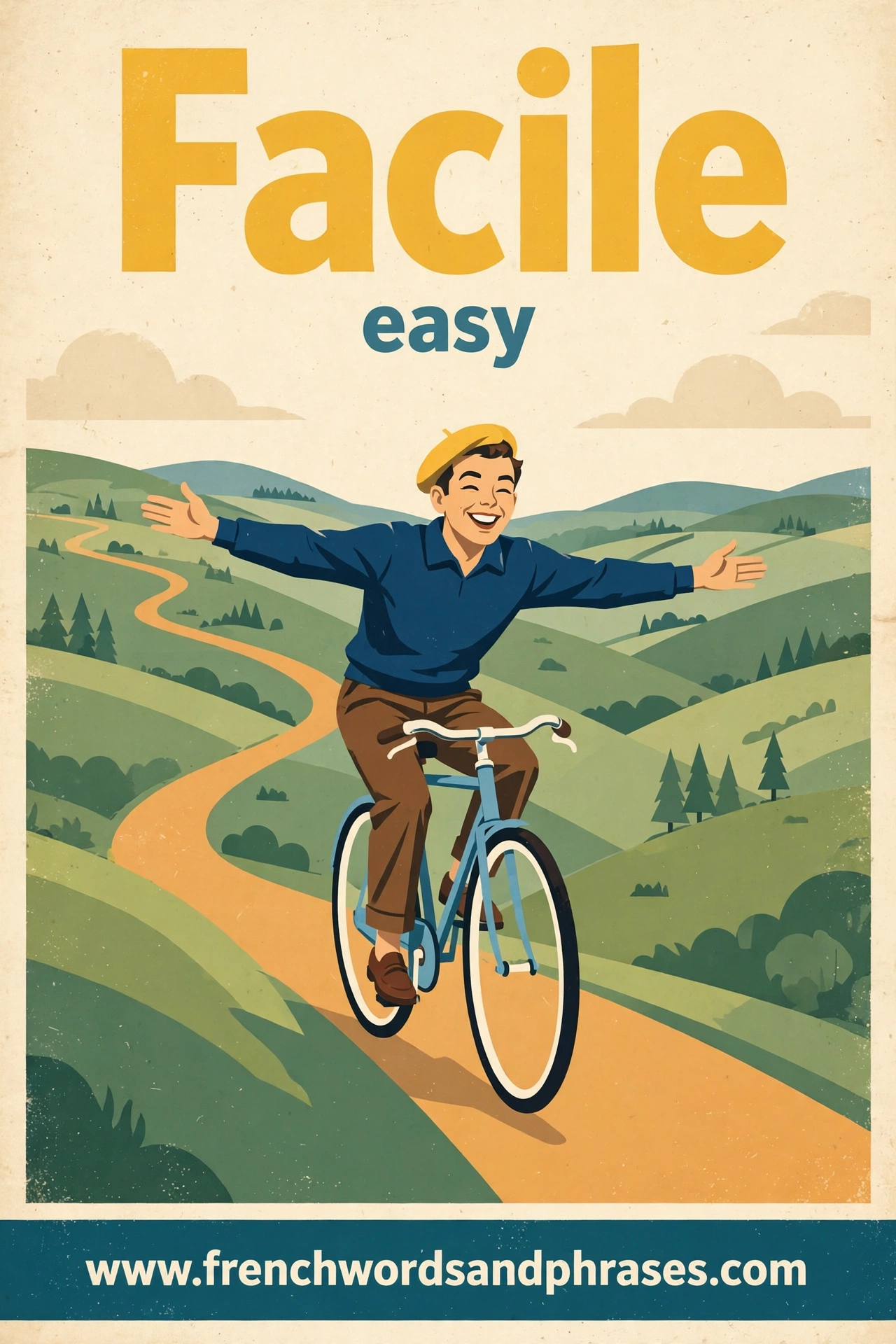
Facile means easy.
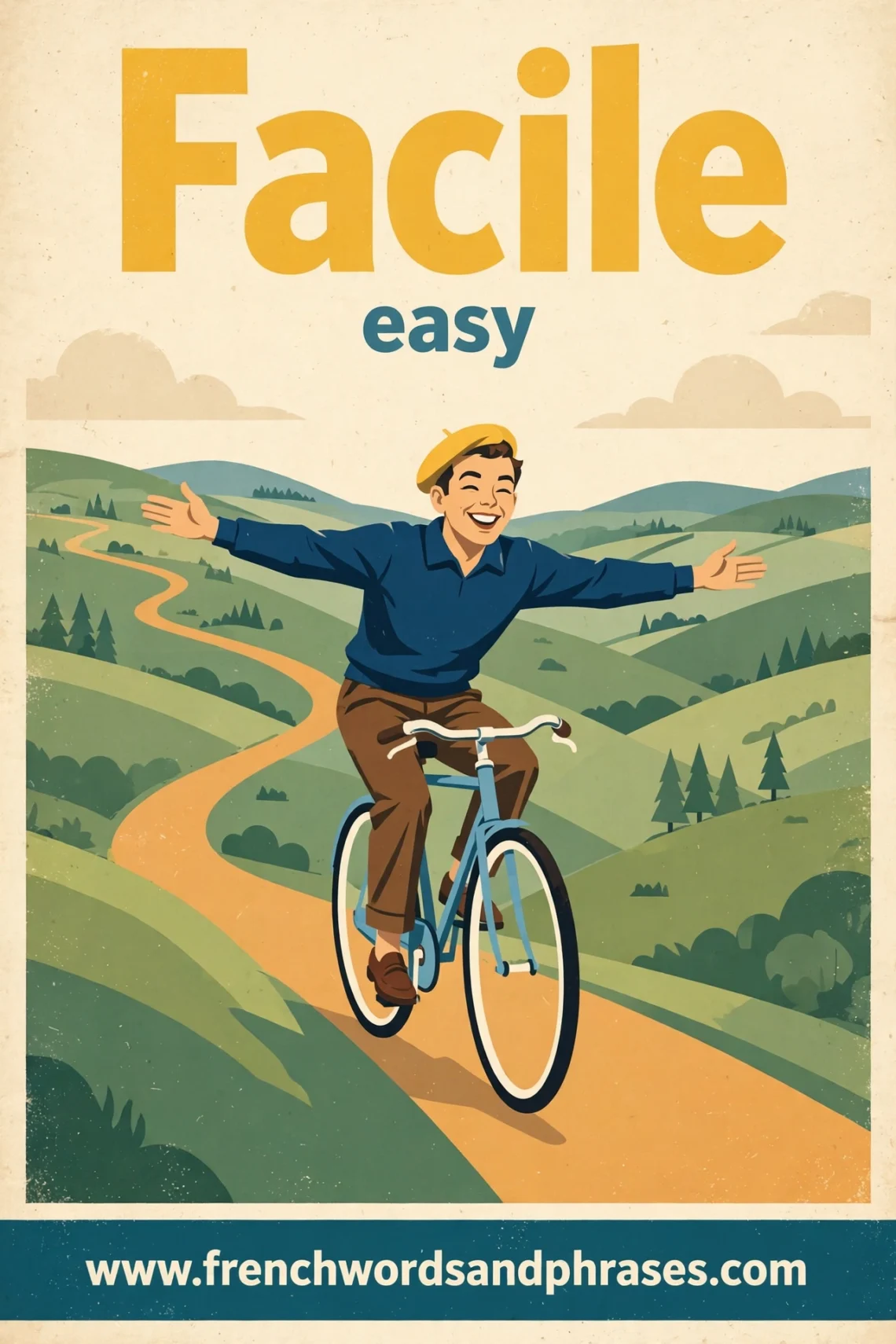
A flat road, a tailwind, a bicycle that almost pedals itself. The crossword finished before the coffee cools, the knot that undoes itself with one gentle pull. Some days, everything is facile.
In this guide, you’ll learn what facile means in English, why it is one of the easiest adjectives in French to use, where it stands in the sentence, and the handy pattern facile à that the French use all day long. Explore French examples, English translations, and practice quizzes.
Understanding the French Adjective Facile
Facile is a French adjective of difficulty — or rather, of its absence. It already ends in -e, so it keeps exactly the same form for masculine and feminine nouns: un exercice facile, une question facile. Only the plural adds an -s.
It means easy — the opposite of difficile. It describes tasks, questions, journeys and victories: un examen facile, une recette facile, une victoire facile. Said of things, facile is pure good news — the word every student hopes to hear and every cook loves to read.
Type: Adjective of difficulty — easiness
Answers the question: What is it like? — easy
Changes form: Only in the plural — facile / faciles; masculine and feminine identical
English equivalents: Easy; simple.
One important usage detail: facile loves the pattern facile à + infinitive — ce livre est facile à lire, this book is easy to read. The à never changes, whatever follows: facile à comprendre, facile à faire, facile à retenir.
Experience the Word
Facile is the adjective of the deep breath — the word you say when the mountain turns out to be a hill, and the hill turns out to have a café at the top.
Imagine the morning of an exam you dreaded for weeks. You open the paper, read the first question, then the second — and smile. Tout est facile. The sun comes out inside the room.
You have not just described a task. You have felt the weight come off it.
How to Use Facile in French: Complete Guide
Let’s explore how facile works in French, beginning with the whole word on one card.
Facile at a Glance
Before the details, here is the whole word on one card.
The Whole Word on One Card
Meaning, type, position and forms — facile in four lines.
| Point | Facile |
|---|---|
| Meaning | easy |
| Type | adjective of difficulty — easiness |
| Usual position | after the noun — un exercice facile |
| Form | facile (masc. and fem.) / faciles (plural) |
Example
Ce jeu est facile, même les enfants gagnent.
This game is easy, even the children win.
The Four Forms of Facile
Facile already ends in -e, so the feminine adds nothing at all. Only the plural takes an -s — written, as so often, but not heard.
| Form | Facile | Example |
|---|---|---|
| Masculine singular | facile | un texte facile — an easy text |
| Feminine singular | facile | une leçon facile — an easy lesson |
| Masculine plural | faciles | des textes faciles — easy texts |
| Feminine plural | faciles | des leçons faciles — easy lessons |
Example
Les questions faciles sont au début du test.
The easy questions are at the start of the test.
Quick Quiz 1
Does facile change for a feminine noun — facile or facila?
Reveal the answer
facile
Une question facile, un exercice facile.
An easy question, an easy exercise.
The Feminine of Facile: Already Done
Facile ends in -e, so there is nothing to add and nothing to double. It is one of the most forgiving adjectives in French: one form does almost everything.
| Pattern | Example |
|---|---|
| Masculine | un problème facile — an easy problem |
| Feminine | une solution facile — an easy solution (the same form) |
| Plural, both genders | des mots faciles — easy words |
| With très | très facile — very easy, for everyone |
Example
La réponse est facile, regarde bien la photo.
The answer is easy, look at the photo carefully.
Where Facile Goes: After the Noun
Facile follows its noun, like most descriptive adjectives — and after être it introduces the useful pattern facile à + infinitive.
| Pattern | Example |
|---|---|
| noun + facile | un chemin facile — an easy path |
| être + facile | Cet exercice est facile. — This exercise is easy. |
| facile à + infinitive | facile à lire — easy to read |
| Before the noun | un facile exercice — never; facile follows |
Example
Ce gâteau est facile à faire et délicieux.
This cake is easy to make and delicious.
Quick Quiz 2
Complete: ce livre est facile ___ lire. (à or de?)
Reveal the answer
à
Ce livre est facile à lire.
This book is easy to read.
Easier Still: Comparing with Facile
Facile compares the regular way. French speakers reach for plus facile constantly — it may be the most optimistic comparison in the language.
| Degree | Example |
|---|---|
| As easy as | aussi facile que — as easy as |
| Easier | plus facile — easier |
| Less easy | moins facile — less easy |
| The easiest (masc.) | le plus facile — l’exercice le plus facile du livre |
| The easiest (fem.) | la plus facile — la question la plus facile de l’examen |
Example
Le deuxième exercice est plus facile que le premier.
The second exercise is easier than the first.
Everyday Expressions with Facile
Facile turns up in classrooms, kitchens and garages — and in one phrase every learner should own: c’est facile !
| Expression | In English |
|---|---|
| c’est facile ! | it’s easy! |
| facile à dire | easier said than done — literally, easy to say |
| facile à vivre | easy-going, easy to live with |
| une victoire facile | an easy win |
| ce n’est pas facile | it’s not easy — life’s refrain |
| avoir la parole facile | to be a smooth, ready talker — literally, to have easy speech |
Example
Facile à dire, mais refaire ce toit, c’est un vrai travail.
Easier said than done, but redoing that roof is a real job.
Quick Quiz 3
What does facile à dire mean?
Reveal the answer
Easier said than done
C’est facile à dire, mais difficile à faire.
It’s easier said than done — literally, easy to say, but hard to do.
Facile and Its Neighbours
On the shelf of difficulty, facile sits at the sunny end. Its neighbours run from simple to impossible — learn them together and the whole scale is yours.
| French | In English |
|---|---|
| simple | simple — plain, not complicated |
| évident | obvious, clear — an easy answer staring at you |
| aisé | easy — formal, a little old-fashioned |
| difficile | difficult — the direct opposite |
| compliqué | complicated |
| impossible | impossible — the far end of the scale |
Example
Au début c’était difficile, maintenant c’est facile.
At first it was difficult, now it’s easy.
Watch Out: The Traps Around Facile
Facile is kind, but it hides two traps: a compliment that isn’t one, and an English twin that doesn’t mean the same.
| Trap | The truth |
|---|---|
| une fille facile | not ‘an easy-going girl’ — a dated insult about a woman’s morals; avoid it |
| ‘easy’ people | for people, say facile à vivre — easy to live with |
| facile à, not facile de | the pattern is facile à + infinitive: facile à comprendre |
| English ‘facile’ | exists but means superficial — French facile is a true compliment for tasks |
Example
C’est une recette facile, parfaite pour les débutants.
It’s an easy recipe, perfect for beginners.
Quick Quiz 4
How do you say ‘easy to understand’ — facile de comprendre or facile à comprendre?
Reveal the answer
facile à comprendre
Son explication est facile à comprendre.
His explanation is easy to understand.
Facile in Everyday French: Real-Life Examples
Now that you know the word, let’s see how facile appears in everyday French.
Example 1 — In class
L’exercice de grammaire était facile, j’ai fini en cinq minutes.
The grammar exercise was easy, I finished in five minutes.
Example 2 — In the kitchen
Cette soupe est très facile à préparer, même un dimanche soir.
This soup is very easy to make, even on a Sunday evening.
Example 3 — On the road
La route est facile : tout droit jusqu’au village, puis à gauche.
The road is easy: straight on to the village, then left.
Example 4 — At work
Avec ce logiciel, envoyer une facture devient facile.
With this software, sending an invoice becomes easy.
Example 5 — Learning French
Le mot « facile » est facile à retenir, non ?
The word ‘facile’ is easy to remember, isn’t it?
Example 6 — Encouragement
Allez, c’est facile, tu vas y arriver du premier coup.
Come on, it’s easy, you’ll manage it first try.
Beyond Translation: The Meaning of Facile
English says easy for the meaning of facile — and the two words are cousins, both descended from Latin facilis, ‘doable’, from the verb ‘to do’.
To call something facile is to say: this can be done, and done by you.
It is the kindest word a teacher owns. And French keeps its shadow close by — difficile, its opposite, shares the same Latin root, as if the language wanted the two to travel together.
How to Remember the French Adjective Facile
Remember it this way: Facile is the easy word that is easy in every way — one form for him and her, and the friendly pattern facile à in its pocket.
- You add nothing for the feminine — un exercice facile, une question facile.
- You keep the à ready — facile à lire, facile à faire, facile à comprendre.
- You park it after the noun — une recette facile, un chemin facile.
The key idea is facile never changes for gender, and it takes à before an infinitive.
Test Your Knowledge of Facile
Let’s see how much you’ve learned. Try answering these questions before revealing the answers.
Question 1
What does facile mean?
Reveal the answer
Easy — the opposite of difficile.
Question 2
What are the forms of facile?
Reveal the answer
facile for masculine and feminine singular, faciles for both plurals.
Question 3
Translate: an easy lesson.
Reveal the answer
Une leçon facile.
Question 4
Complete: ce texte est facile ______ lire.
Reveal the answer
à
Ce texte est facile à lire.
This text is easy to read.
Question 5
What is the opposite of facile?
Reveal the answer
difficile — difficult. Au début c’était difficile, maintenant c’est facile.
Your Final Challenge
Can You Use It?
How would you say this in French?
“This cake is easy to make, and the recipe is easy to follow.”
Reveal the answer
Ce gâteau est facile à faire, et la recette est facile à suivre.
This cake is easy to make, and the recipe is easy to follow.
A little French. A little curiosity. A richer everyday life.
LEARN FRENCH ONE WORD AT A TIME