A French Word to Live By
Translate Face to English
/fas/
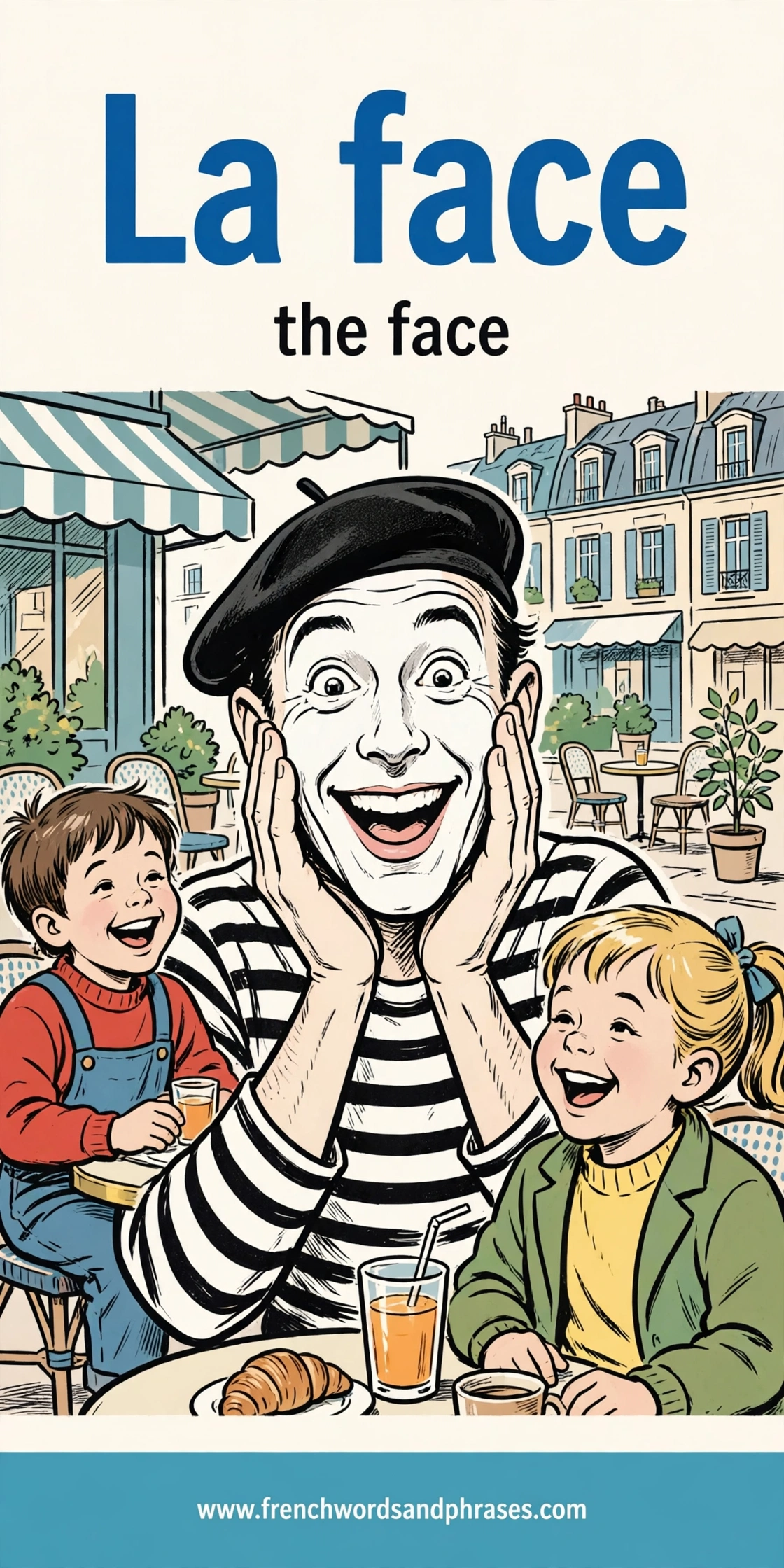
La face means the face.
A coin spins in the air and lands in the dust — pile ou face ? La face, the face: the side of things that looks back at you, the front of a coin, the surface of a mountain, and in careful French, the front of a head itself.
In this guide, you’ll learn what face means in English, how to use it with its articles, how to form its plural, and how it appears in everyday French. Explore French examples, English translations, and practice quizzes.
Understanding the French Noun Face
Face is a feminine French noun, learned with its article: la face, une face. It comes from the Latin facies, form, appearance. One neighbour must be kept apart: the everyday word for a person’s face is le visage; la face serves for coins, surfaces, mountains — and for the human face only in set phrases or comic, familiar speech.
It means the face — first of a coin: pile ou face, heads or tails. Then of anything with a front: la face nord, the north face of a mountain, la face cachée de la lune, the hidden face of the moon, une face du cube, one face of the cube. For people it survives in phrases: face à face, face to face, faire face à, to face up to, en face de, opposite. The face you wash every morning is le visage.
Gender: Feminine — la face
Definite article: la — la face (the face)
Indefinite article: une — une face (a face, a side)
Plural: les faces — regular, with a simple -s
Spelling note: from Latin facies, form — the side a thing shows to the world
Close neighbour: le visage — the everyday word for a person’s face
English equivalents: The face (of a coin, a mountain); a side.
Toss a coin and call pile ou face — pile is the tails side, face is heads. Stand opposite something and you are en face de it: la boulangerie est en face de la gare. Meet a problem head-on and you faites face à it. But for a smile, a wash or a portrait, switch to visage: elle a un beau visage — never say someone has a beautiful face with face unless you are joking.
Experience the Word
Face is the side of the world that presents itself — every coin, cube and mountain has one, turned towards you or hidden away.
Imagine the climbers at dawn studying la face nord, the north face, a wall of shadowed ice that has never once seen the morning sun — the mountain’s secret face, kept turned away from the light.
You have not just named a surface. You have named the aspect things show — la face, the face, front, side and hidden side alike.
How to Use Face in French: Complete Guide
Let’s explore how face works in French, beginning with its articles — la face, une face, pile ou face.
Face with the Definite Article (La, Les)
Used for a specific face or side — of a coin, of the moon, of a mountain.
| Form | French |
|---|---|
| Feminine singular | la face |
| Plural | les faces |
Example
La face cachée de la lune reste invisible depuis la Terre.
The hidden face of the moon stays invisible from Earth.
Face with the Indefinite Article (Une, Des)
Used for one side among several — a cube has six, a coin has two.
| Form | French |
|---|---|
| Feminine singular | une face |
Example
Un dé a six faces numérotées.
A die has six numbered faces.
Face in Its Fixed Phrases (Pile ou face, Face à face…)
Face lives in fixed phrases — learn these and the word is yours.
| Quantity | French |
|---|---|
| heads or tails | pile ou face |
| face to face | face à face |
| opposite, in front of | en face de |
| to face up to | faire face à |
| the north face | la face nord |
Example
On décide à pile ou face ?
Shall we decide by flipping a coin?
Quick Quiz 1
Complete the sentence:
______ face nord de la montagne est couverte de glace. (the)
Reveal the answer
La
La face nord de la montagne est couverte de glace.
The north face of the mountain is covered in ice — face is feminine, so la.
The Plural of Face
Face takes a regular plural in -s — six on a die, two on a coin.
| Number | French |
|---|---|
| Singular | la face |
| Plural | les faces |
Example
Les faces du cube sont toutes de la même taille.
The faces of the cube are all the same size.
Face with Possessive Adjectives (Ma, Ta, Sa…)
Possessives agree with the noun: face is feminine, so ma, ta, sa in the singular.
| Owner | French |
|---|---|
| my | ma face |
| your (tu) | ta face |
| his / her | sa face |
| our | notre face |
| your (vous) | votre face |
| their | leur face |
Example
La pièce montre sa face la plus brillante.
The coin shows its brightest face.
Quick Quiz 2
Complete the sentence:
Le dé a roulé et montre ______ face gagnante. (its)
Reveal the answer
sa
Le dé a roulé et montre sa face gagnante.
The die rolled and shows its winning face — sa, because face is feminine.
Face with Demonstrative Adjectives (Cette, Ces)
Used to point: cette face, this side — the one facing you.
| Form | French |
|---|---|
| Feminine singular | cette face |
| Plural | ces faces |
Example
Cette face de la maison donne sur le jardin.
This side of the house faces the garden.
Face with Adjectives
Adjectives agree with face — feminine singular: la face cachée, la face nord.
| Adjective | With Face |
|---|---|
| cachée (hidden) | la face cachée |
| nord (north) | la face nord |
| sud (south) | la face sud |
| principale (main) | la face principale |
| visible (visible) | la face visible |
Example
La face sud de la maison est toujours ensoleillée.
The south face of the house is always sunny.
Quick Quiz 3
Complete the sentence:
On ne voit jamais la face ______ de la lune. (hidden)
Reveal the answer
cachée
On ne voit jamais la face cachée de la lune.
We never see the hidden face of the moon — cachée, feminine, to agree with face.
Everyday Expressions with Face
Coins, meetings and problems — the face phrases of daily life.
| Expression | In English |
|---|---|
| pile ou face | heads or tails |
| face à face | face to face |
| en face de | opposite, in front of |
| faire face à | to face up to, to cope with |
| la face cachée | the hidden face (of the moon) |
Example
Il faut faire face au problème dès maintenant.
We must face up to the problem right now.
Words from the Same Family as Face
Fronts and surfaces — the words that travel with face.
| French | In English |
|---|---|
| le visage | the face (of a person, everyday word) |
| la façade | the facade, the front of a building |
| pile | tails — the other side of the coin |
| un côté | a side |
| la surface | the surface |
Example
La façade du musée donne sur la place, en face de la gare.
The museum’s facade faces the square, opposite the station.
Quick Quiz 4
What does pile ou face mean?
Reveal the answer
Heads or tails — the coin-toss call: face is the heads side.
On tire à pile ou face pour décider.
We flip a coin to decide.
Face in Everyday French: Real-Life Examples
Now that you know the word, let’s see how face appears in everyday French.
Example 1 — The coin toss
Pile ou face ? Je choisis face.
Heads or tails? I choose heads.
Example 2 — Directions
La pharmacie est en face de la poste.
The pharmacy is opposite the post office.
Example 3 — A meeting
Ils se sont parlé face à face.
They spoke to each other face to face.
Example 4 — Courage
Elle fait face aux difficultés sans se plaindre.
She faces difficulties without complaining.
Example 5 — The moon
La face cachée de la lune fascine les enfants.
The hidden face of the moon fascinates children.
Example 6 — The mountain
La face nord est réservée aux alpinistes experts.
The north face is reserved for expert climbers.
Beyond Translation: The Meaning of Face
Face descends from Latin facies — the form a thing presents. French split the inheritance in two: visage, from the verb to see, took the human face of everyday life, while face kept the geometry of the world — coins, cubes, mountains, moons. Yet the old word keeps breaking back into human affairs through its phrases: to stand en face de someone, to argue face à face, to faire face à trouble. The surface word became the courage word.
To say face is to name the side that meets the world — and the courage to meet it.
It evokes the spinning coin, the shadowed north wall, and the hidden half of the moon.
How to Remember the French Noun Face
Remember it this way: Face is the face of coins, cubes and mountains — la face. The face you wash is le visage.p>
- Always feminine — la face, une face, ma face.
- The coin call — pile ou face, heads or tails; face is heads.
- The human trap — a person’s face is le visage; face is for things and fixed phrases.
The key idea is la face — the face (of a coin, mountain, moon), feminine; a person’s face = le visage.
Test Your Knowledge of Face
Let’s see how much you’ve learned. Try answering these questions before revealing the answers.
Question 1
Is face masculine or feminine?
Reveal the answer
Feminine — la face, une face.
Question 2
How do you say heads or tails?
Reveal the answer
Pile ou face.
Question 3
Translate: The pharmacy is opposite the station.
Reveal the answer
La pharmacie est en face de la gare.
Question 4
What is the everyday French word for a person’s face?
Reveal the answer
Le visage — face serves for coins, surfaces and fixed phrases.
Question 5
Complete the sentence:
______ faces du dé sont numérotées de un à six. (the)
Reveal the answer
Les
Les faces du dé sont numérotées de un à six.
The faces of the die are numbered from one to six.
Your Final Challenge
Can You Use It?
How would you say this in French?
“The pharmacy is opposite the post office.”
Reveal the answer
La pharmacie est en face de la poste.
The pharmacy is opposite the post office.
A little French. A little curiosity. A richer everyday life.
LEARN FRENCH ONE WORD AT A TIME