A French Word to Live By
Translate Employeur to English
/ɑ̃.plwa.jœʁ/
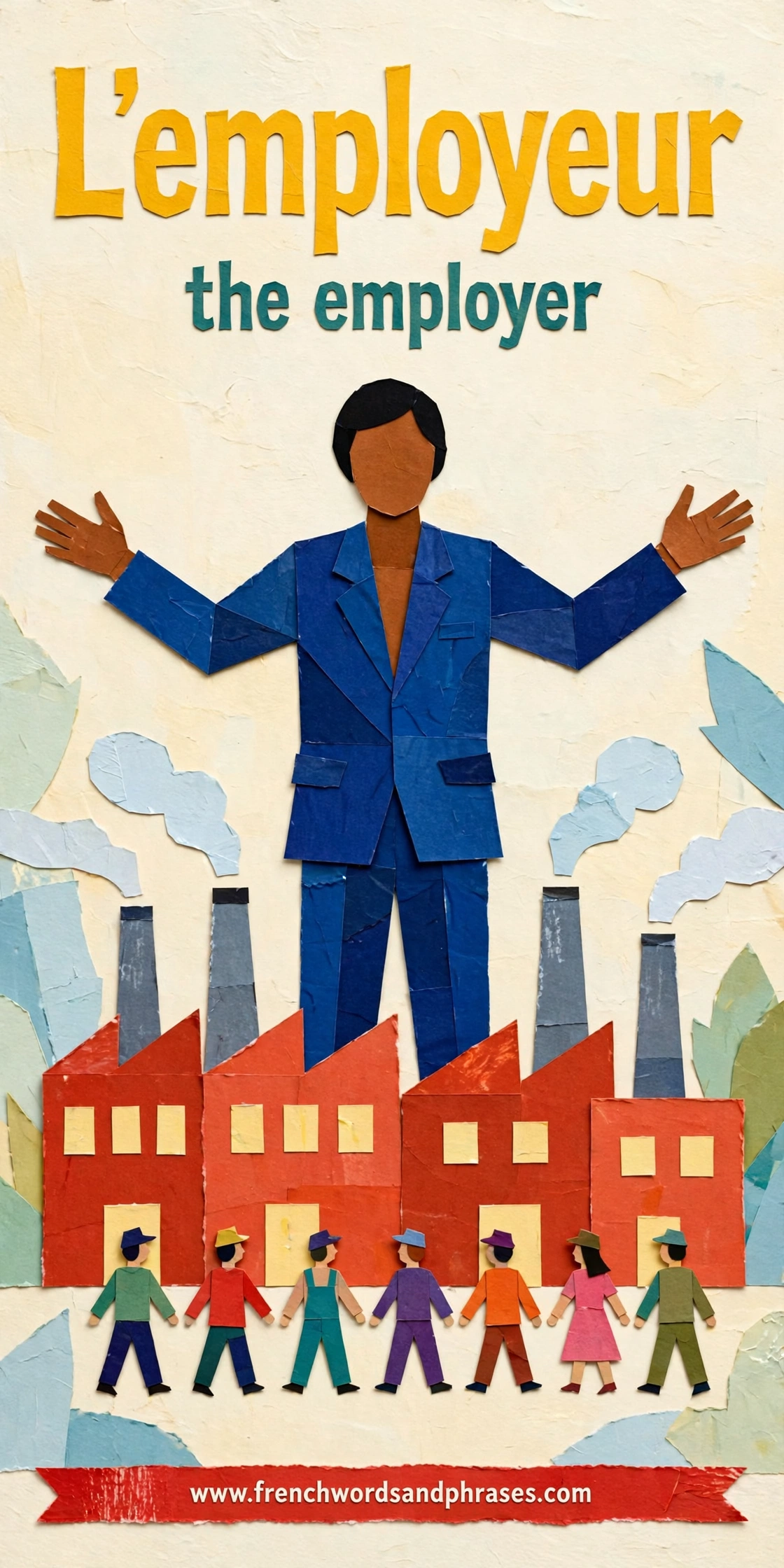
L’employeur means the employer.
On the top floor, behind a door with a brass plate, sits the person whose signature turns an application into a contract. Every candidate straightens their jacket before knocking — l’employeur is waiting.
In this guide, you’ll learn what employeur means in English, how to use it with its articles, how to form its plural, and how it appears in everyday French. Explore French examples, English translations, and practice quizzes.
Understanding the French Noun Employeur
Employeur is a masculine French noun. It is learned together with its article: l’employeur, un employeur — because it begins with a vowel, le shrinks to l’. A feminine form exists, l’employeuse, though French very often keeps employeur for everyone. It is the agent noun of employer: the one who employs.
It means the employer — the person or company that gives work to les salariés (the employees) and pays les salaires (the salaries). The employeur signs le contrat de travail, pays les cotisations (the contributions) and answers for safety at work. In the great pair of French working life, the employeur faces the salarié across the desk.
Gender: Masculine
Feminine: employeuse — une employeuse (rare; employeur is often used for all)
Definite article: l’ — l’employeur (the employer)
Indefinite article: un — un employeur (an employer)
Plural: les employeurs
English equivalents: The employer.
One important usage detail: do not confuse the employeur with l’employé — the employee. The endings tell the story: -eur does the action (l’employeur employs), -é receives it (l’employé is employed). One letter changes which side of the desk you sit on.
Experience the Word
Employeur is more than a signature. In a small French business, the employeur is a person with a name — the baker who takes on an apprentice, the farmer who hires for the harvest — and the word carries the weight of responsibility for other people’s livelihoods.
Imagine the interview from the other side of the desk: the employer reading the letter once more, weighing not just skills but a future colleague, a salary, a family’s rent.
You have not just offered a job. You have taken responsibility — pour un salarié, pour une famille, for an employee, for a family.
How to Use Employeur in French: Complete Guide
Let’s explore how employeur works in French, beginning with its articles — and watch the vowel shrink le into l’.
Employeur with the Definite Article (L’, Les)
Employeur begins with a vowel, so le becomes l’ — the employer everyone in the conversation knows.
| Form | French |
|---|---|
| Singular | l’employeur |
| Plural | les employeurs |
Example
L’employeur reçoit les candidats mardi.
The employer is seeing the candidates on Tuesday.
Employeur with the Indefinite Article (Un, Des)
Used for an employer in general — un employeur, any employer at all.
| Form | French |
|---|---|
| Singular | un employeur |
| Plural | des employeurs |
Example
C’est un employeur respecté dans la région.
He is a respected employer in the region.
Across the Desk: Words Around the Employeur
Contracts, salaries and staff — the vocabulary that surrounds the employeur.
| French | In English |
|---|---|
| le salarié | the employee |
| embaucher | to hire, to take on |
| licencier | to dismiss, to make redundant |
| le contrat de travail | the employment contract |
| les cotisations | the (social) contributions |
| le personnel | the staff |
Example
L’employeur embauche trois nouveaux salariés.
The employer is taking on three new employees.
Quick Quiz 1
Complete the sentence:
______ signe le contrat avec le nouveau salarié.
Reveal the answer
L’employeur
L’employeur signe le contrat avec le nouveau salarié.
The employer signs the contract with the new employee — l’, before the vowel.
The Plural of Employeur
Employeur adds an -s in the plural — les employeurs, the employers of a region or a trade.
| Number | French |
|---|---|
| Singular | l’employeur |
| Plural | les employeurs |
Example
Les employeurs de la région recrutent au printemps.
The region’s employers recruit in the spring.
Employeur with Possessive Adjectives (Mon, Ton, Son…)
A vowel-start noun: mon, ton, son flow into the vowel — mon employeur, my boss in official language.
| Owner | French |
|---|---|
| my | mon employeur |
| your (tu) | ton employeur |
| his / her | son employeur |
| our | notre employeur |
| your (vous) | votre employeur |
| their | leur employeur |
Example
Mon employeur propose une formation à tous les salariés.
My employer offers training to all the employees.
Quick Quiz 2
Complete the sentence:
Elle parle de ______ projet à son employeur. (her)
Reveal the answer
son
Elle parle de son projet à son employeur.
She talks about her project to her employer — son projet, because projet is masculine.
Employeur with Demonstrative Adjectives (Cet, Ces)
Used to point: cet employeur — cet, not ce, because the noun begins with a vowel.
| Form | French |
|---|---|
| Singular | cet employeur |
| Plural | ces employeurs |
Example
Cet employeur paie ses salariés au-dessus du minimum.
This employer pays his employees above the minimum.
Employeur with Adjectives
Adjectives agree with employeur: masculine forms, premier employeur is the classic phrase for a first boss.
| Adjective | With Employeur |
|---|---|
| premier (first) | un premier employeur |
| principal (main) | l’employeur principal |
| nouveau (new) | un nouvel employeur |
| exigeant (demanding) | un employeur exigeant |
| généreux (generous) | un employeur généreux |
Example
Son premier employeur lui a tout appris.
His first employer taught him everything.
Quick Quiz 3
Complete the sentence:
C’est un employeur très ______, mais juste. (demanding)
Reveal the answer
exigeant
C’est un employeur très exigeant, mais juste.
He is a very demanding employer, but a fair one.
Everyday Expressions with Employeur
Hiring and responsibility — the employeur phrases of daily life.
| Expression | In English |
|---|---|
| un employeur modèle | a model employer |
| les obligations de l’employeur | the employer’s obligations |
| changer d’employeur | to change employer, to change jobs |
| un employeur du secteur privé | a private-sector employer |
| déclarer un employeur | to register an employer (officially) |
| l’employeur et le salarié | employer and employee |
Example
Après dix ans, elle change d’employeur pour progresser.
After ten years, she changes employer to move up.
Words from the Same Family as Employeur
Jobs, staff and bosses — the words that travel with employeur.
| French | In English |
|---|---|
| employer | to employ; to use |
| l’emploi | employment; a job |
| l’employé | the employee (a close synonym of salarié) |
| le patron | the boss (everyday word) |
| le chef d’entreprise | the head of a company, the business owner |
| le personnel | the staff |
Example
Le patron, c’est l’employeur que les salariés voient chaque jour.
The boss is the employer the staff see every day.
Quick Quiz 4
What is the difference between l’employeur and l’employé?
Reveal the answer
L’employeur employs; l’employé is employed — the -eur does the action, the -é receives it.
L’employeur paie l’employé à la fin du mois.
The employer pays the employee at the end of the month.
Employeur in Everyday French: Real-Life Examples
Now that you know the word, let’s see how employeur appears in everyday French.
Example 1 — At the interview
L’employeur pose des questions sur son expérience.
The employer asks questions about her experience.
Example 2 — A good boss
Mon employeur écoute toujours ses salariés.
My employer always listens to his employees.
Example 3 — Obligations
L’employeur doit assurer la sécurité du personnel.
The employer must ensure the staff’s safety.
Example 4 — Changing jobs
Il cherche un employeur dans le secteur de la santé.
He is looking for an employer in the health sector.
Example 5 — A small business
Avec trois salariés, elle est un employeur à son échelle.
With three employees, she is an employer in her own right.
Example 6 — The pair
Employeur et salariés signent l’accord ensemble.
Employer and employees sign the agreement together.
Beyond Translation: The Meaning of Employeur
The employeur stands on one side of the great French balance: opposite the salarié, across the desk of the contrat de travail. The word is neutral, administrative, almost abstract — the person behind it may be a multinational or the village baker taking on one apprentice. French law loads the employeur with obligations, and French life still often reduces him to a warmer word: le patron.
To say employeur is to name the other half of the world of work — the half that offers, signs and pays.
It evokes the interview and the signature, the payslips at month’s end — and the small -eur that separates the boss from the employé.
How to Remember the French Noun Employeur
Remember it this way: Employeur is the employer — the -eur does the action; the employé, with -é, receives it.
- You give the job — l’employeur, celui qui embauche.
- You receive the job — l’employé, le salarié.
- You remember the endings — -eur agit, -é reçoit : -eur acts, -é receives.
The key idea is l’employeur employs, l’employé is employed.
Test Your Knowledge of Employeur
Let’s see how much you’ve learned. Try answering these questions before revealing the answers.
Question 1
What does l’employeur mean in English?
Reveal the answer
The employer — the person or company that gives work and pays salaries.
Question 2
How do you say « the employee » with a word from the same family?
Reveal the answer
L’employé — or le salarié; the -é receives the action that the -eur performs.
Question 3
Translate: The employer signs the contract.
Reveal the answer
L’employeur signe le contrat.
Question 4
What is the everyday word for the employer, the boss?
Reveal the answer
Le patron — the word the salariés actually use at the café.
Question 5
Complete the sentence:
______ reçoit les candidats pour le poste.
Reveal the answer
L’employeur
L’employeur reçoit les candidats pour le poste.
The employer is seeing the candidates for the job.
Your Final Challenge
Can You Use It?
How would you say this in French?
“The employer hires two new employees.”
Reveal the answer
L’employeur embauche deux nouveaux salariés.
The employer hires two new employees.
A little French. A little curiosity. A richer everyday life.
LEARN FRENCH ONE WORD AT A TIME