A French Word to Live By
Translate Emploi to English
/ɑ̃.plwa/
L’emploi means employment.
At the job centre, the screen refreshes: new offers, new hopes. A young woman circles one line with her pen — un emploi, the one she has been waiting for.
In this guide, you’ll learn what emploi means in English, how to use it with its articles, how to form its plural, and how it appears in everyday French. Explore French examples, English translations, and practice quizzes.
Understanding the French Noun Emploi
Emploi is a masculine French noun. It is learned together with its article: l’emploi, un emploi — because it begins with a vowel, le shrinks to l’. It is the noun of the verb employer, to employ, to use.
It means employment — work, a job, the state of having one. In everyday French, un emploi is simply a job: chercher un emploi (to look for a job), une offre d’emploi (a job offer, a vacancy), le plein emploi (full employment). And hidden in the schoolbag is its other life: l’emploi du temps is the timetable — the schedule of lessons every French pupil knows by heart.
Gender: Masculine
Definite article: l’ — l’emploi (employment; the job)
Indefinite article: un — un emploi (a job)
Plural: les emplois
Double life: L’emploi du temps = the timetable, the schedule
English equivalents: Employment (bare gloss); a job.
One important usage detail: emploi is the ordinary word for a job, warmer and more common than le travail in announcements: « Offre d’emploi : vendeur recherché ». And never be confused at school: if a pupil talks about mon emploi du temps, he means his timetable, not his career — the same word organises both the working week and the school week.
Experience the Word
Emploi is more than a statistic. Behind every figure for l’emploi in the news there are kitchens where the phone is waited for, suits ironed for interviews, and the immense sentence: « J’ai trouvé un emploi. »
Imagine the morning of the signature: the contract, the new badge, the first coffee with the team — employment turning back into a life with a shape.
You have not just filled a vacancy. You have found your place — une place dans le monde, a place in the world.
How to Use Emploi in French: Complete Guide
Let’s explore how emploi works in French, beginning with its articles — and watch the vowel shrink le into l’.
Emploi with the Definite Article (L’, Les)
Emploi begins with a vowel, so le becomes l’ — employment in general, or the job everyone knows about.
| Form | French |
|---|---|
| Singular | l’emploi |
| Plural | les emplois |
Example
L’emploi des jeunes est une priorité du gouvernement.
Youth employment is a government priority.
Emploi with the Indefinite Article (Un, Des)
Used for a job in general — un emploi, any job at all.
| Form | French |
|---|---|
| Singular | un emploi |
| Plural | des emplois |
Example
Elle cherche un emploi dans la région.
She is looking for a job in the region.
The World of Work: Words Around the Emploi
Offers, interviews and timetables — the vocabulary that surrounds the emploi.
| French | In English |
|---|---|
| une offre d’emploi | a job offer, a vacancy |
| l’emploi du temps | the timetable, the schedule |
| le chômage | unemployment |
| un entretien d’embauche | a job interview |
| le plein emploi | full employment |
| postuler à un emploi | to apply for a job |
Example
Consulte ton emploi du temps, le cours commence à neuf heures.
Check your timetable, the lesson starts at nine.
Quick Quiz 1
Complete the sentence:
Il a trouvé ______ dans une banque.
Reveal the answer
un emploi
Il a trouvé un emploi dans une banque.
He found a job in a bank.
The Plural of Emploi
Emploi adds an -s in the plural — les emplois, the jobs of a town or an economy.
| Number | French |
|---|---|
| Singular | l’emploi |
| Plural | les emplois |
Example
La nouvelle usine crée deux cents emplois.
The new factory is creating two hundred jobs.
Emploi with Possessive Adjectives (Mon, Ton, Son…)
A vowel-start noun: mon, ton, son flow into the vowel — mon emploi, never a broken « ma emploi » (emploi is masculine in any case).
| Owner | French |
|---|---|
| my | mon emploi |
| your (tu) | ton emploi |
| his / her | son emploi |
| our | notre emploi |
| your (vous) | votre emploi |
| their | leur emploi |
Example
Son emploi du temps est chargé cette semaine.
His schedule is busy this week.
Quick Quiz 2
Complete the sentence:
Regarde ______ emploi du temps, nous avons sport à dix heures. (your, tu)
Reveal the answer
ton
Regarde ton emploi du temps, nous avons sport à dix heures.
Look at your timetable, we have PE at ten — ton, before the vowel-start noun.
Emploi with Demonstrative Adjectives (Cet, Ces)
Used to point: cet emploi — cet, not ce, because the noun begins with a vowel.
| Form | French |
|---|---|
| Singular | cet emploi |
| Plural | ces emplois |
Example
Cet emploi correspond parfaitement à son expérience.
This job matches his experience perfectly.
Emploi with Adjectives
Adjectives agree with emploi: masculine forms, stable and précaire describe the security of the job.
| Adjective | With Emploi |
|---|---|
| stable (stable, secure) | un emploi stable |
| précaire (insecure, temporary) | un emploi précaire |
| nouveau (new) | un nouvel emploi |
| premier (first) | un premier emploi |
| saisonnier (seasonal) | un emploi saisonnier |
Example
Après des années d’emplois précaires, elle trouve un emploi stable.
After years of insecure jobs, she finds a stable one.
Quick Quiz 3
Complete the sentence:
Il commence son ______ emploi lundi. (new)
Reveal the answer
nouvel
Il commence son nouvel emploi lundi.
He starts his new job on Monday — nouvel, the special form of nouveau before a vowel.
Everyday Expressions with Emploi
Job hunts and timetables — the emploi phrases of daily life.
| Expression | In English |
|---|---|
| chercher un emploi | to look for a job |
| une offre d’emploi | a job vacancy, a job advert |
| l’emploi du temps | the timetable |
| le plein emploi | full employment |
| un emploi à temps partiel | a part-time job |
| perdre son emploi | to lose one’s job |
Example
Elle consulte les offres d’emploi chaque matin.
She checks the job adverts every morning.
Words from the Same Family as Emploi
Jobs, bosses and unemployment — the words that travel with emploi.
| French | In English |
|---|---|
| employer | to employ; to use |
| l’employeur | the employer |
| le salarié | the employee |
| le chômage | unemployment |
| embaucher | to hire, to take on |
| le travail | work |
Example
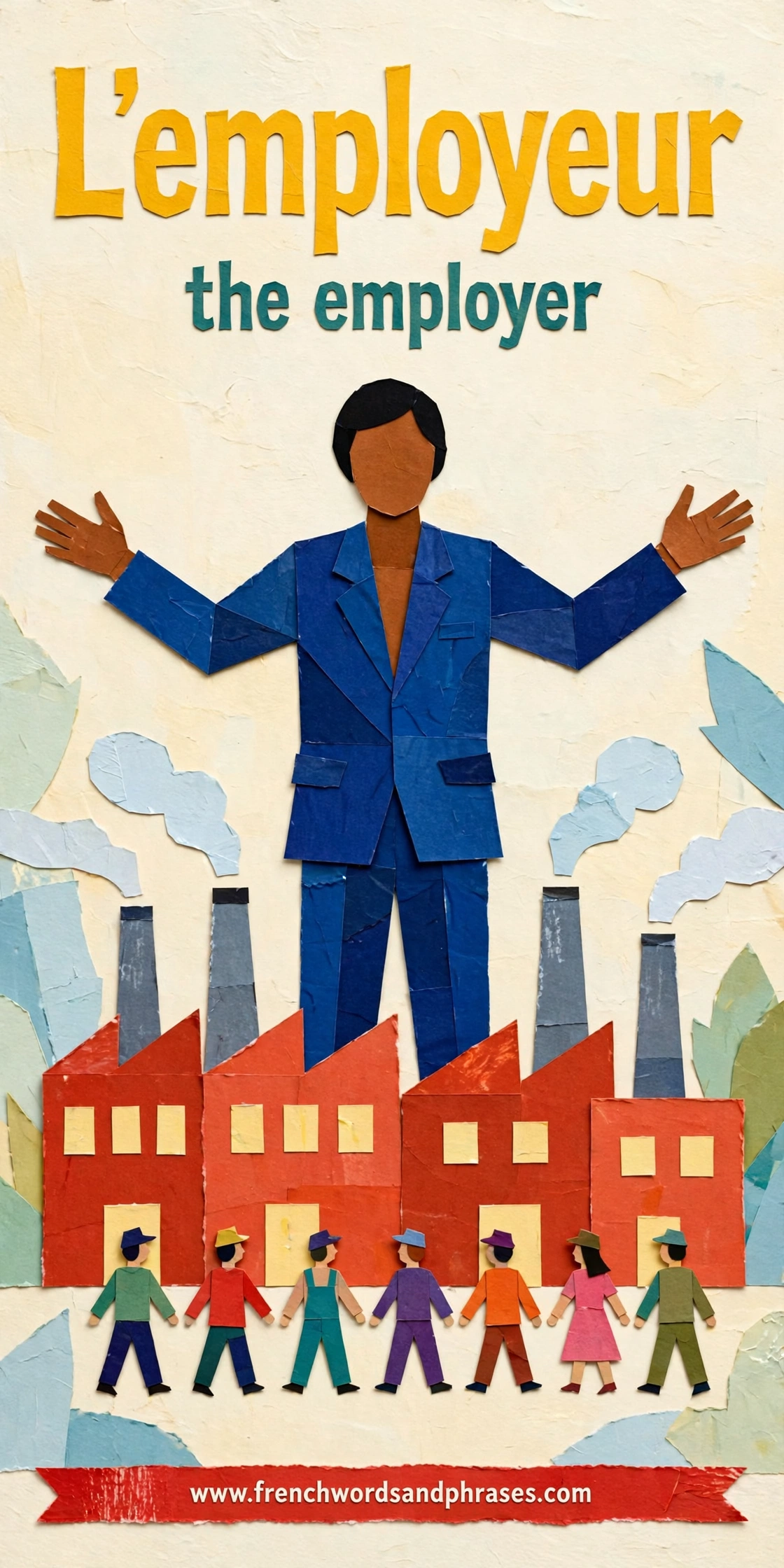
L’employeur embauche deux nouveaux salariés.
The employer is taking on two new employees.
Quick Quiz 4
What is l’emploi du temps?
Reveal the answer
The timetable, the schedule — the same word emploi, organising the school week instead of the working one.
Mon emploi du temps du mardi est très chargé.
My Tuesday timetable is very full.
Emploi in Everyday French: Real-Life Examples
Now that you know the word, let’s see how emploi appears in everyday French.
Example 1 — Job hunting
Il cherche un emploi depuis trois mois.
He has been looking for a job for three months.
Example 2 — Good news
La région annonce la création de mille emplois.
The region announces the creation of a thousand jobs.
Example 3 — At school
Note les devoirs dans ton emploi du temps.
Write the homework in your timetable.
Example 4 — An interview
Son entretien pour l’emploi se passe bien.
His interview for the job is going well.
Example 5 — Part-time
Elle travaille dans un emploi à temps partiel.
She works in a part-time job.
Example 6 — Security
Un emploi stable change la vie d’une famille.
A secure job changes a family’s life.
Beyond Translation: The Meaning of Emploi
L’emploi is the word around which French public life turns: every election is fought on it, every news bulletin counts it. Yet its most intimate form is the smallest — l’emploi du temps, pinned above every schoolchild’s desk, dividing the week into coloured squares. Work and school, the nation and the pupil: one word carries the whole architecture of French time.
To say emploi is to name both a livelihood and a timetable — the shape of a life, organised.
It evokes the job advert circled in pen and the timetable in the satchel — the two great calendars of France.
How to Remember the French Noun Emploi
Remember it this way: Emploi is employment, a job — and, in the schoolbag, l’emploi du temps is the timetable.
- You look for work — chercher un emploi, lire les offres d’emploi.
- You organise the week — l’emploi du temps, heure par heure.
- You meet the boss — l’employeur, celui qui donne l’emploi.
The key idea is l’emploi — a job; l’emploi du temps, the timetable.
Test Your Knowledge of Emploi
Let’s see how much you’ve learned. Try answering these questions before revealing the answers.
Question 1
What does l’emploi mean in English?
Reveal the answer
Employment — and in everyday French, un emploi is simply a job.
Question 2
How do you say « to look for a job » in French?
Reveal the answer
Chercher un emploi — and the adverts are les offres d’emploi.
Question 3
Translate: The factory creates fifty jobs.
Reveal the answer
L’usine crée cinquante emplois.
Question 4
What is l’emploi du temps?
Reveal the answer
The timetable, the schedule — of a schoolchild, a student, or a busy week.
Question 5
Complete the sentence:
Elle a perdu son ______ pendant la crise.
Reveal the answer
emploi
Elle a perdu son emploi pendant la crise.
She lost her job during the crisis.
Your Final Challenge
Can You Use It?
How would you say this in French?
“He is looking for a job in the region.”
Reveal the answer
Il cherche un emploi dans la région.
He is looking for a job in the region.
A little French. A little curiosity. A richer everyday life.
LEARN FRENCH ONE WORD AT A TIME