A French Word to Live By
How to Conjugate Écharper in French
/e.ʃar.pe/
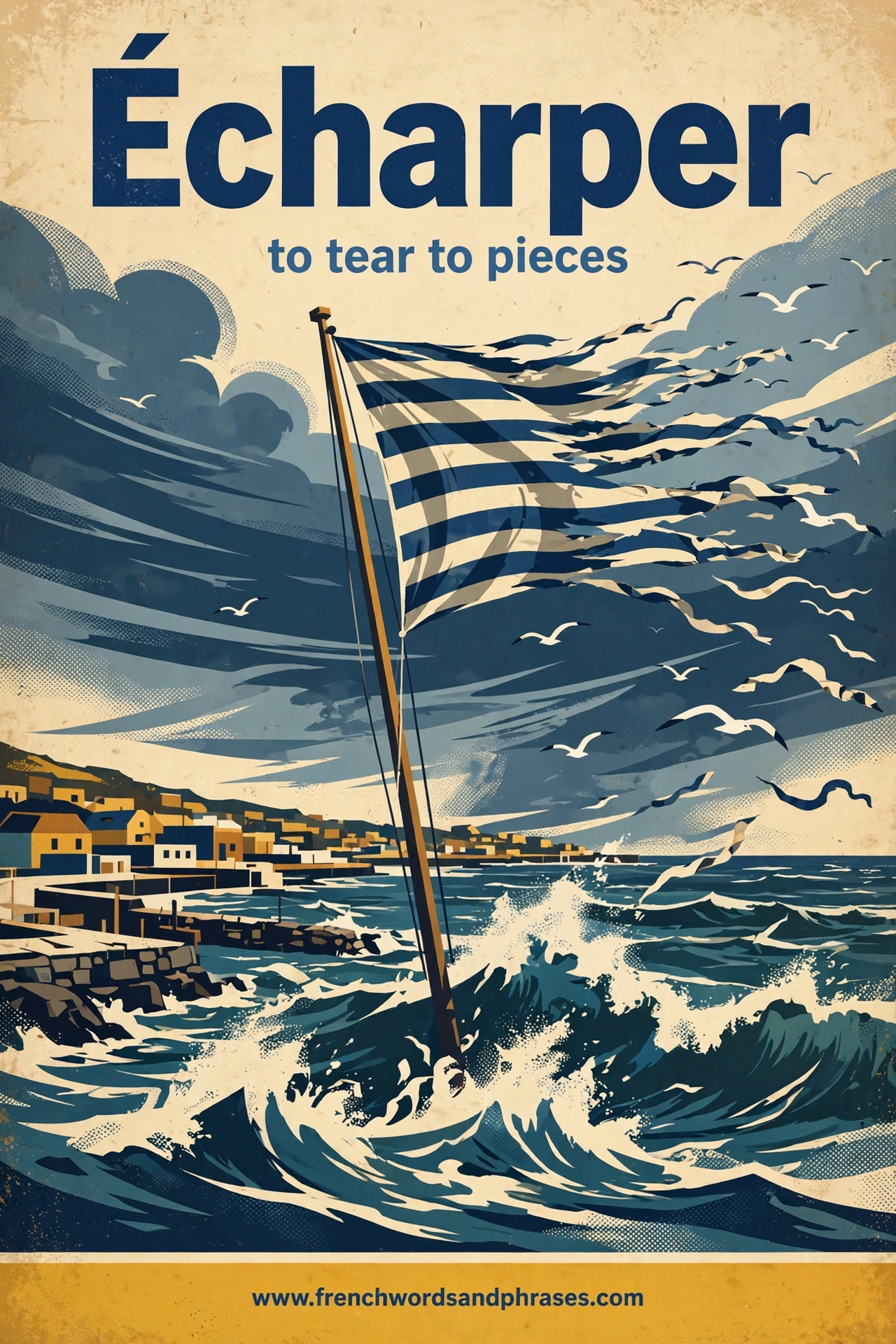
Écharper means to tear to pieces.
A sail shredded by the storm in seconds, a cushion destroyed by a puppy, a reputation dismantled by the morning papers — écharper is the violent verb of tearing to pieces, of claws, weather and critics.
In this guide, you’ll learn how to conjugate écharper in all the major French tenses and moods. Explore complete conjugation tables, French examples, English translations, and practice quizzes.
Understanding the French Verb Écharper
Écharper is a regular French verb belonging to the first group of verbs, those ending in -er.
It means to tear to pieces. It is used literally for animals, storms and machines tearing flesh, cloth or paper to shreds, for crowds in riots, and figuratively — its most common modern home — for critics tearing a play, a book or a politician apart.
Verb classification: First group (-er)
Auxiliary verb: Avoir
Past participle: écharpé
Present participle: écharpant
English equivalents: To tear to pieces, to slash, to shred; se faire écharper — to be torn apart, savaged (also of a book or a reputation); en lambeaux — in tatters.
One important detail: do not confuse écharper with une écharpe, which is a scarf — or a sling for an injured arm. Écharper is what leaves things en lambeaux, in shreds. Newspapers love its figurative sense: son roman s’est fait écharper par la critique, his novel was savaged by the critics; se faire écharper is to be torn apart, by a crowd, a storm or a review.
Experience the Word
Écharper is the verb of no repair — what has been écharpé does not get mended, it gets swept up.
Imagine a theatre the morning after a premiere. On the café table, the reviews lie open: one critic has praised, three have écharpé — and the young playwright reads the shreds of his play over a very quiet coffee.
Nothing was physically torn. The play has been écharpée — torn to pieces in print.
How to Conjugate Écharper: Complete French Conjugation Guide
Let’s explore every major conjugation of écharper, beginning with the indicative mood.
How to Conjugate Écharper in the Indicative Mood
The indicative mood is used to express facts, observations, actions, and events.
How to Conjugate Écharper in the Present Tense (Présent)
Used for actions happening now, habitual actions, and general truths.
| Subject | Conjugation |
|---|---|
| je | écharpe |
| tu | écharpes |
| il / elle | écharpe |
| nous | écharpons |
| vous | écharpez |
| ils / elles | écharpent |
Example
Le chien écharpe le coussin dès qu’on le laisse seul.
The dog tears the cushion to pieces as soon as it is left alone.
Quick Quiz 1
Complete the sentence:
Nous ______ les vieux draps pour faire des chiffons.
Reveal the answer
écharpons
Nous écharpons les vieux draps pour faire des chiffons.
We tear up the old sheets to make rags.
How to Conjugate Écharper in the Passé Composé
Used for completed actions in the past. Écharper takes the auxiliary verb avoir.
| Subject | Conjugation |
|---|---|
| j’ | ai écharpé |
| tu | as écharpé |
| il / elle | a écharpé |
| nous | avons écharpé |
| vous | avez écharpé |
| ils / elles | ont écharpé |
Example
La tempête a écharpé la voile en quelques secondes.
The storm tore the sail to shreds in a few seconds.
How to Conjugate Écharper in the Imparfait (Imperfect Tense)
Used for habitual past actions, descriptions, and ongoing situations in the past.
| Subject | Conjugation |
|---|---|
| je | écharpais |
| tu | écharpais |
| il / elle | écharpait |
| nous | écharpions |
| vous | écharpiez |
| ils / elles | écharpaient |
Example
Dans le roman, les loups écharpaient tout sur leur passage.
In the novel, the wolves tore everything in their path to pieces.
Quick Quiz 2
Choose the correct form:
The storm tore the sail.
La tempête ______ la voile. (a écharpé / est écharpée)
Reveal the answer
a écharpé
La tempête a écharpé la voile.
Écharper takes avoir.
How to Conjugate Écharper in the Plus-que-parfait
Used to describe an action that had already been completed before another past event.
| Subject | Conjugation |
|---|---|
| j’ | avais écharpé |
| tu | avais écharpé |
| il / elle | avait écharpé |
| nous | avions écharpé |
| vous | aviez écharpé |
| ils / elles | avaient écharpé |
Example
Le chat avait écharpé le rideau avant notre retour.
The cat had torn the curtain to shreds before we got back.
How to Conjugate Écharper in the Passé Simple
Primarily used in formal writing, literature, and historical narratives. It is rarely used in everyday conversation.
| Subject | Conjugation |
|---|---|
| je | écharpai |
| tu | écharpas |
| il / elle | écharpa |
| nous | écharpâmes |
| vous | écharpâtes |
| ils / elles | écharpèrent |
Example
D’un coup de griffe, le tigre écharpa la toile de la tente.
With one swipe of its claw, the tiger tore the tent canvas to shreds.
How to Conjugate Écharper in the Passé Antérieur
A literary tense used to express an action completed immediately before another past action, generally in the passé simple.
| Subject | Conjugation |
|---|---|
| j’ | eus écharpé |
| tu | eus écharpé |
| il / elle | eut écharpé |
| nous | eûmes écharpé |
| vous | eûtes écharpé |
| ils / elles | eurent écharpé |
Example
Quand le vent eut écharpé les drapeaux, la fête se termina.
When the wind had torn the flags to shreds, the festival ended.
How to Conjugate Écharper in the Future Tense (Futur Simple)
Used to describe actions that will take place in the future.
| Subject | Conjugation |
|---|---|
| je | écharperai |
| tu | écharperas |
| il / elle | écharpera |
| nous | écharperons |
| vous | écharperez |
| ils / elles | écharperont |
Example
Attention, ce chien écharpera ton ballon en deux minutes.
Careful, that dog will tear your ball to pieces in two minutes.
How to Conjugate Écharper in the Futur Antérieur (Future Perfect)
Used for an action that will have been completed before a particular point in the future.
| Subject | Conjugation |
|---|---|
| j’ | aurai écharpé |
| tu | auras écharpé |
| il / elle | aura écharpé |
| nous | aurons écharpé |
| vous | aurez écharpé |
| ils / elles | auront écharpé |
Example
À la fin de la journée, les enfants auront écharpé la piñata.
By the end of the day, the children will have torn the piñata to pieces.
How to Conjugate Écharper in the Near Future (Futur Proche)
Used to describe something that is going to happen soon. Formed with aller + infinitive.
| Subject | Conjugation |
|---|---|
| je | vais écharper |
| tu | vas écharper |
| il / elle | va écharper |
| nous | allons écharper |
| vous | allez écharper |
| ils / elles | vont écharper |
Example
Le critique va écharper la pièce dans son article de demain.
The critic is going to tear the play to pieces in tomorrow’s article.
How to Conjugate Écharper in the Conditional Mood
The conditional mood expresses what would happen under certain circumstances. It is also frequently used to make polite requests or express wishes.
How to Conjugate Écharper in the Present Conditional
| Subject | Conjugation |
|---|---|
| je | écharperais |
| tu | écharperais |
| il / elle | écharperait |
| nous | écharperions |
| vous | écharperiez |
| ils / elles | écharperaient |
Example
Sans ses gardes, le ministre se ferait écharper par la foule.
Without his guards, the minister would be torn apart by the crowd.
How to Conjugate Écharper in the Past Conditional
| Subject | Conjugation |
|---|---|
| j’ | aurais écharpé |
| tu | aurais écharpé |
| il / elle | aurait écharpé |
| nous | aurions écharpé |
| vous | auriez écharpé |
| ils / elles | auraient écharpé |
Example
La critique aurait écharpé son roman si l’éditeur ne l’avait pas défendu.
The critics would have torn his novel to pieces if the publisher had not defended it.
Écharper in the Literary Past Conditional Form
This less common literary form uses the imperfect subjunctive of avoir.
| Subject | Conjugation |
|---|---|
| j’ | eusse écharpé |
| tu | eusses écharpé |
| il / elle | eût écharpé |
| nous | eussions écharpé |
| vous | eussiez écharpé |
| ils / elles | eussent écharpé |
Example
La foule eût écharpé le traître sur la place.
The crowd would have torn the traitor to pieces in the square.
How to Conjugate Écharper in the Subjunctive Mood
The subjunctive is used to express wishes, emotions, doubts, necessity, and uncertainty. It frequently follows expressions such as il faut que (it is necessary that) or bien que (although).
How to Conjugate Écharper in the Present Subjunctive
| Subject | Conjugation |
|---|---|
| que je | écharpe |
| que tu | écharpes |
| qu’il / qu’elle | écharpe |
| que nous | écharpions |
| que vous | écharpiez |
| qu’ils / qu’elles | écharpent |
Example
Je crains que le chien n’écharpe les chaussettes.
I am afraid the dog will tear the socks to pieces.
Quick Quiz 3
Complete the sentence using the subjunctive:
Il ne faut pas que vous ______ les affiches.
Reveal the answer
écharpiez
Il ne faut pas que vous écharpiez les affiches.
You must not tear the posters to pieces.
How to Conjugate Écharper in the Imperfect Subjunctive
A literary tense, rarely encountered in modern spoken French.
| Subject | Conjugation |
|---|---|
| que je | écharpasse |
| que tu | écharpasses |
| qu’il / qu’elle | écharpât |
| que nous | écharpassions |
| que vous | écharpassiez |
| qu’ils / qu’elles | écharpassent |
Example
On craignait que la foule n’écharpât le drapeau.
People feared the crowd might tear the flag to pieces.
How to Conjugate Écharper in the Pluperfect Subjunctive
A literary construction used to express an action completed before another past action.
| Subject | Conjugation |
|---|---|
| que j’ | eusse écharpé |
| que tu | eusses écharpé |
| qu’il / qu’elle | eût écharpé |
| que nous | eussions écharpé |
| que vous | eussiez écharpé |
| qu’ils / qu’elles | eussent écharpé |
Example
Les journaux racontèrent qu’ils eussent écharpé l’affiche en quelques minutes.
The newspapers reported that they had torn the poster to pieces in a few minutes.
How to Conjugate Écharper in the Past Subjunctive
| Subject | Conjugation |
|---|---|
| que j’ | aie écharpé |
| que tu | aies écharpé |
| qu’il / qu’elle | ait écharpé |
| que nous | ayons écharpé |
| que vous | ayez écharpé |
| qu’ils / qu’elles | aient écharpé |
Example
Je suis étonné que le chat ait écharpé tout le rideau.
I am amazed the cat tore the whole curtain to shreds.
How to Conjugate Écharper in the Imperative
The imperative is used to give commands, instructions, invitations, or suggestions. Subject pronouns are omitted.
How to Conjugate Écharper in the Present Imperative
| Person | Conjugation |
|---|---|
| (tu) | écharpe |
| (nous) | écharpons |
| (vous) | écharpez |
Example
N’écharpe pas ce livre, il est précieux !
Do not tear this book to pieces, it is precious!
Quick Quiz 4
How would you say Do not tear this book to pieces (tu form)?
Reveal the answer
N’écharpe pas ce livre !
French Participles of Écharper
Participles are verb forms that can be used in compound tenses and other grammatical constructions.
Present Participle of Écharper
écharpant
En écharpant l’emballage, il a enfin trouvé le cadeau.
By tearing the wrapping to pieces, he finally found the present.
Past Participle of Écharper
écharpé
Écharpée par les ronces, sa robe était en lambeaux.
Torn to pieces by the brambles, her dress was in tatters.
Écharper in Everyday French: Real-Life Examples
Now that you know the conjugations, let’s see how écharper appears in everyday French.
Example 1 — Present
Le chien écharpe toujours les coussins.
The dog always tears the cushions to pieces.
Example 2 — Passé composé
Le chat a écharpé le rideau du salon.
The cat tore the living-room curtain to shreds.
Example 3 — Imparfait
Les critiques écharpaient chaque nouvelle pièce.
The critics used to tear every new play to pieces.
Example 4 — Future
La tempête écharpera les drapeaux si elle continue.
The storm will tear the flags to shreds if it keeps up.
Example 5 — Conditional
Tu écharperais ce vieux drap pour faire des chiffons ?
Would you tear up this old sheet to make rags?
Example 6 — Imperative
N’écharpez pas les affiches !
Do not tear the posters to pieces!
Beyond Translation: The Meaning of Écharper
English tear to pieces matches the literal verb; French écharper adds a whole second career in the newspapers.
Se faire écharper is the review nobody wants.
Books, plays, ministers and reputations are écharpés every morning in print — no claws, no storm, just ink, and the result is the same: en lambeaux.
How to Remember the French Verb Écharper
Remember it this way: Écharper is about torn to ribbons — by claws, storms or critics.
- Écharper = into shreds: flesh, cloth or reputations — what is écharpé ends en lambeaux, in tatters.
- Se faire écharper par la critique — to be savaged by the critics, the newspaper sense.
- Regular -er: j’écharpe, nous écharpons, past participle écharpé. Not to confuse with une écharpe, a scarf or a sling.
The key idea is torn to ribbons — by claws, storms or critics.
Test Your Knowledge of Écharper
Let’s see how much you’ve learned. Try answering these questions before revealing the answers.
Question 1
How do you say to be savaged by the critics in French?
Reveal the answer
Se faire écharper par la critique.
Question 2
How do you say The dog tears the cushions to pieces in French?
Reveal the answer
Le chien écharpe les coussins.
Question 3
Translate: The cat tore the curtain to shreds.
Reveal the answer
Le chat a écharpé le rideau.
Question 4
What is the past participle of écharper?
Reveal the answer
Écharpé.
Question 5
Complete the sentence:
Je crains que le chien n’______ les chaussettes.
Reveal the answer
écharpe
Je crains que le chien n’écharpe les chaussettes.
I am afraid the dog will tear the socks to pieces.
Your Final Challenge
Can You Use It?
How would you say this in French?
The critic tore the play to pieces, but the audience applauded.
Reveal the answer
Le critique a écharpé la pièce, mais le public, lui, a applaudi.
The critic tore the play to pieces, but the audience applauded.
A little French. A little curiosity. A richer everyday life.
LEARN FRENCH ONE WORD AT A TIME