
A French Word to Live By
How to Conjugate Échauder in French
/e.ʃo.de/
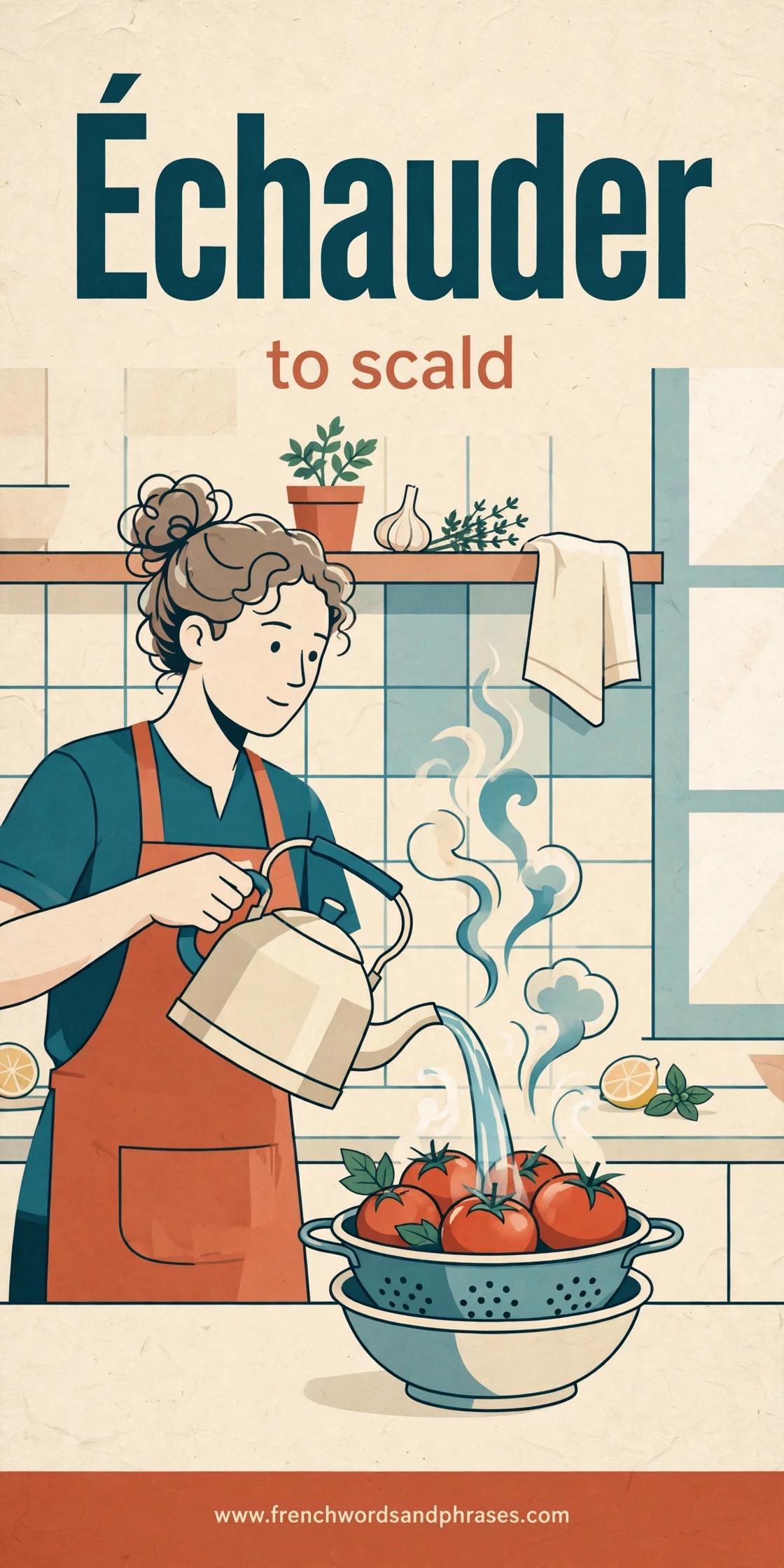
Échauder means to scald.
A tomato plunged for one minute into boiling water so its skin slips off, a hand jerked back from the steam of a pot — échauder is the verb of scalding, and of the famous cat who learned his lesson from it.
In this guide, you’ll learn how to conjugate échauder in all the major French tenses and moods. Explore complete conjugation tables, French examples, English translations, and practice quizzes.
Understanding the French Verb Échauder
Échauder is a regular French verb belonging to the first group of verbs, those ending in -er.
It means to scald. It is commonly used in cooking for scalding tomatoes, peaches and almonds to peel them and poultry before plucking, in accidents for skin scalded by steam or boiling water, and everywhere in its figurative form — être échaudé, to have been burned by an experience and grown wary.
Verb classification: First group (-er)
Auxiliary verb: Avoir
Past participle: échaudé
Present participle: échaudant
English equivalents: To scald; chat échaudé craint l’eau froide — a scalded cat fears cold water (once bitten, twice shy); échauder des tomates — to scald tomatoes to peel them.
One important detail: échauder is built on chaud, hot, and it owns one of the most quoted proverbs in French: chat échaudé craint l’eau froide — the scalded cat fears cold water, the French twin of once bitten, twice shy. In the kitchen the verb is gentler: you échauder tomatoes, peaches and almonds in boiling water for a minute so the skins slip off, and you échauder poultry before plucking it.
Experience the Word
Échauder is the verb of the quick plunge — one minute in boiling water, and skins, feathers and careless fingers all learn the same lesson.
Imagine a farmhouse kitchen in tomato season. A basket of tomatoes goes into the steaming pot, one minute by the clock, then into cold water — and the skins slide off like silk, ready for the sauce.
The tomatoes have not been cooked. They have been échaudées — scalded just enough to let go of their skins.
How to Conjugate Échauder: Complete French Conjugation Guide
Let’s explore every major conjugation of échauder, beginning with the indicative mood.
How to Conjugate Échauder in the Indicative Mood
The indicative mood is used to express facts, observations, actions, and events.
How to Conjugate Échauder in the Present Tense (Présent)
Used for actions happening now, habitual actions, and general truths.
| Subject | Conjugation |
|---|---|
| je | échaude |
| tu | échaudes |
| il / elle | échaude |
| nous | échaudons |
| vous | échaudez |
| ils / elles | échaudent |
Example
Elle échaude les tomates avant de les peler.
She scalds the tomatoes before peeling them.
Quick Quiz 1
Complete the sentence:
Nous ______ les tomates avant de les peler.
Reveal the answer
échaudons
Nous échaudons les tomates avant de les peler.
We scald the tomatoes before peeling them.
How to Conjugate Échauder in the Passé Composé
Used for completed actions in the past. Échauder takes the auxiliary verb avoir.
| Subject | Conjugation |
|---|---|
| j’ | ai échaudé |
| tu | as échaudé |
| il / elle | a échaudé |
| nous | avons échaudé |
| vous | avez échaudé |
| ils / elles | ont échaudé |
Example
Il a échaudé sa main en versant l’eau bouillante.
He scalded his hand while pouring the boiling water.
How to Conjugate Échauder in the Imparfait (Imperfect Tense)
Used for habitual past actions, descriptions, and ongoing situations in the past.
| Subject | Conjugation |
|---|---|
| je | échaudais |
| tu | échaudais |
| il / elle | échaudait |
| nous | échaudions |
| vous | échaudiez |
| ils / elles | échaudaient |
Example
Autrefois, on échaudait le lait pour le conserver plus longtemps.
In the old days, people used to scald milk to keep it longer.
Quick Quiz 2
Choose the correct form:
She scalded the peaches.
Elle ______ les pêches. (a échaudé / est échaudée)
Reveal the answer
a échaudé
Elle a échaudé les pêches.
Échauder takes avoir.
How to Conjugate Échauder in the Plus-que-parfait
Used to describe an action that had already been completed before another past event.
| Subject | Conjugation |
|---|---|
| j’ | avais échaudé |
| tu | avais échaudé |
| il / elle | avait échaudé |
| nous | avions échaudé |
| vous | aviez échaudé |
| ils / elles | avaient échaudé |
Example
Elle avait échaudé les pêches avant l’arrivée des invités.
She had scalded the peaches before the guests arrived.
How to Conjugate Échauder in the Passé Simple
Primarily used in formal writing, literature, and historical narratives. It is rarely used in everyday conversation.
| Subject | Conjugation |
|---|---|
| je | échaudai |
| tu | échaudas |
| il / elle | échauda |
| nous | échaudâmes |
| vous | échaudâtes |
| ils / elles | échaudèrent |
Example
Les cuisiniers échaudèrent les tomates par centaines avant le service.
The cooks scalded the tomatoes by the hundred before the service.
How to Conjugate Échauder in the Passé Antérieur
A literary tense used to express an action completed immediately before another past action, generally in the passé simple.
| Subject | Conjugation |
|---|---|
| j’ | eus échaudé |
| tu | eus échaudé |
| il / elle | eut échaudé |
| nous | eûmes échaudé |
| vous | eûtes échaudé |
| ils / elles | eurent échaudé |
Example
Quand ils eurent échaudé les tomates, ils les pelèrent en un rien de temps.
When they had scalded the tomatoes, they peeled them in no time.
How to Conjugate Échauder in the Future Tense (Futur Simple)
Used to describe actions that will take place in the future.
| Subject | Conjugation |
|---|---|
| je | échauderai |
| tu | échauderas |
| il / elle | échaudera |
| nous | échauderons |
| vous | échauderez |
| ils / elles | échauderont |
Example
Demain, j’échauderai les amandes pour le gâteau.
Tomorrow, I will scald the almonds for the cake.
How to Conjugate Échauder in the Futur Antérieur (Future Perfect)
Used for an action that will have been completed before a particular point in the future.
| Subject | Conjugation |
|---|---|
| j’ | aurai échaudé |
| tu | auras échaudé |
| il / elle | aura échaudé |
| nous | aurons échaudé |
| vous | aurez échaudé |
| ils / elles | auront échaudé |
Example
À midi, elle aura échaudé toutes les pêches.
By noon, she will have scalded all the peaches.
How to Conjugate Échauder in the Near Future (Futur Proche)
Used to describe something that is going to happen soon. Formed with aller + infinitive.
| Subject | Conjugation |
|---|---|
| je | vais échauder |
| tu | vas échauder |
| il / elle | va échauder |
| nous | allons échauder |
| vous | allez échauder |
| ils / elles | vont échauder |
Example
Je vais échauder les tomates, attends deux minutes.
I am going to scald the tomatoes, wait two minutes.
How to Conjugate Échauder in the Conditional Mood
The conditional mood expresses what would happen under certain circumstances. It is also frequently used to make polite requests or express wishes.
How to Conjugate Échauder in the Present Conditional
| Subject | Conjugation |
|---|---|
| je | échauderais |
| tu | échauderais |
| il / elle | échauderait |
| nous | échauderions |
| vous | échauderiez |
| ils / elles | échauderaient |
Example
Si l’eau était plus chaude, elle échauderait les tomates en dix secondes.
If the water were hotter, it would scald the tomatoes in ten seconds.
How to Conjugate Échauder in the Past Conditional
| Subject | Conjugation |
|---|---|
| j’ | aurais échaudé |
| tu | aurais échaudé |
| il / elle | aurait échaudé |
| nous | aurions échaudé |
| vous | auriez échaudé |
| ils / elles | auraient échaudé |
Example
Il aurait échaudé sa main si la cocotte avait glissé.
He would have scalded his hand if the pot had slipped.
Échauder in the Literary Past Conditional Form
This less common literary form uses the imperfect subjunctive of avoir.
| Subject | Conjugation |
|---|---|
| j’ | eusse échaudé |
| tu | eusses échaudé |
| il / elle | eût échaudé |
| nous | eussions échaudé |
| vous | eussiez échaudé |
| ils / elles | eussent échaudé |
Example
Le cuisinier eût échaudé les volailles avant de les plumer.
The cook would have scalded the poultry before plucking it.
How to Conjugate Échauder in the Subjunctive Mood
The subjunctive is used to express wishes, emotions, doubts, necessity, and uncertainty. It frequently follows expressions such as il faut que (it is necessary that) or bien que (although).
How to Conjugate Échauder in the Present Subjunctive
| Subject | Conjugation |
|---|---|
| que je | échaude |
| que tu | échaudes |
| qu’il / qu’elle | échaude |
| que nous | échaudions |
| que vous | échaudiez |
| qu’ils / qu’elles | échaudent |
Example
Il faut que tu échaudes les tomates une minute, pas plus.
You must scald the tomatoes for one minute, no more.
Quick Quiz 3
Complete the sentence using the subjunctive:
Il faut que vous ______ les amandes.
Reveal the answer
échaudiez
Il faut que vous échaudiez les amandes.
You must scald the almonds.
How to Conjugate Échauder in the Imperfect Subjunctive
A literary tense, rarely encountered in modern spoken French.
| Subject | Conjugation |
|---|---|
| que je | échaudasse |
| que tu | échaudasses |
| qu’il / qu’elle | échaudât |
| que nous | échaudassions |
| que vous | échaudassiez |
| qu’ils / qu’elles | échaudassent |
Example
La recette voulait qu’on échaudât les amandes avant de les monder.
The recipe required the almonds to be scalded before blanching.
How to Conjugate Échauder in the Pluperfect Subjunctive
A literary construction used to express an action completed before another past action.
| Subject | Conjugation |
|---|---|
| que j’ | eusse échaudé |
| que tu | eusses échaudé |
| qu’il / qu’elle | eût échaudé |
| que nous | eussions échaudé |
| que vous | eussiez échaudé |
| qu’ils / qu’elles | eussent échaudé |
Example
Il se plaignit qu’on l’eût échaudé avec l’eau du bain.
He complained that they had scalded him with the bath water.
How to Conjugate Échauder in the Past Subjunctive
| Subject | Conjugation |
|---|---|
| que j’ | aie échaudé |
| que tu | aies échaudé |
| qu’il / qu’elle | ait échaudé |
| que nous | ayons échaudé |
| que vous | ayez échaudé |
| qu’ils / qu’elles | aient échaudé |
Example
Je regrette qu’elle ait échaudé les tomates trop longtemps.
I regret that she scalded the tomatoes too long.
How to Conjugate Échauder in the Imperative
The imperative is used to give commands, instructions, invitations, or suggestions. Subject pronouns are omitted.
How to Conjugate Échauder in the Present Imperative
| Person | Conjugation |
|---|---|
| (tu) | échaude |
| (nous) | échaudons |
| (vous) | échaudez |
Example
Échaudez les tomates une minute, puis pelez-les !
Scald the tomatoes for one minute, then peel them!
Quick Quiz 4
How would you say Scald the tomatoes for one minute (vous form)?
Reveal the answer
Échaudez les tomates une minute !
French Participles of Échauder
Participles are verb forms that can be used in compound tenses and other grammatical constructions.
Present Participle of Échauder
échaudant
En échaudant les tomates, elle chantait doucement.
While scalding the tomatoes, she sang softly.
Past Participle of Échauder
échaudé
Échaudée une minute, la tomate se pèle toute seule.
Scalded for one minute, the tomato peels itself.
Échauder in Everyday French: Real-Life Examples
Now that you know the conjugations, let’s see how échauder appears in everyday French.
Example 1 — Present
Elle échaude les tomates avant de les peler.
She scalds the tomatoes before peeling them.
Example 2 — Passé composé
Il a échaudé sa main avec l’eau bouillante.
He scalded his hand with the boiling water.
Example 3 — Imparfait
On échaudait le lait autrefois pour le conserver.
People used to scald milk in the old days to preserve it.
Example 4 — Future
Nous échauderons les pêches cet après-midi.
We will scald the peaches this afternoon.
Example 5 — Conditional
Tu échauderais les tomates, toi ?
Would you scald the tomatoes?
Example 6 — Imperative
Échaudez les amandes avant de les monder !
Scald the almonds before blanching them!
Beyond Translation: The Meaning of Échauder
English scald stays mostly in the kitchen and the first-aid kit; French échauder walks straight into a proverb that the whole country quotes.
Chat échaudé craint l’eau froide.
Anyone who has been burned once — by water, by love, by a bad bargain — is un chat échaudé, and French uses the scalded cat where English reaches for the bitten hand.
How to Remember the French Verb Échauder
Remember it this way: Échauder is about boiling water, one quick plunge — and the proverb of the scalded cat.
- Chaud means hot: échauder is what boiling water does — to tomatoes, almonds or careless hands.
- Chat échaudé craint l’eau froide — the scalded cat fears cold water: once bitten, twice shy.
- Regular -er: j’échaude, nous échaudons, past participle échaudé.
The key idea is boiling water, one quick plunge — and the proverb of the scalded cat.
Test Your Knowledge of Échauder
Let’s see how much you’ve learned. Try answering these questions before revealing the answers.
Question 1
What does the proverb Chat échaudé craint l’eau froide mean?
Reveal the answer
Once bitten, twice shy — literally, a scalded cat fears cold water.
Question 2
How do you say She scalds the tomatoes before peeling them in French?
Reveal the answer
Elle échaude les tomates avant de les peler.
Question 3
Translate: He scalded his hand with the boiling water.
Reveal the answer
Il a échaudé sa main avec l’eau bouillante.
Question 4
What is the past participle of échauder?
Reveal the answer
Échaudé.
Question 5
Complete the sentence:
Il faut que tu ______ les tomates une minute.
Reveal the answer
échaudes
Il faut que tu échaudes les tomates une minute.
You must scald the tomatoes for one minute.
Your Final Challenge
Can You Use It?
How would you say this in French?
She scalds the tomatoes for one minute, and the skin comes off by itself.
Reveal the answer
Elle échaude les tomates une minute, et la peau part toute seule.
She scalds the tomatoes for one minute, and the skin comes off by itself.
A little French. A little curiosity. A richer everyday life.
LEARN FRENCH ONE WORD AT A TIME




